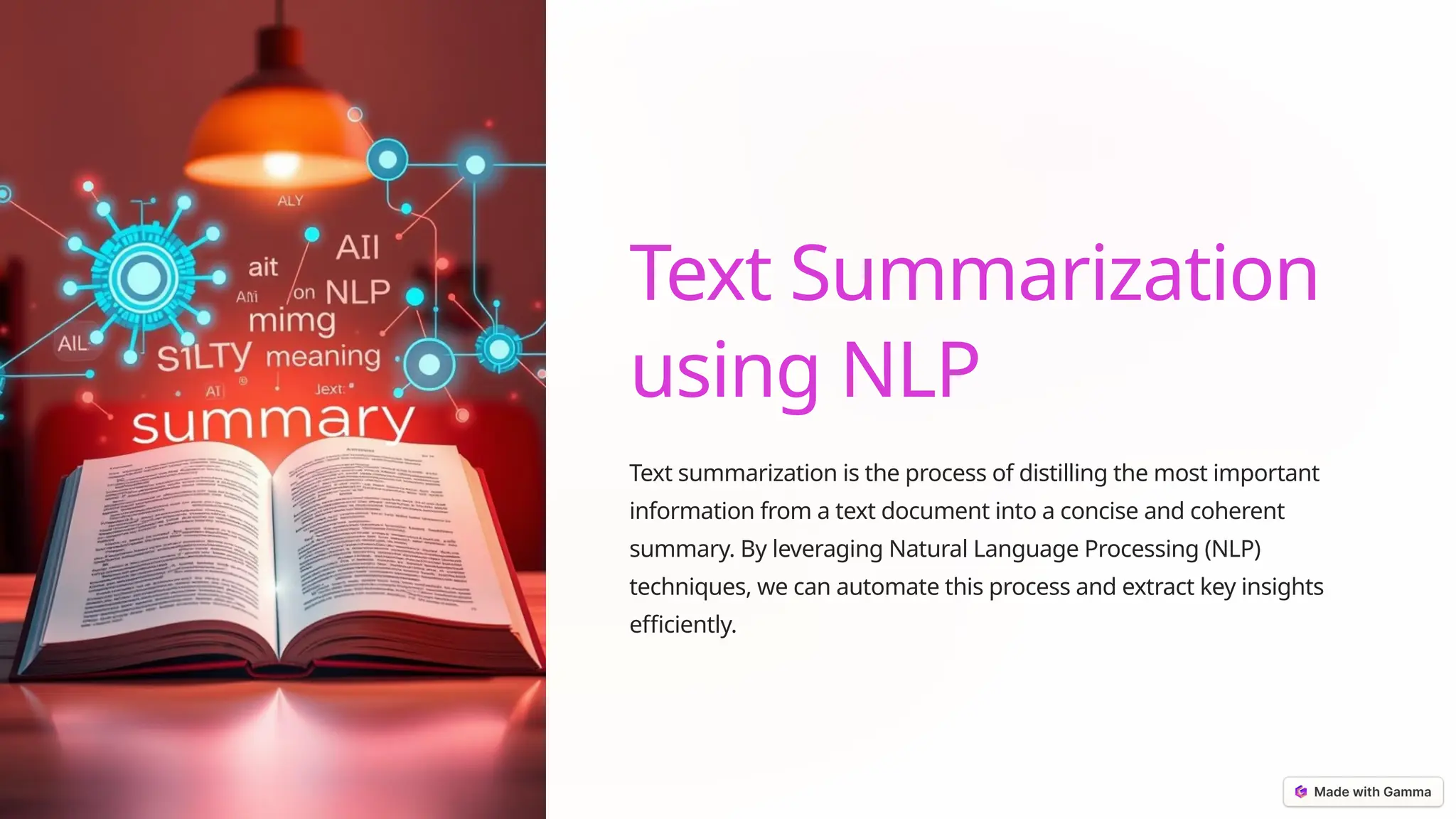
Text Summarization
using NLP
Text summarization is the process of distilling the most important
information from a text document into a concise and coherent
summary. By leveraging Natural Language Processing (NLP)
techniques, we can automate this process and extract key insights
efficiently.
Introduction to Text
Summarization
1 Concise
Representation
Text summarization aims
to provide a condensed
version of a document,
capturing the essential
information.
2 Time-Saving
Summaries enable
readers to quickly grasp
the key points without
having to read the entire
document.
3 Improved Comprehension
Summaries highlight the most relevant information, enhancing
the reader's understanding of the content.
Overview of Natural Language Processing (NLP)
Foundations
NLP is a field of Artificial Intelligence
that focuses on the interaction
between computers and human
language.
Key Capabilities
NLP techniques enable machines to
understand, interpret, and generate
human language, facilitating
communication and information
extraction.
Applications
NLP powers a wide range of
applications, such as machine
translation, chatbots, sentiment
analysis, and text summarization.
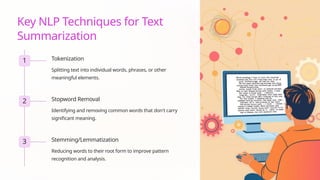
Key NLP Techniques for Text
Summarization
1 Tokenization
Splitting text into individual words, phrases, or other
meaningful elements.
2 Stopword Removal
Identifying and removing common words that don't carry
significant meaning.
3 Stemming/Lemmatization
Reducing words to their root form to improve pattern
recognition and analysis.
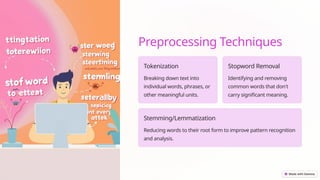
Preprocessing Techniques
Tokenization
Breaking down text into
individual words, phrases, or
other meaningful units.
Stopword Removal
Identifying and removing
common words that don't
carry significant meaning.
Stemming/Lemmatization
Reducing words to their root form to improve pattern recognition
and analysis.
Feature Extraction
Term Frequency (TF)
Term Frequency (TF) measures the
frequency of a word's appearance
within a single document. A higher TF
indicates the word is more prominent
in that specific document. This is a
simple but effective way to gauge the
importance of words within a
document's context. For example, the
word "blockchain" would have a high
TF in a document about cryptocurrency,
while having a low TF in a document
about cooking.
Inverse Document Frequency
(IDF)
Inverse Document Frequency (IDF)
complements TF by measuring how
rare a word is across a collection of
documents. Words that appear in many
documents have a low IDF, while words
appearing in only a few documents
have a high IDF. Combining TF and IDF
(TF-IDF) helps identify words that are
not only frequent within a document
but also relatively unique to it, making
them strong indicators of the
document's topic.
Sentence Scoring
Sentence scoring assigns a numerical
value to each sentence in a document
to reflect its importance for
summarization. Various factors
influence sentence scores, including: its
position in the document (e.g.,
sentences at the beginning or end are
often more important); length (longer
sentences may contain more
information); and keyword density
(sentences containing many high-TF-
IDF words are likely more central to the
document's theme). These scores help
algorithms select the most informative
sentences for the summary.
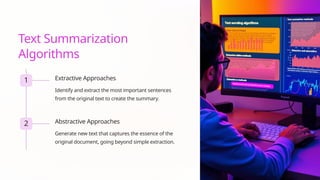
Text Summarization
Algorithms
1 Extractive Approaches
Identify and extract the most important sentences
from the original text to create the summary.
2 Abstractive Approaches
Generate new text that captures the essence of the
original document, going beyond simple extraction.
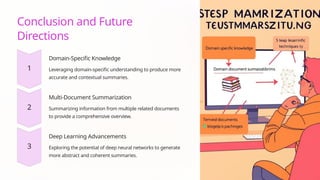
Conclusion and Future
Directions
Domain-Specific Knowledge
Leveraging domain-specific understanding to produce more
accurate and contextual summaries.
Multi-Document Summarization
Summarizing information from multiple related documents
to provide a comprehensive overview.
Deep Learning Advancements
Exploring the potential of deep neural networks to generate
more abstract and coherent summaries.
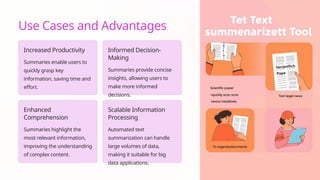
Use Cases and Advantages
Increased Productivity
Summaries enable users to
quickly grasp key
information, saving time and
effort.
Informed Decision-
Making
Summaries provide concise
insights, allowing users to
make more informed
decisions.
Enhanced
Comprehension
Summaries highlight the
most relevant information,
improving the understanding
of complex content.
Scalable Information
Processing
Automated text
summarization can handle
large volumes of data,
making it suitable for big
data applications.

Text-Summarization-using-Natural language processingP.pptx

  • 1.
    Text Summarization using NLP Textsummarization is the process of distilling the most important information from a text document into a concise and coherent summary. By leveraging Natural Language Processing (NLP) techniques, we can automate this process and extract key insights efficiently.
  • 2.
    Introduction to Text Summarization 1Concise Representation Text summarization aims to provide a condensed version of a document, capturing the essential information. 2 Time-Saving Summaries enable readers to quickly grasp the key points without having to read the entire document. 3 Improved Comprehension Summaries highlight the most relevant information, enhancing the reader's understanding of the content.
  • 3.
    Overview of NaturalLanguage Processing (NLP) Foundations NLP is a field of Artificial Intelligence that focuses on the interaction between computers and human language. Key Capabilities NLP techniques enable machines to understand, interpret, and generate human language, facilitating communication and information extraction. Applications NLP powers a wide range of applications, such as machine translation, chatbots, sentiment analysis, and text summarization.
  • 4.
    Key NLP Techniquesfor Text Summarization 1 Tokenization Splitting text into individual words, phrases, or other meaningful elements. 2 Stopword Removal Identifying and removing common words that don't carry significant meaning. 3 Stemming/Lemmatization Reducing words to their root form to improve pattern recognition and analysis.
  • 5.
    Preprocessing Techniques Tokenization Breaking downtext into individual words, phrases, or other meaningful units. Stopword Removal Identifying and removing common words that don't carry significant meaning. Stemming/Lemmatization Reducing words to their root form to improve pattern recognition and analysis.
  • 6.
    Feature Extraction Term Frequency(TF) Term Frequency (TF) measures the frequency of a word's appearance within a single document. A higher TF indicates the word is more prominent in that specific document. This is a simple but effective way to gauge the importance of words within a document's context. For example, the word "blockchain" would have a high TF in a document about cryptocurrency, while having a low TF in a document about cooking. Inverse Document Frequency (IDF) Inverse Document Frequency (IDF) complements TF by measuring how rare a word is across a collection of documents. Words that appear in many documents have a low IDF, while words appearing in only a few documents have a high IDF. Combining TF and IDF (TF-IDF) helps identify words that are not only frequent within a document but also relatively unique to it, making them strong indicators of the document's topic. Sentence Scoring Sentence scoring assigns a numerical value to each sentence in a document to reflect its importance for summarization. Various factors influence sentence scores, including: its position in the document (e.g., sentences at the beginning or end are often more important); length (longer sentences may contain more information); and keyword density (sentences containing many high-TF- IDF words are likely more central to the document's theme). These scores help algorithms select the most informative sentences for the summary.
  • 7.
    Text Summarization Algorithms 1 ExtractiveApproaches Identify and extract the most important sentences from the original text to create the summary. 2 Abstractive Approaches Generate new text that captures the essence of the original document, going beyond simple extraction.
  • 8.
    Conclusion and Future Directions Domain-SpecificKnowledge Leveraging domain-specific understanding to produce more accurate and contextual summaries. Multi-Document Summarization Summarizing information from multiple related documents to provide a comprehensive overview. Deep Learning Advancements Exploring the potential of deep neural networks to generate more abstract and coherent summaries.
  • 9.
    Use Cases andAdvantages Increased Productivity Summaries enable users to quickly grasp key information, saving time and effort. Informed Decision- Making Summaries provide concise insights, allowing users to make more informed decisions. Enhanced Comprehension Summaries highlight the most relevant information, improving the understanding of complex content. Scalable Information Processing Automated text summarization can handle large volumes of data, making it suitable for big data applications.