© 2018, IRJET | Impact Factor value: 7.211 | ISO 9001:2008 Certified Journal | Page 1603
Text Highlighting – A Machine Learning Approach
Varun Ranganathan1, Ashwini Raja2, Avanthikaa Ravichandran3, Nethra Viswanathan4
1,2,3,4 Student, Department of Computer Science, SSN College of Engineering, Tamil Nadu, India
---------------------------------------------------------------------***---------------------------------------------------------------------
Abstract - Text Highlighting involves selecting certain
important sentences from a document that help provide a
good overview of the entire document. In thispaperweexplore
five different machine learning models built to perform text
highlighting. We also propose a new method of generating an
extractive summarization dataset from human generated
summaries for a set of documents, inspired by the work of
Nallapatti et. Al [1].
Key Words: Text Highlighting, Text Summarization,
Extractive Summarization, Machine Learning, Support
Vector Machine, Neural Network, Convolutional Neural
Network
1. INTRODUCTION
Automatic Text Summarization is the process of reducing
document text to highlight the essence of it and retain only
the major points of the original document. There are two
different approaches to create these summaries – extractive
text summarization and abstractive text summarization.
Extractive summaries are created by choosing sentences
from the text that are necessary to capture the meaning of it
while ignoring those sentencesthat can be removedwithout
losing the meaning of the given text. It does not generateany
new sentences. Abstractive summaries, on the other hand,
seek to understand the meaning of the sentences and uses
Natural Language Processing techniques to generate new
sentences that capture this meaning in a shorter text.
The project highlighted in this paper uses only extractive
techniques since it focuses on text highlighting rather than
summary generation. Text highlighting chooses those
sentences verbatim from the text that provide an overview
of the entire passage.
Additionally, extractive summarization techniques have
shown better results than most abstractive summarization
techniques since this technique does not modifytheintentof
the sentence, especially when the usage of a particularfigure
of speech is not common across languages or the way a
specific language is spoken in different regions. Most
abstractive systems use extractive techniques as well to
improve the accuracy of the output.
Work has been carried out in the field of automatic text
summarization from as early as the 1950s. Early works
mainly used features such as word and phrase frequency to
identify salient sentences for extractive summarization.
Since then, various models such as Naive Bayesian
classification, neural networks etc. have been developed to
generate these extractive summaries [3]. Support Vector
Machines have also been proposed to identify and extract
important sentences [6]. This project explores several
machine learning models and their performance in
extractive text summarization. We also propose a new
method of generating extractive summarization datasets
from human generated summaries based on the work of
Nallapatti et. Al [1]. ConvNets have also been used to
perform text summarization [5]. Two different CNNs are
constructed in this project and their accuracies compared.
To evaluate the accuracy of the generated summaries,
several metrics have been proposed. These include human
evaluation of generated summaries and metrics that
calculate the deviation of a generated summary from the
standard human-created summary [4]. This project usesthe
ROUGE metric for evaluation which usesn-gram andlongest
common subsequence statistics to compare the similarity
between the standard summaries and the generated
summaries.
2. PROPOSED APPROACH
The aimof extractive summarization is to pickthe important
sentences from a text containing many sentences. To do this,
we built a classifierthatwould accept a sentenceasinputand
classify it as important (required to be included in the
summary) or irrelevant (need not be included in the
summary).
2.1 Creating a feature Vector Representation of a
Sentence
We created a feature vector consisting of 10 features for
every sentence. This was done to analyze sentences
grammatically and to make inferencesabout the importance
of a sentence based on its construction and placement. We
identified a few main features which helps us determine the
importance of a sentence. The 10 features we used are as
follows.
2.1.1 First Sentence Indicator
In many pieces of text, the first sentence contains important
information. For instance, the first sentence of most news
articles is vital and gives the reader of a gist of the entire
article. If the sentence being processed is the firstsentenceof
a document, the value of this feature is 1, otherwise it is 0.
2.1.2 Presence of Redundant Words
The presence of certain words such as ‘furthermore’,
‘additionally’, ’moreover’ in a sentence indicates that the
sentence is an elaboration of a previously established
International Research Journal of Engineering and Technology (IRJET) e-ISSN: 2395-0056
Volume: 05 Issue: 08 | Aug 2018 www.irjet.net p-ISSN: 2395-0072
© 2018, IRJET | Impact Factor value: 7.211 | ISO 9001:2008 Certified Journal | Page 1604
thought or concept and need not be included in the
summary. We collected a list of such words and if such a
word is present in the sentence, the value of this feature is 1,
otherwise 0.
2.1.3 Presence of Important Terms
Before processing and creating a vector foreverysentencein
the document, we processed the document tofindtermsthat
are important to the context of this document. To dothat,we
POS Tagged every sentence in the document using the Penn
Treebank tag set and found all the terms corresponding to
some form of a noun. We then picked the five most
frequently occurring terms and labeled these as ‘Important
Terms’. If a sentence contained at least one of these terms,
the values of this feature is 1, otherwise 0.
2.1.4 Relative Sentence Length
We found the length of the current sentence beingprocessed
and divided it by the length of the longest sentence in the
document to get the relative length of this sentence.
2.1.5 Relative Sentence Position
We found the position of the sentence being processed and
divided it by the number of sentences in the document to
find the relative position of this sentence in the document.
2.1.6 Sentence-to-Center Sentence Cohesion
We found the sentence at center of the document and found
the similarity between the sentence beingprocessedandthis
sentence to get the Sentence-to-Center Sentence Cohesion.
We used Cosine Similarity to compute similarity.
2.1.7 Sentence-to-Longest Sentence Cohesion
We found the longest sentence in the document and found
the similarity between the sentence beingprocessedandthis
sentence to get the Sentence-to-Longest Sentence Cohesion.
We used Cosine Similarity to compute similarity.
2.1.8 Sentence-to-Sentence Cohesion
We found the similarity between the sentence being
processed and every other sentence in the document and
computed the total to get the total similarity score. We then
divided this by the number of sentences in the document to
get the value of this feature. We used Cosine Similarity to
compute similarity.
2.1.9 Number of Nouns
We found the number of nouns (by POSTaggingthesentence
and then detecting terms with a relevant noun tag) present
in the sentence being processed and then divided it by a
constant normalizing factor to get the value of this feature.
2.1.10 Number of Verbs
We found the number of verbs(by POS Tagging the sentence
and then detecting termswith a relevant verb tag)presentin
the sentence being processed and then divided it by a
constant normalizing factor to get the value of this feature.
2.2 Models Used for Classification
The model to be used for classification was to be decided
after comparingthe performanceoffiveprospectivemodels–
a simple Artificial Neural Network, a NaïveBayesClassifier,a
Support Vector Machine, and two different Convolutional
Neural Networks.
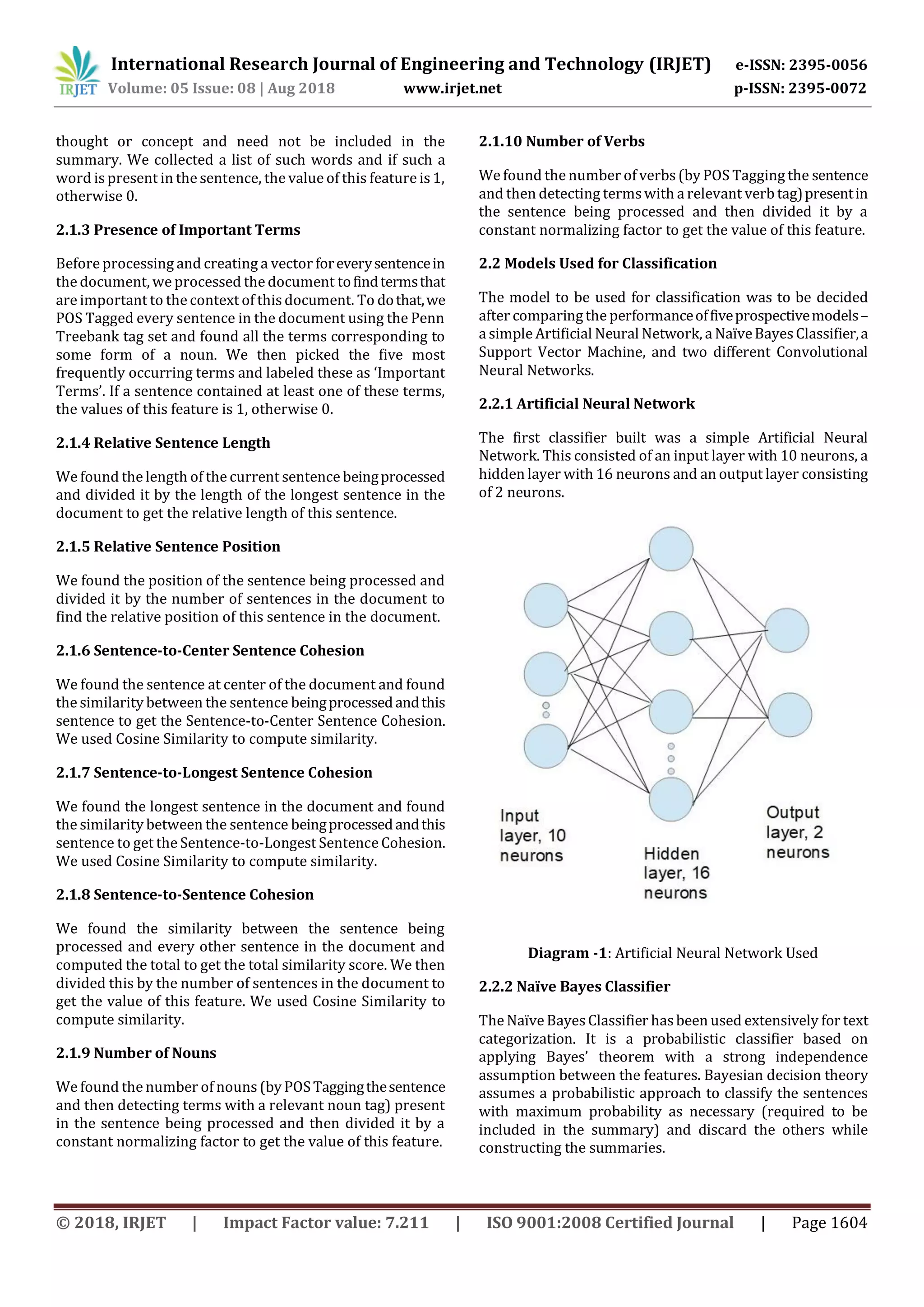
2.2.1 Artificial Neural Network
The first classifier built was a simple Artificial Neural
Network. This consisted of an input layer with 10 neurons, a
hidden layer with 16 neurons and an output layer consisting
of 2 neurons.
Diagram -1: Artificial Neural Network Used
2.2.2 Naïve Bayes Classifier
The NaïveBayesClassifier hasbeen used extensively for text
categorization. It is a probabilistic classifier based on
applying Bayes’ theorem with a strong independence
assumption between the features. Bayesian decision theory
assumes a probabilistic approach to classify the sentences
with maximum probability as necessary (required to be
included in the summary) and discard the others while
constructing the summaries.
International Research Journal of Engineering and Technology (IRJET) e-ISSN: 2395-0056
Volume: 05 Issue: 08 | Aug 2018 www.irjet.net p-ISSN: 2395-0072
© 2018, IRJET | Impact Factor value: 7.211 | ISO 9001:2008 Certified Journal | Page 1605
2.2.3 Support Vector Machine
A Support VectorMachine is a supervised learningalgorithm
which can be used for classification and regression. It has
been used widely for the purposesof linear classificationand
can even be used for non-linear classification. It constructs a
hyperplane or a set of hyperplanes in a high or infinite
dimensional space which it then uses to classify data, which
in this case is used to identify if a sentence is to be includedin
the summary or not.
2.2.4 Convolutional Neural Network:
A convolutional network is used to classify the sentences for
text highlighting. This approach is used to test if a
convolutional neural network would give better results for
text classification. The model used has the following layers-
convolutional layer of a single dimension with 16 filters, a
dense layerwith16 neurons, a flattenlayer and adenselayer
with 2neurons. The optimizerusedisanAdamoptimizerand
a categorical cross entropy loss function is used.
Diagram -2: Convolutional Neural Network Used
Two approaches areused to the vectorizationofthewordsin
the document.
2.2.4.1 Approach 1: Vectorization of Dataset using
features
In this approach, the feature vectors used in the previous
models are preserved. These feature vectors are built on the
10 features presented above.
2.2.4.2 Approach 2: Vectorization of Dataset using Word
Embeddings
In this approach, the dataset is vectorized by creating word
embeddings for eachword. Ahashof eachword is createdby
using a onehot encoding. This createsanintegerencodingfor
each word in the dataset. A vocabulary size is specified to
create the hash.
3. Extractive Training from Abstractive Summaries
Most summarization datasets contain abstractive human
written ‘gold standard’ summaries. These abstractive
summaries are far easier for humans to generate than
extractive summaries. However, the datasetrequiredtotrain
our classifier has to be extractive in nature. We needed a
dataset containing documents along with a tag of 1
(important and should be included in the summary) or 0
(irrelevant and need not be included in the summary) for
every sentence. Very few datasets containeddatainthisform
and moreover these datasets were relatively smaller than
other abstractive summarization datasets.
To solve this problem, we devised an algorithm to generate
an extractive 1 or 0 dataset, given an abstractive
summarization dataset (one that contained a ‘gold standard’
summary for every document).
This algorithm was inspired by the technique used in
SummaRuNNer [1]. While their algorithm picks sentences
based on a Greedy approach with the aim of increasing the
ROUGE score, our algorithm works in a different manner.
Our algorithm first generates all n-grams (we used n=3)
from the ‘gold standard’ summary for a certain document. It
then picks all the sentences in the document that contain at
least 1 n-gram in common with the list of n-grams we had
previously generated. This way, we are able to generate
extractive summaries that are good representations of the
documents.
4. THE DATASET
We required alargedataset to be able to effectively train and
test our classifiers. We use the CNN/Daily Mail corpus [2].
This was initially used for a reading comprehension task as
outlinedin paper[2]. However, this datasethasbeenusedfor
summarization tasks as demonstrated bySummaRuNNer[1].
Each article of this dataset contains a set of highlights of
article which we treated as a ‘gold standard’ summary. We
then use our algorithm that allows extractive training from
abstractive summaries to generate extractive summaries of
every article where every sentence of the article is tagged
either as important (required to be includedinthesummary)
or irrelevant (need not be included in the summary).
5. EXPERIMENTS
First, we generated an extractive summarization dataset
using our algorithm from the CNN/Daily Mail corpus[2]. The
ROUGE recall scores, computed for the extractivesummaries
generated by our algorithm compared with the ‘gold
standard’ summaries, are tabulated below.
International Research Journal of Engineering and Technology (IRJET) e-ISSN: 2395-0056
Volume: 05 Issue: 08 | Aug 2018 www.irjet.net p-ISSN: 2395-0072
© 2018, IRJET | Impact Factor value: 7.211 | ISO 9001:2008 Certified Journal | Page 1606
Table -1: ROUGE recall scores
ROUGE - 1 ROUGE - 2 ROUGE - L
0.3695 0.1596 0.3434
We selected a subset of the data and equalized the data so
that there were an equal numberof sentencesinbothclasses.
There was a total of 806042 sentences that were used for
training andtesting. The sentenceswere thenvectorizedinto
a vector of size 10 and all the classifiers were trained and
tested with a data split of 90%-10%. The results have been
tabulated below.
Table -2: Results of testing
Results
Classifier Accuracy F1
Score
Precisio
n Score
Recall
Score
ANN 0.7076 0.7067 0.7102 0.7075
Naïve Bayes 0.6204 0.5567 0.7764 0.6190
SVM 0.7074 0.7069 0.7089 0.7074
CNN:
Approach 1
0.7104 0.7095 0.7128 0.7102
In additiontothese classifiers, we also tested CNN:Approach
2. But due to limited available computational power, we
tested this classifier with a vector of size 8 and of a dataset
with 13106 sentences.
Table -3: Results of testing
Results
Classifier Accuracy F1
Score
Precisio
n Score
Recall
Score
CNN:
Approach 2
0.6521 0.6444 0.6629 0.6501
6. CONCLUSION AND FUTURE WORK
After testing the first four classifiers we concluded that our
first CNN model (CNN: Approach 1) had the highest
accuracy. The SVM also came very close in terms of accuracy
and can be considered if this project is to be implemented in
a device with lower computational power.
We believe that in the future, this system can be extended to
other domains, after training it with relevant datasets. We
also believe that if the hash based Convolutional Neural
Network (CNN: Approach 2) wastrained withalargervector
size and on the complete dataset, it would yield better
results.
REFERENCES
[1] R. Nallapati, F. Zhai and B. Zhou, “SummaRuNNer: A
Recurrent Neural Network based Sequence Model for
Extractive Summarization of Documents, Published at
AAAI 2017”, The Thirty-First AAAI Conference on
Artificial Intelligence (AAAI-2017)
[2] D. Chen, J. Bolton, C. Manning, “A Thorough Examination
of the CNN/Daily Mail Reading Comprehension
Task”,ACL 2016
[3] Mehdi Allahyari, Seyedamin Pouriyeh, Mehdi
Assefi, Saeid Safaei, Elizabeth D. Trippe, Juan B.
Gutierrez, Krys Kochut, “Text Summarization
Techniques: A Brief Survey”, arXiv:1707.02268
[4] Dipanjan Das, Andr´e F.T. Martins, “A Survey on
Automatic Text Summarization”
[5] Yong Zhang, Meng JooEr, Mahardhika Pratama,
“Extractive document summarization based on
convolutional neural networks”, IECON 2016 – 42nd
Annual Conference of the IEEE Electronics Society
[6] Nadira Begum, Mohamed Fattah, Fuji Ren, (2009),
“Automatic text summarization using support vector
machine”, International Journal of Innovative
Computing, Information and Control. 5. 1987-1996.
International Research Journal of Engineering and Technology (IRJET) e-ISSN: 2395-0056
Volume: 05 Issue: 08 | Aug 2018 www.irjet.net p-ISSN: 2395-0072

IRJET- Text Highlighting – A Machine Learning Approach

  • 1.
    © 2018, IRJET| Impact Factor value: 7.211 | ISO 9001:2008 Certified Journal | Page 1603 Text Highlighting – A Machine Learning Approach Varun Ranganathan1, Ashwini Raja2, Avanthikaa Ravichandran3, Nethra Viswanathan4 1,2,3,4 Student, Department of Computer Science, SSN College of Engineering, Tamil Nadu, India ---------------------------------------------------------------------***--------------------------------------------------------------------- Abstract - Text Highlighting involves selecting certain important sentences from a document that help provide a good overview of the entire document. In thispaperweexplore five different machine learning models built to perform text highlighting. We also propose a new method of generating an extractive summarization dataset from human generated summaries for a set of documents, inspired by the work of Nallapatti et. Al [1]. Key Words: Text Highlighting, Text Summarization, Extractive Summarization, Machine Learning, Support Vector Machine, Neural Network, Convolutional Neural Network 1. INTRODUCTION Automatic Text Summarization is the process of reducing document text to highlight the essence of it and retain only the major points of the original document. There are two different approaches to create these summaries – extractive text summarization and abstractive text summarization. Extractive summaries are created by choosing sentences from the text that are necessary to capture the meaning of it while ignoring those sentencesthat can be removedwithout losing the meaning of the given text. It does not generateany new sentences. Abstractive summaries, on the other hand, seek to understand the meaning of the sentences and uses Natural Language Processing techniques to generate new sentences that capture this meaning in a shorter text. The project highlighted in this paper uses only extractive techniques since it focuses on text highlighting rather than summary generation. Text highlighting chooses those sentences verbatim from the text that provide an overview of the entire passage. Additionally, extractive summarization techniques have shown better results than most abstractive summarization techniques since this technique does not modifytheintentof the sentence, especially when the usage of a particularfigure of speech is not common across languages or the way a specific language is spoken in different regions. Most abstractive systems use extractive techniques as well to improve the accuracy of the output. Work has been carried out in the field of automatic text summarization from as early as the 1950s. Early works mainly used features such as word and phrase frequency to identify salient sentences for extractive summarization. Since then, various models such as Naive Bayesian classification, neural networks etc. have been developed to generate these extractive summaries [3]. Support Vector Machines have also been proposed to identify and extract important sentences [6]. This project explores several machine learning models and their performance in extractive text summarization. We also propose a new method of generating extractive summarization datasets from human generated summaries based on the work of Nallapatti et. Al [1]. ConvNets have also been used to perform text summarization [5]. Two different CNNs are constructed in this project and their accuracies compared. To evaluate the accuracy of the generated summaries, several metrics have been proposed. These include human evaluation of generated summaries and metrics that calculate the deviation of a generated summary from the standard human-created summary [4]. This project usesthe ROUGE metric for evaluation which usesn-gram andlongest common subsequence statistics to compare the similarity between the standard summaries and the generated summaries. 2. PROPOSED APPROACH The aimof extractive summarization is to pickthe important sentences from a text containing many sentences. To do this, we built a classifierthatwould accept a sentenceasinputand classify it as important (required to be included in the summary) or irrelevant (need not be included in the summary). 2.1 Creating a feature Vector Representation of a Sentence We created a feature vector consisting of 10 features for every sentence. This was done to analyze sentences grammatically and to make inferencesabout the importance of a sentence based on its construction and placement. We identified a few main features which helps us determine the importance of a sentence. The 10 features we used are as follows. 2.1.1 First Sentence Indicator In many pieces of text, the first sentence contains important information. For instance, the first sentence of most news articles is vital and gives the reader of a gist of the entire article. If the sentence being processed is the firstsentenceof a document, the value of this feature is 1, otherwise it is 0. 2.1.2 Presence of Redundant Words The presence of certain words such as ‘furthermore’, ‘additionally’, ’moreover’ in a sentence indicates that the sentence is an elaboration of a previously established International Research Journal of Engineering and Technology (IRJET) e-ISSN: 2395-0056 Volume: 05 Issue: 08 | Aug 2018 www.irjet.net p-ISSN: 2395-0072
  • 2.
    © 2018, IRJET| Impact Factor value: 7.211 | ISO 9001:2008 Certified Journal | Page 1604 thought or concept and need not be included in the summary. We collected a list of such words and if such a word is present in the sentence, the value of this feature is 1, otherwise 0. 2.1.3 Presence of Important Terms Before processing and creating a vector foreverysentencein the document, we processed the document tofindtermsthat are important to the context of this document. To dothat,we POS Tagged every sentence in the document using the Penn Treebank tag set and found all the terms corresponding to some form of a noun. We then picked the five most frequently occurring terms and labeled these as ‘Important Terms’. If a sentence contained at least one of these terms, the values of this feature is 1, otherwise 0. 2.1.4 Relative Sentence Length We found the length of the current sentence beingprocessed and divided it by the length of the longest sentence in the document to get the relative length of this sentence. 2.1.5 Relative Sentence Position We found the position of the sentence being processed and divided it by the number of sentences in the document to find the relative position of this sentence in the document. 2.1.6 Sentence-to-Center Sentence Cohesion We found the sentence at center of the document and found the similarity between the sentence beingprocessedandthis sentence to get the Sentence-to-Center Sentence Cohesion. We used Cosine Similarity to compute similarity. 2.1.7 Sentence-to-Longest Sentence Cohesion We found the longest sentence in the document and found the similarity between the sentence beingprocessedandthis sentence to get the Sentence-to-Longest Sentence Cohesion. We used Cosine Similarity to compute similarity. 2.1.8 Sentence-to-Sentence Cohesion We found the similarity between the sentence being processed and every other sentence in the document and computed the total to get the total similarity score. We then divided this by the number of sentences in the document to get the value of this feature. We used Cosine Similarity to compute similarity. 2.1.9 Number of Nouns We found the number of nouns (by POSTaggingthesentence and then detecting terms with a relevant noun tag) present in the sentence being processed and then divided it by a constant normalizing factor to get the value of this feature. 2.1.10 Number of Verbs We found the number of verbs(by POS Tagging the sentence and then detecting termswith a relevant verb tag)presentin the sentence being processed and then divided it by a constant normalizing factor to get the value of this feature. 2.2 Models Used for Classification The model to be used for classification was to be decided after comparingthe performanceoffiveprospectivemodels– a simple Artificial Neural Network, a NaïveBayesClassifier,a Support Vector Machine, and two different Convolutional Neural Networks. 2.2.1 Artificial Neural Network The first classifier built was a simple Artificial Neural Network. This consisted of an input layer with 10 neurons, a hidden layer with 16 neurons and an output layer consisting of 2 neurons. Diagram -1: Artificial Neural Network Used 2.2.2 Naïve Bayes Classifier The NaïveBayesClassifier hasbeen used extensively for text categorization. It is a probabilistic classifier based on applying Bayes’ theorem with a strong independence assumption between the features. Bayesian decision theory assumes a probabilistic approach to classify the sentences with maximum probability as necessary (required to be included in the summary) and discard the others while constructing the summaries. International Research Journal of Engineering and Technology (IRJET) e-ISSN: 2395-0056 Volume: 05 Issue: 08 | Aug 2018 www.irjet.net p-ISSN: 2395-0072
  • 3.
    © 2018, IRJET| Impact Factor value: 7.211 | ISO 9001:2008 Certified Journal | Page 1605 2.2.3 Support Vector Machine A Support VectorMachine is a supervised learningalgorithm which can be used for classification and regression. It has been used widely for the purposesof linear classificationand can even be used for non-linear classification. It constructs a hyperplane or a set of hyperplanes in a high or infinite dimensional space which it then uses to classify data, which in this case is used to identify if a sentence is to be includedin the summary or not. 2.2.4 Convolutional Neural Network: A convolutional network is used to classify the sentences for text highlighting. This approach is used to test if a convolutional neural network would give better results for text classification. The model used has the following layers- convolutional layer of a single dimension with 16 filters, a dense layerwith16 neurons, a flattenlayer and adenselayer with 2neurons. The optimizerusedisanAdamoptimizerand a categorical cross entropy loss function is used. Diagram -2: Convolutional Neural Network Used Two approaches areused to the vectorizationofthewordsin the document. 2.2.4.1 Approach 1: Vectorization of Dataset using features In this approach, the feature vectors used in the previous models are preserved. These feature vectors are built on the 10 features presented above. 2.2.4.2 Approach 2: Vectorization of Dataset using Word Embeddings In this approach, the dataset is vectorized by creating word embeddings for eachword. Ahashof eachword is createdby using a onehot encoding. This createsanintegerencodingfor each word in the dataset. A vocabulary size is specified to create the hash. 3. Extractive Training from Abstractive Summaries Most summarization datasets contain abstractive human written ‘gold standard’ summaries. These abstractive summaries are far easier for humans to generate than extractive summaries. However, the datasetrequiredtotrain our classifier has to be extractive in nature. We needed a dataset containing documents along with a tag of 1 (important and should be included in the summary) or 0 (irrelevant and need not be included in the summary) for every sentence. Very few datasets containeddatainthisform and moreover these datasets were relatively smaller than other abstractive summarization datasets. To solve this problem, we devised an algorithm to generate an extractive 1 or 0 dataset, given an abstractive summarization dataset (one that contained a ‘gold standard’ summary for every document). This algorithm was inspired by the technique used in SummaRuNNer [1]. While their algorithm picks sentences based on a Greedy approach with the aim of increasing the ROUGE score, our algorithm works in a different manner. Our algorithm first generates all n-grams (we used n=3) from the ‘gold standard’ summary for a certain document. It then picks all the sentences in the document that contain at least 1 n-gram in common with the list of n-grams we had previously generated. This way, we are able to generate extractive summaries that are good representations of the documents. 4. THE DATASET We required alargedataset to be able to effectively train and test our classifiers. We use the CNN/Daily Mail corpus [2]. This was initially used for a reading comprehension task as outlinedin paper[2]. However, this datasethasbeenusedfor summarization tasks as demonstrated bySummaRuNNer[1]. Each article of this dataset contains a set of highlights of article which we treated as a ‘gold standard’ summary. We then use our algorithm that allows extractive training from abstractive summaries to generate extractive summaries of every article where every sentence of the article is tagged either as important (required to be includedinthesummary) or irrelevant (need not be included in the summary). 5. EXPERIMENTS First, we generated an extractive summarization dataset using our algorithm from the CNN/Daily Mail corpus[2]. The ROUGE recall scores, computed for the extractivesummaries generated by our algorithm compared with the ‘gold standard’ summaries, are tabulated below. International Research Journal of Engineering and Technology (IRJET) e-ISSN: 2395-0056 Volume: 05 Issue: 08 | Aug 2018 www.irjet.net p-ISSN: 2395-0072
  • 4.
    © 2018, IRJET| Impact Factor value: 7.211 | ISO 9001:2008 Certified Journal | Page 1606 Table -1: ROUGE recall scores ROUGE - 1 ROUGE - 2 ROUGE - L 0.3695 0.1596 0.3434 We selected a subset of the data and equalized the data so that there were an equal numberof sentencesinbothclasses. There was a total of 806042 sentences that were used for training andtesting. The sentenceswere thenvectorizedinto a vector of size 10 and all the classifiers were trained and tested with a data split of 90%-10%. The results have been tabulated below. Table -2: Results of testing Results Classifier Accuracy F1 Score Precisio n Score Recall Score ANN 0.7076 0.7067 0.7102 0.7075 Naïve Bayes 0.6204 0.5567 0.7764 0.6190 SVM 0.7074 0.7069 0.7089 0.7074 CNN: Approach 1 0.7104 0.7095 0.7128 0.7102 In additiontothese classifiers, we also tested CNN:Approach 2. But due to limited available computational power, we tested this classifier with a vector of size 8 and of a dataset with 13106 sentences. Table -3: Results of testing Results Classifier Accuracy F1 Score Precisio n Score Recall Score CNN: Approach 2 0.6521 0.6444 0.6629 0.6501 6. CONCLUSION AND FUTURE WORK After testing the first four classifiers we concluded that our first CNN model (CNN: Approach 1) had the highest accuracy. The SVM also came very close in terms of accuracy and can be considered if this project is to be implemented in a device with lower computational power. We believe that in the future, this system can be extended to other domains, after training it with relevant datasets. We also believe that if the hash based Convolutional Neural Network (CNN: Approach 2) wastrained withalargervector size and on the complete dataset, it would yield better results. REFERENCES [1] R. Nallapati, F. Zhai and B. Zhou, “SummaRuNNer: A Recurrent Neural Network based Sequence Model for Extractive Summarization of Documents, Published at AAAI 2017”, The Thirty-First AAAI Conference on Artificial Intelligence (AAAI-2017) [2] D. Chen, J. Bolton, C. Manning, “A Thorough Examination of the CNN/Daily Mail Reading Comprehension Task”,ACL 2016 [3] Mehdi Allahyari, Seyedamin Pouriyeh, Mehdi Assefi, Saeid Safaei, Elizabeth D. Trippe, Juan B. Gutierrez, Krys Kochut, “Text Summarization Techniques: A Brief Survey”, arXiv:1707.02268 [4] Dipanjan Das, Andr´e F.T. Martins, “A Survey on Automatic Text Summarization” [5] Yong Zhang, Meng JooEr, Mahardhika Pratama, “Extractive document summarization based on convolutional neural networks”, IECON 2016 – 42nd Annual Conference of the IEEE Electronics Society [6] Nadira Begum, Mohamed Fattah, Fuji Ren, (2009), “Automatic text summarization using support vector machine”, International Journal of Innovative Computing, Information and Control. 5. 1987-1996. International Research Journal of Engineering and Technology (IRJET) e-ISSN: 2395-0056 Volume: 05 Issue: 08 | Aug 2018 www.irjet.net p-ISSN: 2395-0072