By: Joseph Primicerio
January 28, 2019
Multi-Cloud Networking
An Overview of the Networking Complexities in a
Hybrid and Multi-cloud World
Cloud Networking Complexities
Hybrid and Multi-Cloud Factors:
 Routing traffic rapidly and securely between disparate cloud platforms is
complex; avoid complex Managed VPN solutions
 Automation needed for disparate CLI’s, BGP ASN’s, and routing tables
 Managing multiple cloud, SaaS, network, and colocation providers is a
juggling act!
 Every provider will have their own proprietary method for management,
monitoring, storage, and network solutions.
 Establishing standard security capabilities and policies
 Ability to enforce security for users, data, and applications everywhere is
essential
The need for digital transformation increases complexity with managing multiple
apps, on multiple clouds, and leveraging a mix of public, private and hybrid cloud
networks.
Other Complexities
Modernization
 Hybrid clouds need modernized data center and processes to support both legacy and
new applications.
 New capabilities need to support rapid provisioning, higher performance, and data
mobility between disparate clouds (public and private).
Monitoring and Security
 Multi-cloud networks need capability to monitor and secure traffic flows in/out of public
cloud environments.
 End-to-end encryption needed for every virtual circuit/path/connection.
Suppliers
 There are a plethora of options; need to carefully evaluate network requirements and
migrate workloads accordingly to avoid vendor-lock.
Connectivity
 Network Abstraction: Purpose-built networking in the cloud is all software driven.
 Automation needed for disparate CLI’s, BGP ASN’s, and routing tables.
 End-to-end encryption needed for every virtual circuit/path/connection.
Simplifying Complexity
Potential Methods:
 SD-WAN or Software-defined networking
 Cloud On Ramp Service Providers
 Carrier-Neutral Colocation Services
 AWS Direct Connect
 Azure Express Route
While a multi-cloud strategy will help to avoid vendor lock-in, increase
reliability and protect mission-critical data, it has inherent complexity.
Before leaping into multi-cloud, consider these few potential methods to
simplify the complexity.
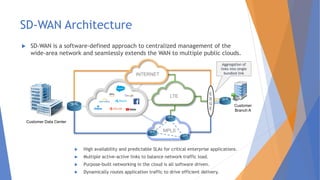
SD-WAN Architecture
 SD-WAN is a software-defined approach to centralized management of the
wide-area network and seamlessly extends the WAN to multiple public clouds.
 High availability and predictable SLAs for critical enterprise applications.
 Multiple active-active links to balance network traffic load.
 Purpose-built networking in the cloud is all software driven.
 Dynamically routes application traffic to drive efficient delivery.
Aggregation of
links into single
bundled link
MPLS
Customer Data Center
E
D
G
E
Customer
Branch A
LTE
INTERNET
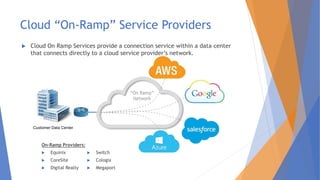
Cloud “On-Ramp” Service Providers
 Cloud On Ramp Services provide a connection service within a data center
that connects directly to a cloud service provider’s network.
“On Ramp”
Network
On-Ramp Providers:
 Equinix
 CoreSite
 Digital Realty
 Switch
 Cologix
 Megaport
Customer Data Center
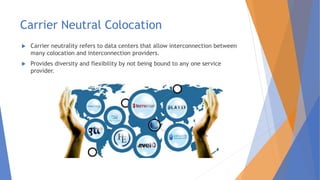
Carrier Neutral Colocation
 Carrier neutrality refers to data centers that allow interconnection between
many colocation and interconnection providers.
 Provides diversity and flexibility by not being bound to any one service
provider.
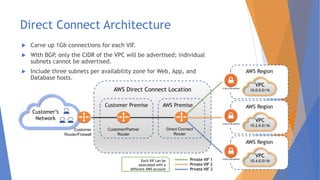
Direct Connect Architecture
 Carve up 1Gb connections for each VIF.
 With BGP, only the CIDR of the VPC will be advertised; individual
subnets cannot be advertised.
 Include three subnets per availability zone for Web, App, and
Database hosts.
AWS Region
VPC
10.2.0.0/16
AWS Direct Connect Location
AWS PremiseCustomer Premise
Direct Connect
Router
Customer/Partner
Router
Customer
Router/Firewall
Customer’s
Network
AWS Region
VPC
10.0.0.0/16
AWS Region
VPC
10.4.0.0/16Private VIF 1
Private VIF 2
Private VIF 3
Each VIF can be
associated with a
different AWS account
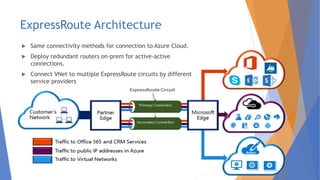
ExpressRoute Architecture
 Same connectivity methods for connection to Azure Cloud.
 Deploy redundant routers on-prem for active-active
connections.
 Connect VNet to multiple ExpressRoute circuits by different
service providers

Multi cloud networking

  • 1.
    By: Joseph Primicerio January28, 2019 Multi-Cloud Networking An Overview of the Networking Complexities in a Hybrid and Multi-cloud World
  • 2.
    Cloud Networking Complexities Hybridand Multi-Cloud Factors:  Routing traffic rapidly and securely between disparate cloud platforms is complex; avoid complex Managed VPN solutions  Automation needed for disparate CLI’s, BGP ASN’s, and routing tables  Managing multiple cloud, SaaS, network, and colocation providers is a juggling act!  Every provider will have their own proprietary method for management, monitoring, storage, and network solutions.  Establishing standard security capabilities and policies  Ability to enforce security for users, data, and applications everywhere is essential The need for digital transformation increases complexity with managing multiple apps, on multiple clouds, and leveraging a mix of public, private and hybrid cloud networks.
  • 3.
    Other Complexities Modernization  Hybridclouds need modernized data center and processes to support both legacy and new applications.  New capabilities need to support rapid provisioning, higher performance, and data mobility between disparate clouds (public and private). Monitoring and Security  Multi-cloud networks need capability to monitor and secure traffic flows in/out of public cloud environments.  End-to-end encryption needed for every virtual circuit/path/connection. Suppliers  There are a plethora of options; need to carefully evaluate network requirements and migrate workloads accordingly to avoid vendor-lock. Connectivity  Network Abstraction: Purpose-built networking in the cloud is all software driven.  Automation needed for disparate CLI’s, BGP ASN’s, and routing tables.  End-to-end encryption needed for every virtual circuit/path/connection.
  • 4.
    Simplifying Complexity Potential Methods: SD-WAN or Software-defined networking  Cloud On Ramp Service Providers  Carrier-Neutral Colocation Services  AWS Direct Connect  Azure Express Route While a multi-cloud strategy will help to avoid vendor lock-in, increase reliability and protect mission-critical data, it has inherent complexity. Before leaping into multi-cloud, consider these few potential methods to simplify the complexity.
  • 5.
    SD-WAN Architecture  SD-WANis a software-defined approach to centralized management of the wide-area network and seamlessly extends the WAN to multiple public clouds.  High availability and predictable SLAs for critical enterprise applications.  Multiple active-active links to balance network traffic load.  Purpose-built networking in the cloud is all software driven.  Dynamically routes application traffic to drive efficient delivery. Aggregation of links into single bundled link MPLS Customer Data Center E D G E Customer Branch A LTE INTERNET
  • 6.
    Cloud “On-Ramp” ServiceProviders  Cloud On Ramp Services provide a connection service within a data center that connects directly to a cloud service provider’s network. “On Ramp” Network On-Ramp Providers:  Equinix  CoreSite  Digital Realty  Switch  Cologix  Megaport Customer Data Center
  • 7.
    Carrier Neutral Colocation Carrier neutrality refers to data centers that allow interconnection between many colocation and interconnection providers.  Provides diversity and flexibility by not being bound to any one service provider.
  • 8.
    Direct Connect Architecture Carve up 1Gb connections for each VIF.  With BGP, only the CIDR of the VPC will be advertised; individual subnets cannot be advertised.  Include three subnets per availability zone for Web, App, and Database hosts. AWS Region VPC 10.2.0.0/16 AWS Direct Connect Location AWS PremiseCustomer Premise Direct Connect Router Customer/Partner Router Customer Router/Firewall Customer’s Network AWS Region VPC 10.0.0.0/16 AWS Region VPC 10.4.0.0/16Private VIF 1 Private VIF 2 Private VIF 3 Each VIF can be associated with a different AWS account
  • 9.
    ExpressRoute Architecture  Sameconnectivity methods for connection to Azure Cloud.  Deploy redundant routers on-prem for active-active connections.  Connect VNet to multiple ExpressRoute circuits by different service providers