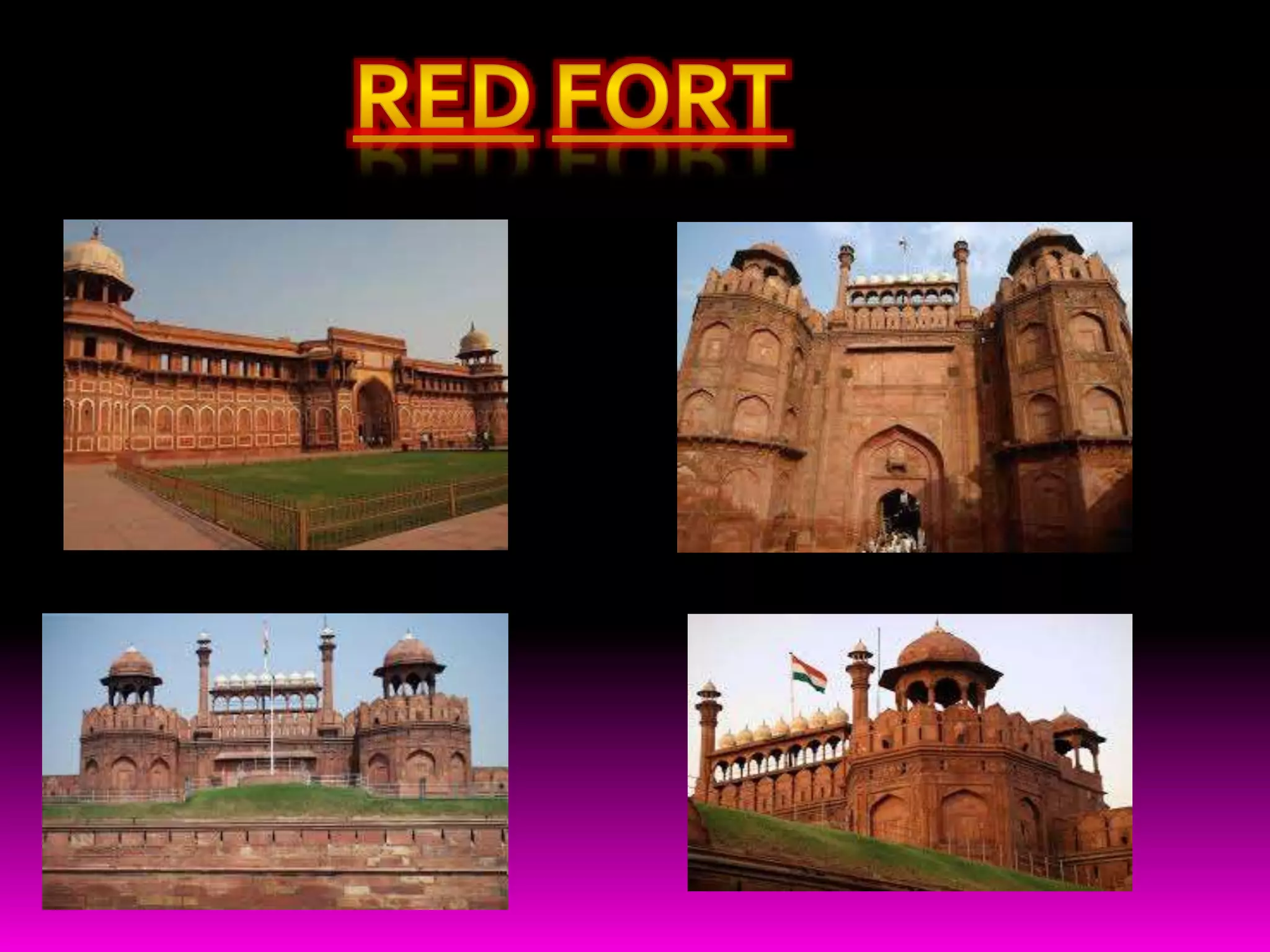
The Red Fort was the residence of the Mughal
emperor of India for nearly 200 years, until 1857. It
is located in the centre of Delhi and houses a
number of museums. In addition to
accommodating the emperors and their
households, it was the ceremonial and political
centre of Mughal government and the setting for
events critically impacting the region.
The Red Fort is an iconic symbol of India. On the
Independence Day of India (15 August), the Prime
Minister of India hoists the national flag at the main
gate of the fort and delivers a nationally-broadcast
speech from its ramparts.
HISTORY
Emperor Shah Jahan commissioned construction of
the Red Fort in 1638, when he decided to shift his
capital from Agra to Delhi. Its design is credited to
architect Ustad Ahmad Lahauri, the same architect
who constructed theTaj Mahal.The fort lies along
theYamuna River, which fed the moats
surrounding most of the walls. Construction began
in the sacred month of Muharram, on 13 May 1638.
Supervised by Shah Jahan, it was completed in
1648.
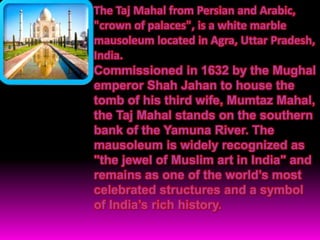
The Taj Mahal from Persian and Arabic,
"crown of palaces", is a white marble
mausoleum located in Agra, Uttar Pradesh,
India.
Commissioned in 1632 by the Mughal
emperor Shah Jahan to house the
tomb of his third wife, Mumtaz Mahal,
the Taj Mahal stands on the southern
bank of the Yamuna River. The
mausoleum is widely recognized as
"the jewel of Muslim art in India" and
remains as one of the world’s most
celebrated structures and a symbol
of India’s rich history.
Origin and Inspiration
In 1631, Shah Jahan, emperor during the Mughal
empire's period of greatest prosperity, was grief-
stricken when his third wife, Mumtaz Mahal, a
Persian princess, died during the birth of their 14th
child, Gauhara Begum. Construction of the Taj Mahal
began in 1632. The court chronicles of Shah Jahan's
grief illustrate the love story traditionally held as an
inspiration for Taj Mahal. The principal mausoleum
was completed in 1648 and the surrounding
buildings and garden were finished about five years
later.
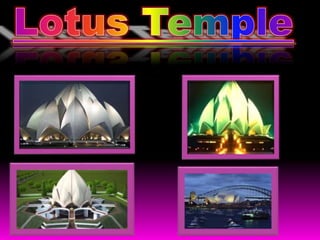
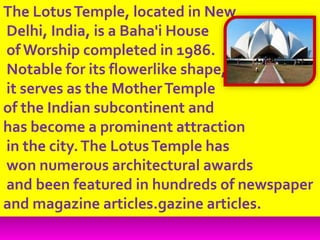
The LotusTemple, located in New
Delhi, India, is a Baha'i House
of Worship completed in 1986.
Notable for its flowerlike shape,
it serves as the MotherTemple
of the Indian subcontinent and
has become a prominent attraction
in the city.The LotusTemple has
won numerous architectural awards
and been featured in hundreds of newspaper
and magazine articles.gazine articles.
The design of the EiffelTower was originated
by Maurice Koechlin and Émile Nouguier, two
senior engineers who worked for the
Compagnie des Établissements Eiffel, after
discussion about a suitable centrepiece for the
proposed 1889 Exposition Universelle, a
World's Fair which would celebrate the
centennial of the French Revolution. In May
1884 Koechlin, working at home, made an
outline drawing of their scheme, described by
him as "a great pylon, consisting of four lattice
girders standing apart at the base and coming
together at the top, joined together by metal
trusses at regular intervals".
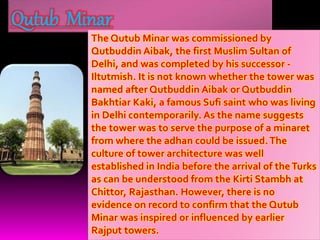
Qutub Minar
The Qutub Minar was commissioned by
Qutbuddin Aibak, the first Muslim Sultan of
Delhi, and was completed by his successor -
Iltutmish. It is not known whether the tower was
named after Qutbuddin Aibak or Qutbuddin
Bakhtiar Kaki, a famous Sufi saint who was living
in Delhi contemporarily. As the name suggests
the tower was to serve the purpose of a minaret
from where the adhan could be issued.The
culture of tower architecture was well
established in India before the arrival of theTurks
as can be understood from the Kirti Stambh at
Chittor, Rajasthan. However, there is no
evidence on record to confirm that the Qutub
Minar was inspired or influenced by earlier
Rajput towers.
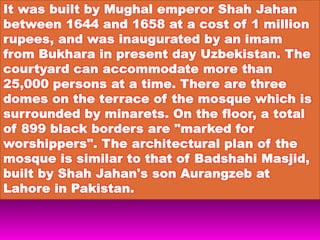
It was built by Mughal emperor Shah Jahan
between 1644 and 1658 at a cost of 1 million
rupees, and was inaugurated by an imam
from Bukhara in present day Uzbekistan. The
courtyard can accommodate more than
25,000 persons at a time. There are three
domes on the terrace of the mosque which is
surrounded by minarets. On the floor, a total
of 899 black borders are "marked for
worshippers". The architectural plan of the
mosque is similar to that of Badshahi Masjid,
built by Shah Jahan's son Aurangzeb at
Lahore in Pakistan.
KashiVishwanathTemple
Sarnath
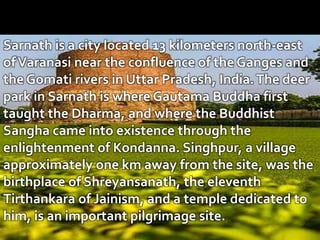
Sarnath is a city located 13 kilometers north-east
ofVaranasi near the confluence of the Ganges and
the Gomati rivers in Uttar Pradesh, India.The deer
park in Sarnath is where Gautama Buddha first
taught the Dharma, and where the Buddhist
Sangha came into existence through the
enlightenment of Kondanna. Singhpur, a village
approximately one km away from the site, was the
birthplace of Shreyansanath, the eleventh
Tirthankara of Jainism, and a temple dedicated to
him, is an important pilgrimage site.
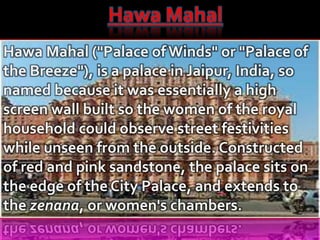
Hawa Mahal
Hawa Mahal ("Palace ofWinds" or "Palace of
the Breeze"), is a palace in Jaipur, India, so
named because it was essentially a high
screen wall built so the women of the royal
household could observe street festivities
while unseen from the outside. Constructed
of red and pink sandstone, the palace sits on
the edge of the City Palace, and extends to
the zenana, or women's chambers.
Ajanta Caves
The Ajanta Caves in Aurangabad district of Maharashtra,
India are about 30 rock-cut Buddhist cave monuments which
date from the 2nd century BCE to about 480 or 650 CE. The
caves include paintings and sculptures described by the
government Archaeological Survey of India as "the finest
surviving examples of Indian art, particularly painting", which
are masterpieces of Buddhist religious art, with figures of the
Buddha and depictions of the Jataka tales. The caves were
built in two phases starting around the 2nd century BCE, with
the second group of caves built around 400–650 CE
according to older accounts, or all in a brief period of 460 to
480 according to the recent proposals of Walter M. Spink. The
site is a protected monument in the care of the
Archaeological Survey of India, and since 1983, the Ajanta
Caves have been a UNESCO World Heritage Site.
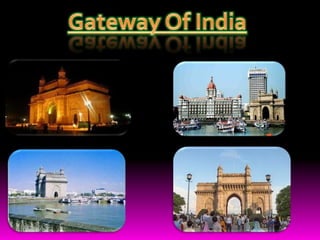
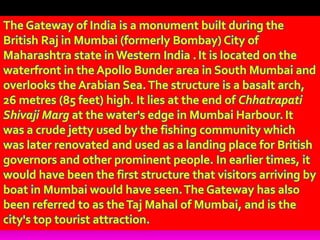
The Gateway of India is a monument built during the
British Raj in Mumbai (formerly Bombay) City of
Maharashtra state in Western India .It is located on the
waterfront in the Apollo Bunder area in South Mumbai and
overlooks the Arabian Sea.The structure is a basalt arch,
26 metres (85 feet) high. It lies at the end of Chhatrapati
Shivaji Marg at the water's edge in Mumbai Harbour.It
was a crude jetty used by the fishing community which
was later renovated and used as a landing place for British
governors and other prominent people. In earlier times, it
would have been the first structure that visitors arriving by
boat in Mumbai would have seen.The Gateway has also
been referred to as theTaj Mahal of Mumbai, and is the
city's top tourist attraction.
The Charminar, also known as built in 1591 CE, is a
monument and mosque located in
Hyderabad,Telangana, India.The landmark has
become a global icon of Hyderabad, listed among
the most recognized structures of India.The
Charminar is situated on the east bank of Musi
river.To the west lies the Laad Bazaar, and to the
southwest lies the richly ornamented granite
Makkah Masjid.The English name is a translation
and combination of the Urdu words Chār and
Minar, translating to "FourTowers"; the
eponymous towers are ornate minarets attached
and supported by four grand arches.
Kurukshetra
Kurukshetra is a place of historical and religious
importance. Kurukshetra is in Haryana state of India.
It is also known as Dharmakshetra ("Holy Place").
According to the Puranas, Kurukshetra is a region
named after King Kuru, the ancestor of Kauravas
and Pandavas, as depicted in epic Mahabharata. The
importance of the place is attributed to the fact that
the Kurukshetra War of the Mahabharata was fought
on this land and the Bhagavad Gita was preached
here during the war when Lord Krishna found Arjuna
in a terrible dilemma.
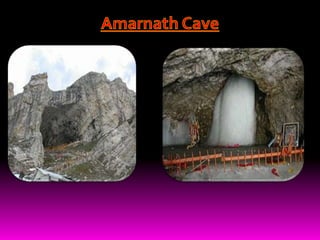
Amarnath cave is a Hindu shrine located in Jammu and
Kashmir, India. It is dedicated to Shiva.The cave is
situated at an altitude of 3,888 m (12,756 ft),about
141 km (88 mi) from Srinagar, the capital of Jammu and
Kashmir and reached through Pahalgam town.The shrine
forms an important part of Hinduism, and is considered
to be one of the holiest shrines in Hinduism.The cave is
surrounded by snowy mountains.The cave itself is
covered with snow most of the year except for a short
period of time in summer when it is open for pilgrims.
Thousands of Hindu devotees make an annual pilgrimage
to the Amarnath cave on challenging mountainous
terrain to see an ice stalagmite formed inside the cave.
Historical places

Historical places

  • 2.
    The Red Fortwas the residence of the Mughal emperor of India for nearly 200 years, until 1857. It is located in the centre of Delhi and houses a number of museums. In addition to accommodating the emperors and their households, it was the ceremonial and political centre of Mughal government and the setting for events critically impacting the region. The Red Fort is an iconic symbol of India. On the Independence Day of India (15 August), the Prime Minister of India hoists the national flag at the main gate of the fort and delivers a nationally-broadcast speech from its ramparts.
  • 3.
    HISTORY Emperor Shah Jahancommissioned construction of the Red Fort in 1638, when he decided to shift his capital from Agra to Delhi. Its design is credited to architect Ustad Ahmad Lahauri, the same architect who constructed theTaj Mahal.The fort lies along theYamuna River, which fed the moats surrounding most of the walls. Construction began in the sacred month of Muharram, on 13 May 1638. Supervised by Shah Jahan, it was completed in 1648.
  • 5.
    The Taj Mahalfrom Persian and Arabic, "crown of palaces", is a white marble mausoleum located in Agra, Uttar Pradesh, India. Commissioned in 1632 by the Mughal emperor Shah Jahan to house the tomb of his third wife, Mumtaz Mahal, the Taj Mahal stands on the southern bank of the Yamuna River. The mausoleum is widely recognized as "the jewel of Muslim art in India" and remains as one of the world’s most celebrated structures and a symbol of India’s rich history.
  • 6.
    Origin and Inspiration In1631, Shah Jahan, emperor during the Mughal empire's period of greatest prosperity, was grief- stricken when his third wife, Mumtaz Mahal, a Persian princess, died during the birth of their 14th child, Gauhara Begum. Construction of the Taj Mahal began in 1632. The court chronicles of Shah Jahan's grief illustrate the love story traditionally held as an inspiration for Taj Mahal. The principal mausoleum was completed in 1648 and the surrounding buildings and garden were finished about five years later.
  • 8.
    The LotusTemple, locatedin New Delhi, India, is a Baha'i House of Worship completed in 1986. Notable for its flowerlike shape, it serves as the MotherTemple of the Indian subcontinent and has become a prominent attraction in the city.The LotusTemple has won numerous architectural awards and been featured in hundreds of newspaper and magazine articles.gazine articles.
  • 9.
    The design ofthe EiffelTower was originated by Maurice Koechlin and Émile Nouguier, two senior engineers who worked for the Compagnie des Établissements Eiffel, after discussion about a suitable centrepiece for the proposed 1889 Exposition Universelle, a World's Fair which would celebrate the centennial of the French Revolution. In May 1884 Koechlin, working at home, made an outline drawing of their scheme, described by him as "a great pylon, consisting of four lattice girders standing apart at the base and coming together at the top, joined together by metal trusses at regular intervals".
  • 10.
    Qutub Minar The QutubMinar was commissioned by Qutbuddin Aibak, the first Muslim Sultan of Delhi, and was completed by his successor - Iltutmish. It is not known whether the tower was named after Qutbuddin Aibak or Qutbuddin Bakhtiar Kaki, a famous Sufi saint who was living in Delhi contemporarily. As the name suggests the tower was to serve the purpose of a minaret from where the adhan could be issued.The culture of tower architecture was well established in India before the arrival of theTurks as can be understood from the Kirti Stambh at Chittor, Rajasthan. However, there is no evidence on record to confirm that the Qutub Minar was inspired or influenced by earlier Rajput towers.
  • 12.
    It was builtby Mughal emperor Shah Jahan between 1644 and 1658 at a cost of 1 million rupees, and was inaugurated by an imam from Bukhara in present day Uzbekistan. The courtyard can accommodate more than 25,000 persons at a time. There are three domes on the terrace of the mosque which is surrounded by minarets. On the floor, a total of 899 black borders are "marked for worshippers". The architectural plan of the mosque is similar to that of Badshahi Masjid, built by Shah Jahan's son Aurangzeb at Lahore in Pakistan.
  • 13.
  • 14.
  • 15.
    Sarnath is acity located 13 kilometers north-east ofVaranasi near the confluence of the Ganges and the Gomati rivers in Uttar Pradesh, India.The deer park in Sarnath is where Gautama Buddha first taught the Dharma, and where the Buddhist Sangha came into existence through the enlightenment of Kondanna. Singhpur, a village approximately one km away from the site, was the birthplace of Shreyansanath, the eleventh Tirthankara of Jainism, and a temple dedicated to him, is an important pilgrimage site.
  • 16.
    Hawa Mahal Hawa Mahal("Palace ofWinds" or "Palace of the Breeze"), is a palace in Jaipur, India, so named because it was essentially a high screen wall built so the women of the royal household could observe street festivities while unseen from the outside. Constructed of red and pink sandstone, the palace sits on the edge of the City Palace, and extends to the zenana, or women's chambers.
  • 17.
    Ajanta Caves The AjantaCaves in Aurangabad district of Maharashtra, India are about 30 rock-cut Buddhist cave monuments which date from the 2nd century BCE to about 480 or 650 CE. The caves include paintings and sculptures described by the government Archaeological Survey of India as "the finest surviving examples of Indian art, particularly painting", which are masterpieces of Buddhist religious art, with figures of the Buddha and depictions of the Jataka tales. The caves were built in two phases starting around the 2nd century BCE, with the second group of caves built around 400–650 CE according to older accounts, or all in a brief period of 460 to 480 according to the recent proposals of Walter M. Spink. The site is a protected monument in the care of the Archaeological Survey of India, and since 1983, the Ajanta Caves have been a UNESCO World Heritage Site.
  • 19.
    The Gateway ofIndia is a monument built during the British Raj in Mumbai (formerly Bombay) City of Maharashtra state in Western India .It is located on the waterfront in the Apollo Bunder area in South Mumbai and overlooks the Arabian Sea.The structure is a basalt arch, 26 metres (85 feet) high. It lies at the end of Chhatrapati Shivaji Marg at the water's edge in Mumbai Harbour.It was a crude jetty used by the fishing community which was later renovated and used as a landing place for British governors and other prominent people. In earlier times, it would have been the first structure that visitors arriving by boat in Mumbai would have seen.The Gateway has also been referred to as theTaj Mahal of Mumbai, and is the city's top tourist attraction.
  • 21.
    The Charminar, alsoknown as built in 1591 CE, is a monument and mosque located in Hyderabad,Telangana, India.The landmark has become a global icon of Hyderabad, listed among the most recognized structures of India.The Charminar is situated on the east bank of Musi river.To the west lies the Laad Bazaar, and to the southwest lies the richly ornamented granite Makkah Masjid.The English name is a translation and combination of the Urdu words Chār and Minar, translating to "FourTowers"; the eponymous towers are ornate minarets attached and supported by four grand arches.
  • 22.
    Kurukshetra Kurukshetra is aplace of historical and religious importance. Kurukshetra is in Haryana state of India. It is also known as Dharmakshetra ("Holy Place"). According to the Puranas, Kurukshetra is a region named after King Kuru, the ancestor of Kauravas and Pandavas, as depicted in epic Mahabharata. The importance of the place is attributed to the fact that the Kurukshetra War of the Mahabharata was fought on this land and the Bhagavad Gita was preached here during the war when Lord Krishna found Arjuna in a terrible dilemma.
  • 25.
    Amarnath cave isa Hindu shrine located in Jammu and Kashmir, India. It is dedicated to Shiva.The cave is situated at an altitude of 3,888 m (12,756 ft),about 141 km (88 mi) from Srinagar, the capital of Jammu and Kashmir and reached through Pahalgam town.The shrine forms an important part of Hinduism, and is considered to be one of the holiest shrines in Hinduism.The cave is surrounded by snowy mountains.The cave itself is covered with snow most of the year except for a short period of time in summer when it is open for pilgrims. Thousands of Hindu devotees make an annual pilgrimage to the Amarnath cave on challenging mountainous terrain to see an ice stalagmite formed inside the cave.