MUDA WASTE REDUCTION
SUBMITTED BY
JAYESH CHOUHAN (FPB1517/052)
RAHUL DUTTA (FPB1517/057)
SUBMITTED TO
PROF. SURESH V. CHANDRA
PROPERTY OF INDUS BUSINESS ACADEMY 1December 14, 2015
Introduction:
 Muda is a Japanese term which means “WASTE”.
 It is any activity which adds costs or time to the company but does not add any value.
 Wastage is consuming more resources (time, money, space, etc.) than are necessary to
produce the goods, or services, that the customer wants.
Types of Waste:
• Pure Waste: Waste that could be reduced without affecting the customer and sales is called pure waste.
Example: Holding excess inventory.
• Incidental Waste: Actions that need to be done based on how the current system operates but do not
add value are incidental waste. Example: Over processing of goods.
PROPERTY OF INDUS BUSINESS ACADEMY 2December 14, 2015
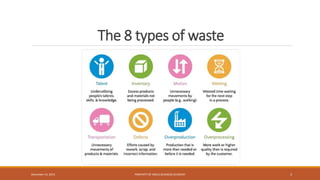
The 8 types of waste
PROPERTY OF INDUS BUSINESS ACADEMY 3December 14, 2015
Overproduction
 It refers to the process where more than needed is produced to meet order requirements,
sooner and faster than it is needed, it causes almost all other types of waste.
 This is the worst waste of all kinds because it helps cause almost all the other kinds of wastes.
 It leads to excess inventory, paperwork, handling, storage, space, interest charges, machinery,
defects, people and overhead.
 Common causes:
• Producing more than is required to make up for yield loss.
• Scheduling production to forecasted demand.
• Unnecessary production to show higher machine utilization (or lower manufacturing cost)
PROPERTY OF INDUS BUSINESS ACADEMY 4December 14, 2015
Strategies to eliminate Overproduction
 The first step is to realize that we are doing it, because it is often very difficult to realize as
every seems to be busy.
 Strong production planning and control.
 Production according to customer schedule.
 Adopting to suitable demand forecasting methods and making periodical updates to the system.
PROPERTY OF INDUS BUSINESS ACADEMY 5December 14, 2015
Inventory
 Inventory comprises of finished goods semi-finished products or parts and supplies. Excess
inventory is a real waste as it dose not add value but add to the cost.
 It requires people, equipment and space to count, transport, store and maintain it.
 If we do not get orders the material will become obsolete, and be thrown away.
 Common causes:
 Overproduction
 Poor equipment layout
 Defective, or questionable parts
 Mismatched production speeds
PROPERTY OF INDUS BUSINESS ACADEMY 6December 14, 2015
Strategies to eliminate excess Inventory
 Dispose off obsolete material to save space and to avoid confusion.
 Do not produce items ahead of customer's delivery requirements.
 Do not manufacture products in excess of customer's requirements.
 Making value flow at the pull of the customer, the idea of Just in Time (JIT) production.
PROPERTY OF INDUS BUSINESS ACADEMY 7December 14, 2015
Waiting
 It occurs when worker or machine is not performing its job.
 People may be waiting for parts or instructions.
 Mostly they are waiting for one another, which often happens when they are not aligned to
their objectives.
 The talent of employees is also wasted.
 Waiting for parts, instructions, approval, information, maintenance, decisions.
 Common causes:
 Mismatched production rates
 Poor layout
 Machine breakdowns
 Excessively staffed
PROPERTY OF INDUS BUSINESS ACADEMY 8December 14, 2015
Strategies to eliminate waste in Waiting
 Balance the workload by redistributing tasks in the process.
 Eliminate unnecessary approval processes.
 Build other tasks into the daily work schedule so that employees are occupied during waiting
periods.
 Prevent delays by providing for backups.
PROPERTY OF INDUS BUSINESS ACADEMY 9December 14, 2015
Motion
 Walking without working (away from workstation) .
 Searching for tools, materials or information.
 Reaching, bending or unnecessary motion due to poor housekeeping or workplace layout.
 Process is not designed with employees in mind.
 Strategies to eliminate
• Motion economy principal
• Effective supervision
PROPERTY OF INDUS BUSINESS ACADEMY 10December 14, 2015
Transportation
 It is highly visible form of waste unnecessary transportation create the need for more storage
space, more equipment's and workers.
 Poor layouts lead to things being moved multiple times.
 If things are not well place, they can be hard to find.
 Material can get damaged if it’s moved too much.
 Common causes:
 Excessive distance between operations (layout).
 Single skill focused operations.
PROPERTY OF INDUS BUSINESS ACADEMY 11December 14, 2015
Strategies to eliminate Transportation waste
 Store material as close to the point of use as possible
 Avoid transportation over long distance.
 Avoid over production.
PROPERTY OF INDUS BUSINESS ACADEMY 12December 14, 2015
Over Processing
 Doing more than is necessary to produce an effectively functioning product.
 Extra setup steps, over-specification of the process, extra processing steps.
 Common causes:
 Lack of standard work or processes
 Equipment over designed
 Process not updated with technology changes
PROPERTY OF INDUS BUSINESS ACADEMY 13December 14, 2015
Strategies to eliminate over processing
 Identify where delays occur in the process and quantify if it is avoidable delay and unavoidable
delays
 Eliminate avoidable delay in the process. This is a waste in processing
PROPERTY OF INDUS BUSINESS ACADEMY 14December 14, 2015
Defects
 Defects imply rework or reject. Research confirms that 20 to 30% of manufacturing company’s
gross revenues are spent on correcting mistake.
 Defects cause rework, confusion and upsets a synchronized set of processes.
 Product defects leads to loss of customer & future business.
 Common causes:
• Incorrect product design
• Defective materials
• Poorly trained employees
PROPERTY OF INDUS BUSINESS ACADEMY 15December 14, 2015
Strategies to eliminate defects
 Implement standard operations procedures (SOP) and training to ensure that the correct
methods are undertaken and standards achieved.
 Design reviews.
 Training to employees.
 Maintenance of machines and equipment.
PROPERTY OF INDUS BUSINESS ACADEMY 16December 14, 2015
People Skill’s
 Employees are seen as a source of labor only, not seen as true process experts.
 People are told what to do, and asked not to think how to do it more effectively.
 Employees are not involved in finding solutions, opportunities to improve the process.
 Strategies to eliminate wastage
• People are the biggest asset, respect them, nurture them and involve them indecision making process.
• Team working, training, and clear leadership are required to stop wastage in people skill’s.
PROPERTY OF INDUS BUSINESS ACADEMY 17December 14, 2015
THANK YOU !!
PROPERTY OF INDUS BUSINESS ACADEMY 18December 14, 2015

Muda - Waste reduction

  • 1.
    MUDA WASTE REDUCTION SUBMITTEDBY JAYESH CHOUHAN (FPB1517/052) RAHUL DUTTA (FPB1517/057) SUBMITTED TO PROF. SURESH V. CHANDRA PROPERTY OF INDUS BUSINESS ACADEMY 1December 14, 2015
  • 2.
    Introduction:  Muda isa Japanese term which means “WASTE”.  It is any activity which adds costs or time to the company but does not add any value.  Wastage is consuming more resources (time, money, space, etc.) than are necessary to produce the goods, or services, that the customer wants. Types of Waste: • Pure Waste: Waste that could be reduced without affecting the customer and sales is called pure waste. Example: Holding excess inventory. • Incidental Waste: Actions that need to be done based on how the current system operates but do not add value are incidental waste. Example: Over processing of goods. PROPERTY OF INDUS BUSINESS ACADEMY 2December 14, 2015
  • 3.
    The 8 typesof waste PROPERTY OF INDUS BUSINESS ACADEMY 3December 14, 2015
  • 4.
    Overproduction  It refersto the process where more than needed is produced to meet order requirements, sooner and faster than it is needed, it causes almost all other types of waste.  This is the worst waste of all kinds because it helps cause almost all the other kinds of wastes.  It leads to excess inventory, paperwork, handling, storage, space, interest charges, machinery, defects, people and overhead.  Common causes: • Producing more than is required to make up for yield loss. • Scheduling production to forecasted demand. • Unnecessary production to show higher machine utilization (or lower manufacturing cost) PROPERTY OF INDUS BUSINESS ACADEMY 4December 14, 2015
  • 5.
    Strategies to eliminateOverproduction  The first step is to realize that we are doing it, because it is often very difficult to realize as every seems to be busy.  Strong production planning and control.  Production according to customer schedule.  Adopting to suitable demand forecasting methods and making periodical updates to the system. PROPERTY OF INDUS BUSINESS ACADEMY 5December 14, 2015
  • 6.
    Inventory  Inventory comprisesof finished goods semi-finished products or parts and supplies. Excess inventory is a real waste as it dose not add value but add to the cost.  It requires people, equipment and space to count, transport, store and maintain it.  If we do not get orders the material will become obsolete, and be thrown away.  Common causes:  Overproduction  Poor equipment layout  Defective, or questionable parts  Mismatched production speeds PROPERTY OF INDUS BUSINESS ACADEMY 6December 14, 2015
  • 7.
    Strategies to eliminateexcess Inventory  Dispose off obsolete material to save space and to avoid confusion.  Do not produce items ahead of customer's delivery requirements.  Do not manufacture products in excess of customer's requirements.  Making value flow at the pull of the customer, the idea of Just in Time (JIT) production. PROPERTY OF INDUS BUSINESS ACADEMY 7December 14, 2015
  • 8.
    Waiting  It occurswhen worker or machine is not performing its job.  People may be waiting for parts or instructions.  Mostly they are waiting for one another, which often happens when they are not aligned to their objectives.  The talent of employees is also wasted.  Waiting for parts, instructions, approval, information, maintenance, decisions.  Common causes:  Mismatched production rates  Poor layout  Machine breakdowns  Excessively staffed PROPERTY OF INDUS BUSINESS ACADEMY 8December 14, 2015
  • 9.
    Strategies to eliminatewaste in Waiting  Balance the workload by redistributing tasks in the process.  Eliminate unnecessary approval processes.  Build other tasks into the daily work schedule so that employees are occupied during waiting periods.  Prevent delays by providing for backups. PROPERTY OF INDUS BUSINESS ACADEMY 9December 14, 2015
  • 10.
    Motion  Walking withoutworking (away from workstation) .  Searching for tools, materials or information.  Reaching, bending or unnecessary motion due to poor housekeeping or workplace layout.  Process is not designed with employees in mind.  Strategies to eliminate • Motion economy principal • Effective supervision PROPERTY OF INDUS BUSINESS ACADEMY 10December 14, 2015
  • 11.
    Transportation  It ishighly visible form of waste unnecessary transportation create the need for more storage space, more equipment's and workers.  Poor layouts lead to things being moved multiple times.  If things are not well place, they can be hard to find.  Material can get damaged if it’s moved too much.  Common causes:  Excessive distance between operations (layout).  Single skill focused operations. PROPERTY OF INDUS BUSINESS ACADEMY 11December 14, 2015
  • 12.
    Strategies to eliminateTransportation waste  Store material as close to the point of use as possible  Avoid transportation over long distance.  Avoid over production. PROPERTY OF INDUS BUSINESS ACADEMY 12December 14, 2015
  • 13.
    Over Processing  Doingmore than is necessary to produce an effectively functioning product.  Extra setup steps, over-specification of the process, extra processing steps.  Common causes:  Lack of standard work or processes  Equipment over designed  Process not updated with technology changes PROPERTY OF INDUS BUSINESS ACADEMY 13December 14, 2015
  • 14.
    Strategies to eliminateover processing  Identify where delays occur in the process and quantify if it is avoidable delay and unavoidable delays  Eliminate avoidable delay in the process. This is a waste in processing PROPERTY OF INDUS BUSINESS ACADEMY 14December 14, 2015
  • 15.
    Defects  Defects implyrework or reject. Research confirms that 20 to 30% of manufacturing company’s gross revenues are spent on correcting mistake.  Defects cause rework, confusion and upsets a synchronized set of processes.  Product defects leads to loss of customer & future business.  Common causes: • Incorrect product design • Defective materials • Poorly trained employees PROPERTY OF INDUS BUSINESS ACADEMY 15December 14, 2015
  • 16.
    Strategies to eliminatedefects  Implement standard operations procedures (SOP) and training to ensure that the correct methods are undertaken and standards achieved.  Design reviews.  Training to employees.  Maintenance of machines and equipment. PROPERTY OF INDUS BUSINESS ACADEMY 16December 14, 2015
  • 17.
    People Skill’s  Employeesare seen as a source of labor only, not seen as true process experts.  People are told what to do, and asked not to think how to do it more effectively.  Employees are not involved in finding solutions, opportunities to improve the process.  Strategies to eliminate wastage • People are the biggest asset, respect them, nurture them and involve them indecision making process. • Team working, training, and clear leadership are required to stop wastage in people skill’s. PROPERTY OF INDUS BUSINESS ACADEMY 17December 14, 2015
  • 18.
    THANK YOU !! PROPERTYOF INDUS BUSINESS ACADEMY 18December 14, 2015