ASSESSMENTS FOR
   LEARNING

     Travis Issler
     Anna Brown
    Chip Whipple
    Scott Musser
     Kelly Kriner
What is the first thing you
think of when you hear the
     word assessment?
What is the first thing you
think of when you hear the
     word assessment?
Test
What is the first thing you
think of when you hear the
     word assessment?
Test

Quiz
What is the first thing you
think of when you hear the
     word assessment?
Test

Quiz

Portfolio
What is the first thing you
think of when you hear the
     word assessment?
Test

Quiz

Portfolio

Standardized tests
What is the first thing you
think of when you hear the
     word assessment?
Test

Quiz

Portfolio

Standardized tests

Annual Review
What is the first thing you
think of when you hear the
     word assessment?
Test

Quiz

Portfolio

Standardized tests

Annual Review

Presentation
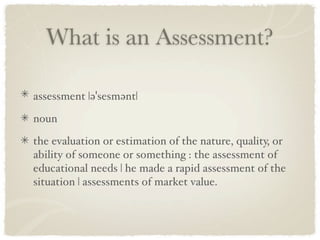
What is an Assessment?

assessment |əˈsesmənt|

noun

the evaluation or estimation of the nature, quality, or
ability of someone or something : the assessment of
educational needs | he made a rapid assessment of the
situation | assessments of market value.
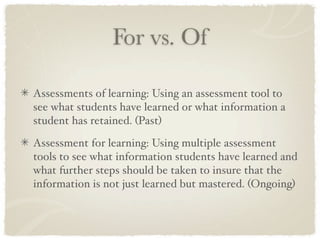
For vs. Of
For vs. Of

Assessments of learning: Using an assessment tool to
see what students have learned or what information a
student has retained. (Past)

Assessment for learning: Using multiple assessment
tools to see what information students have learned and
what further steps should be taken to insure that the
information is not just learned but mastered. (Ongoing)
A great example of what is
 NOT an assessment for
         learning!

http://www.youtube.com/watch?v=ZEZXipnMNYw
Performance Assessment
Defined by congress, Office of technology Assessment
(OTA)(1992), as “testing methods that require students
to create an answer or product that demonstrates
knowledge and skills.”

“These are a viable alternative to norm-referenced tests.
Teachers can use performance assessments to obtain a
much richer and more complete picture of what
students know and are able to do.” (TeacherVision)
How to use Performance
     Assessments
How to use Performance
      Assessments
It should be a continuation of your lessons
How to use Performance
      Assessments
It should be a continuation of your lessons

It can be student constructed rather than teacher
selected
How to use Performance
      Assessments
It should be a continuation of your lessons

It can be student constructed rather than teacher
selected

It should always involve teacher observation
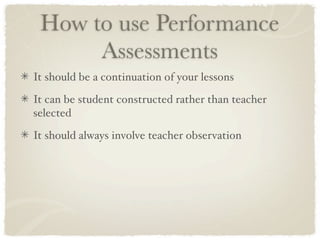
How to use Performance
      Assessments
It should be a continuation of your lessons

It can be student constructed rather than teacher
selected

It should always involve teacher observation

It should highlight the students’ learning and thought
process not just their answers.
How to use Performance
      Assessments
It should be a continuation of your lessons

It can be student constructed rather than teacher
selected

It should always involve teacher observation

It should highlight the students’ learning and thought
process not just their answers.

    This might mean they get the wrong answer, but
    their thought process can outweigh that answer.
http://www.youtube.com/watch?v=ZQ4lJXxb4jI
What do we need to do first?
 We need to be masters of our content. (Not master
 teachers, just masters of our individual teaching subject)
What do we need to do first?
 We need to be masters of our content. (Not master
 teachers, just masters of our individual teaching subject)

 Understand how state standards integrate into our
 curriculum because these are our overall goals for the
 students.
What do we need to do first?
 We need to be masters of our content. (Not master
 teachers, just masters of our individual teaching subject)

 Understand how state standards integrate into our
 curriculum because these are our overall goals for the
 students.

 Scaffold student learning so that each standard is built
 upon the other.
What do we need to do first?
 We need to be masters of our content. (Not master
 teachers, just masters of our individual teaching subject)

 Understand how state standards integrate into our
 curriculum because these are our overall goals for the
 students.

 Scaffold student learning so that each standard is built
 upon the other.

 Transform achievement benchmarks into student-
 friendly versions.
Types of Assessments For Learning
 and Performance Assessments
Types of Assessments For Learning
 and Performance Assessments
 Student selected presentations
Types of Assessments For Learning
 and Performance Assessments
 Student selected presentations

 Group activities with class appointed rotating jobs
Types of Assessments For Learning
 and Performance Assessments
 Student selected presentations

 Group activities with class appointed rotating jobs

 Anecdotal notes!!!!!
Types of Assessments For Learning
 and Performance Assessments
 Student selected presentations

 Group activities with class appointed rotating jobs

 Anecdotal notes!!!!!

 Tests students can retake
Types of Assessments For Learning
 and Performance Assessments
 Student selected presentations

 Group activities with class appointed rotating jobs

 Anecdotal notes!!!!!

 Tests students can retake

 Student lead study time
Types of Assessments For Learning
 and Performance Assessments
 Student selected presentations

 Group activities with class appointed rotating jobs

 Anecdotal notes!!!!!

 Tests students can retake

 Student lead study time

 Practice Quizzes
Types of Assessments For Learning
 and Performance Assessments
 Student selected presentations

 Group activities with class appointed rotating jobs

 Anecdotal notes!!!!!

 Tests students can retake

 Student lead study time

 Practice Quizzes

 Self-Assessments
Types of Assessments For Learning
 and Performance Assessments
 Student selected presentations

 Group activities with class appointed rotating jobs

 Anecdotal notes!!!!!

 Tests students can retake

 Student lead study time

 Practice Quizzes

 Self-Assessments

 Movies, Music, Dance, Drawings
chemistry video
What To Do With It Once
     You’ve Got It!!
REFLECT! Remember assessments FOR learning are
to help us know what we need to do, as teachers, to
ensure our students are mastering the material.
REFLECT! Remember assessments FOR learning are
to help us know what we need to do, as teachers, to
ensure our students are mastering the material.

RECORD! Keep a folder for each student instead of
just sending everything home with them. You can look
back and see their progress over time. This also helps
the students see their own progress over time.
REFLECT! Remember assessments FOR learning are
to help us know what we need to do, as teachers, to
ensure our students are mastering the material.

RECORD! Keep a folder for each student instead of
just sending everything home with them. You can look
back and see their progress over time. This also helps
the students see their own progress over time.

RE-ASSESS! Assessments for learning are done while
the learning is happening! It is something that should be
constant and building. This shows us what we need to
do next. Show students the success they have made and
help them take pride in it. This encourages confidence
in the content and encourages them to keep striving!
References
Robyn R. Jackson, 2009. Never work harder than your
students pg. 125-169.

Rick Stiggins, 2005. Assessments for learning defined pg. 1-3.

TeacherVision, 11/2/09. 5:25 pm
www.teachervision.fen.com/teaching-methods/
classroom-management/27717.html.

Rachel Quenemoen and Martha Thurlow, 2007.
Learning opportunities for your child through alternate
assessments. US Department of Education.
thoughts to leave you with...


http://www.youtube.com/watch?
v=sO0JAs7M2yo&feature=related

Assessments

  • 1.
    ASSESSMENTS FOR LEARNING Travis Issler Anna Brown Chip Whipple Scott Musser Kelly Kriner
  • 2.
    What is thefirst thing you think of when you hear the word assessment?
  • 3.
    What is thefirst thing you think of when you hear the word assessment? Test
  • 4.
    What is thefirst thing you think of when you hear the word assessment? Test Quiz
  • 5.
    What is thefirst thing you think of when you hear the word assessment? Test Quiz Portfolio
  • 6.
    What is thefirst thing you think of when you hear the word assessment? Test Quiz Portfolio Standardized tests
  • 7.
    What is thefirst thing you think of when you hear the word assessment? Test Quiz Portfolio Standardized tests Annual Review
  • 8.
    What is thefirst thing you think of when you hear the word assessment? Test Quiz Portfolio Standardized tests Annual Review Presentation
  • 9.
    What is anAssessment?
  • 10.
    What is anAssessment? assessment |əˈsesmənt| noun the evaluation or estimation of the nature, quality, or ability of someone or something : the assessment of educational needs | he made a rapid assessment of the situation | assessments of market value.
  • 11.
  • 12.
    For vs. Of Assessmentsof learning: Using an assessment tool to see what students have learned or what information a student has retained. (Past) Assessment for learning: Using multiple assessment tools to see what information students have learned and what further steps should be taken to insure that the information is not just learned but mastered. (Ongoing)
  • 13.
    A great exampleof what is NOT an assessment for learning! http://www.youtube.com/watch?v=ZEZXipnMNYw
  • 14.
  • 15.
    Performance Assessment Defined bycongress, Office of technology Assessment (OTA)(1992), as “testing methods that require students to create an answer or product that demonstrates knowledge and skills.” “These are a viable alternative to norm-referenced tests. Teachers can use performance assessments to obtain a much richer and more complete picture of what students know and are able to do.” (TeacherVision)
  • 16.
    How to usePerformance Assessments
  • 17.
    How to usePerformance Assessments It should be a continuation of your lessons
  • 18.
    How to usePerformance Assessments It should be a continuation of your lessons It can be student constructed rather than teacher selected
  • 19.
    How to usePerformance Assessments It should be a continuation of your lessons It can be student constructed rather than teacher selected It should always involve teacher observation
  • 20.
    How to usePerformance Assessments It should be a continuation of your lessons It can be student constructed rather than teacher selected It should always involve teacher observation It should highlight the students’ learning and thought process not just their answers.
  • 21.
    How to usePerformance Assessments It should be a continuation of your lessons It can be student constructed rather than teacher selected It should always involve teacher observation It should highlight the students’ learning and thought process not just their answers. This might mean they get the wrong answer, but their thought process can outweigh that answer.
  • 22.
  • 23.
    What do weneed to do first?
  • 24.
    What do weneed to do first? We need to be masters of our content. (Not master teachers, just masters of our individual teaching subject)
  • 25.
    What do weneed to do first? We need to be masters of our content. (Not master teachers, just masters of our individual teaching subject) Understand how state standards integrate into our curriculum because these are our overall goals for the students.
  • 26.
    What do weneed to do first? We need to be masters of our content. (Not master teachers, just masters of our individual teaching subject) Understand how state standards integrate into our curriculum because these are our overall goals for the students. Scaffold student learning so that each standard is built upon the other.
  • 27.
    What do weneed to do first? We need to be masters of our content. (Not master teachers, just masters of our individual teaching subject) Understand how state standards integrate into our curriculum because these are our overall goals for the students. Scaffold student learning so that each standard is built upon the other. Transform achievement benchmarks into student- friendly versions.
  • 28.
    Types of AssessmentsFor Learning and Performance Assessments
  • 29.
    Types of AssessmentsFor Learning and Performance Assessments Student selected presentations
  • 30.
    Types of AssessmentsFor Learning and Performance Assessments Student selected presentations Group activities with class appointed rotating jobs
  • 31.
    Types of AssessmentsFor Learning and Performance Assessments Student selected presentations Group activities with class appointed rotating jobs Anecdotal notes!!!!!
  • 32.
    Types of AssessmentsFor Learning and Performance Assessments Student selected presentations Group activities with class appointed rotating jobs Anecdotal notes!!!!! Tests students can retake
  • 33.
    Types of AssessmentsFor Learning and Performance Assessments Student selected presentations Group activities with class appointed rotating jobs Anecdotal notes!!!!! Tests students can retake Student lead study time
  • 34.
    Types of AssessmentsFor Learning and Performance Assessments Student selected presentations Group activities with class appointed rotating jobs Anecdotal notes!!!!! Tests students can retake Student lead study time Practice Quizzes
  • 35.
    Types of AssessmentsFor Learning and Performance Assessments Student selected presentations Group activities with class appointed rotating jobs Anecdotal notes!!!!! Tests students can retake Student lead study time Practice Quizzes Self-Assessments
  • 36.
    Types of AssessmentsFor Learning and Performance Assessments Student selected presentations Group activities with class appointed rotating jobs Anecdotal notes!!!!! Tests students can retake Student lead study time Practice Quizzes Self-Assessments Movies, Music, Dance, Drawings
  • 37.
  • 38.
    What To DoWith It Once You’ve Got It!!
  • 40.
    REFLECT! Remember assessmentsFOR learning are to help us know what we need to do, as teachers, to ensure our students are mastering the material.
  • 41.
    REFLECT! Remember assessmentsFOR learning are to help us know what we need to do, as teachers, to ensure our students are mastering the material. RECORD! Keep a folder for each student instead of just sending everything home with them. You can look back and see their progress over time. This also helps the students see their own progress over time.
  • 42.
    REFLECT! Remember assessmentsFOR learning are to help us know what we need to do, as teachers, to ensure our students are mastering the material. RECORD! Keep a folder for each student instead of just sending everything home with them. You can look back and see their progress over time. This also helps the students see their own progress over time. RE-ASSESS! Assessments for learning are done while the learning is happening! It is something that should be constant and building. This shows us what we need to do next. Show students the success they have made and help them take pride in it. This encourages confidence in the content and encourages them to keep striving!

  • 43.
    References Robyn R. Jackson,2009. Never work harder than your students pg. 125-169. Rick Stiggins, 2005. Assessments for learning defined pg. 1-3. TeacherVision, 11/2/09. 5:25 pm www.teachervision.fen.com/teaching-methods/ classroom-management/27717.html. Rachel Quenemoen and Martha Thurlow, 2007. Learning opportunities for your child through alternate assessments. US Department of Education.
  • 44.
    thoughts to leaveyou with... http://www.youtube.com/watch? v=sO0JAs7M2yo&feature=related