h
BY
Henock.N (r2)
MRI CONTRAST AGENT
1
H
 MRI contrast agents are a group of contrast
media used to improve the visibility of internal
body structures in magnetic resonance
imaging (MRI).
 The most commonly used compounds for contrast
enhancement are gadolinium-based. MRI contrast
agents alter the relaxation times of atoms within
body tissues where they are present after oral
or intravenous administration.
2
 Most clinically used MRI contrast agents work
through shortening the T1 relaxation time of
protons located nearby.
 T1 shortens with an increase in rate of stimulated
emission from high energy states (spin anti-aligned
with the main field) to low energy states (spin
aligned).
3
 To, enhance the inherent contrast between tissue,
Mri contrast must alter rate of relaxation of the
proton within tissue.
 Relaxation must be vary for different tissues in
order to produce differential enhancement of signal
4
 MRI contrast agent must exert a large magnetic
field density( a property imparted by their unpaired
electron) to interact with the magnetic moment of
proton in the tissue and shorten their relaxation
time
 The electron magnetic moment also cause the local
change in magnetic field promting more rapid
proton dephasing and shortens the relaxation time
5
 Agents with unpaired electron pair spins used asMRI
contrast agent. This may be classifiedinto three group
 Ferromagnetic
 Paramagnetic- example gadolinium…
Used as major contrast agent made soluble by
chelation …shortens T1 relaxation..bright signal on T1
weighted image i.e Hyperintense
 Super-magnetic-ferrite.. Used for reduction of T2
relaxation time.. Decreased signal intensity seems
black
6
Chelates
 Chelate means “claw”
 Chelates surround an ion and make a cage around it
 A chelate of gadolinium occupies all available space
around the ion except water molecule
7
Gd chelate
8
 MRI contrast agents may be administered by injection into the
blood stream or orally, depending on the subject of interest.
 Oral administration is well suited to G.I. tract scans, while
intravascular administration proves more useful for most other
scans. A variety of agents of both types enhance scans
routinely.
9
 MRI contrast agents can be classified in
many ways, including by their:
 chemical composition
 administration route
 magnetic properties
 effect on the images
10
 biodistribution and applications:
 Extracellular fluid agents (also known as intravenous
contrast agents)
 Blood pool agents (also known as intravascular contrast
agents)
 Organ specific agents (i.e.Gastrointestinal contrast agents
and hepatobiliary contrast agents)
 Active targeting/cell labeling agents (i.e. tumor-specific
agents)
 pH-sensitive agents
11
12
Gadolinium containing MRI contrast agents (often termed simply
"gado" or "gad")
Used for enhancement of vessels in MR angiography or
for brain tumor enhancement
13
 For large vessels such as the aorta and its branches, the
gadolinium(III) dose can be as low as 0.1 mmol per kg
body mass.
 Higher concentrations are often used for finer
vasculature.
14
 Types of gadolinium contrast agents
 Extracellular fluid agents
Ionic (i.e. Magnevist and Dotarem)
Neutral (i.e. Omniscan, Prohance, Gadavist, OptiMARK)
 Blood pool agents
Albumin-binding gadolinium complexes
(i.e. Ablavar and Gadocoletic acid)
 Polymeric gadolinium
complexes (i.e. Gadomelitol
and Gadomer 17)
 Organ-specific agents
(i.e. Primovist and Multihance which are used as hepatobiliary
agents)
15
 Gadolinium-containing contrast agents approved for human
use Presently, nine different types of gadolinium-containing
contrast agents are available in different territories
gadoterate (Dotarem)
gadodiamide (Omniscan)
gadobenate (MultiHance)
gadopentetate (Magnevist, Magnegita, Gado-MRT ratiopharm)
gadoteridol (ProHance)
gadoversetamide (OptiMARK)
gadoxetate (Primovist)
gadobutrol (Gadovist)
16
 Iron oxide: Superparamagnetic
Two types of iron oxide contrast agents exist:
superparamagnetic iron oxide (SPIO)
and ultra small superparamagnetic iron oxide (USPIO).
when injected during imaging reduce the T2/ T2* signals of
absorbing tissues.
SPIO and USPIO contrast agents have been used successfully in
some instances for liver tumor enhancement
17
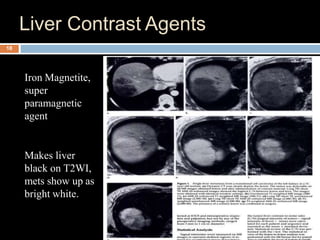
Liver Contrast Agents
Iron Magnetite,
super
paramagnetic
agent
Makes liver
black on T2WI,
mets show up as
bright white.
18
 Oral administration of contrast
agents
 A wide variety of oral contrast agents can enhance images
of the gastrointestinal tract.
 They include gadolinium and manganese chelates, or iron
salts for T1 signal enhancement.
 SPIO, barium sulfate, air and clay have been used to lower
T2 signal.
19
Other contrast agents
For MR colonography& MRCP
 Water/saline contrast
 Negative oral contrast
 Geritol
 Blueberry juice, pineapple juice
20
Negative contrast agents
 Used to make stomach contents black in MRCP
 Geritol, blueberry juice, pineapple juice
 Iron in Geritol
 Mn in these juices
21
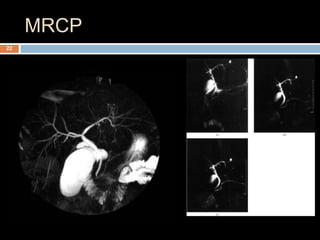
MRCP
22
Side effect of MRI contrast
 The most common, so called normal, side effects of
MRI contrast agent are mild and temporary in nature.
They include
 warmth
 pain or burning at the injection site,
 low blood pressure,
 minor skin rash,
 mild headaches,
 changes in blood clotting,
 light headedness and nausea.
 Typically these side effects do not require any treatments.
23
 The most common allergic reaction symptoms to MRI contrast
agents include
 swelling of the face,
 rashes,
 itching,
 sweating,
 watery or itchy eyes, and
 shortness of breath.
25
NSF
 Nephrogenic Systemic Fibrosis
 Fatal
 2-10 wks
 Progressive thickening and hyperpigmentation of skin
 Most likely caused by free Gd
 Prevent by screening patients for renal disease
 Calculate estimated creatinine clearance
27
NSF
 Risk factors
 CKD
 AKI
 Dialysis
 Indications for creatinine
 Age>60 yr
 Hx of kidney disease
 Single kidney or kidney surgery
 HTN or DM
27
CONTRAINDICATION
 Patient have history of CKD/renal failure i.e.
no normal renal clearance
 Allergic history
 pregnancy
28
Pregnant and lactating
 Assumed to cross the placenta
 exreted via urinary tract to amniotic fluid
 No subsequent evidence of teratogenesis
 Small percent excreted in breast milk
 No reported direct toxicity
 Discard breast milk 12-24 after GBCAS if possible
 In children ,it should be used when necessary
References
Safe use of contrast media :what the radiologist needs
to know; radiographics 2015
 ACR manual on contrast media, 2017Needs to Know1
Thank you!!!Radiologist Needs to Know1

MRI contrast RADIOLOGY

  • 1.
  • 2.
     MRI contrastagents are a group of contrast media used to improve the visibility of internal body structures in magnetic resonance imaging (MRI).  The most commonly used compounds for contrast enhancement are gadolinium-based. MRI contrast agents alter the relaxation times of atoms within body tissues where they are present after oral or intravenous administration. 2
  • 3.
     Most clinicallyused MRI contrast agents work through shortening the T1 relaxation time of protons located nearby.  T1 shortens with an increase in rate of stimulated emission from high energy states (spin anti-aligned with the main field) to low energy states (spin aligned). 3
  • 4.
     To, enhancethe inherent contrast between tissue, Mri contrast must alter rate of relaxation of the proton within tissue.  Relaxation must be vary for different tissues in order to produce differential enhancement of signal 4
  • 5.
     MRI contrastagent must exert a large magnetic field density( a property imparted by their unpaired electron) to interact with the magnetic moment of proton in the tissue and shorten their relaxation time  The electron magnetic moment also cause the local change in magnetic field promting more rapid proton dephasing and shortens the relaxation time 5
  • 6.
     Agents withunpaired electron pair spins used asMRI contrast agent. This may be classifiedinto three group  Ferromagnetic  Paramagnetic- example gadolinium… Used as major contrast agent made soluble by chelation …shortens T1 relaxation..bright signal on T1 weighted image i.e Hyperintense  Super-magnetic-ferrite.. Used for reduction of T2 relaxation time.. Decreased signal intensity seems black 6
  • 7.
    Chelates  Chelate means“claw”  Chelates surround an ion and make a cage around it  A chelate of gadolinium occupies all available space around the ion except water molecule 7
  • 8.
  • 9.
     MRI contrastagents may be administered by injection into the blood stream or orally, depending on the subject of interest.  Oral administration is well suited to G.I. tract scans, while intravascular administration proves more useful for most other scans. A variety of agents of both types enhance scans routinely. 9
  • 10.
     MRI contrastagents can be classified in many ways, including by their:  chemical composition  administration route  magnetic properties  effect on the images 10
  • 11.
     biodistribution andapplications:  Extracellular fluid agents (also known as intravenous contrast agents)  Blood pool agents (also known as intravascular contrast agents)  Organ specific agents (i.e.Gastrointestinal contrast agents and hepatobiliary contrast agents)  Active targeting/cell labeling agents (i.e. tumor-specific agents)  pH-sensitive agents 11
  • 12.
  • 13.
    Gadolinium containing MRIcontrast agents (often termed simply "gado" or "gad") Used for enhancement of vessels in MR angiography or for brain tumor enhancement 13
  • 14.
     For largevessels such as the aorta and its branches, the gadolinium(III) dose can be as low as 0.1 mmol per kg body mass.  Higher concentrations are often used for finer vasculature. 14
  • 15.
     Types ofgadolinium contrast agents  Extracellular fluid agents Ionic (i.e. Magnevist and Dotarem) Neutral (i.e. Omniscan, Prohance, Gadavist, OptiMARK)  Blood pool agents Albumin-binding gadolinium complexes (i.e. Ablavar and Gadocoletic acid)  Polymeric gadolinium complexes (i.e. Gadomelitol and Gadomer 17)  Organ-specific agents (i.e. Primovist and Multihance which are used as hepatobiliary agents) 15
  • 16.
     Gadolinium-containing contrastagents approved for human use Presently, nine different types of gadolinium-containing contrast agents are available in different territories gadoterate (Dotarem) gadodiamide (Omniscan) gadobenate (MultiHance) gadopentetate (Magnevist, Magnegita, Gado-MRT ratiopharm) gadoteridol (ProHance) gadoversetamide (OptiMARK) gadoxetate (Primovist) gadobutrol (Gadovist) 16
  • 17.
     Iron oxide:Superparamagnetic Two types of iron oxide contrast agents exist: superparamagnetic iron oxide (SPIO) and ultra small superparamagnetic iron oxide (USPIO). when injected during imaging reduce the T2/ T2* signals of absorbing tissues. SPIO and USPIO contrast agents have been used successfully in some instances for liver tumor enhancement 17
  • 18.
    Liver Contrast Agents IronMagnetite, super paramagnetic agent Makes liver black on T2WI, mets show up as bright white. 18
  • 19.
     Oral administrationof contrast agents  A wide variety of oral contrast agents can enhance images of the gastrointestinal tract.  They include gadolinium and manganese chelates, or iron salts for T1 signal enhancement.  SPIO, barium sulfate, air and clay have been used to lower T2 signal. 19
  • 20.
    Other contrast agents ForMR colonography& MRCP  Water/saline contrast  Negative oral contrast  Geritol  Blueberry juice, pineapple juice 20
  • 21.
    Negative contrast agents Used to make stomach contents black in MRCP  Geritol, blueberry juice, pineapple juice  Iron in Geritol  Mn in these juices 21
  • 22.
  • 23.
    Side effect ofMRI contrast  The most common, so called normal, side effects of MRI contrast agent are mild and temporary in nature. They include  warmth  pain or burning at the injection site,  low blood pressure,  minor skin rash,  mild headaches,  changes in blood clotting,  light headedness and nausea.  Typically these side effects do not require any treatments. 23
  • 24.
     The mostcommon allergic reaction symptoms to MRI contrast agents include  swelling of the face,  rashes,  itching,  sweating,  watery or itchy eyes, and  shortness of breath. 25
  • 25.
    NSF  Nephrogenic SystemicFibrosis  Fatal  2-10 wks  Progressive thickening and hyperpigmentation of skin  Most likely caused by free Gd  Prevent by screening patients for renal disease  Calculate estimated creatinine clearance 27
  • 26.
    NSF  Risk factors CKD  AKI  Dialysis  Indications for creatinine  Age>60 yr  Hx of kidney disease  Single kidney or kidney surgery  HTN or DM 27
  • 27.
    CONTRAINDICATION  Patient havehistory of CKD/renal failure i.e. no normal renal clearance  Allergic history  pregnancy 28
  • 28.
    Pregnant and lactating Assumed to cross the placenta  exreted via urinary tract to amniotic fluid  No subsequent evidence of teratogenesis  Small percent excreted in breast milk  No reported direct toxicity  Discard breast milk 12-24 after GBCAS if possible  In children ,it should be used when necessary
  • 29.
    References Safe use ofcontrast media :what the radiologist needs to know; radiographics 2015  ACR manual on contrast media, 2017Needs to Know1
  • 30.