Health management information
system
1
Definitions: Health information system
– Any system that captures, stores, manages or
transmits information related to the health of individuals
or the activities of organizations that work within
the health sector
– A system that integrates data collection, processing,
reporting, and use of the information necessary for
improving health service effectiveness and efficiency
through better management at all levels of health
services
– A set of components and procedures organized with the
objective of generating information which will improve
health care management decisions at all levels of the
health system 2
Definitions (2)
• Management information system
– A formal method of making available accurate and
timely information to management that is necessary to
facilitate the decision making process and enable the
organizations’ planning, control and operational
functions to be carried out effectively
• Health management information system
– Application of the principles of management information
system in health care systems
– Information management system specially designed in
management and planning of health programs as
opposed to delivery of care
3
Definitions (3)
• HMIS is a data collection system specifically
designed to support planning, management, and
decision making in health facilities and
organizations
4
Importance of health information systems
• Supports each step in the management cycle
• Improved health information system is linked to
good management  critical for increasing
efficiency of health services
• It is required by policy makers, managers, health
care providers, community health workers
5
Importance of health information systems (2)
• Data from different sources are used for multiple
purposes at different levels of health care system
– Individual level data about patient's profile, health care
needs, & treatment are used for clinical decision-making
– Health facility level data, both from aggregated facility-level
records and from administrative sources such as drug
procurement records, enable health care managers to
determine resource needs, guide purchasing decisions for
drugs, equipment and supplies, and develop community
outreach
– Population level data are essential for public health decision-
making
– Public health surveillance brings together information from
both facilities and communities
6
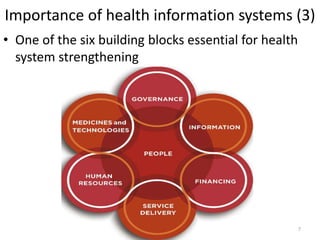
Importance of health information systems (3)
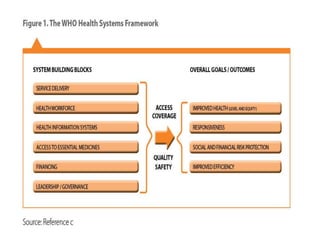
• One of the six building blocks essential for health
system strengthening
7
8
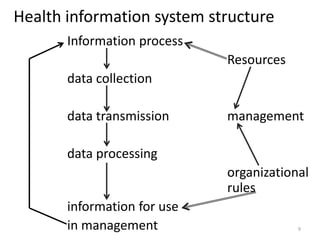
Health information system structure
Information process
Resources
data collection
data transmission management
data processing
organizational
rules
information for use
in management 9
Health information system components
• Data/ information/ knowledge component
• Hardware / software / network components
• Process / task / system component
• Integration / interoperability
• User / administration / management component
10
Health information system components (2)
• Inputs (Health information system resources)
– Consist of legislative, regulatory, and planning
frameworks required to ensure a fully functioning health
information system
– The resources that are prerequisites for such a system to
be functional.
• Resources involve personnel, financing, logistics support,
information and communications technology (ICT), and
coordinating mechanisms within and among the components
11
Health information system components (3)
• Processes
– Indicators
• A core set of indicators and related targets for the components of
health information  Indicators need to encompass determinants
of health; health system inputs, outputs, and outcomes; and health
status.
– Data sources can be divided into two main categories:
• Population-based approaches (censuses, civil registration, and
population surveys) and
• Institution-based data (individual records, service records, and
resource records).
– Data management
• All aspects of data handling: collection, storage, quality-assurance,
flow, processing, compilation, and analysis 12
Health information system components (4)
• Outputs
– Information products.
• Data must be transformed into information that will become
the basis for evidence and knowledge to shape health action
– Dissemination and use.
• The value of health information can be enhanced by making it
readily accessible to decision makers (giving due attention to
behavioral and organizational constraints) and by providing
incentives for information use
13
Desired characteristics of information in
health services
• Relevance
• Accuracy (provides the information that it is supposed
to provide)
• Completeness (both in geographical coverage and in
terms of range/amount of data it is supposed to
provide)
• Timeliness
• Conciseness
• Reliable (information that it is consistent) 14
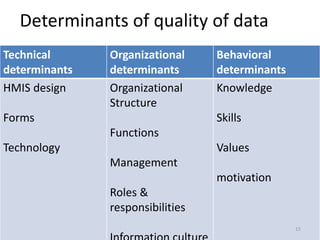
Determinants of quality of data
Technical
determinants
Organizational
determinants
Behavioral
determinants
HMIS design
Forms
Technology
Organizational
Structure
Functions
Management
Roles &
responsibilities
Knowledge
Skills
Values
motivation
15
Areas of assessment for quality
• Information use
• Data quality
• Data burden
• Human resource
• ICT
• Finance, resource 16
What is wrong with current HIS?
• Information use
– Mere collection and reporting of data to higher level
– Aggregation of unused data
– No information use for performance and service delivery
improvement at the periphery
– Irrelevance of information gathered
– Management staff rely on gut feeling to make decisions
instead of using available data  lack of interest & capacity
– Resistance to changes
17
What is wrong with current HIS? (2)
• Data Quality
– Poor quality data leads to erroneous conclusion and
improper decision
– Additional work of late error detection
– Important data items often missed
– Significant discrepancy between data reported and
recorded in registers in the facilities
18
What is wrong with current HIS? (3)
• Data Burden
– Too much data is collected
• Duplication of efforts
– Independent data collection requirements of different
partners
• Non-comparability
– Different definitions of indicators among different
partners and across regions
• Skills in interpreting information & Problem solving
appeared weak at all levels 19
What is wrong with current HIS?
• Lack of timely reporting & feedback
• Limited funding
• Deficiency in information infrastructure
• Network vulnerability to break-down / failure to
function due to viruses, difficult system codes,
repair delays
• Inadequate human resource to work on HIS 20
Components of HMIS
• Epidemiological surveillance (notifiable infectious
diseases, environmental conditions, and risk factors)
• Routine reporting
• Specific program reporting (Malaria, TB, HIV etc)
• Administrative systems (health care financing systems,
health personnel systems, logistic systems)
• Vital registration 22
Steps in developing HMIS
• Review existing system
• Define data needs of relevant units within health
system
• Determine most appropriate data flow
• Design data collection and reporting tools
• Develop procedures for data processing 23
Steps in developing HMIS (2)
• Develop & implement training program for data
providers and data users
• Pre-test and if necessary redesign system for data
collection, flow, processing and utilization
• Monitor and evaluate system
• Develop data dissemination and feedback
mechanisms
24
Key issues to address & monitor in HMIS
• Movement of data through out the system
– Impose strict timetable of flow of data at each level
– Ensure two way flow
– Ensure regular cycle of analysis and feedback
• Accessibility and analyzability of data
• Transmission of finding to potential users
25
Data collection instruments
• Data collection instruments for patient / client
management
– Curative e.g. medical records, laboratory forms, referral
forms
– Preventive e.g. growth cards, MCH cards, school health
cards
• Data collection instruments for health unit
management
– Service delivery records e.g. tally sheets, registers, etc
– Resource management records
26
Sources of data for HIS
• Health institutions (inpatient, outpatient and other
activities)
• Vital registration systems (births, deaths, and
migratory movements)
• Laboratories and pharmaceuticals
• Community
27
Sources of data for HIS (2)
• Census
• Special programmes reporting e.g. TB, MCH
• Administrative systems e.g. financing system,
personnel systems, logistics systems
• Investigation of outbreaks
– Surveys and surveillances
– Disease notifications
– Routine reports 28
Frameworks for assessment of HIS
performance
• Health Metrics Network (HMN) Framework
• General Data Dissemination Strategy
• World Bank Statistical Capacity-Building Score
• HIS performance index (HISPIX)
READ ABOUT
29
Indicators for assessment of HIS
performance
• Indicators related to data generation using core
sources and methods (health surveys, civil
registration, census, facility reporting, health system
resource tracking)
• Indicators related to country capacities for
synthesis, analysis and validation of data.
30
Health surveys
• Country has a 10 year costed survey plan that
covers all priority health topics and takes into
account other relevant data source
• Two or more data points available for child
mortality in the past 5 years
• Two or more population-based data points for
maternal mortality in the last 10 years
• Two or more data points for coverage of key health
interventions in the last 5 years
• One or more data point on smoking and adult
nutritional status in the last 5 years
31
Birth and death registration
• Percentage of births registered
• Percentage of deaths registered
• ICD10 used in district hospitals and causes of
death reported to national level
32
Census
• Census completed within past 10 years
• Population projections for districts and smaller
administrative areas available in print and
electronically, well documented
33
Health facility reporting
• Number of institutional deliveries available, by district, and
published within 12 months of preceding year
• HIV prevalence for relevant surveillance populations
published within 12 months of preceding year
• Country web site for health statistics with latest report and
data available to the general public
• Reporting of notifiable diseases makes use of modern
communication technology and reporting of statistics from
district to national levels is web-based
• Percentage of districts that submit timely, complete, accurate
reports to national level
• Data quality assessments carried out and published within
last 3 years
• International Health Regulations implemented according to
international standards
34
Health system resource tracking
• At least one national health accounts completed in
last 5 years
• National database with public and private sector
health facilities, and geocoding, available and
updated within last 3 years
• National database with health workers by district
and main cadres updated within last 2 years
• Annual data on availability of tracer medicines and
commodities in public and private health facilities
35
Capacity for analysis, synthesis and validation
of health data
• Have designated and functioning institutional
mechanisms charged with analysis of health statistics,
synthesis of data from different sources and validation
of data from population and facility sources
• Have national set of indicators with targets and annual
reporting to inform annual health sector reviews and
other planning cycles
• There is a national microdata archive for health surveys
and census that is operational
• Survey data are used to assess and adjust routine
reports from health facility on vaccinations with the
results published within 12 months of the preceding
year 36
Capacity for analysis, synthesis and
validation of health data (2)
• A burden of disease study has been conducted
within the last 5 years by national stakeholders
• A study of health systems performance has been
carried out within the last 5 years by national
stakeholders
• There is national commitment to transparency in
data dissemination and acknowledgement of
uncertainty
• The official annual health statistics report has been
published within 12 months of the preceding
(calendar or fiscal) year 37
Criteria for selecting indicators
• Validity
• Cost
• Importance of subject matter to be addressed
• Does indicator actually capture change in
phenomenon under study? (specificity)
38

2 Health management information system2.pptx

  • 1.
  • 2.
    Definitions: Health informationsystem – Any system that captures, stores, manages or transmits information related to the health of individuals or the activities of organizations that work within the health sector – A system that integrates data collection, processing, reporting, and use of the information necessary for improving health service effectiveness and efficiency through better management at all levels of health services – A set of components and procedures organized with the objective of generating information which will improve health care management decisions at all levels of the health system 2
  • 3.
    Definitions (2) • Managementinformation system – A formal method of making available accurate and timely information to management that is necessary to facilitate the decision making process and enable the organizations’ planning, control and operational functions to be carried out effectively • Health management information system – Application of the principles of management information system in health care systems – Information management system specially designed in management and planning of health programs as opposed to delivery of care 3
  • 4.
    Definitions (3) • HMISis a data collection system specifically designed to support planning, management, and decision making in health facilities and organizations 4
  • 5.
    Importance of healthinformation systems • Supports each step in the management cycle • Improved health information system is linked to good management  critical for increasing efficiency of health services • It is required by policy makers, managers, health care providers, community health workers 5
  • 6.
    Importance of healthinformation systems (2) • Data from different sources are used for multiple purposes at different levels of health care system – Individual level data about patient's profile, health care needs, & treatment are used for clinical decision-making – Health facility level data, both from aggregated facility-level records and from administrative sources such as drug procurement records, enable health care managers to determine resource needs, guide purchasing decisions for drugs, equipment and supplies, and develop community outreach – Population level data are essential for public health decision- making – Public health surveillance brings together information from both facilities and communities 6
  • 7.
    Importance of healthinformation systems (3) • One of the six building blocks essential for health system strengthening 7
  • 8.
  • 9.
    Health information systemstructure Information process Resources data collection data transmission management data processing organizational rules information for use in management 9
  • 10.
    Health information systemcomponents • Data/ information/ knowledge component • Hardware / software / network components • Process / task / system component • Integration / interoperability • User / administration / management component 10
  • 11.
    Health information systemcomponents (2) • Inputs (Health information system resources) – Consist of legislative, regulatory, and planning frameworks required to ensure a fully functioning health information system – The resources that are prerequisites for such a system to be functional. • Resources involve personnel, financing, logistics support, information and communications technology (ICT), and coordinating mechanisms within and among the components 11
  • 12.
    Health information systemcomponents (3) • Processes – Indicators • A core set of indicators and related targets for the components of health information  Indicators need to encompass determinants of health; health system inputs, outputs, and outcomes; and health status. – Data sources can be divided into two main categories: • Population-based approaches (censuses, civil registration, and population surveys) and • Institution-based data (individual records, service records, and resource records). – Data management • All aspects of data handling: collection, storage, quality-assurance, flow, processing, compilation, and analysis 12
  • 13.
    Health information systemcomponents (4) • Outputs – Information products. • Data must be transformed into information that will become the basis for evidence and knowledge to shape health action – Dissemination and use. • The value of health information can be enhanced by making it readily accessible to decision makers (giving due attention to behavioral and organizational constraints) and by providing incentives for information use 13
  • 14.
    Desired characteristics ofinformation in health services • Relevance • Accuracy (provides the information that it is supposed to provide) • Completeness (both in geographical coverage and in terms of range/amount of data it is supposed to provide) • Timeliness • Conciseness • Reliable (information that it is consistent) 14
  • 15.
    Determinants of qualityof data Technical determinants Organizational determinants Behavioral determinants HMIS design Forms Technology Organizational Structure Functions Management Roles & responsibilities Knowledge Skills Values motivation 15
  • 16.
    Areas of assessmentfor quality • Information use • Data quality • Data burden • Human resource • ICT • Finance, resource 16
  • 17.
    What is wrongwith current HIS? • Information use – Mere collection and reporting of data to higher level – Aggregation of unused data – No information use for performance and service delivery improvement at the periphery – Irrelevance of information gathered – Management staff rely on gut feeling to make decisions instead of using available data  lack of interest & capacity – Resistance to changes 17
  • 18.
    What is wrongwith current HIS? (2) • Data Quality – Poor quality data leads to erroneous conclusion and improper decision – Additional work of late error detection – Important data items often missed – Significant discrepancy between data reported and recorded in registers in the facilities 18
  • 19.
    What is wrongwith current HIS? (3) • Data Burden – Too much data is collected • Duplication of efforts – Independent data collection requirements of different partners • Non-comparability – Different definitions of indicators among different partners and across regions • Skills in interpreting information & Problem solving appeared weak at all levels 19
  • 20.
    What is wrongwith current HIS? • Lack of timely reporting & feedback • Limited funding • Deficiency in information infrastructure • Network vulnerability to break-down / failure to function due to viruses, difficult system codes, repair delays • Inadequate human resource to work on HIS 20
  • 21.
    Components of HMIS •Epidemiological surveillance (notifiable infectious diseases, environmental conditions, and risk factors) • Routine reporting • Specific program reporting (Malaria, TB, HIV etc) • Administrative systems (health care financing systems, health personnel systems, logistic systems) • Vital registration 22
  • 22.
    Steps in developingHMIS • Review existing system • Define data needs of relevant units within health system • Determine most appropriate data flow • Design data collection and reporting tools • Develop procedures for data processing 23
  • 23.
    Steps in developingHMIS (2) • Develop & implement training program for data providers and data users • Pre-test and if necessary redesign system for data collection, flow, processing and utilization • Monitor and evaluate system • Develop data dissemination and feedback mechanisms 24
  • 24.
    Key issues toaddress & monitor in HMIS • Movement of data through out the system – Impose strict timetable of flow of data at each level – Ensure two way flow – Ensure regular cycle of analysis and feedback • Accessibility and analyzability of data • Transmission of finding to potential users 25
  • 25.
    Data collection instruments •Data collection instruments for patient / client management – Curative e.g. medical records, laboratory forms, referral forms – Preventive e.g. growth cards, MCH cards, school health cards • Data collection instruments for health unit management – Service delivery records e.g. tally sheets, registers, etc – Resource management records 26
  • 26.
    Sources of datafor HIS • Health institutions (inpatient, outpatient and other activities) • Vital registration systems (births, deaths, and migratory movements) • Laboratories and pharmaceuticals • Community 27
  • 27.
    Sources of datafor HIS (2) • Census • Special programmes reporting e.g. TB, MCH • Administrative systems e.g. financing system, personnel systems, logistics systems • Investigation of outbreaks – Surveys and surveillances – Disease notifications – Routine reports 28
  • 28.
    Frameworks for assessmentof HIS performance • Health Metrics Network (HMN) Framework • General Data Dissemination Strategy • World Bank Statistical Capacity-Building Score • HIS performance index (HISPIX) READ ABOUT 29
  • 29.
    Indicators for assessmentof HIS performance • Indicators related to data generation using core sources and methods (health surveys, civil registration, census, facility reporting, health system resource tracking) • Indicators related to country capacities for synthesis, analysis and validation of data. 30
  • 30.
    Health surveys • Countryhas a 10 year costed survey plan that covers all priority health topics and takes into account other relevant data source • Two or more data points available for child mortality in the past 5 years • Two or more population-based data points for maternal mortality in the last 10 years • Two or more data points for coverage of key health interventions in the last 5 years • One or more data point on smoking and adult nutritional status in the last 5 years 31
  • 31.
    Birth and deathregistration • Percentage of births registered • Percentage of deaths registered • ICD10 used in district hospitals and causes of death reported to national level 32
  • 32.
    Census • Census completedwithin past 10 years • Population projections for districts and smaller administrative areas available in print and electronically, well documented 33
  • 33.
    Health facility reporting •Number of institutional deliveries available, by district, and published within 12 months of preceding year • HIV prevalence for relevant surveillance populations published within 12 months of preceding year • Country web site for health statistics with latest report and data available to the general public • Reporting of notifiable diseases makes use of modern communication technology and reporting of statistics from district to national levels is web-based • Percentage of districts that submit timely, complete, accurate reports to national level • Data quality assessments carried out and published within last 3 years • International Health Regulations implemented according to international standards 34
  • 34.
    Health system resourcetracking • At least one national health accounts completed in last 5 years • National database with public and private sector health facilities, and geocoding, available and updated within last 3 years • National database with health workers by district and main cadres updated within last 2 years • Annual data on availability of tracer medicines and commodities in public and private health facilities 35
  • 35.
    Capacity for analysis,synthesis and validation of health data • Have designated and functioning institutional mechanisms charged with analysis of health statistics, synthesis of data from different sources and validation of data from population and facility sources • Have national set of indicators with targets and annual reporting to inform annual health sector reviews and other planning cycles • There is a national microdata archive for health surveys and census that is operational • Survey data are used to assess and adjust routine reports from health facility on vaccinations with the results published within 12 months of the preceding year 36
  • 36.
    Capacity for analysis,synthesis and validation of health data (2) • A burden of disease study has been conducted within the last 5 years by national stakeholders • A study of health systems performance has been carried out within the last 5 years by national stakeholders • There is national commitment to transparency in data dissemination and acknowledgement of uncertainty • The official annual health statistics report has been published within 12 months of the preceding (calendar or fiscal) year 37
  • 37.
    Criteria for selectingindicators • Validity • Cost • Importance of subject matter to be addressed • Does indicator actually capture change in phenomenon under study? (specificity) 38