






Moving Beyond Line Graphs
@jonfroehlich
Feedback is about
empowering people
with information to
positively inform and
change behavior
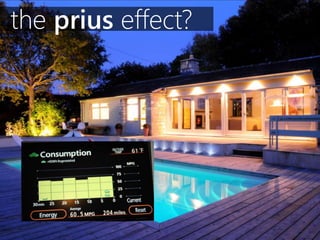
the prius effect?
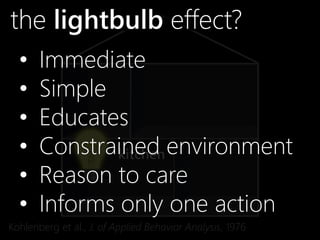
• Immediate
• Simple
• Educates
• Constrained environment
• Reason to care
• Informs only one action
why is the prius effective?
the prius effect?
1976
Kohlenberg et al., J. of Applied Behavior Analysis, 1976
kitchen
Kohlenberg et al., J. of Applied Behavior Analysis, 1976
kitchen
Kohlenberg et al., J. of Applied Behavior Analysis, 1976
• Immediate
• Simple
• Educates
• Constrained environment
• Reason to care
• Informs only one action
the lightbulb effect?
kitchen
Kohlenberg et al., J. of Applied Behavior Analysis, 1976
• Immediate
• Simple
• Educates
• Constrained environment
• Reason to care
• Informs only one action
the lightbulb effect?
2010
• Talk about feedback intervention
• Talk about energy savings from feedback
studies
12
Feedback results in
energy savings of
between 5-12%
Darby, 2000; Abrahamse, 2005; Fischer, 2008; EPRI 2009
• Talk about feedback intervention
• Talk about energy savings from feedback
studies
13
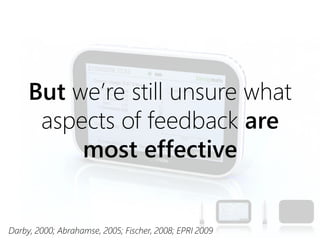
But we’re still unsure what
aspects of feedback are
most effective
Darby, 2000; Abrahamse, 2005; Fischer, 2008; EPRI 2009
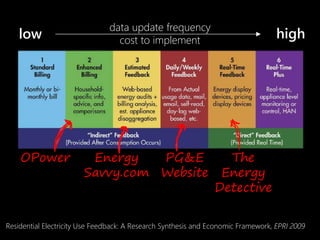
data update frequency
cost to implementlow high
Residential Electricity Use Feedback: A Research Synthesis and Economic Framework, EPRI 2009
data update frequency
cost to implementlow high
Residential Electricity Use Feedback: A Research Synthesis and Economic Framework, EPRI 2009
OPower PG&E
Website
The
Energy
Detective
Energy
Savvy.com
data update frequency
cost to implementlow high
-10
0
10
20
30
PercentSavings
Type2 Type3 Type4 Type5 Type6
• Talk about feedback intervention
• Talk about energy savings from feedback
studies
17
More information !=
More Behavior Change
Darby, 2000; Abrahamse, 2005; Fischer, 2008; EPRI 2009
Data Presentation >
Data Update Frequency
Feedback du jour
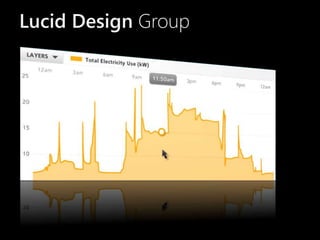
line graphs
TED The Energy Detective
Google PowerMeter
Yello Strom
Wattson Holmes
Lucid Design Group
Microsoft Hohm
High cognitive
burden on person.
Why?
How much time per day
do we expect people will
spend exploring their
consumption behaviors?
How much time per day
do people spend
exploring their finances?
financially prudent
8.4 hrs/mo  16.8 min/day
less financially successful
4.6 hrs/mo  9.2 min/day
me (grad student)
0.5 hrs/mo  1 min/day
< 1 min
How actionable is this information?
Line Graphs
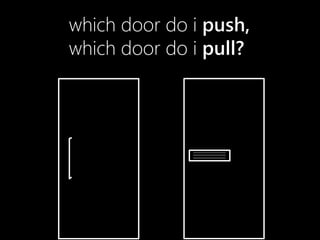
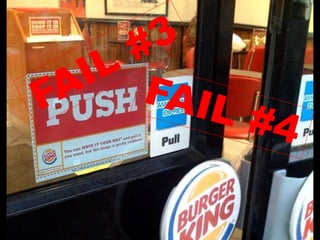
which door do i push,
which door do i pull?
which door do i push,
which door do i pull?
which door do i push,
which door do i pull?
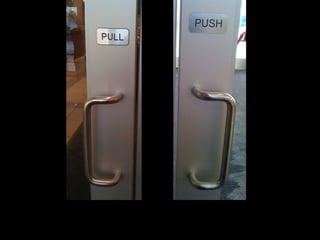
pull push
which door do i push,
which door do i pull?
Norman door!
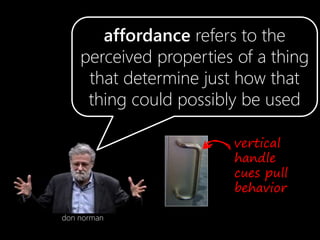
affordance refers to the
perceived properties of a thing
that determine just how that
thing could possibly be used
don norman
vertical
handle
cues pull
behavior
affordances affect our perception of use
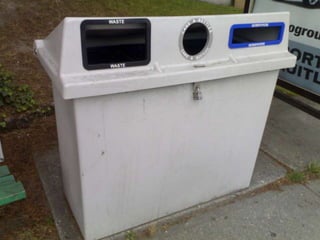
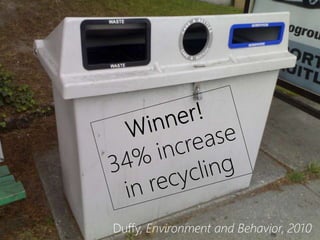
can affordances change our behavior?
In-N-Out
Burger!
Battle of the Cans
Battle of the Cans
Duffy, Environment and Behavior, 2010
Whatdoes this have to do with feedback?
Perceptual affordance refers to
the perceived properties of a thing
that determine how that thing is
used
Flat
textured
surface
affords
pushing!
Vertical
handle
affords
pulling
Motivational affordance refers
to the perceived properties of
information that determine how
that information is acted upon
Highly
effective at
stopping
drivers
Motivational affordance refers
to the perceived properties of
information that determine how
that information is acted upon
Highly
effective at
stopping
drivers
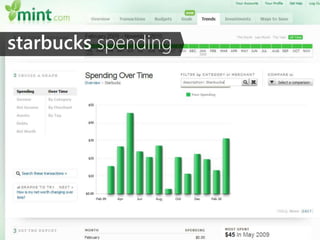
analytics engine for
personal spending
How much money do I spend
per month on Starbucks?
starbucks spending
This type of inquiry is not possible
with current energy feedback
systems; it needs to be.
Future
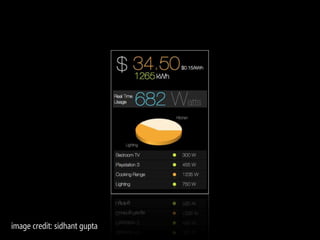
Feedback system provides
dissaggregated feedback
itemized energy feedback
image credit: sidhant gupta
Hot Water Heater
Consumes 19% of
Your House’s Energy
Feedback system suggests
lowest effort actions for
greatest efficiency gain
Replace Your Hot
Water Heater with
a Tankless System
and Save $250/yr
You are losing
$250/yr by using
this water heater
< 1 min
See also: CHI 2010 talk
http://bit.ly/jonuw
See also: these two papers
http://bit.ly/jonuw
Best
Paper!
fresh off the presses:
http://bit.ly/jonuw
photo credits
first/last slide: flickr code poet
slide 6: trinity university, class of 1976
slide 11: monctonblogger
slide 18: remarkably domestic
slide 25: flickr grant mitchell
slide 27,28,30,71: flickr tonyvc
slide 47: steve foon images
slide 48, 51: loston wallace
slide 49,51: flickr conbon33
slide 50,51, 52, 53: flickr sillgywailo
Moving Beyond Line Graphs
twitter: @jonfroehlich
design:
use:
build: ubicomp labuniversity of washington sustainability researchuniversity of washington

Moving Beyond Line Graphs: A (Brief) History and Future of Eco-Feedback Design

Editor's Notes

  • #7 1976 Apple is formed Viking 1 lander successfully lands on mars Elvis is still alive First study of energy feedback
  • #8 But we these simple devices have been found to reduce consumption: Kohlenberg Powercost blue monitor – cananda study Positive Energy Bills Which leads me to ask: why do we need all this data?
  • #12 Still have robots on Mars Economic recession ends supposedly BECC 4th year
  • #13 Feedback technologies have been shown to be one of the most effective strategies in reducing energy consumption in the home, although they have not been comprehensively explored in the transportation domain. Corinna Fischer reviewed approximately twenty studies exploring the effects of feedback on electricity consumption and found that typical energy savings were between 5 and 12%.
  • #14 Feedback technologies have been shown to be one of the most effective strategies in reducing energy consumption in the home, although they have not been comprehensively explored in the transportation domain. Corinna Fischer reviewed approximately twenty studies exploring the effects of feedback on electricity consumption and found that typical energy savings were between 5 and 12%.
  • #15 Residential Electricity Use Feedback: A Research Synthesis and Economic Framework
  • #16 Residential Electricity Use Feedback: A Research Synthesis and Economic Framework
  • #17 Why aren’t real-time (type 5) and real-time plus (type 6) dwarfing the other feedback types in effectiveness?
  • #18 More information does not guarantee more behavior change Data presentation outweighs data update frequency, which is why a redesigned bill ala Positive Energy can promote greater energy efficiency than a real-time feedback system
  • #26 Financial analyst
  • #27 Financial analyst
  • #33 The Doors were a successful rock band fronted by Jim Morrison
  • #37 http://chriselyea.com/design-lessons-learned/badly-designed-doors/
  • #38 http://chriselyea.com/design-lessons-learned/badly-designed-doors/
  • #39 http://chriselyea.com/design-lessons-learned/badly-designed-doors/
  • #40 Design of Everyday Things (also Psychology of Everyday Things)
  • #42 If you have to write an instruction manual on the door, it’s a design failure
  • #45 These afford the pushing action so much they are called panic doors
  • #56 The problem is we are talking about the design of interfaces here to inform and motivate behavior.
  • #58 Or information affordance Or data affordance Or effect affordance Just made up motivational affordance but the idea is…
  • #65 Targets specific behaviors Highly personalized Disaggregated
  • #71 Framing bias
  • #76 I take visuals very seriously (as one can probably tell from my slides). And, with that, I try my best to credit my sources. Thanks particularly to those flickr users who share their photos under creative commons.