Knowledge Mapping for  Open Sensemaking Communities Simon Buckingham Shum & Alexandra Okada OpenLearn 2007 Conference, Milton Keynes, UK, 30-31 Oct. 2007 Knowledge Media Institute, Open University, UK
Overview Stepping out of Gutenberg’s shadow Spatial maps Knowledge Maps Sensemaking infrastructure for structured discourse
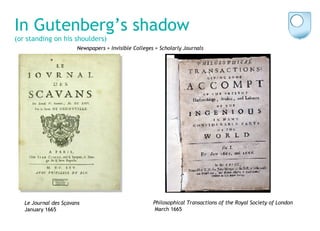
In Gutenberg’s shadow   (or standing on his shoulders) Philosophical Transactions of the Royal Society of London March 1665 Le Journal des S ça v ans January 1665 Newspapers + Invisible Colleges = Scholarly Journals
We want to change cognition The most reproduced photo in the world (?). Transformed how we saw ourselves.
We want to change cognition One way to do this is through visualizations of thinking Computer-supported knowledge mapping is one way to slow people down and get them to reflect on what they are thinking and saying
The power of maps (1) Aesthetic appeal Use of landmarks for shared orientation Selective hiding and highlighting of detail for a specific purpose http://flickr.com/photos/hooly/473301482/
The power of maps (2) User-controlled views and detail Context + focus (Shneiderman) http://flickr.com/photos/revdancatt/40617383/
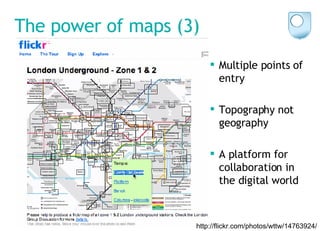
The power of maps (3) Multiple points of entry Topography not geography A platform for collaboration in the digital world http://flickr.com/photos/wttw/14763924/
Geographical maps help… transcend the limitations of private, individual representations of terrain in order to augment group planning, reasoning and memory open new possibilities for collective attention, re-living the past, envisaging new scenarios, coordinating actions and making decisions mediate the inner mental world and outer physical world make sense of the universe at different scales, by overlaying meanings onto that world remember what is important, and explore possible configurations of the unknown
Open Sensemaking Communities OPEN to…  people and perspectives SENSEMAKING… Interpreting, patterning, redressing surprise, externalising understanding, constructing plausible narratives about the world  (Karl Weick, 1995) COMMUNITIES learners and ‘professional’ analysts predefined communities or emergent
Knowledge  maps (1) “ Foundational concept, fragmented thinking, line of argument, blue skies research, peripheral work”… … we  spatialise  the world of ideas all the time Maps  can be used to make such configurations tangible, whether sketched on a napkin or modelled in software
The challenge What sensemaking infrastructure will enable us to do something like this… … for intellectual landscapes over OERs?
Chaomei Chen: visualization of trends in a literature (terrorism) Q2: Previous hot topic? Q3: Turning point? Q4: Transition path? Q1: Current hot topic?
Knowledge maps (2) information visualization: representing spatially, intellectual worlds that have no intrinsic spatial properties mapping as an intrinsic part of  personal and collective sensemaking mapping the structure of  physical phenomena  (e.g. a biological process) intellectual artifacts  (e.g. a curriculum) intellectual processes  of inquiry (e.g. a meeting discussion, or a scientific or public debate).
Knowledge mapping as sensemaking Clarify the intellectual moves and commitments at different levels.  Incorporate further contributions from others, whether in agreement or not.  Provoke, mediate, capture and improve constructive discourse.  Maps are narratives
Web maps Web Map about mapping tools with  Nestor Web Cartographer
Mindmaps Mind Map created with Buzan’s iMindmap
Concept maps Concept Map created with CMap Tools
Evidence maps Using  SEAS  to map the strength of evidential support  for an answer to a question
Argument maps  ( Reason!Able )
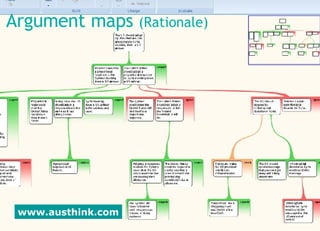
Argument maps  (Rationale) www.austhink.com
Literatures as discourse networks: Don’t try this in Google…
Don’t try this in Google…
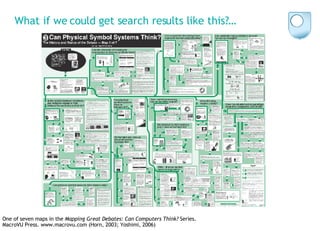
What if we could get search results like this?… One of seven maps in the  Mapping Great Debates: Can Computers Think?  Series.  MacroVU Press. www.macrovu.com (Horn, 2003; Yoshimi, 2006)
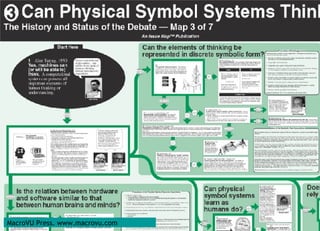
Horn (zoomed in) MacroVU Press. www.macrovu.com
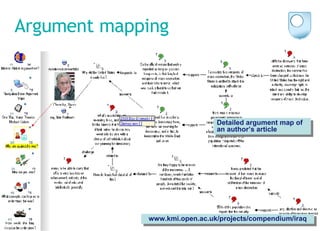
Argument mapping Detailed argument map of an author’s article www.kmi.open.ac.uk/projects/compendium/iraq
Dialogue maps Dialogue Map created  in  Compendium  (OpenLearn’s knowledge mapping tool)
Dialogue maps: JSB’s keynote http://kmi.open.ac.uk/people/sbs/news
Real time mapping to scaffold learning conversations… (e-PhD mentoring video)
KM Tool 1:  Compendium Desktop Java application, with active user community:  CompendiumInstitute .org   Publishes read only HTML maps + XML to the OER web environment (Moodle) Moodle PHP open source code to manage Compendium maps
Compendium + Moodle
Compendium + Moodle
Compendium + Moodle Compendium software downloads: encouraging
Compendium + Moodle XML downloads: small  (not the same as just viewing a map)
Compendium + Moodle Compendium map uploads: very small
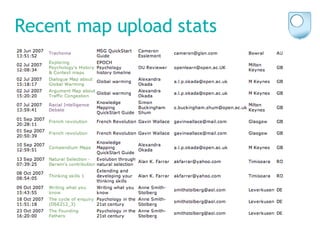
Recent map upload stats
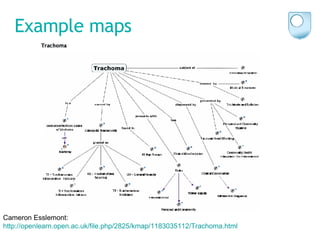
Example maps Cameron Esslemont:  http://openlearn.open.ac.uk/file.php/2825/kmap/1183035112/Trachoma.html
Example maps Alan Farrar:  http://openlearn.open.ac.uk/file.php/1646/kmap/1189665565/Natural%20Selection.html
Knowledge Maps by f-f Educators Student assignments: lecture classes + homework UC Berkeley example:
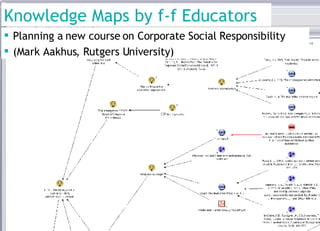
Knowledge Maps by f-f Educators Planning a new course on Corporate Social Responsibility (Mark Aakhus, Rutgers University)
Knowledge Maps by f-f Educators A professor dialogue maps the concept of a ‘disagreement space’ in conversation with a student (Mark Aakhus, Rutgers University)
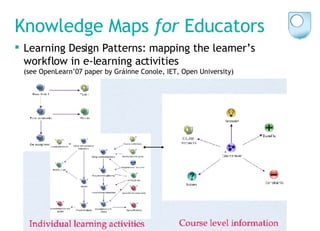
Knowledge Maps  for  Educators Learning Design Patterns: mapping the learner’s workflow in e-learning activities  (see OpenLearn’07 paper by Gr áinne Conole, IET, Open University)
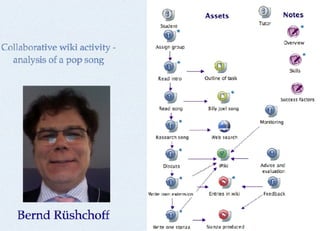
Knowledge Maps for Educators Learning Design Patterns: mapping the learner’s workflow in e-learning activities  (Gr áinne Conole, IET, Open University)
Next steps…
Web  Compendium initiatives EU Project CoPe_it! has implemented a web-centric IBIS tool, interoperable with Compendium (see left) http://copeit.cti.gr   Also… Conzilla now supports Dialogue Mapping GlaxoSmithKline have piloted a web-centric extension to Compendium Rutgers University is experimenting with Citrix to provide shared web access to Compendium
KM Tool 2: Web tool for connecting ‘Ideas’ “ From tag clouds to tag webs” Generate maps from personal and the world’s connections Embed maps in other websites RSS feeds and URLs cohereweb.net
Cohere  Idea cloud Created by the user, possibly seeded by a bookmark RSS feed (e.g. del.icio.us, CiteULike, etc.)
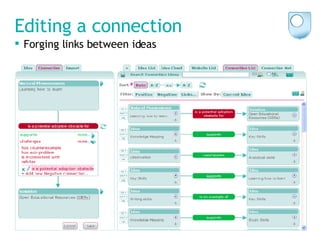
Editing a connection Forging links between ideas
Cohere  Connection Net Self-organising graph generated from personal, or world’s, connections Controls for adjusting scale, link-length and gravity Click Ideas and Connections to edit Can be filtered and searched by keyword, or connection structure on user-specified links
Cohere  snippets Embedding Ideas/Maps in other websites for viral spread Click target icon to view Knowledge Map http://cohereweb.net/x/y/z <iframe>xyz</iframe> Full Screen Knowledge Map Get URL Get Snippet Code < > 8
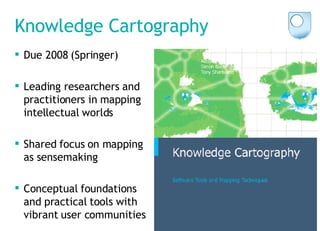
Knowledge Cartography Due 2008 (Springer) Leading researchers and practitioners in mapping intellectual worlds Shared focus on mapping as sensemaking Conceptual foundations and practical tools with vibrant user communities
Conclusions Knowledge mapping has a central role to play in weaving narrative connections between OERs Moreover, we currently lack infrastructures for large scale, structured discourse and visualization We are working towards a social-semantic web environment for learners and other analysts to weave and contest the connections between ideas
To know more… KMi’s scholarly software R&D Hypermedia Discourse project   www.kmi.open.ac.uk/projects/hyperdiscourse Open Sensemaking Communities project  www.kmi.open.ac.uk/projects/osc

Knowledge Mapping for Open Sensemaking Communities

  • 1.
    Knowledge Mapping for Open Sensemaking Communities Simon Buckingham Shum & Alexandra Okada OpenLearn 2007 Conference, Milton Keynes, UK, 30-31 Oct. 2007 Knowledge Media Institute, Open University, UK
  • 2.
    Overview Stepping outof Gutenberg’s shadow Spatial maps Knowledge Maps Sensemaking infrastructure for structured discourse
  • 3.
    In Gutenberg’s shadow (or standing on his shoulders) Philosophical Transactions of the Royal Society of London March 1665 Le Journal des S ça v ans January 1665 Newspapers + Invisible Colleges = Scholarly Journals
  • 4.
    We want tochange cognition The most reproduced photo in the world (?). Transformed how we saw ourselves.
  • 5.
    We want tochange cognition One way to do this is through visualizations of thinking Computer-supported knowledge mapping is one way to slow people down and get them to reflect on what they are thinking and saying
  • 6.
    The power ofmaps (1) Aesthetic appeal Use of landmarks for shared orientation Selective hiding and highlighting of detail for a specific purpose http://flickr.com/photos/hooly/473301482/
  • 7.
    The power ofmaps (2) User-controlled views and detail Context + focus (Shneiderman) http://flickr.com/photos/revdancatt/40617383/
  • 8.
    The power ofmaps (3) Multiple points of entry Topography not geography A platform for collaboration in the digital world http://flickr.com/photos/wttw/14763924/
  • 9.
    Geographical maps help…transcend the limitations of private, individual representations of terrain in order to augment group planning, reasoning and memory open new possibilities for collective attention, re-living the past, envisaging new scenarios, coordinating actions and making decisions mediate the inner mental world and outer physical world make sense of the universe at different scales, by overlaying meanings onto that world remember what is important, and explore possible configurations of the unknown
  • 10.
    Open Sensemaking CommunitiesOPEN to… people and perspectives SENSEMAKING… Interpreting, patterning, redressing surprise, externalising understanding, constructing plausible narratives about the world (Karl Weick, 1995) COMMUNITIES learners and ‘professional’ analysts predefined communities or emergent
  • 11.
    Knowledge maps(1) “ Foundational concept, fragmented thinking, line of argument, blue skies research, peripheral work”… … we spatialise the world of ideas all the time Maps can be used to make such configurations tangible, whether sketched on a napkin or modelled in software
  • 12.
    The challenge Whatsensemaking infrastructure will enable us to do something like this… … for intellectual landscapes over OERs?
  • 13.
    Chaomei Chen: visualizationof trends in a literature (terrorism) Q2: Previous hot topic? Q3: Turning point? Q4: Transition path? Q1: Current hot topic?
  • 14.
    Knowledge maps (2)information visualization: representing spatially, intellectual worlds that have no intrinsic spatial properties mapping as an intrinsic part of personal and collective sensemaking mapping the structure of physical phenomena (e.g. a biological process) intellectual artifacts (e.g. a curriculum) intellectual processes of inquiry (e.g. a meeting discussion, or a scientific or public debate).
  • 15.
    Knowledge mapping assensemaking Clarify the intellectual moves and commitments at different levels. Incorporate further contributions from others, whether in agreement or not. Provoke, mediate, capture and improve constructive discourse. Maps are narratives
  • 16.
    Web maps WebMap about mapping tools with Nestor Web Cartographer
  • 17.
    Mindmaps Mind Mapcreated with Buzan’s iMindmap
  • 18.
    Concept maps ConceptMap created with CMap Tools
  • 19.
    Evidence maps Using SEAS to map the strength of evidential support for an answer to a question
  • 20.
    Argument maps ( Reason!Able )
  • 21.
    Argument maps (Rationale) www.austhink.com
  • 22.
    Literatures as discoursenetworks: Don’t try this in Google…
  • 23.
    Don’t try thisin Google…
  • 24.
    What if wecould get search results like this?… One of seven maps in the Mapping Great Debates: Can Computers Think? Series. MacroVU Press. www.macrovu.com (Horn, 2003; Yoshimi, 2006)
  • 25.
    Horn (zoomed in)MacroVU Press. www.macrovu.com
  • 26.
    Argument mapping Detailedargument map of an author’s article www.kmi.open.ac.uk/projects/compendium/iraq
  • 27.
    Dialogue maps DialogueMap created in Compendium (OpenLearn’s knowledge mapping tool)
  • 28.
    Dialogue maps: JSB’skeynote http://kmi.open.ac.uk/people/sbs/news
  • 29.
    Dialogue maps: JSB’skeynote http://kmi.open.ac.uk/people/sbs/news
  • 30.
    Real time mappingto scaffold learning conversations… (e-PhD mentoring video)
  • 31.
    KM Tool 1: Compendium Desktop Java application, with active user community: CompendiumInstitute .org Publishes read only HTML maps + XML to the OER web environment (Moodle) Moodle PHP open source code to manage Compendium maps
  • 32.
  • 33.
  • 34.
    Compendium + MoodleCompendium software downloads: encouraging
  • 35.
    Compendium + MoodleXML downloads: small (not the same as just viewing a map)
  • 36.
    Compendium + MoodleCompendium map uploads: very small
  • 37.
  • 38.
    Example maps CameronEsslemont: http://openlearn.open.ac.uk/file.php/2825/kmap/1183035112/Trachoma.html
  • 39.
    Example maps AlanFarrar: http://openlearn.open.ac.uk/file.php/1646/kmap/1189665565/Natural%20Selection.html
  • 40.
    Knowledge Maps byf-f Educators Student assignments: lecture classes + homework UC Berkeley example:
  • 41.
    Knowledge Maps byf-f Educators Student assignments: lecture classes + homework UC Berkeley example:
  • 42.
    Knowledge Maps byf-f Educators Planning a new course on Corporate Social Responsibility (Mark Aakhus, Rutgers University)
  • 43.
    Knowledge Maps byf-f Educators A professor dialogue maps the concept of a ‘disagreement space’ in conversation with a student (Mark Aakhus, Rutgers University)
  • 44.
    Knowledge Maps for Educators Learning Design Patterns: mapping the learner’s workflow in e-learning activities (see OpenLearn’07 paper by Gr áinne Conole, IET, Open University)
  • 45.
    Knowledge Maps forEducators Learning Design Patterns: mapping the learner’s workflow in e-learning activities (Gr áinne Conole, IET, Open University)
  • 46.
  • 47.
    Web Compendiuminitiatives EU Project CoPe_it! has implemented a web-centric IBIS tool, interoperable with Compendium (see left) http://copeit.cti.gr Also… Conzilla now supports Dialogue Mapping GlaxoSmithKline have piloted a web-centric extension to Compendium Rutgers University is experimenting with Citrix to provide shared web access to Compendium
  • 48.
    KM Tool 2:Web tool for connecting ‘Ideas’ “ From tag clouds to tag webs” Generate maps from personal and the world’s connections Embed maps in other websites RSS feeds and URLs cohereweb.net
  • 49.
    Cohere Ideacloud Created by the user, possibly seeded by a bookmark RSS feed (e.g. del.icio.us, CiteULike, etc.)
  • 50.
    Editing a connectionForging links between ideas
  • 51.
    Cohere ConnectionNet Self-organising graph generated from personal, or world’s, connections Controls for adjusting scale, link-length and gravity Click Ideas and Connections to edit Can be filtered and searched by keyword, or connection structure on user-specified links
  • 52.
    Cohere snippetsEmbedding Ideas/Maps in other websites for viral spread Click target icon to view Knowledge Map http://cohereweb.net/x/y/z <iframe>xyz</iframe> Full Screen Knowledge Map Get URL Get Snippet Code < > 8
  • 53.
    Knowledge Cartography Due2008 (Springer) Leading researchers and practitioners in mapping intellectual worlds Shared focus on mapping as sensemaking Conceptual foundations and practical tools with vibrant user communities
  • 54.
    Conclusions Knowledge mappinghas a central role to play in weaving narrative connections between OERs Moreover, we currently lack infrastructures for large scale, structured discourse and visualization We are working towards a social-semantic web environment for learners and other analysts to weave and contest the connections between ideas
  • 55.
    To know more…KMi’s scholarly software R&D Hypermedia Discourse project www.kmi.open.ac.uk/projects/hyperdiscourse Open Sensemaking Communities project www.kmi.open.ac.uk/projects/osc