Psychological Research on 
Energy Feedback 
Beth Karlin 
Transformational Media Lab 
University of California, Irvine 
Papers listed here. Contact me for details: bkarlin@uci.edu.
Beth Bio 
2 
B. Karlin 
About Me 
I am an academic who believes the role of a researcher is not only to 
better understand the world but also to improve it and I devote my 
time equally to both goals. I work as a research psychologist, social 
change strategist, and program evaluator. 
My primary position is at UC Irvine as the founder and Director of the 
Transformational Media Lab (TML) within the Center for 
Unconventional Security Affairs (CUSA). My lab studies the role of 
media and technology in social and environmental change. Current 
projects investigate the design and use of technology-enabled feedback, 
public acceptance of new technology, audience engagement in 
documentary film, and media-based social activism. 
In addition to my role at the University, I also work with government, 
private, and non-profit organizations on the design, implementation, 
and evaluation of media and technology programs for behavior change.
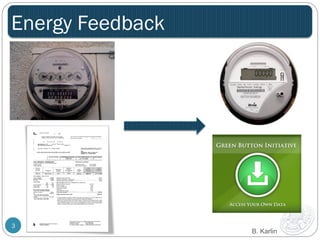
Energy Feedback 
3 
B. Karlin
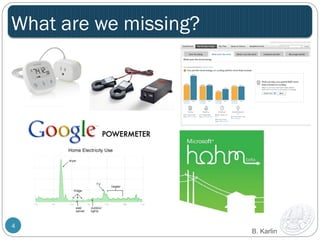
What are we missing? 
4 
B. Karlin
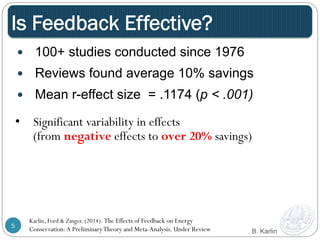
Is Feedback Effective? 
— 100+ studies conducted since 1976 
— Reviews found average 10% savings 
— Mean r-effect size = .1174 (p < .001) 
(from negative effects to over 20% savings) 
B. Karlin 
• Significant variability in effects 
Karlin, Ford & Zinger. (2014). The Effects of Feedback on Energy 
Conservation: A Preliminary Theory 5 and Meta-Analysis. Under Review
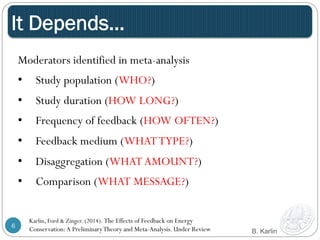
It Depends… 
Moderators identified in meta-analysis 
• Study population (WHO?) 
• Study duration (HOW LONG?) 
• Frequency of feedback (HOW OFTEN?) 
• Feedback medium (WHAT TYPE?) 
• Disaggregation (WHAT AMOUNT?) 
• Comparison (WHAT MESSAGE?) 
B. Karlin 
6 
Karlin, Ford & Zinger. (2014). The Effects of Feedback on Energy 
Conservation: A Preliminary Theory and Meta-Analysis. Under Review
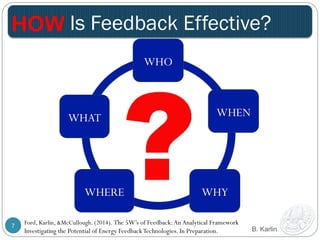
Is Feedback Effective? 
WHAT 
WHO 
WHEN 
WHERE WHY 
HOW 
B. Karlin 
Ford, Karlin, &McCullough. (2014). The 5W’s of Feedback: An Analytical Framework 
Investigating the Potential of Energy Feedback Technologies. In Preparation. 
7
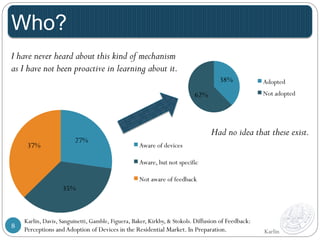
Who? 
Karlin 
27% 
37% Aware of devices 
35% 
Aware, but not specific 
Not aware of feedback 
38% 
62% 
Adopted 
Not adopted 
Had no idea that these exist. 
I have never heard about this kind of mechanism 
as I have not been proactive in learning about it. 
Karlin, Davis, Sanguinetti, Gamble, Figuera, Baker, Kirkby, & Stokols. Diffusion of Feedback: 
Perceptions and Adoption of Devices in the Residential 8 Market. In Preparation.
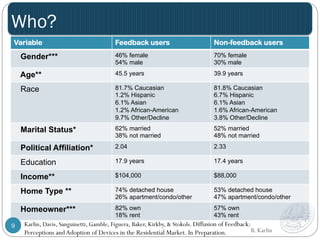
Who? 
Variable Feedback users Non-feedback users 
Gender*** 46% female 
54% male 
70% female 
30% male 
Age** 45.5 years 39.9 years 
Race 81.7% Caucasian 
1.2% Hispanic 
6.1% Asian 
1.2% African-American 
9.7% Other/Decline 
81.8% Caucasian 
6.7% Hispanic 
6.1% Asian 
1.6% African-American 
3.8% Other/Decline 
Marital Status* 62% married 
38% not married 
52% married 
48% not married 
Political Affiliation* 2.04 2.33 
Education 17.9 years 17.4 years 
Income** $104,000 $88,000 
Home Type ** 74% detached house 
26% apartment/condo/other 
53% detached house 
47% apartment/condo/other 
Homeowner*** 82% own 
18% rent 
57% own 
43% rent 
B. Karlin 
9 Karlin, Davis, Sanguinetti, Gamble, Figuera, Baker, Kirkby, & Stokols. Diffusion of Feedback: 
Perceptions and Adoption of Devices in the Residential Market. In Preparation.
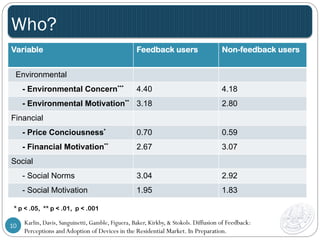
Who? 
Variable Feedback users 
Non-feedback users 
Environmental 
- Environmental Concern*** 4.40 4.18 
- Environmental Motivation** 3.18 2.80 
Financial 
- Price Conciousness* 0.70 0.59 
- Financial Motivation** 2.67 3.07 
Social 
- Social Norms 3.04 2.92 
- Social Motivation 1.95 1.83 
* p < .05, ** p < .01, p < .001 
10 Karlin, Davis, Sanguinetti, Gamble, Figuera, Baker, Kirkby, & Stokols. Diffusion of Feedback: 
Perceptions and Adoption of Devices in the Residential Market. In Preparation.
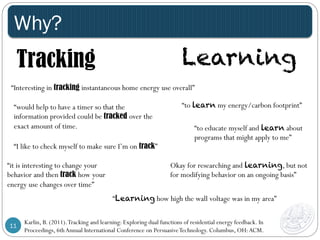
Why? 
Tracking Learning 
“Interesting in tracking instantaneous home energy use overall” 
“would help to have a timer so that the 
information provided could be tracked over the 
exact amount of time. “to educate myself and learn about 
“I like to check myself to make sure I’m on track” 
“to learn my energy/carbon footprint” 
programs that might apply to me” 
Okay for researching and learning, but not 
for modifying behavior on an ongoing basis” 
“Learning how high the wall voltage was in my area” 
“it is interesting to change your 
behavior and then track how your 
energy use changes over time” 
11 Karlin, B. (2011). Tracking and learning: Exploring dual functions of residential energy feedback. In 
Proceedings, 6th Annual International Conference on Persuasive Technology. Columbus, OH: ACM.
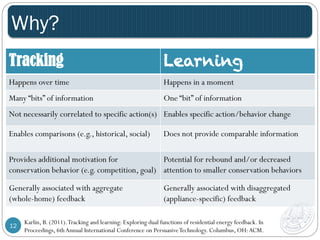
Why? 
Tracking Learning 
Happens over time Happens in a moment 
Many “bits” of information One “bit” of information 
Not necessarily correlated to specific action(s) Enables specific action/behavior change 
Enables comparisons (e.g., historical, social) Does not provide comparable information 
Provides additional motivation for 
conservation behavior (e.g. competition, goal) 
Potential for rebound and/or decreased 
attention to smaller conservation behaviors 
Generally associated with aggregate 
(whole-home) feedback 
Generally associated with disaggregated 
(appliance-specific) feedback 
12 Karlin, B. (2011). Tracking and learning: Exploring dual functions of residential energy feedback. In 
Proceedings, 6th Annual International Conference on Persuasive Technology. Columbus, OH: ACM.
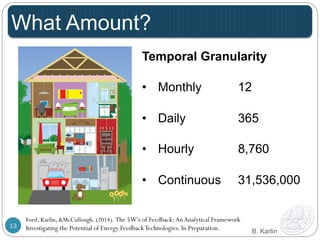
What Amount? 
Temporal Granularity 
• Monthly 12 
• Daily 365 
• Hourly 8,760 
• Continuous 31,536,000 
B. Karlin 
Ford, Karlin, &McCullough. (2014). The 5W’s of Feedback: An Analytical Framework 
Investigating the Potential of Energy Feedback 13 Technologies. In Preparation.
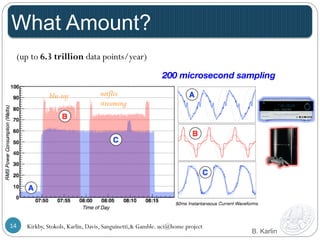
What Amount? 
(up to 6.3 trillion data points/year) 
blu-ray netflix 
streaming 
200 microsecond sampling 
B. Karlin 
Kirkby, Stokols, Karlin, Davis, Sanguinetti,& 14 Gamble. uci@home project
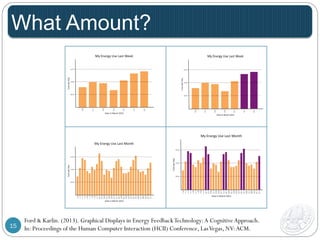
What Amount? 
Ford & Karlin. (2013). Graphical Displays in Energy Feedback Technology: A Cognitive Approach. 
In: Proceedings of the Human Computer Interaction (HCII) Conference, 15 Las Vegas, NV: ACM.
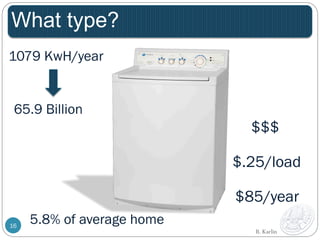
What type? 
1079 KwH/year 
65.9 Billion 
5.8% of average home 
$$$ 
$.25/load 
$85/year 
B. Karlin 
16
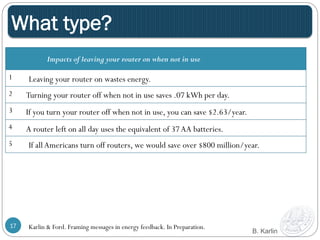
What type? 
B. Karlin 
Impacts of leaving your router on when not in use 
1 
2 
3 
4 
5 
Leaving your router on wastes energy. 
Turning your router off when not in use saves .07 kWh per day. 
If you turn your router off when not in use, you can save $2.63/year. 
A router left on all day uses the equivalent of 37 AA batteries. 
If all Americans turn off routers, we would save over $800 million/year. 
Karlin & Ford. Framing messages in energy 17 feedback. In Preparation.
What Type? 
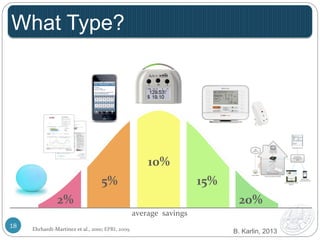
10% 
5% 
15% 
2% 
20% 
average 
savings 
Ehrhardt-­‐Martinez 
et 
al., 
2010; 
EPRI, 
2009 
B. Karlin, 2013 
18
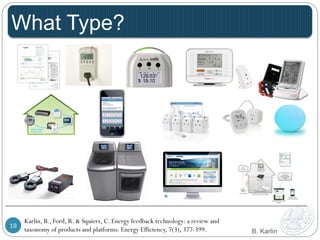
What Type? 
B. Karlin 
Karlin, B., Ford, R. & Squiers, C. Energy feedback technology: a review and 
taxonomy of products and platforms. 19 Energy Efficiency, 7(3), 377-399.
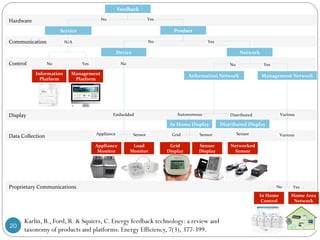
Hardware 
Communication 
Control 
Display 
Data 
Collection 
Proprietary 
Communications 
Feedback 
Product 
Management 
Platform 
Device 
Network 
No 
Yes 
Information 
Network 
Management 
Network 
In 
Home 
Control 
Home 
Area 
Network 
Distributed 
Display 
Service 
Load 
Monitor 
Grid 
Display 
Sensor 
Display 
Networked 
Sensor 
Appliance 
Monitor 
In 
Home 
Display 
Information 
Platform 
No 
Yes 
No 
Embedded 
Various 
Autonomous 
Distributed 
Various 
Appliance 
Sensor 
Grid 
Sensor 
Sensor 
N/A 
No 
Yes 
No 
Yes 
No 
Yes 
20 
Karlin, B., Ford, R. & Squiers, C. Energy feedback technology: a review and 
taxonomy of products and platforms. Energy Efficiency, 7(3), 377-399.
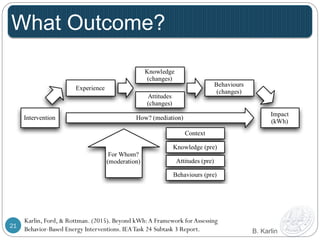
What Outcome? 
Karlin, Ford, & Rottman. (2015). Beyond kWh: A Framework for Assessing 
Behavior-Based Energy Interventions. IEA Task 24 Subtask 3 Report. B. Karlin 
21
Thank you! 
Beth Karlin 
Transformational Media Lab 
University of California, Irvine 
bkarlin@uci.edu 
Co-Authors 
— David Kirkby, Physics 
— Daniel Stokols, Psychology and Social Behavior 
— Nora Davis, Social Ecology 
— Angela Sanguinetti, Planning, Policy, and Design 
— Kristen Gamble, Psychology and Social Behavior 
— Kristen Figueira, UCLA 
— Jessie Baker, NYU 
— Rebecca Ford, Victoria University of Wellington 
— Sea Rottman, International Energy Agency 
— Cassandra Squiers, UC Santa Barbara 
22

Psychological Research on Energy Feedback

  • 1.
    Psychological Research on Energy Feedback Beth Karlin Transformational Media Lab University of California, Irvine Papers listed here. Contact me for details: bkarlin@uci.edu.
  • 2.
    Beth Bio 2 B. Karlin About Me I am an academic who believes the role of a researcher is not only to better understand the world but also to improve it and I devote my time equally to both goals. I work as a research psychologist, social change strategist, and program evaluator. My primary position is at UC Irvine as the founder and Director of the Transformational Media Lab (TML) within the Center for Unconventional Security Affairs (CUSA). My lab studies the role of media and technology in social and environmental change. Current projects investigate the design and use of technology-enabled feedback, public acceptance of new technology, audience engagement in documentary film, and media-based social activism. In addition to my role at the University, I also work with government, private, and non-profit organizations on the design, implementation, and evaluation of media and technology programs for behavior change.
  • 3.
  • 4.
    What are wemissing? 4 B. Karlin
  • 5.
    Is Feedback Effective? — 100+ studies conducted since 1976 — Reviews found average 10% savings — Mean r-effect size = .1174 (p < .001) (from negative effects to over 20% savings) B. Karlin • Significant variability in effects Karlin, Ford & Zinger. (2014). The Effects of Feedback on Energy Conservation: A Preliminary Theory 5 and Meta-Analysis. Under Review
  • 6.
    It Depends… Moderatorsidentified in meta-analysis • Study population (WHO?) • Study duration (HOW LONG?) • Frequency of feedback (HOW OFTEN?) • Feedback medium (WHAT TYPE?) • Disaggregation (WHAT AMOUNT?) • Comparison (WHAT MESSAGE?) B. Karlin 6 Karlin, Ford & Zinger. (2014). The Effects of Feedback on Energy Conservation: A Preliminary Theory and Meta-Analysis. Under Review
  • 7.
    Is Feedback Effective? WHAT WHO WHEN WHERE WHY HOW B. Karlin Ford, Karlin, &McCullough. (2014). The 5W’s of Feedback: An Analytical Framework Investigating the Potential of Energy Feedback Technologies. In Preparation. 7
  • 8.
    Who? Karlin 27% 37% Aware of devices 35% Aware, but not specific Not aware of feedback 38% 62% Adopted Not adopted Had no idea that these exist. I have never heard about this kind of mechanism as I have not been proactive in learning about it. Karlin, Davis, Sanguinetti, Gamble, Figuera, Baker, Kirkby, & Stokols. Diffusion of Feedback: Perceptions and Adoption of Devices in the Residential 8 Market. In Preparation.
  • 9.
    Who? Variable Feedbackusers Non-feedback users Gender*** 46% female 54% male 70% female 30% male Age** 45.5 years 39.9 years Race 81.7% Caucasian 1.2% Hispanic 6.1% Asian 1.2% African-American 9.7% Other/Decline 81.8% Caucasian 6.7% Hispanic 6.1% Asian 1.6% African-American 3.8% Other/Decline Marital Status* 62% married 38% not married 52% married 48% not married Political Affiliation* 2.04 2.33 Education 17.9 years 17.4 years Income** $104,000 $88,000 Home Type ** 74% detached house 26% apartment/condo/other 53% detached house 47% apartment/condo/other Homeowner*** 82% own 18% rent 57% own 43% rent B. Karlin 9 Karlin, Davis, Sanguinetti, Gamble, Figuera, Baker, Kirkby, & Stokols. Diffusion of Feedback: Perceptions and Adoption of Devices in the Residential Market. In Preparation.
  • 10.
    Who? Variable Feedbackusers Non-feedback users Environmental - Environmental Concern*** 4.40 4.18 - Environmental Motivation** 3.18 2.80 Financial - Price Conciousness* 0.70 0.59 - Financial Motivation** 2.67 3.07 Social - Social Norms 3.04 2.92 - Social Motivation 1.95 1.83 * p < .05, ** p < .01, p < .001 10 Karlin, Davis, Sanguinetti, Gamble, Figuera, Baker, Kirkby, & Stokols. Diffusion of Feedback: Perceptions and Adoption of Devices in the Residential Market. In Preparation.
  • 11.
    Why? Tracking Learning “Interesting in tracking instantaneous home energy use overall” “would help to have a timer so that the information provided could be tracked over the exact amount of time. “to educate myself and learn about “I like to check myself to make sure I’m on track” “to learn my energy/carbon footprint” programs that might apply to me” Okay for researching and learning, but not for modifying behavior on an ongoing basis” “Learning how high the wall voltage was in my area” “it is interesting to change your behavior and then track how your energy use changes over time” 11 Karlin, B. (2011). Tracking and learning: Exploring dual functions of residential energy feedback. In Proceedings, 6th Annual International Conference on Persuasive Technology. Columbus, OH: ACM.
  • 12.
    Why? Tracking Learning Happens over time Happens in a moment Many “bits” of information One “bit” of information Not necessarily correlated to specific action(s) Enables specific action/behavior change Enables comparisons (e.g., historical, social) Does not provide comparable information Provides additional motivation for conservation behavior (e.g. competition, goal) Potential for rebound and/or decreased attention to smaller conservation behaviors Generally associated with aggregate (whole-home) feedback Generally associated with disaggregated (appliance-specific) feedback 12 Karlin, B. (2011). Tracking and learning: Exploring dual functions of residential energy feedback. In Proceedings, 6th Annual International Conference on Persuasive Technology. Columbus, OH: ACM.
  • 13.
    What Amount? TemporalGranularity • Monthly 12 • Daily 365 • Hourly 8,760 • Continuous 31,536,000 B. Karlin Ford, Karlin, &McCullough. (2014). The 5W’s of Feedback: An Analytical Framework Investigating the Potential of Energy Feedback 13 Technologies. In Preparation.
  • 14.
    What Amount? (upto 6.3 trillion data points/year) blu-ray netflix streaming 200 microsecond sampling B. Karlin Kirkby, Stokols, Karlin, Davis, Sanguinetti,& 14 Gamble. uci@home project
  • 15.
    What Amount? Ford& Karlin. (2013). Graphical Displays in Energy Feedback Technology: A Cognitive Approach. In: Proceedings of the Human Computer Interaction (HCII) Conference, 15 Las Vegas, NV: ACM.
  • 16.
    What type? 1079KwH/year 65.9 Billion 5.8% of average home $$$ $.25/load $85/year B. Karlin 16
  • 17.
    What type? B.Karlin Impacts of leaving your router on when not in use 1 2 3 4 5 Leaving your router on wastes energy. Turning your router off when not in use saves .07 kWh per day. If you turn your router off when not in use, you can save $2.63/year. A router left on all day uses the equivalent of 37 AA batteries. If all Americans turn off routers, we would save over $800 million/year. Karlin & Ford. Framing messages in energy 17 feedback. In Preparation.
  • 18.
    What Type? 10% 5% 15% 2% 20% average savings Ehrhardt-­‐Martinez et al., 2010; EPRI, 2009 B. Karlin, 2013 18
  • 19.
    What Type? B.Karlin Karlin, B., Ford, R. & Squiers, C. Energy feedback technology: a review and taxonomy of products and platforms. 19 Energy Efficiency, 7(3), 377-399.
  • 20.
    Hardware Communication Control Display Data Collection Proprietary Communications Feedback Product Management Platform Device Network No Yes Information Network Management Network In Home Control Home Area Network Distributed Display Service Load Monitor Grid Display Sensor Display Networked Sensor Appliance Monitor In Home Display Information Platform No Yes No Embedded Various Autonomous Distributed Various Appliance Sensor Grid Sensor Sensor N/A No Yes No Yes No Yes 20 Karlin, B., Ford, R. & Squiers, C. Energy feedback technology: a review and taxonomy of products and platforms. Energy Efficiency, 7(3), 377-399.
  • 21.
    What Outcome? Karlin,Ford, & Rottman. (2015). Beyond kWh: A Framework for Assessing Behavior-Based Energy Interventions. IEA Task 24 Subtask 3 Report. B. Karlin 21
  • 22.
    Thank you! BethKarlin Transformational Media Lab University of California, Irvine bkarlin@uci.edu Co-Authors — David Kirkby, Physics — Daniel Stokols, Psychology and Social Behavior — Nora Davis, Social Ecology — Angela Sanguinetti, Planning, Policy, and Design — Kristen Gamble, Psychology and Social Behavior — Kristen Figueira, UCLA — Jessie Baker, NYU — Rebecca Ford, Victoria University of Wellington — Sea Rottman, International Energy Agency — Cassandra Squiers, UC Santa Barbara 22