Case presentation
Presenter-Dr Syed Furquan Ali
Personal data:
• Name – Jayshree Patil
• Handedness- Right Handed
• Date of Admission-
• Date of examination –
• Age – 52 years
• Sex - Female
• Religion – Hindu
• Occupation – Homemaker
• Address – Shahabazar, Kalaburagi .
• Informant – Patient Husband and Daughter (reliable)
Chief complaints with duration :
Weakness of Right upper limb since 1.5 years
Difficulty in speaking since 1.5 years
Difficulty in swallowing since 1 year
Weakness of Left Upper Limb since 6 months
Difficulty in walking since 5 months
History of Presenting Illness:
• Patient was apparently alright 1.5 years back then she started noticing
weakness in her Right Upper Limb which was insidious in onset and
gradually progressive.
• Initially she was unable to break pieces of chapati, mix food in plate, button
and unbutton her clothes, weakness in holding a glass using right hand later
she started feeling weakness in lifting her arm above the head while taking
bath and weakness while combing her hair with her right hand.
• Over next 4-5 months patient had developed severe weakness of her right
upper limb such that she has to take help of her left upper limb to move
her right upper limb.
• Simultaneously patient and her husband also noticed involuntary
twitching movements in her right arm and forearm.
• Patients husband also noticed thinning of her hand and forearm.
• It was also noticed that her right hand was rigid while moving.
• However patient denies of any pain, tingling or numbness in her right
upper limb during this period.
• Patients husband also noticed her having difficulty in speaking and change
in the quality of her voice in the form of nasal intonation since 1.5 years
which was insidious in onset and gradually progressive.
• Over next 6 months it progressed such that her words were
non-comprehensible.
• However patient is able to understand words and respond back to
commands
• Patient also complained of difficulty in swallowing food since 1 year
which was insidious in onset and gradually progressive
• Initially she was having difficulty in mixing food in her mouth or
spitting out her sputum later it progressed to difficulty in swallowing
the food which was more for Solids than Liquids.
• It has progressed such that patient is able to swallow only Liquid or
semisolid food.
• It was also associated with regurgitation of food and drooling of saliva
or water from angle of mouth.
• Then patient started noticing weakness in her Left upper limb since 6
months which was insidious in onset gradually progressive.
• Initially she was unable to hold utensils, break pieces of chapati, mix
food in plate, button and unbutton her clothes using Left hand.
• Later she started feeling weakness in lifting her arm above the head
while taking bath and weakness while combing her hair with her left
hand.
• It was also associated with involuntary twitching movements in her
left arm and forearm.
• Patients husband also noticed thinning of her left hand and forearm.
• It was also noticed that her left hand was rigid while moving.
• However patient denies of any pain, tingling or numbness in her right
upper limb during this period.
• Patient also complained of Difficulty in walking since 5 months which
was insidious in onset gradually progressive
• Initially patient used to walk on her own later she started having
weakness while walking on level ground or climbing stairs and she
used help of attenders to walk.
• Subsequently She also started having weakness while getting up from
sitting position and squatting position.
• It was also associated with frequent falls while trying to walk or using
washroom.
• It was also associated with twitching of muscles in both lower limbs.
• It was not associated with difficulty in putting on slippers, holding,
gripping and removing slippers.
• It was not associated with muscle cramps or contracture, tingling,
numbness or pain in both lower limbs.
There was no history of :
• No history of Loss of smell
• No history of Double vision, blurring of vision, difficulty in opening of eyelids
• No history of loss of sensation over face, taste sensation
• No history of Tinnitus, hard of hearing, giddiness
• No history of Difficulty in neck or shoulder movements
• No history of Involuntary movements of b/l upper limb and lower limb.
• No history of tingling, painful or burning sensation over upper or lower limb
• No history of difficulty in appreciating cold or warm water while taking bath
• No history suggestive of bowel and bladder involvement.
• No history of cognitive impairment or emotional liability
• No history of Tremors
• No history of Difficulty in breathing
• No history of Headache, Seizures or Loss of Consciousness
• No history of Significant Weight Loss
• No history of Fever, neck rigidity, projectile vomiting
• No history of Trauma to neck or back
Past history:
• H/o Hospital Admission 3 months back due to self fall and trauma to head,
she was treated conservatively for scalp hematoma and discharged.
• H/o Hospital admission for similar complaints 1 year back and was given NG
tube feeding for 15 days and discharged with oral medications and advised for
regular physiotherapy.
• History of Regular physiotherapy since 1 year.
• Not a known case of HTN/T2DM/IHD/TB/Epilepsy/Thyroid Di.sorders
Family history:
• Born out of non consanguineous marriage .
• She is 2nd
out of 2 siblings
• Got Married Non Consanguineously
• Has 4 children to self .
• All are keeping good health
• No h/o similar complaints in the family members.
Personal history:
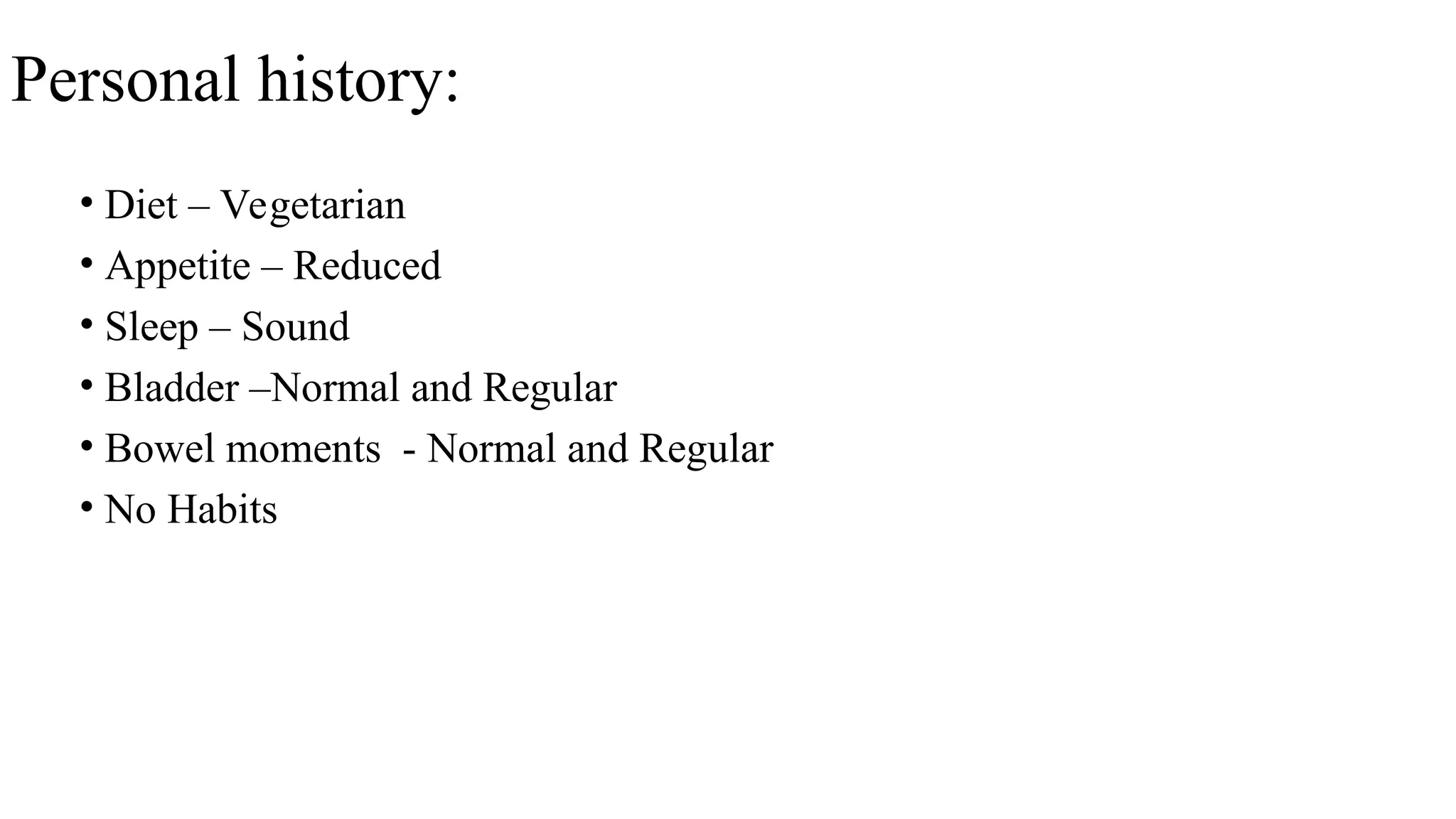
• Diet – Vegetarian
• Appetite – Reduced
• Sleep – Sound
• Bladder –Normal and Regular
• Bowel moments - Normal and Regular
• No Habits
History analysis
52 yrs old female with progressive weakness of right upper limb, Difficulty in
speaking since 1.5 years, Difficulty in swallowing since 1 year, Left upperlimb
weakness since 6 months and difficulty in walking since 5 months with no history
of sensory symptoms, bowel and bladder involvement
I would like to consider CNS involvement
Neurologically – Asymmetrical Motor Weakness with Bulbar Palsy
Anatomically – Neurons of Corticospinal tract,Anterior horn cells,and cranial
nuclei at medulla oblongata
Pathologically – Degenerative
Etiology – Sporadic
General physical examination:
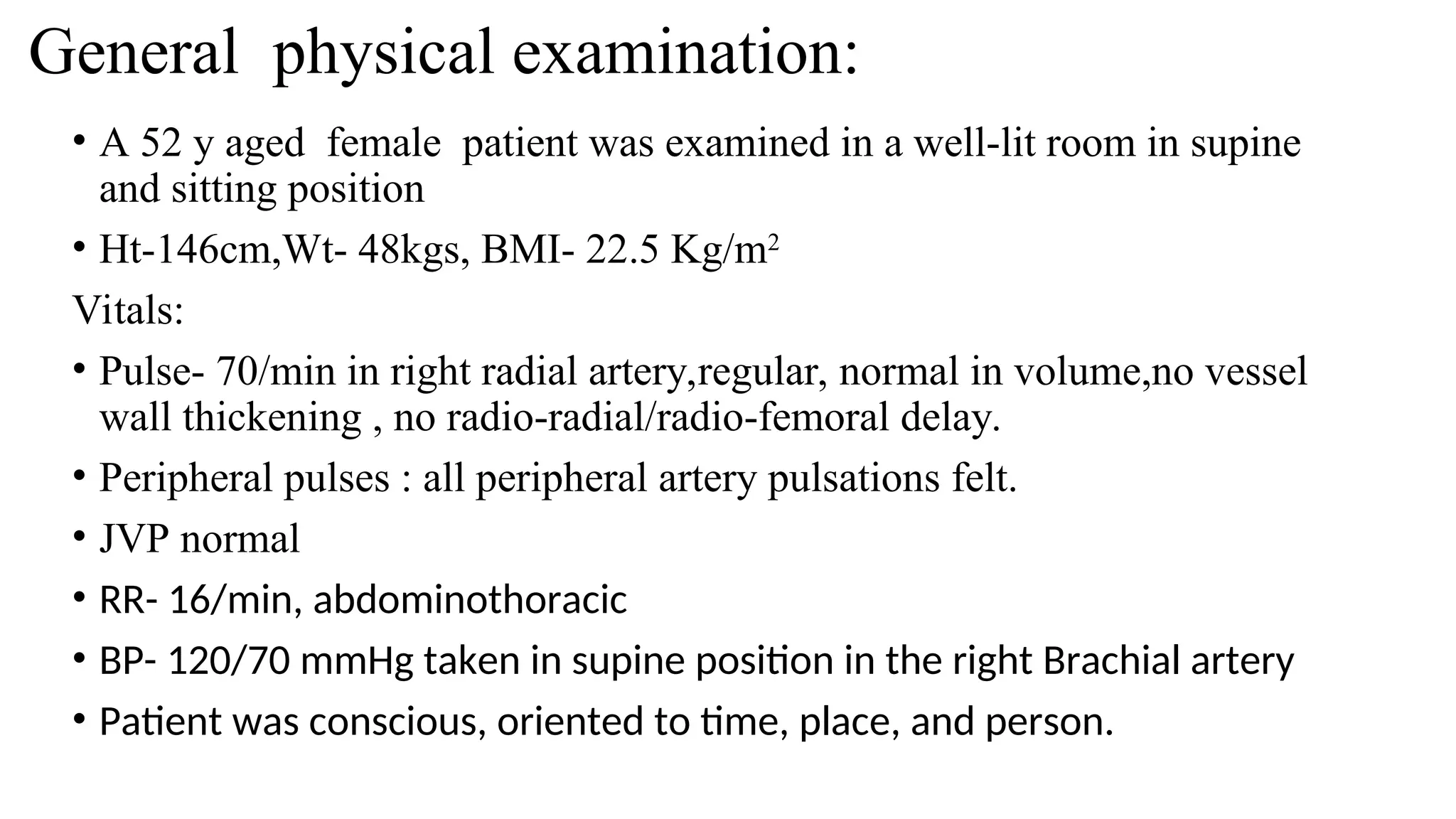
• A 52 y aged female patient was examined in a well-lit room in supine
and sitting position
• Ht-146cm,Wt- 48kgs, BMI- 22.5 Kg/m2
Vitals:
• Pulse- 70/min in right radial artery,regular, normal in volume,no vessel
wall thickening , no radio-radial/radio-femoral delay.
• Peripheral pulses : all peripheral artery pulsations felt.
• JVP normal
• RR- 16/min, abdominothoracic
• BP- 120/70 mmHg taken in supine position in the right Brachial artery
• Patient was conscious, oriented to time, place, and person.
• No Pallor, Icterus
• Oral cavity –
• Tongue Atrophied with fasciculations seen
• Multiple fallen teeths noted
• No cyanosis, clubbing, lymphadenopathy, or oedema
• Upper Limb – B/L wasting present in Forearm,
B/L Thenar and hypothenar muscle wasting present
• Lower Limb – Muscle Wasting not seen,no dialated veins,no swelling.
• Chest and Abdomen – No dialated veins/scars/sinuses seen
• No kyphoscoliosis or any spinal deformity seen.
• Skin over the back is normal.
• No gibbus.
• Back Examination:
CNS examination:
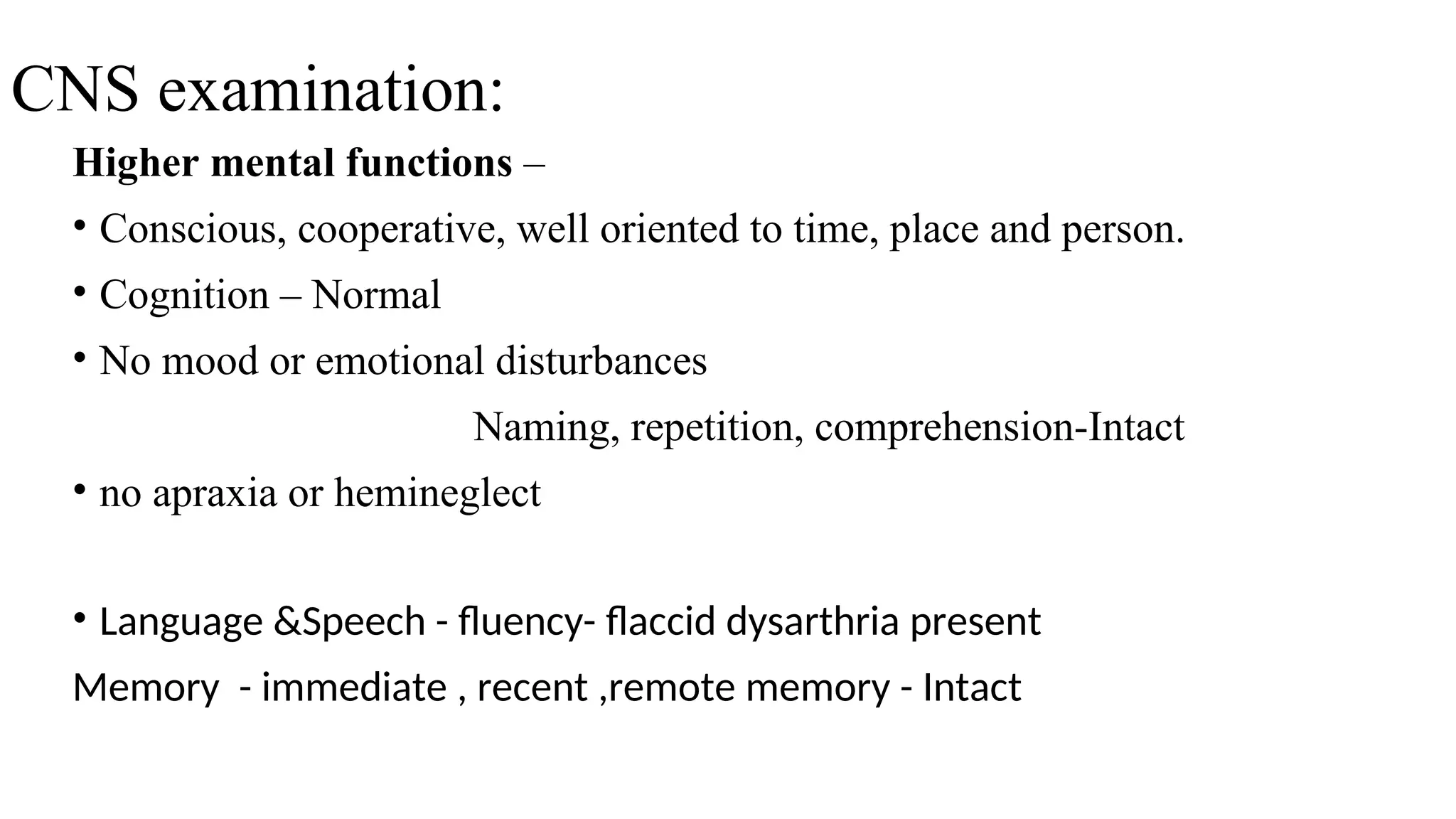
Higher mental functions –
• Conscious, cooperative, well oriented to time, place and person.
• Cognition – Normal
• No mood or emotional disturbances
Naming, repetition, comprehension-Intact
• no apraxia or hemineglect
• Language &Speech - fluency- flaccid dysarthria present
Memory - immediate , recent ,remote memory - Intact
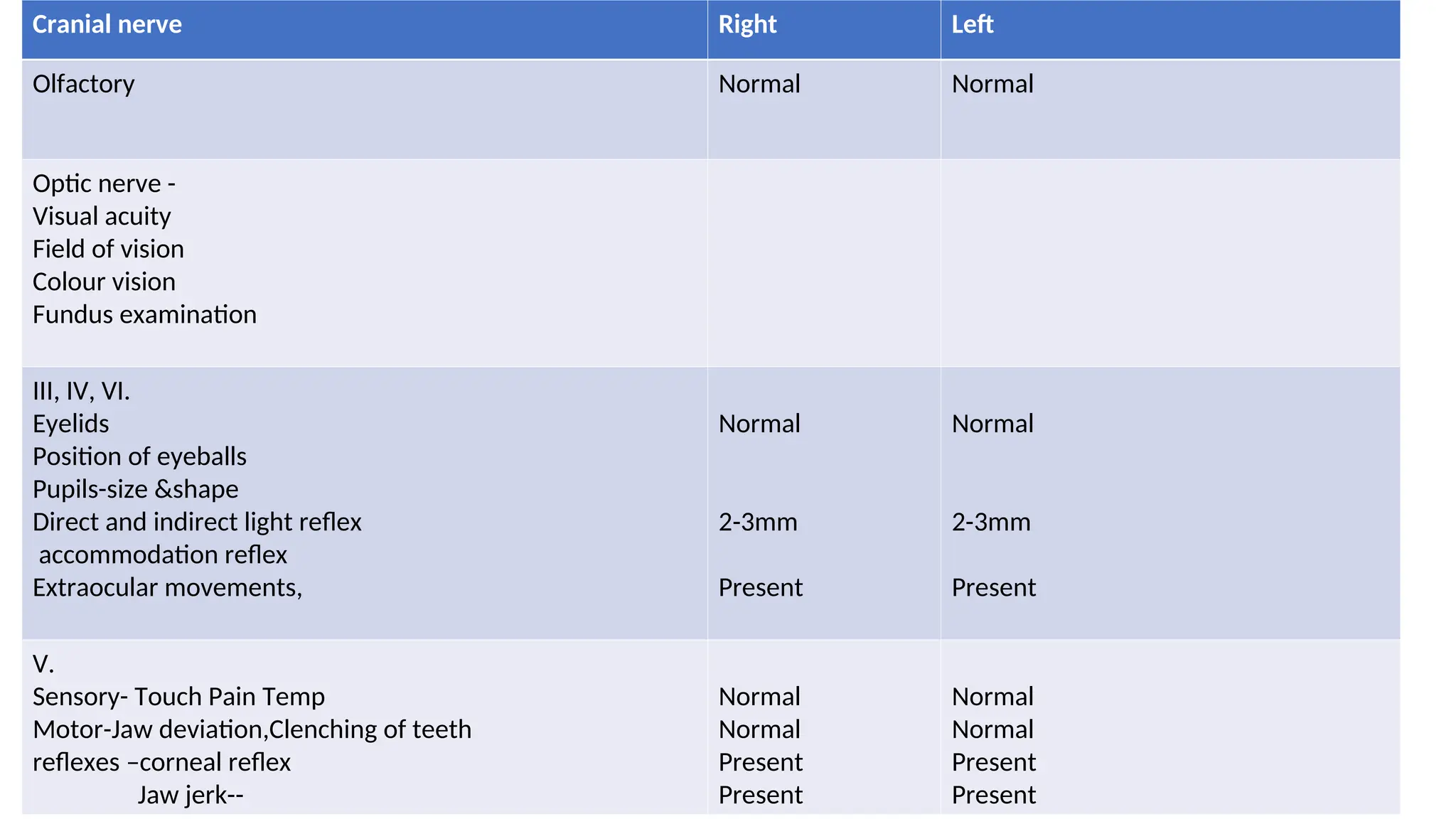
Cranial nerve Right Left
Olfactory Normal Normal
Optic nerve -
Visual acuity
Field of vision
Colour vision
Fundus examination
III, IV, VI.
Eyelids
Position of eyeballs
Pupils-size &shape
Direct and indirect light reflex
accommodation reflex
Extraocular movements,
Normal
2-3mm
Present
Normal
2-3mm
Present
V.
Sensory- Touch Pain Temp
Motor-Jaw deviation,Clenching of teeth
reflexes –corneal reflex
Jaw jerk--
Normal
Normal
Present
Present
Normal
Normal
Present
Present
Right Left
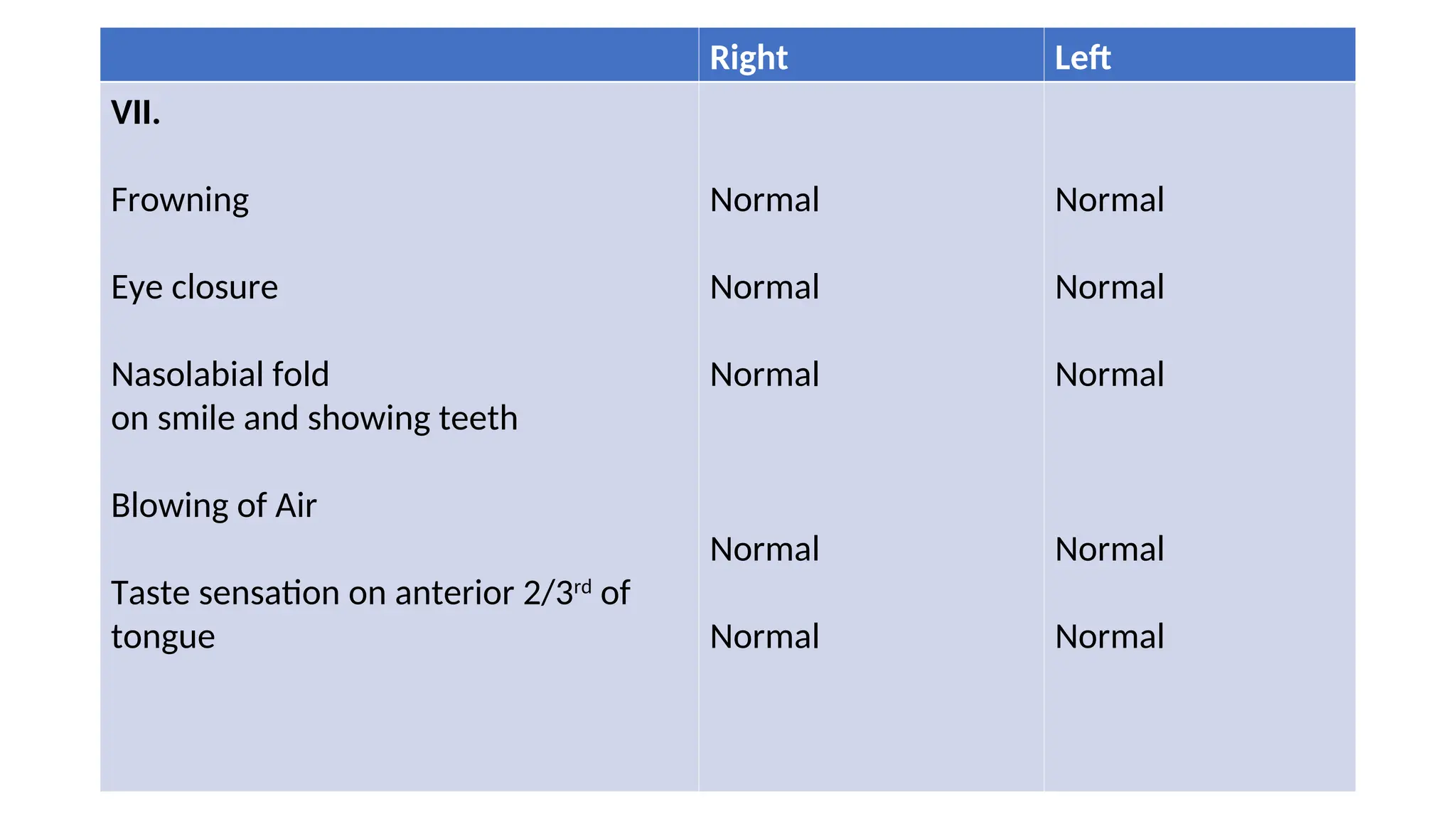
VII.
Frowning
Eye closure
Nasolabial fold
on smile and showing teeth
Blowing of Air
Taste sensation on anterior 2/3rd
of
tongue
Normal
Normal
Normal
Normal
Normal
Normal
Normal
Normal
Normal
Normal
Cranial nerves (Cont’d):
Right Left
VIII.
Rinnes test
Webers test
ABC
AC > BC
Same as examiner
Centralized
AC > BC
Centralized
Same as examiner
IX, X
Movement & Position of Uvula
Gag reflex
Taste in Posterior 1/3rd
of Tongue
Normal & Central
Present
Couldn’t be elicited
Normal & Central
Present
Couldn’t be elicited
XI
Shoulder shrugging, head turning Normal Normal
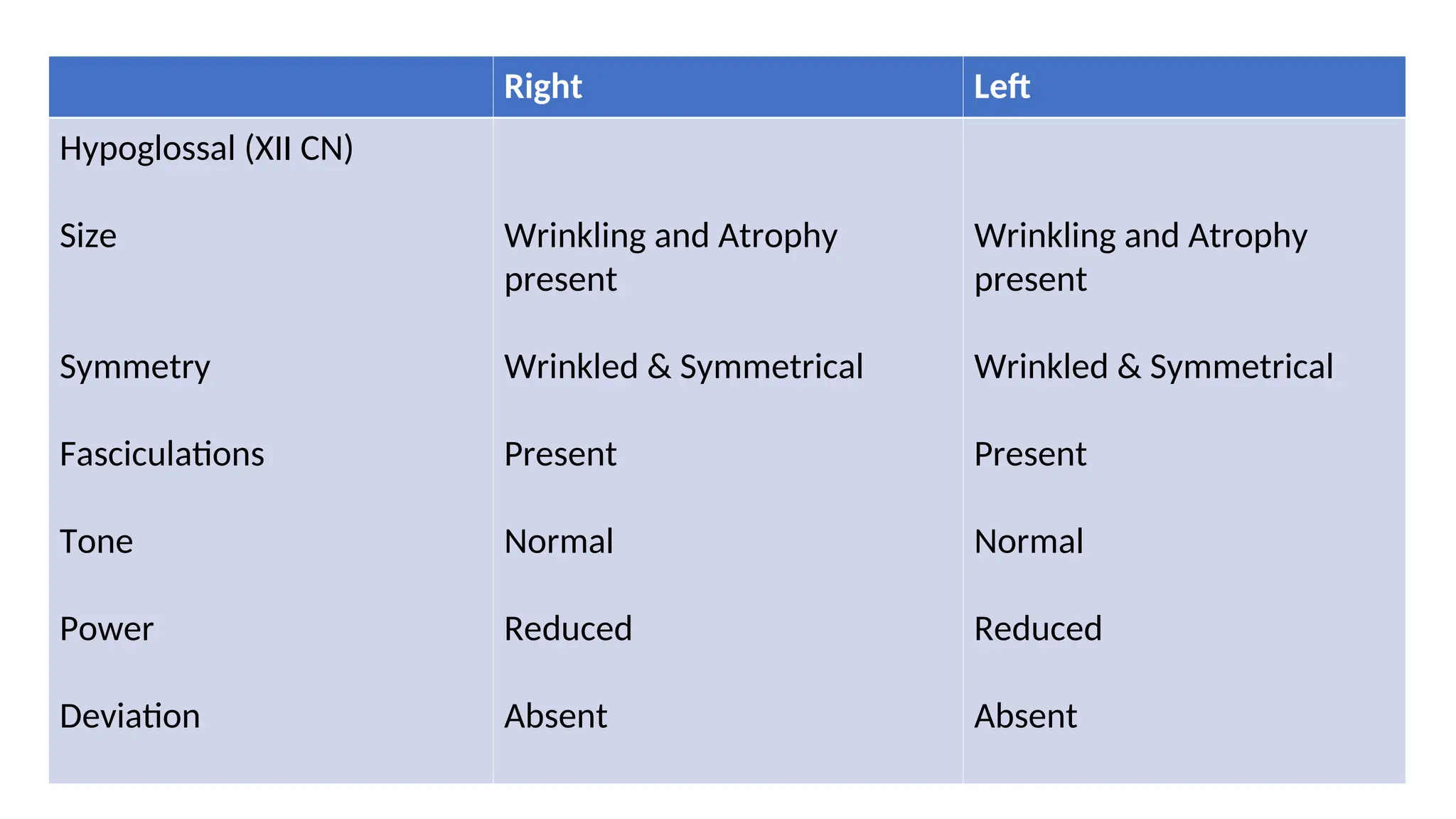
Right Left
Hypoglossal (XII CN)
Size
Symmetry
Fasciculations
Tone
Power
Deviation
Wrinkling and Atrophy
present
Wrinkled & Symmetrical
Present
Normal
Reduced
Absent
Wrinkling and Atrophy
present
Wrinkled & Symmetrical
Present
Normal
Reduced
Absent
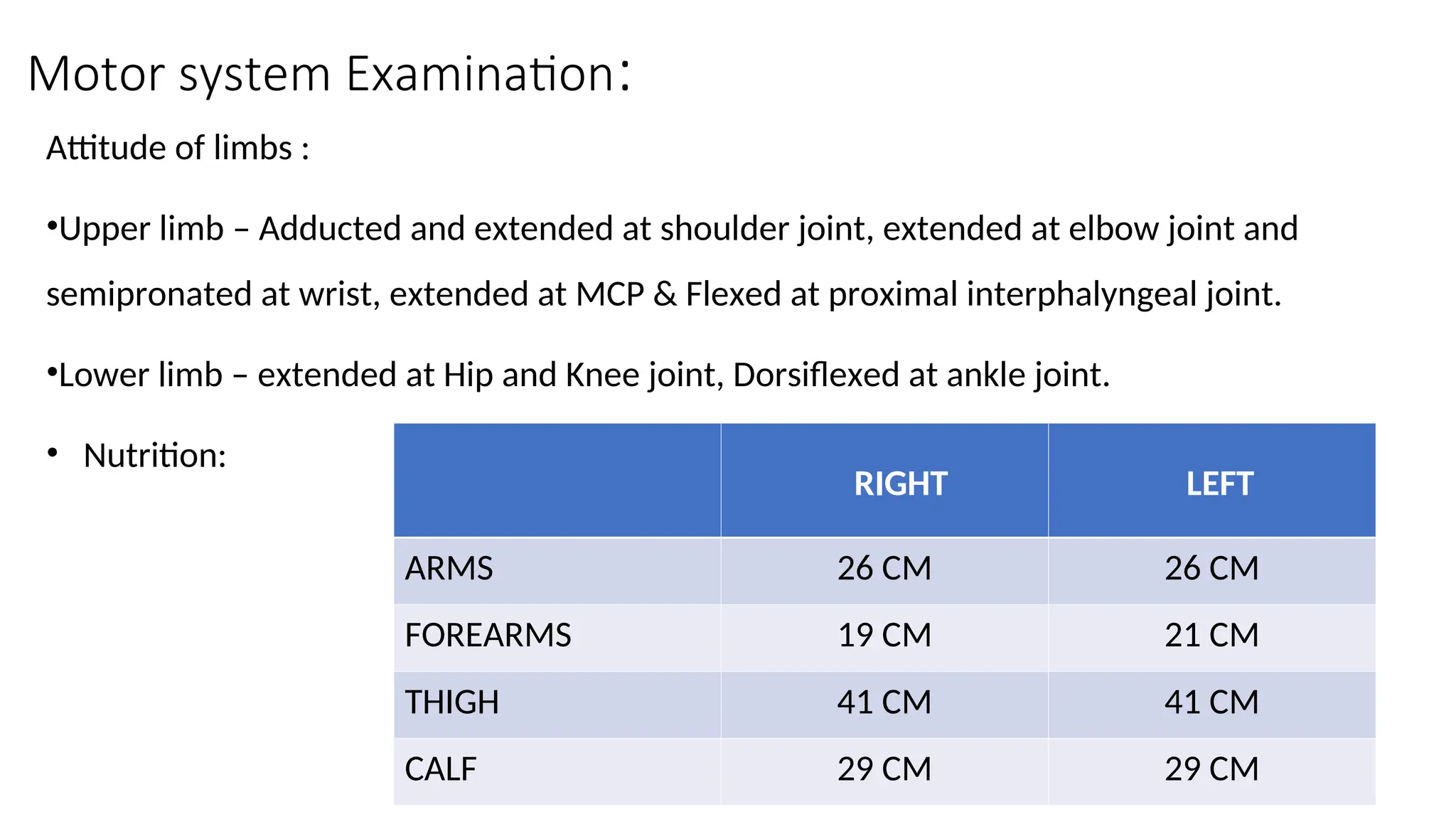
Motor system Examination:
Attitude of limbs :
•Upper limb – Adducted and extended at shoulder joint, extended at elbow joint and
semipronated at wrist, extended at MCP & Flexed at proximal interphalyngeal joint.
•Lower limb – extended at Hip and Knee joint, Dorsiflexed at ankle joint.
• Nutrition:
RIGHT LEFT
ARMS 26 CM 26 CM
FOREARMS 19 CM 21 CM
THIGH 41 CM 41 CM
CALF 29 CM 29 CM
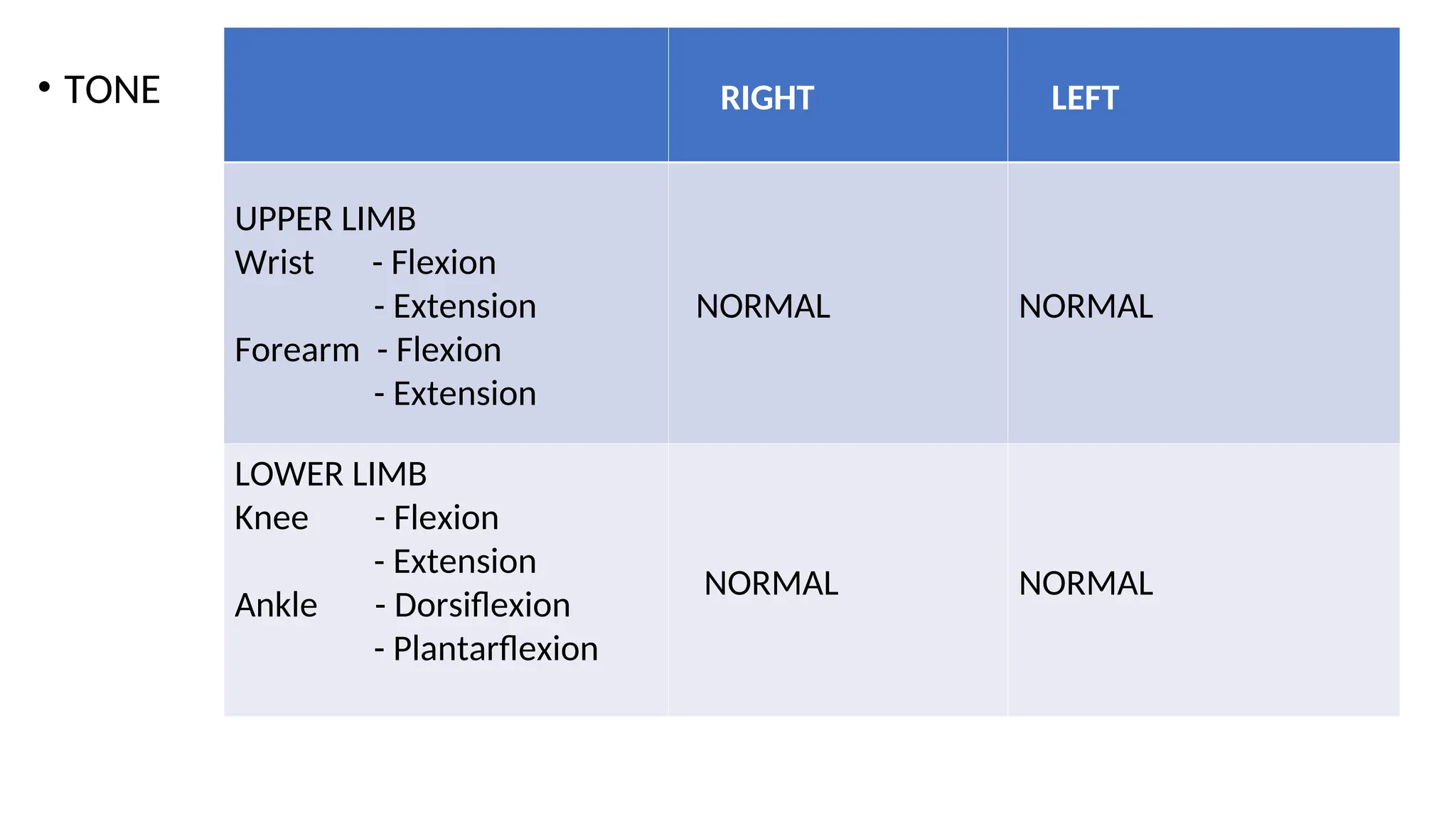
• TONE RIGHT LEFT
UPPER LIMB
Wrist - Flexion
- Extension
Forearm - Flexion
- Extension
NORMAL NORMAL
LOWER LIMB
Knee - Flexion
- Extension
Ankle - Dorsiflexion
- Plantarflexion
NORMAL NORMAL
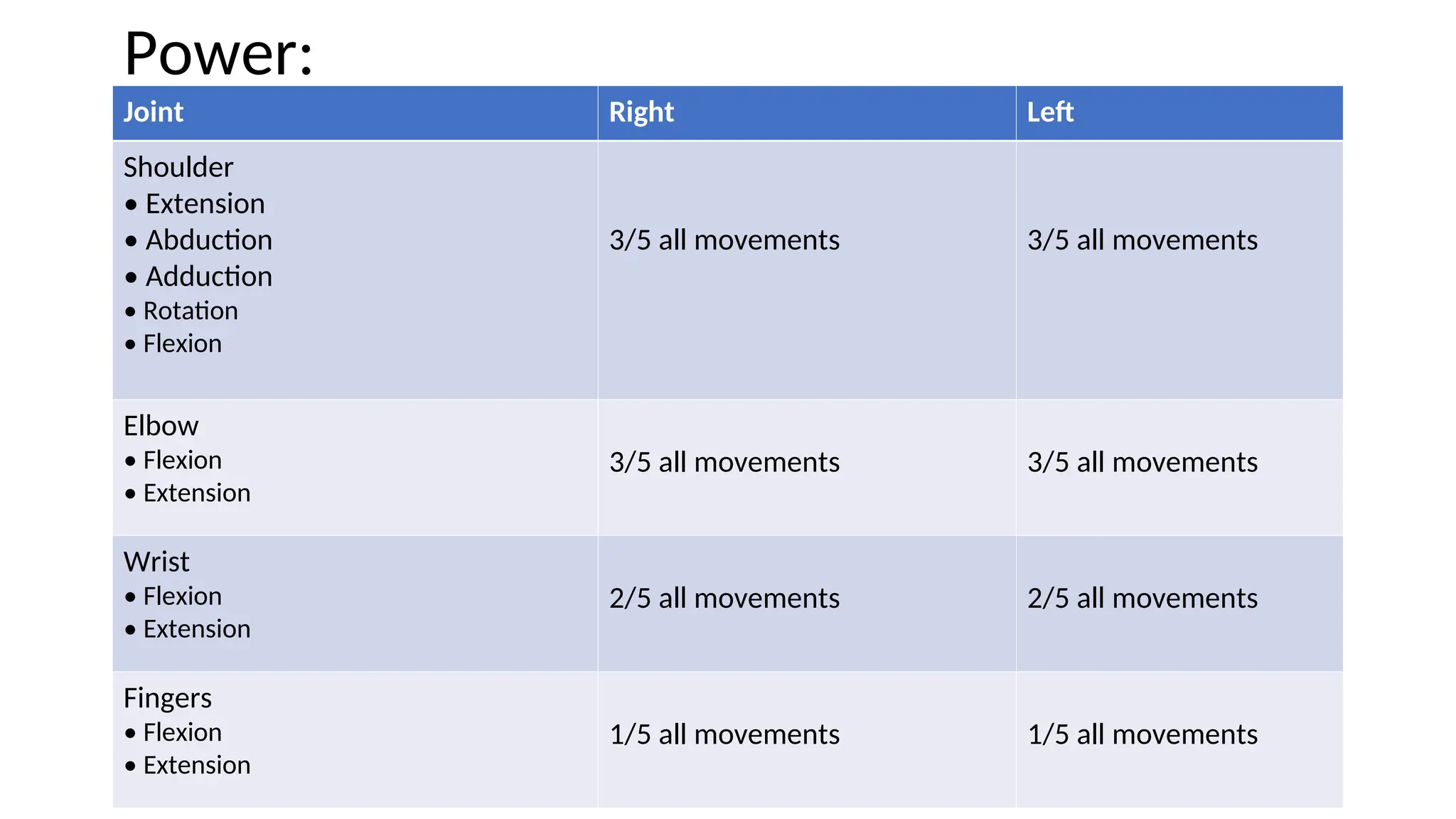
Power:
Joint Right Left
Shoulder
• Extension
• Abduction
• Adduction
• Rotation
• Flexion
3/5 all movements 3/5 all movements
Elbow
• Flexion
• Extension
3/5 all movements 3/5 all movements
Wrist
• Flexion
• Extension
2/5 all movements 2/5 all movements
Fingers
• Flexion
• Extension
1/5 all movements 1/5 all movements
Power (Cont’d):
Joint Right Left
Hip
• Flexion
• Extension
• Abduction
• Adduction
• Rotation
4/5 all movements 2/5 all movements
Knee
• Flexion
• Extension
4/5 all movements 4/5 all movements
Ankle
• Extension
• Flexion
4/5 all movements 4/5 all movements
REFLEXES : SUPERFICIAL
RIGHT LEFT
CORNEAL (V , VII) AND
CONJUCTIVAL
+ +
ABDOMEN (T10 T11 T12 ) Absent Absent
PLANTARS ( L5,S1) Extensor Extensor
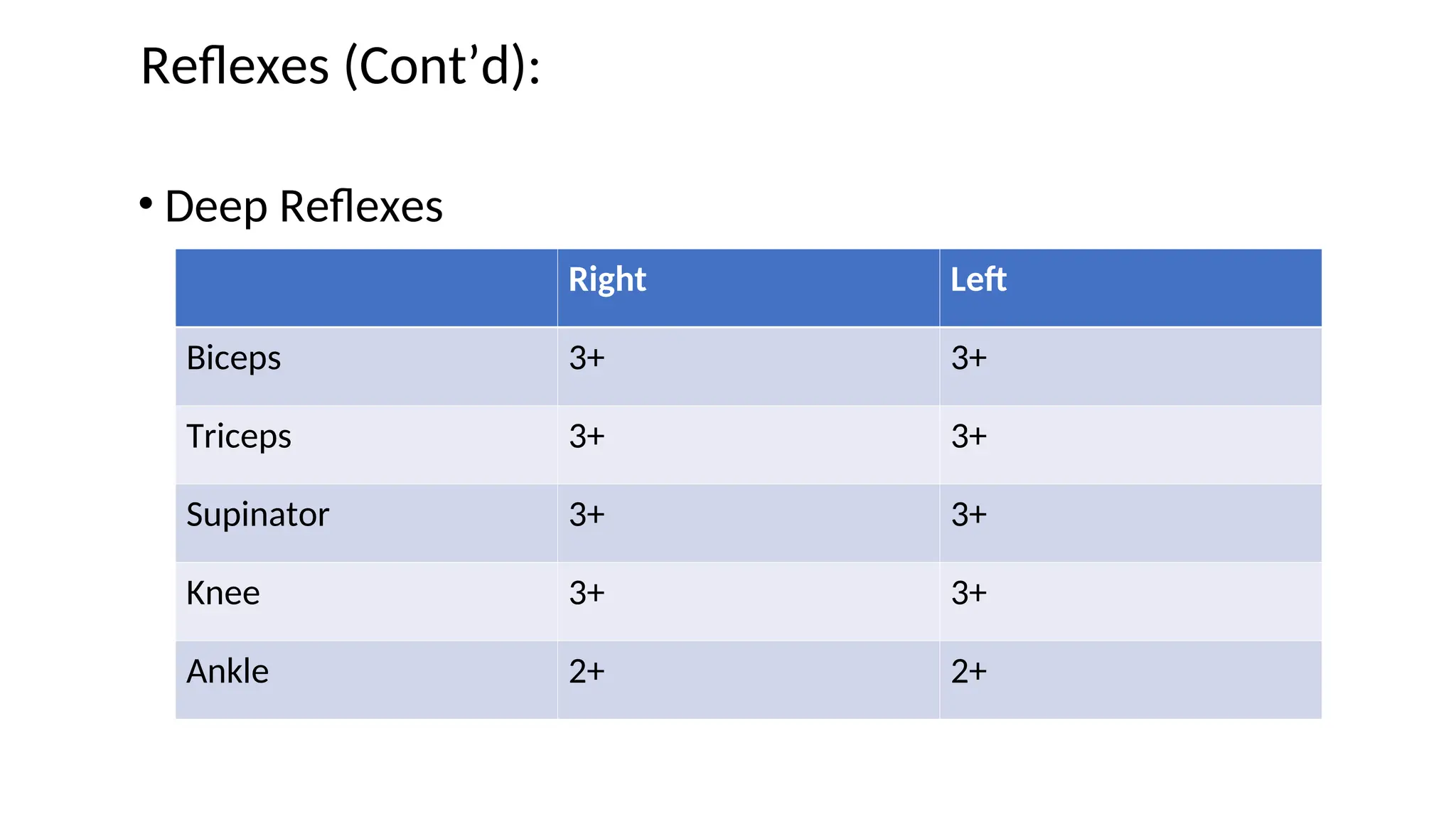
• Deep Reflexes
Right Left
Biceps 3+ 3+
Triceps 3+ 3+
Supinator 3+ 3+
Knee 3+ 3+
Ankle 2+ 2+
Reflexes (Cont’d):
Sensory system:
• Primary sensations - touch, pain, temperature, vibration and position sense are
normal bilaterally
• Cortical sensations – tactile localisation , discrimation , graphestheisa ,
topognosis is normal .
• Signs of Meningeal Irritation : Absent
• Autonomic function examination : Normal
• Examination of carotids : Normal, no bruit
CEREBELLAR SIGNS
right left
Finger nose test Could to perform Could to perform
Finger nose finger test Could to perform Could to perform
Dysdiadokinesia Could to perform Could to perform
Knee heel test Could to perform Could to perform
Titubation Absent
Nystagmus Absent Absent
Intentional tremors Absent Absent
Speech Flaccid Dysarthia
Pendular knee jerk Absent Absent
Gait,rhombergs sign and
tandem walking
Could not be assesed
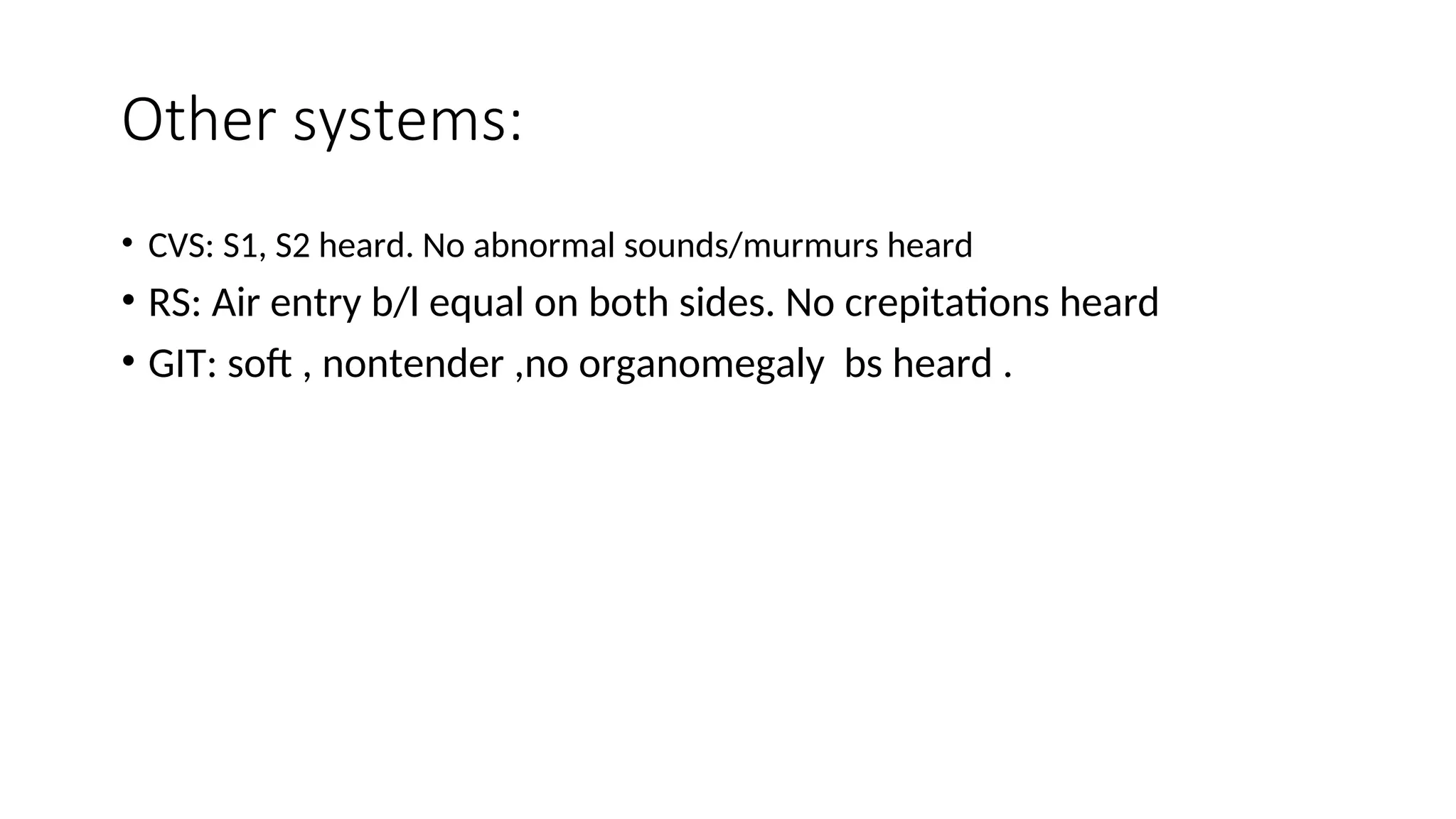
Other systems:
• CVS: S1, S2 heard. No abnormal sounds/murmurs heard
• RS: Air entry b/l equal on both sides. No crepitations heard
• GIT: soft , nontender ,no organomegaly bs heard .
Thank you!

Motor neurone disease case presentation.ppt

  • 1.
  • 2.
    Personal data: • Name– Jayshree Patil • Handedness- Right Handed • Date of Admission- • Date of examination – • Age – 52 years • Sex - Female • Religion – Hindu • Occupation – Homemaker • Address – Shahabazar, Kalaburagi . • Informant – Patient Husband and Daughter (reliable)
  • 3.
    Chief complaints withduration : Weakness of Right upper limb since 1.5 years Difficulty in speaking since 1.5 years Difficulty in swallowing since 1 year Weakness of Left Upper Limb since 6 months Difficulty in walking since 5 months
  • 4.
    History of PresentingIllness: • Patient was apparently alright 1.5 years back then she started noticing weakness in her Right Upper Limb which was insidious in onset and gradually progressive. • Initially she was unable to break pieces of chapati, mix food in plate, button and unbutton her clothes, weakness in holding a glass using right hand later she started feeling weakness in lifting her arm above the head while taking bath and weakness while combing her hair with her right hand.
  • 5.
    • Over next4-5 months patient had developed severe weakness of her right upper limb such that she has to take help of her left upper limb to move her right upper limb. • Simultaneously patient and her husband also noticed involuntary twitching movements in her right arm and forearm. • Patients husband also noticed thinning of her hand and forearm. • It was also noticed that her right hand was rigid while moving. • However patient denies of any pain, tingling or numbness in her right upper limb during this period.
  • 6.
    • Patients husbandalso noticed her having difficulty in speaking and change in the quality of her voice in the form of nasal intonation since 1.5 years which was insidious in onset and gradually progressive. • Over next 6 months it progressed such that her words were non-comprehensible. • However patient is able to understand words and respond back to commands
  • 7.
    • Patient alsocomplained of difficulty in swallowing food since 1 year which was insidious in onset and gradually progressive • Initially she was having difficulty in mixing food in her mouth or spitting out her sputum later it progressed to difficulty in swallowing the food which was more for Solids than Liquids. • It has progressed such that patient is able to swallow only Liquid or semisolid food. • It was also associated with regurgitation of food and drooling of saliva or water from angle of mouth.
  • 8.
    • Then patientstarted noticing weakness in her Left upper limb since 6 months which was insidious in onset gradually progressive. • Initially she was unable to hold utensils, break pieces of chapati, mix food in plate, button and unbutton her clothes using Left hand. • Later she started feeling weakness in lifting her arm above the head while taking bath and weakness while combing her hair with her left hand.
  • 9.
    • It wasalso associated with involuntary twitching movements in her left arm and forearm. • Patients husband also noticed thinning of her left hand and forearm. • It was also noticed that her left hand was rigid while moving. • However patient denies of any pain, tingling or numbness in her right upper limb during this period.
  • 10.
    • Patient alsocomplained of Difficulty in walking since 5 months which was insidious in onset gradually progressive • Initially patient used to walk on her own later she started having weakness while walking on level ground or climbing stairs and she used help of attenders to walk. • Subsequently She also started having weakness while getting up from sitting position and squatting position. • It was also associated with frequent falls while trying to walk or using washroom.
  • 11.
    • It wasalso associated with twitching of muscles in both lower limbs. • It was not associated with difficulty in putting on slippers, holding, gripping and removing slippers. • It was not associated with muscle cramps or contracture, tingling, numbness or pain in both lower limbs.
  • 12.
    There was nohistory of : • No history of Loss of smell • No history of Double vision, blurring of vision, difficulty in opening of eyelids • No history of loss of sensation over face, taste sensation • No history of Tinnitus, hard of hearing, giddiness • No history of Difficulty in neck or shoulder movements • No history of Involuntary movements of b/l upper limb and lower limb. • No history of tingling, painful or burning sensation over upper or lower limb • No history of difficulty in appreciating cold or warm water while taking bath • No history suggestive of bowel and bladder involvement.
  • 13.
    • No historyof cognitive impairment or emotional liability • No history of Tremors • No history of Difficulty in breathing • No history of Headache, Seizures or Loss of Consciousness • No history of Significant Weight Loss • No history of Fever, neck rigidity, projectile vomiting • No history of Trauma to neck or back
  • 14.
    Past history: • H/oHospital Admission 3 months back due to self fall and trauma to head, she was treated conservatively for scalp hematoma and discharged. • H/o Hospital admission for similar complaints 1 year back and was given NG tube feeding for 15 days and discharged with oral medications and advised for regular physiotherapy. • History of Regular physiotherapy since 1 year. • Not a known case of HTN/T2DM/IHD/TB/Epilepsy/Thyroid Di.sorders
  • 15.
    Family history: • Bornout of non consanguineous marriage . • She is 2nd out of 2 siblings • Got Married Non Consanguineously • Has 4 children to self . • All are keeping good health • No h/o similar complaints in the family members.
  • 16.
    Personal history: • Diet– Vegetarian • Appetite – Reduced • Sleep – Sound • Bladder –Normal and Regular • Bowel moments - Normal and Regular • No Habits
  • 17.
    History analysis 52 yrsold female with progressive weakness of right upper limb, Difficulty in speaking since 1.5 years, Difficulty in swallowing since 1 year, Left upperlimb weakness since 6 months and difficulty in walking since 5 months with no history of sensory symptoms, bowel and bladder involvement I would like to consider CNS involvement Neurologically – Asymmetrical Motor Weakness with Bulbar Palsy Anatomically – Neurons of Corticospinal tract,Anterior horn cells,and cranial nuclei at medulla oblongata Pathologically – Degenerative Etiology – Sporadic
  • 18.
    General physical examination: •A 52 y aged female patient was examined in a well-lit room in supine and sitting position • Ht-146cm,Wt- 48kgs, BMI- 22.5 Kg/m2 Vitals: • Pulse- 70/min in right radial artery,regular, normal in volume,no vessel wall thickening , no radio-radial/radio-femoral delay. • Peripheral pulses : all peripheral artery pulsations felt. • JVP normal • RR- 16/min, abdominothoracic • BP- 120/70 mmHg taken in supine position in the right Brachial artery • Patient was conscious, oriented to time, place, and person.
  • 19.
    • No Pallor,Icterus • Oral cavity – • Tongue Atrophied with fasciculations seen • Multiple fallen teeths noted • No cyanosis, clubbing, lymphadenopathy, or oedema • Upper Limb – B/L wasting present in Forearm, B/L Thenar and hypothenar muscle wasting present • Lower Limb – Muscle Wasting not seen,no dialated veins,no swelling. • Chest and Abdomen – No dialated veins/scars/sinuses seen • No kyphoscoliosis or any spinal deformity seen. • Skin over the back is normal. • No gibbus. • Back Examination:
  • 20.
    CNS examination: Higher mentalfunctions – • Conscious, cooperative, well oriented to time, place and person. • Cognition – Normal • No mood or emotional disturbances Naming, repetition, comprehension-Intact • no apraxia or hemineglect • Language &Speech - fluency- flaccid dysarthria present Memory - immediate , recent ,remote memory - Intact
  • 21.
    Cranial nerve RightLeft Olfactory Normal Normal Optic nerve - Visual acuity Field of vision Colour vision Fundus examination III, IV, VI. Eyelids Position of eyeballs Pupils-size &shape Direct and indirect light reflex accommodation reflex Extraocular movements, Normal 2-3mm Present Normal 2-3mm Present V. Sensory- Touch Pain Temp Motor-Jaw deviation,Clenching of teeth reflexes –corneal reflex Jaw jerk-- Normal Normal Present Present Normal Normal Present Present
  • 22.
    Right Left VII. Frowning Eye closure Nasolabialfold on smile and showing teeth Blowing of Air Taste sensation on anterior 2/3rd of tongue Normal Normal Normal Normal Normal Normal Normal Normal Normal Normal
  • 23.
    Cranial nerves (Cont’d): RightLeft VIII. Rinnes test Webers test ABC AC > BC Same as examiner Centralized AC > BC Centralized Same as examiner IX, X Movement & Position of Uvula Gag reflex Taste in Posterior 1/3rd of Tongue Normal & Central Present Couldn’t be elicited Normal & Central Present Couldn’t be elicited XI Shoulder shrugging, head turning Normal Normal
  • 24.
    Right Left Hypoglossal (XIICN) Size Symmetry Fasciculations Tone Power Deviation Wrinkling and Atrophy present Wrinkled & Symmetrical Present Normal Reduced Absent Wrinkling and Atrophy present Wrinkled & Symmetrical Present Normal Reduced Absent
  • 25.
    Motor system Examination: Attitudeof limbs : •Upper limb – Adducted and extended at shoulder joint, extended at elbow joint and semipronated at wrist, extended at MCP & Flexed at proximal interphalyngeal joint. •Lower limb – extended at Hip and Knee joint, Dorsiflexed at ankle joint. • Nutrition: RIGHT LEFT ARMS 26 CM 26 CM FOREARMS 19 CM 21 CM THIGH 41 CM 41 CM CALF 29 CM 29 CM
  • 26.
    • TONE RIGHTLEFT UPPER LIMB Wrist - Flexion - Extension Forearm - Flexion - Extension NORMAL NORMAL LOWER LIMB Knee - Flexion - Extension Ankle - Dorsiflexion - Plantarflexion NORMAL NORMAL
  • 27.
    Power: Joint Right Left Shoulder •Extension • Abduction • Adduction • Rotation • Flexion 3/5 all movements 3/5 all movements Elbow • Flexion • Extension 3/5 all movements 3/5 all movements Wrist • Flexion • Extension 2/5 all movements 2/5 all movements Fingers • Flexion • Extension 1/5 all movements 1/5 all movements
  • 28.
    Power (Cont’d): Joint RightLeft Hip • Flexion • Extension • Abduction • Adduction • Rotation 4/5 all movements 2/5 all movements Knee • Flexion • Extension 4/5 all movements 4/5 all movements Ankle • Extension • Flexion 4/5 all movements 4/5 all movements
  • 29.
    REFLEXES : SUPERFICIAL RIGHTLEFT CORNEAL (V , VII) AND CONJUCTIVAL + + ABDOMEN (T10 T11 T12 ) Absent Absent PLANTARS ( L5,S1) Extensor Extensor
  • 30.
    • Deep Reflexes RightLeft Biceps 3+ 3+ Triceps 3+ 3+ Supinator 3+ 3+ Knee 3+ 3+ Ankle 2+ 2+ Reflexes (Cont’d):
  • 31.
    Sensory system: • Primarysensations - touch, pain, temperature, vibration and position sense are normal bilaterally • Cortical sensations – tactile localisation , discrimation , graphestheisa , topognosis is normal .
  • 32.
    • Signs ofMeningeal Irritation : Absent • Autonomic function examination : Normal • Examination of carotids : Normal, no bruit
  • 33.
    CEREBELLAR SIGNS right left Fingernose test Could to perform Could to perform Finger nose finger test Could to perform Could to perform Dysdiadokinesia Could to perform Could to perform Knee heel test Could to perform Could to perform Titubation Absent Nystagmus Absent Absent Intentional tremors Absent Absent Speech Flaccid Dysarthia Pendular knee jerk Absent Absent Gait,rhombergs sign and tandem walking Could not be assesed
  • 34.
    Other systems: • CVS:S1, S2 heard. No abnormal sounds/murmurs heard • RS: Air entry b/l equal on both sides. No crepitations heard • GIT: soft , nontender ,no organomegaly bs heard .
  • 36.