EDUC281
Motivation
&
Learning
Continuing Motivation
We have to consider 2 forces:
1. The possibility that the expectations and
consequences have been met.
2. The attributes done by the learners about the
results of learning.
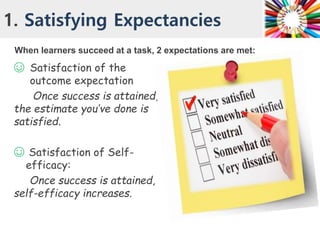
1. Satisfying Expectancies
When learners succeed at a task, 2 expectations are met:
☺ Satisfaction of the
outcome expectation
Once success is attained,
the estimate you’ve done is
satisfied.
☺ Satisfaction of Self-
efficacy:
Once success is attained,
self-efficacy increases.
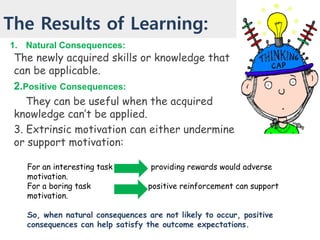
The Results of Learning:
1. Natural Consequences:
The newly acquired skills or knowledge that
can be applicable.
2.Positive Consequences:
They can be useful when the acquired
knowledge can’t be applied.
3. Extrinsic motivation can either undermine
or support motivation:
For an interesting task providing rewards would adverse
motivation.
For a boring task positive reinforcement can support
motivation.
So, when natural consequences are not likely to occur, positive
consequences can help satisfy the outcome expectations.
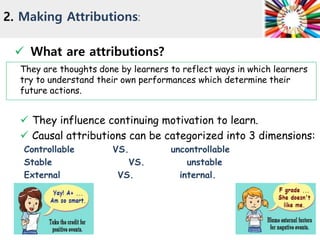
2. Making Attributions:
 What are attributions?
They are thoughts done by learners to reflect ways in which learners
try to understand their own performances which determine their
future actions.
 They influence continuing motivation to learn.
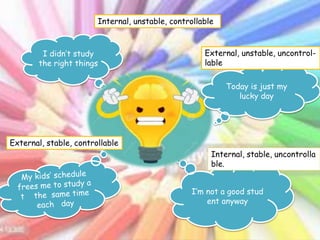
 Causal attributions can be categorized into 3 dimensions:
Controllable VS. uncontrollable
Stable VS. unstable
External VS. internal.
.
I didn’t study
the right things
I’m not a good stud
ent anyway
Today is just my
lucky day
Internal, unstable, controllable
External, unstable, uncontrol-
lable
Internal, stable, uncontrolla
ble.
External, stable, controllable
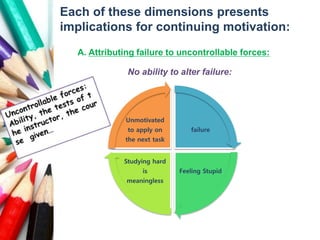
Each of these dimensions presents
implications for continuing motivation:
A. Attributing failure to uncontrollable forces:
No ability to alter failure:
failure
Feeling Stupid
Studying hard
is
meaningless
Unmotivated
to apply on
the next task
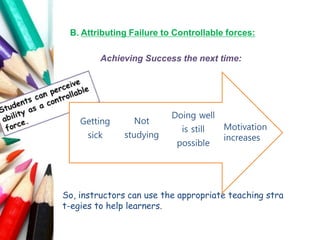
B. Attributing Failure to Controllable forces:
Achieving Success the next time:
Doing well
is still
possible
Not
studying
Getting
sick
Motivation
increases
So, instructors can use the appropriate teaching stra
t-egies to help learners.
Be aware of Cues!
Indirect cues prompt weak students to ascrib
e their failure to law ability.
Help is more likely to be offered when the need f
or help is caused by uncontrollable forces.
Some instructional strategies can
lead to unexpected negative conse
quences for students’ perceptions
of their own abilities.
Self-Regulation
☺To self-regulate is to set goals for your learning, and
then try to observe, regulate and control your cognition,
motivation and behavior.
☺ It involves the use of certain strategies to control
learning, monitor progress, and structure the
environment in ways to support learning.
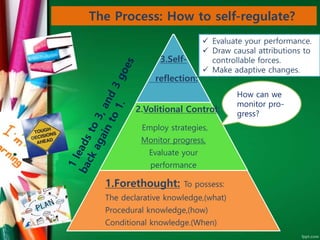
The Process: How to self-regulate?
3.Self-
reflection:
2.Volitional Control:
Employ strategies,
Monitor progress,
Evaluate your
performance
1.Forethought: To possess:
The declarative knowledge,(what)
Procedural knowledge,(how)
Conditional knowledge.(When)
 Evaluate your performance.
 Draw causal attributions to
controllable forces.
 Make adaptive changes.
How can we
monitor pro-
gress?
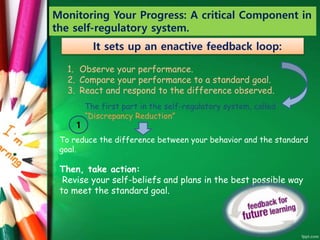
Monitoring Your Progress: A critical Component in
the self-regulatory system.
It sets up an enactive feedback loop:
1. Observe your performance.
2. Compare your performance to a standard goal.
3. React and respond to the difference observed.
The first part in the self-regulatory system, called
“Discrepancy Reduction”
To reduce the difference between your behavior and the standard
goal.
Then, take action:
Revise your self-beliefs and plans in the best possible way
to meet the standard goal.
1
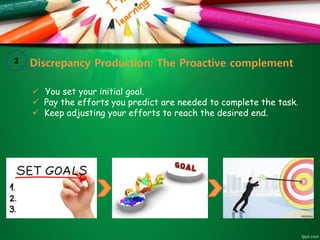
2 Discrepancy Production: The Proactive complement
 You set your initial goal.
 Pay the efforts you predict are needed to complete the task.
 Keep adjusting your efforts to reach the desired end.
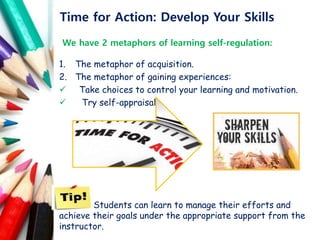
Time for Action: Develop Your Skills
We have 2 metaphors of learning self-regulation:
1. The metaphor of acquisition.
2. The metaphor of gaining experiences:
 Take choices to control your learning and motivation.
 Try self-appraisal.
Students can learn to manage their efforts and
achieve their goals under the appropriate support from the
instructor.
Your Guidelines to Be Self-Regulated:
1. Provide Opportunities for learners:
You have to experience the freedom to choose your
strategies and manage your time.
2. Provide chances for self-appraisals:
You have to modify strategies and efforts, and to
review your goals under the light of the progress
observed.
3. Build or engage within a reflective community:
Living within a reflective community can help you
progress fast in your self-regulation progress.
A Model of Motivational Design:
An Integrated Model to Understand Motivation
☺ Both consequences of achievement and attributions
affect motivation in the future learning task.
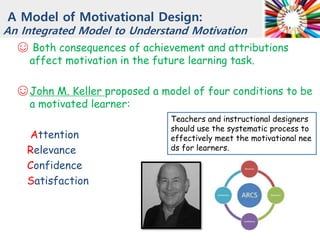
☺John M. Keller proposed a model of four conditions to be
a motivated learner:
Attention
Relevance
Confidence
Satisfaction
Teachers and instructional designers
should use the systematic process to
effectively meet the motivational nee
ds for learners.
Keller’s Recommendations to Develop
Motivation-1
-Problem-solving methods
-Variation in instructional
presentation.
1
2
“Relevance, in its most general sense, refers to those things which
we perceive as instrumental in meeting needs and satisfying
personal desires, including the accomplishment of personal goals”
Keller, 1987
• Unexpected approaches.
• Personal experience and humor.
• Techniques involving a sense of mystery.
• Problem-solving methods.
• Variation in instructional presentations.
• Accomplishing ends-oriented strategy, and
means-orien- ted strategy.
• Utilizing familiar approaches.
Keller’s Recommendations to Develop
Motivation-2
Equity is handled according to the learner’s expectations
and the outcomes of performance.
Application of the ARCS model have ended up with
interesting findings, accomplishing a great deal of
motivational environment.
3
4
3 ways to build
confidence:
• Making what is expected of students clear to
create a positive expectations of success.
• Providing success opportunities for students.
• Giving learners a reasonable degree of self-regul
ation.
• Opportunities to use the newly acquired skills
(natural consequences).
• Usage of positive consequences for accumula-
ting information.
• Apply equity to compare one’s performance to
others’ in the same learning experience.
☺ Motivation is most of the time a problem
in learning.
☺ Learners can be:
Uninterested,
fearful,
disinclined to learn.
☺ Instructors are concerned about how to solve it.
So, how to
solve it?
Motivational Design Process
The motivational design process begins with the consideration of the learner’s
characteristics.
Keller calls this “audience analysis”
Motivational Design Process
Step One: Analyze the audience.
• Who are the learners?
• How are they ready and interested to learn?
• What motivational problems you may face?
• Keller recommends developing an audience profile using
ARCS model.
ARCS Model
• It identifies: -Gaps in motivation
-Over Motivation.
• Requires rating attitude of members in each category:
Based on past exp-
erience with similar
learners.
Interviews with members
of the target population.
1 2
In order to acquire a sense of the audience analysis process, consider
the following hypothetical cases:
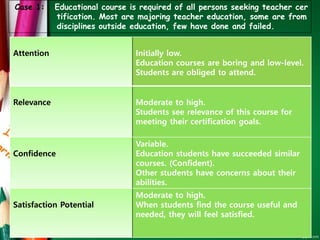
Attention Initially low.
Education courses are boring and low-level.
Students are obliged to attend.
Relevance Moderate to high.
Students see relevance of this course for
meeting their certification goals.
Confidence
Variable.
Education students have succeeded similar
courses. (Confident).
Other students have concerns about their
abilities.
Satisfaction Potential
Moderate to high.
When students find the course useful and
needed, they will feel satisfied.
Case 1: Educational course is required of all persons seeking teacher cer
tification. Most are majoring teacher education, some are from
disciplines outside education, few have done and failed.
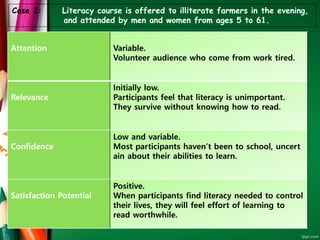
Attention Variable.
Volunteer audience who come from work tired.
Relevance
Initially low.
Participants feel that literacy is unimportant.
They survive without knowing how to read.
Confidence
Low and variable.
Most participants haven’t been to school, uncert
ain about their abilities to learn.
Satisfaction Potential
Positive.
When participants find literacy needed to control
their lives, they will feel effort of learning to
read worthwhile.
Case 2: Literacy course is offered to illiterate farmers in the evening,
and attended by men and women from ages 5 to 61.
Motivational Design Process
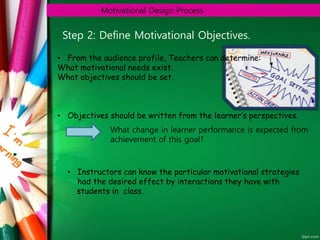
Step 2: Define Motivational Objectives.
• From the audience profile, Teachers can determine:
What motivational needs exist.
What objectives should be set.
• Objectives should be written from the learner’s perspectives.
What change in learner performance is expected from
achievement of this goal?
• Instructors can know the particular motivational strategies
had the desired effect by interactions they have with
students in class.
Motivational Design Process
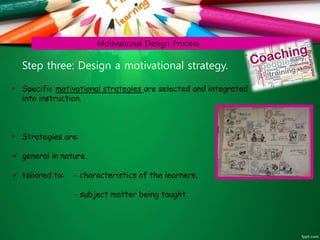
Step three: Design a motivational strategy.
• Specific motivational strategies are selected and integrated
into instruction.
• Strategies are:
 general in nature.
 tailored to: - characteristics of the learners,
- subject matter being taught.
Keller recommends:
1. Brainstorming different ideas for accomplishing motiv-
ational objectives.
2. Selecting ideas that best fit:
☺ students,
☺instructor’s style,
☺content,
☺format of construction,
☺time,
☺available resources.
Motivational Design Process
Step Four: Try out and revise as necessary
• Final step: Trying out the selected strategies in step 3.
• May occur in:
-Field trial of the instruction prior to its actual implementation,
-Formative evaluation of course, Workshop…,
-Natural implementation of the instruction.
Important: Motivation should be thought about separately from other
aspects of instruction
If the strategies are failing to produce desired results, they can be revised
or replaced.
However, sometimes revision of the motivational design is needed because
the audience profile is faulty.
Different instructional methods
might be selected.
Different sequence of
designed activities
OR,

Motivation and learning

  • 1.
  • 2.
    Continuing Motivation We haveto consider 2 forces: 1. The possibility that the expectations and consequences have been met. 2. The attributes done by the learners about the results of learning.
  • 3.
    1. Satisfying Expectancies Whenlearners succeed at a task, 2 expectations are met: ☺ Satisfaction of the outcome expectation Once success is attained, the estimate you’ve done is satisfied. ☺ Satisfaction of Self- efficacy: Once success is attained, self-efficacy increases.
  • 4.
    The Results ofLearning: 1. Natural Consequences: The newly acquired skills or knowledge that can be applicable. 2.Positive Consequences: They can be useful when the acquired knowledge can’t be applied. 3. Extrinsic motivation can either undermine or support motivation: For an interesting task providing rewards would adverse motivation. For a boring task positive reinforcement can support motivation. So, when natural consequences are not likely to occur, positive consequences can help satisfy the outcome expectations.
  • 5.
    2. Making Attributions: What are attributions? They are thoughts done by learners to reflect ways in which learners try to understand their own performances which determine their future actions.  They influence continuing motivation to learn.  Causal attributions can be categorized into 3 dimensions: Controllable VS. uncontrollable Stable VS. unstable External VS. internal. .
  • 6.
    I didn’t study theright things I’m not a good stud ent anyway Today is just my lucky day Internal, unstable, controllable External, unstable, uncontrol- lable Internal, stable, uncontrolla ble. External, stable, controllable
  • 7.
    Each of thesedimensions presents implications for continuing motivation: A. Attributing failure to uncontrollable forces: No ability to alter failure: failure Feeling Stupid Studying hard is meaningless Unmotivated to apply on the next task
  • 8.
    B. Attributing Failureto Controllable forces: Achieving Success the next time: Doing well is still possible Not studying Getting sick Motivation increases So, instructors can use the appropriate teaching stra t-egies to help learners.
  • 9.
    Be aware ofCues! Indirect cues prompt weak students to ascrib e their failure to law ability. Help is more likely to be offered when the need f or help is caused by uncontrollable forces. Some instructional strategies can lead to unexpected negative conse quences for students’ perceptions of their own abilities.
  • 10.
    Self-Regulation ☺To self-regulate isto set goals for your learning, and then try to observe, regulate and control your cognition, motivation and behavior. ☺ It involves the use of certain strategies to control learning, monitor progress, and structure the environment in ways to support learning.
  • 11.
    The Process: Howto self-regulate? 3.Self- reflection: 2.Volitional Control: Employ strategies, Monitor progress, Evaluate your performance 1.Forethought: To possess: The declarative knowledge,(what) Procedural knowledge,(how) Conditional knowledge.(When)  Evaluate your performance.  Draw causal attributions to controllable forces.  Make adaptive changes. How can we monitor pro- gress?
  • 12.
    Monitoring Your Progress:A critical Component in the self-regulatory system. It sets up an enactive feedback loop: 1. Observe your performance. 2. Compare your performance to a standard goal. 3. React and respond to the difference observed. The first part in the self-regulatory system, called “Discrepancy Reduction” To reduce the difference between your behavior and the standard goal. Then, take action: Revise your self-beliefs and plans in the best possible way to meet the standard goal. 1
  • 13.
    2 Discrepancy Production:The Proactive complement  You set your initial goal.  Pay the efforts you predict are needed to complete the task.  Keep adjusting your efforts to reach the desired end.
  • 14.
    Time for Action:Develop Your Skills We have 2 metaphors of learning self-regulation: 1. The metaphor of acquisition. 2. The metaphor of gaining experiences:  Take choices to control your learning and motivation.  Try self-appraisal. Students can learn to manage their efforts and achieve their goals under the appropriate support from the instructor.
  • 15.
    Your Guidelines toBe Self-Regulated: 1. Provide Opportunities for learners: You have to experience the freedom to choose your strategies and manage your time. 2. Provide chances for self-appraisals: You have to modify strategies and efforts, and to review your goals under the light of the progress observed. 3. Build or engage within a reflective community: Living within a reflective community can help you progress fast in your self-regulation progress.
  • 16.
    A Model ofMotivational Design: An Integrated Model to Understand Motivation ☺ Both consequences of achievement and attributions affect motivation in the future learning task. ☺John M. Keller proposed a model of four conditions to be a motivated learner: Attention Relevance Confidence Satisfaction Teachers and instructional designers should use the systematic process to effectively meet the motivational nee ds for learners.
  • 17.
    Keller’s Recommendations toDevelop Motivation-1 -Problem-solving methods -Variation in instructional presentation. 1 2 “Relevance, in its most general sense, refers to those things which we perceive as instrumental in meeting needs and satisfying personal desires, including the accomplishment of personal goals” Keller, 1987 • Unexpected approaches. • Personal experience and humor. • Techniques involving a sense of mystery. • Problem-solving methods. • Variation in instructional presentations. • Accomplishing ends-oriented strategy, and means-orien- ted strategy. • Utilizing familiar approaches.
  • 18.
    Keller’s Recommendations toDevelop Motivation-2 Equity is handled according to the learner’s expectations and the outcomes of performance. Application of the ARCS model have ended up with interesting findings, accomplishing a great deal of motivational environment. 3 4 3 ways to build confidence: • Making what is expected of students clear to create a positive expectations of success. • Providing success opportunities for students. • Giving learners a reasonable degree of self-regul ation. • Opportunities to use the newly acquired skills (natural consequences). • Usage of positive consequences for accumula- ting information. • Apply equity to compare one’s performance to others’ in the same learning experience.
  • 19.
    ☺ Motivation ismost of the time a problem in learning. ☺ Learners can be: Uninterested, fearful, disinclined to learn. ☺ Instructors are concerned about how to solve it. So, how to solve it? Motivational Design Process
  • 20.
    The motivational designprocess begins with the consideration of the learner’s characteristics. Keller calls this “audience analysis”
  • 21.
    Motivational Design Process StepOne: Analyze the audience. • Who are the learners? • How are they ready and interested to learn? • What motivational problems you may face? • Keller recommends developing an audience profile using ARCS model.
  • 22.
    ARCS Model • Itidentifies: -Gaps in motivation -Over Motivation. • Requires rating attitude of members in each category: Based on past exp- erience with similar learners. Interviews with members of the target population. 1 2 In order to acquire a sense of the audience analysis process, consider the following hypothetical cases:
  • 23.
    Attention Initially low. Educationcourses are boring and low-level. Students are obliged to attend. Relevance Moderate to high. Students see relevance of this course for meeting their certification goals. Confidence Variable. Education students have succeeded similar courses. (Confident). Other students have concerns about their abilities. Satisfaction Potential Moderate to high. When students find the course useful and needed, they will feel satisfied. Case 1: Educational course is required of all persons seeking teacher cer tification. Most are majoring teacher education, some are from disciplines outside education, few have done and failed.
  • 24.
    Attention Variable. Volunteer audiencewho come from work tired. Relevance Initially low. Participants feel that literacy is unimportant. They survive without knowing how to read. Confidence Low and variable. Most participants haven’t been to school, uncert ain about their abilities to learn. Satisfaction Potential Positive. When participants find literacy needed to control their lives, they will feel effort of learning to read worthwhile. Case 2: Literacy course is offered to illiterate farmers in the evening, and attended by men and women from ages 5 to 61.
  • 25.
    Motivational Design Process Step2: Define Motivational Objectives. • From the audience profile, Teachers can determine: What motivational needs exist. What objectives should be set. • Objectives should be written from the learner’s perspectives. What change in learner performance is expected from achievement of this goal? • Instructors can know the particular motivational strategies had the desired effect by interactions they have with students in class.
  • 26.
    Motivational Design Process Stepthree: Design a motivational strategy. • Specific motivational strategies are selected and integrated into instruction. • Strategies are:  general in nature.  tailored to: - characteristics of the learners, - subject matter being taught.
  • 27.
    Keller recommends: 1. Brainstormingdifferent ideas for accomplishing motiv- ational objectives. 2. Selecting ideas that best fit: ☺ students, ☺instructor’s style, ☺content, ☺format of construction, ☺time, ☺available resources.
  • 28.
    Motivational Design Process StepFour: Try out and revise as necessary • Final step: Trying out the selected strategies in step 3. • May occur in: -Field trial of the instruction prior to its actual implementation, -Formative evaluation of course, Workshop…, -Natural implementation of the instruction. Important: Motivation should be thought about separately from other aspects of instruction If the strategies are failing to produce desired results, they can be revised or replaced.
  • 29.
    However, sometimes revisionof the motivational design is needed because the audience profile is faulty. Different instructional methods might be selected. Different sequence of designed activities OR,