The Seven C’s of
Effective
Communication
Chapter No.2
Resource Person: Ali Durrani
Introduction
• To compose effective written or oral
messages, you must apply certain
communication principles. These principles
provide guidelines for effective written and
oral communication.
The Seven C’s of Effective Communication
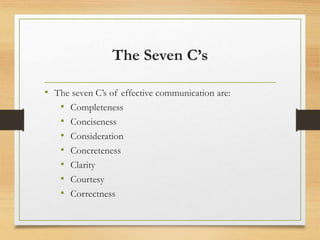
The Seven C’s
• The seven C’s of effective communication are:
• Completeness
• Conciseness
• Consideration
• Concreteness
• Clarity
• Courtesy
• Correctness
1. Completeness
• Your business message is complete when it
contains all facts the reader or listener needs
for the reaction you desire.
• Remember that communicators – senders
and receivers – differ in their mental filters;
they are influenced by their backgrounds,
viewpoints, needs, experiences etc.
1. Completeness – Cont…
• Because of these differences, communication
senders need to assess their messages through
the eyes of receivers to be sure they have
included all relevant information.
• Message receivers – either listeners or readers
– desire complete information to their
questions.
1. Completeness – Cont…
• Completeness offers numerous benefits:
1. Complete messages are more likely to bring
the desired results without the expense of
additional messages.
2. They can do a better job of building
goodwill.
1. Completeness – Cont…
• For completeness, keep the following guidelines in mind:
• Provide all necessary information
When initiating the message, make sure to provide all the information that
reader needs for through and accurate understanding. To make your
message complete; answer 5 ‘W’ & 1 ‘H’ questions including;
1) Who
2) What
3) When
4) Where
5) Why
6) How
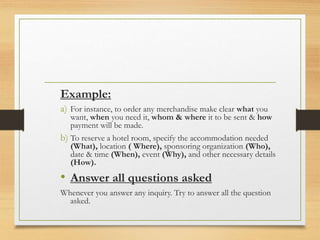
Example:
a) For instance, to order any merchandise make clear what you
want, when you need it, whom & where it to be sent & how
payment will be made.
b) To reserve a hotel room, specify the accommodation needed
(What), location ( Where), sponsoring organization (Who),
date & time (When), event (Why), and other necessary details
(How).
• Answer all questions asked
Whenever you answer any inquiry. Try to answer all the question
asked.
• Give something extra, when desirable
When answering to any inquiry, you must do
more than answering the customer’s situations.
2. Conciseness
• Conciseness is saying what you have to say in the
fewest possible words.
• A concise message is complete without being
wordy.
• It is essential to effective business
communication.
• A concise message saves time and expense for
both sender and receiver.
2. Conciseness – Cont…
• Conciseness contributes to emphasis; by eliminating unnecessary
words, you let important ideas stand out.
• To achieve conciseness, observe the following suggestions:
• Eliminate wordy expressions
You should avoid wordy expressions; consider following;
Example;
 WORDY: At this time
 CONCISE: Now
 WORDY: Due to the fact that
 CONCISE: Because
• Include only relevant material
The effective & concise message should omit not only the
wordy expressions but also irrelevant statement. Observe
following suggestions;
1) Stick to the purpose of message
2) Delete the irrelevant words
3) Omit the information obvious to the receiver
4) Avoid long introductions & explanations etc
5) Get to the important point tactfully & concisely.
• Avoid unnecessary repetition
Sometimes repetition is necessary for emphasis. But when same
thing is said two or three times without reason, message
becomes lengthy & boring. Observe following guidelines to
eliminate repetition;
1) Use shorter name after you have mentioned the long one.
e.g: Institute of Management Sciences & IMS
2) Use pronouns rather than long names:
e.g: It, They or Abbreviations.
3) Cut out all needless repetition of sentences.
3. Consideration
• Consideration means preparing every message
with the message receiver in mind; try to put
yourself in their place. When you are
considerate, you are aware of their desires,
problems, circumstances, emotions, and probable
reactions to your request. Consideration means
understanding of human nature.
• This thoughtful consideration is also called “you-
attitude”.
3. Consideration – Cont…
• Three specific ways to indicate consideration:
• Focus on “you” instead of “I” and “we”.
Example:
We Attitude;
I am delighted to announce that we will be extending our hours to
make shopping more convenient;
You Attitude;
You will be able to shop evenings with the extended hours
• Show audience benefit
Whenever possible & true, show how your receiver will benefit
from the message.
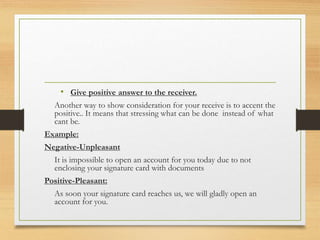
• Give positive answer to the receiver.
Another way to show consideration for your receive is to accent the
positive.. It means that stressing what can be done instead of what
cant be.
Example:
Negative-Unpleasant
It is impossible to open an account for you today due to not
enclosing your signature card with documents
Positive-Pleasant:
As soon your signature card reaches us, we will gladly open an
account for you.
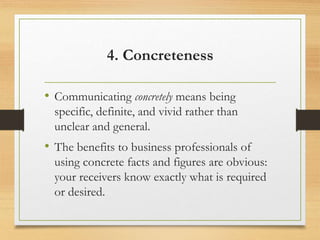
4. Concreteness
• Communicating concretely means being
specific, definite, and vivid rather than
unclear and general.
• The benefits to business professionals of
using concrete facts and figures are obvious:
your receivers know exactly what is required
or desired.
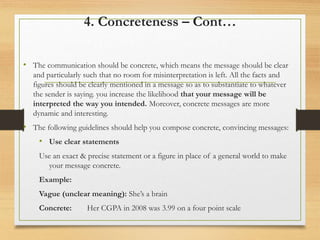
4. Concreteness – Cont…
• The communication should be concrete, which means the message should be clear
and particularly such that no room for misinterpretation is left. All the facts and
figures should be clearly mentioned in a message so as to substantiate to whatever
the sender is saying. you increase the likelihood that your message will be
interpreted the way you intended. Moreover, concrete messages are more
dynamic and interesting.
• The following guidelines should help you compose concrete, convincing messages:
• Use clear statements
Use an exact & precise statement or a figure in place of a general world to make
your message concrete.
Example:
Vague (unclear meaning): She’s a brain
Concrete: Her CGPA in 2008 was 3.99 on a four point scale
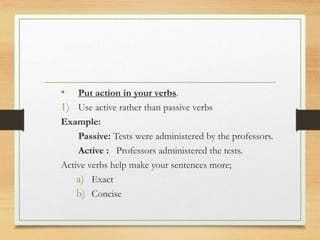
• Put action in your verbs.
1) Use active rather than passive verbs
Example:
Passive: Tests were administered by the professors.
Active : Professors administered the tests.
Active verbs help make your sentences more;
a) Exact
b) Concise
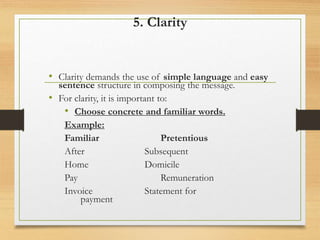
5. Clarity
• Clarity demands the use of simple language and easy
sentence structure in composing the message.
• For clarity, it is important to:
• Choose concrete and familiar words.
Example:
Familiar Pretentious
After Subsequent
Home Domicile
Pay Remuneration
Invoice Statement for
payment
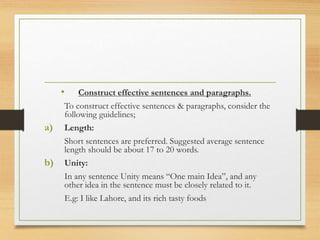
• Construct effective sentences and paragraphs.
To construct effective sentences & paragraphs, consider the
following guidelines;
a) Length:
Short sentences are preferred. Suggested average sentence
length should be about 17 to 20 words.
b) Unity:
In any sentence Unity means “One main Idea”, and any
other idea in the sentence must be closely related to it.
E.g: I like Lahore, and its rich tasty foods
c) Put main idea up front
Put main idea up front within the message.
6. Courtesy
• Courtesy means not only thinking about receiver but
also valuing his feelings.
• Courtesy stems from a sincere you-attitude.
• The following are suggestions for generating a courteous
tone:
• Don’t be blunt
Example
Tactless: Stupid Letter; I cant understand any of it
Tactful: I am sorry, its my understanding, the letter
was not clear.
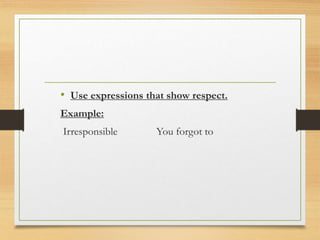
• Use expressions that show respect.
Example:
Irresponsible You forgot to
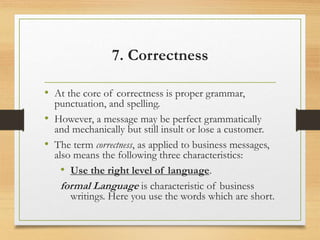
7. Correctness
• At the core of correctness is proper grammar,
punctuation, and spelling.
• However, a message may be perfect grammatically
and mechanically but still insult or lose a customer.
• The term correctness, as applied to business messages,
also means the following three characteristics:
• Use the right level of language.
formal Language is characteristic of business
writings. Here you use the words which are short.
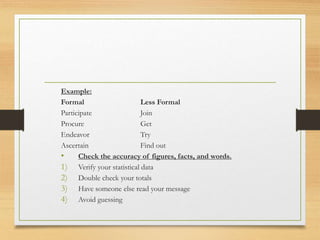
Example:
Formal Less Formal
Participate Join
Procure Get
Endeavor Try
Ascertain Find out
• Check the accuracy of figures, facts, and words.
1) Verify your statistical data
2) Double check your totals
3) Have someone else read your message
4) Avoid guessing
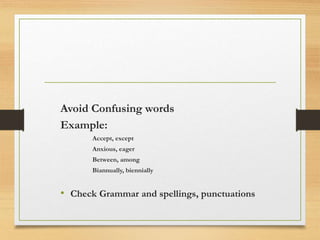
Avoid Confusing words
Example:
Accept, except
Anxious, eager
Between, among
Biannually, biennially
• Check Grammar and spellings, punctuations

Chapter 2 seven_cs

  • 1.
    The Seven C’sof Effective Communication Chapter No.2 Resource Person: Ali Durrani
  • 2.
    Introduction • To composeeffective written or oral messages, you must apply certain communication principles. These principles provide guidelines for effective written and oral communication.
  • 3.
    The Seven C’sof Effective Communication
  • 4.
    The Seven C’s •The seven C’s of effective communication are: • Completeness • Conciseness • Consideration • Concreteness • Clarity • Courtesy • Correctness
  • 5.
    1. Completeness • Yourbusiness message is complete when it contains all facts the reader or listener needs for the reaction you desire. • Remember that communicators – senders and receivers – differ in their mental filters; they are influenced by their backgrounds, viewpoints, needs, experiences etc.
  • 6.
    1. Completeness –Cont… • Because of these differences, communication senders need to assess their messages through the eyes of receivers to be sure they have included all relevant information. • Message receivers – either listeners or readers – desire complete information to their questions.
  • 7.
    1. Completeness –Cont… • Completeness offers numerous benefits: 1. Complete messages are more likely to bring the desired results without the expense of additional messages. 2. They can do a better job of building goodwill.
  • 8.
    1. Completeness –Cont… • For completeness, keep the following guidelines in mind: • Provide all necessary information When initiating the message, make sure to provide all the information that reader needs for through and accurate understanding. To make your message complete; answer 5 ‘W’ & 1 ‘H’ questions including; 1) Who 2) What 3) When 4) Where 5) Why 6) How
  • 9.
    Example: a) For instance,to order any merchandise make clear what you want, when you need it, whom & where it to be sent & how payment will be made. b) To reserve a hotel room, specify the accommodation needed (What), location ( Where), sponsoring organization (Who), date & time (When), event (Why), and other necessary details (How). • Answer all questions asked Whenever you answer any inquiry. Try to answer all the question asked.
  • 10.
    • Give somethingextra, when desirable When answering to any inquiry, you must do more than answering the customer’s situations.
  • 11.
    2. Conciseness • Concisenessis saying what you have to say in the fewest possible words. • A concise message is complete without being wordy. • It is essential to effective business communication. • A concise message saves time and expense for both sender and receiver.
  • 12.
    2. Conciseness –Cont… • Conciseness contributes to emphasis; by eliminating unnecessary words, you let important ideas stand out. • To achieve conciseness, observe the following suggestions: • Eliminate wordy expressions You should avoid wordy expressions; consider following; Example;  WORDY: At this time  CONCISE: Now  WORDY: Due to the fact that  CONCISE: Because
  • 13.
    • Include onlyrelevant material The effective & concise message should omit not only the wordy expressions but also irrelevant statement. Observe following suggestions; 1) Stick to the purpose of message 2) Delete the irrelevant words 3) Omit the information obvious to the receiver 4) Avoid long introductions & explanations etc 5) Get to the important point tactfully & concisely.
  • 14.
    • Avoid unnecessaryrepetition Sometimes repetition is necessary for emphasis. But when same thing is said two or three times without reason, message becomes lengthy & boring. Observe following guidelines to eliminate repetition; 1) Use shorter name after you have mentioned the long one. e.g: Institute of Management Sciences & IMS 2) Use pronouns rather than long names: e.g: It, They or Abbreviations. 3) Cut out all needless repetition of sentences.
  • 15.
    3. Consideration • Considerationmeans preparing every message with the message receiver in mind; try to put yourself in their place. When you are considerate, you are aware of their desires, problems, circumstances, emotions, and probable reactions to your request. Consideration means understanding of human nature. • This thoughtful consideration is also called “you- attitude”.
  • 16.
    3. Consideration –Cont… • Three specific ways to indicate consideration: • Focus on “you” instead of “I” and “we”. Example: We Attitude; I am delighted to announce that we will be extending our hours to make shopping more convenient; You Attitude; You will be able to shop evenings with the extended hours • Show audience benefit Whenever possible & true, show how your receiver will benefit from the message.
  • 17.
    • Give positiveanswer to the receiver. Another way to show consideration for your receive is to accent the positive.. It means that stressing what can be done instead of what cant be. Example: Negative-Unpleasant It is impossible to open an account for you today due to not enclosing your signature card with documents Positive-Pleasant: As soon your signature card reaches us, we will gladly open an account for you.
  • 18.
    4. Concreteness • Communicatingconcretely means being specific, definite, and vivid rather than unclear and general. • The benefits to business professionals of using concrete facts and figures are obvious: your receivers know exactly what is required or desired.
  • 19.
    4. Concreteness –Cont… • The communication should be concrete, which means the message should be clear and particularly such that no room for misinterpretation is left. All the facts and figures should be clearly mentioned in a message so as to substantiate to whatever the sender is saying. you increase the likelihood that your message will be interpreted the way you intended. Moreover, concrete messages are more dynamic and interesting. • The following guidelines should help you compose concrete, convincing messages: • Use clear statements Use an exact & precise statement or a figure in place of a general world to make your message concrete. Example: Vague (unclear meaning): She’s a brain Concrete: Her CGPA in 2008 was 3.99 on a four point scale
  • 20.
    • Put actionin your verbs. 1) Use active rather than passive verbs Example: Passive: Tests were administered by the professors. Active : Professors administered the tests. Active verbs help make your sentences more; a) Exact b) Concise
  • 21.
    5. Clarity • Claritydemands the use of simple language and easy sentence structure in composing the message. • For clarity, it is important to: • Choose concrete and familiar words. Example: Familiar Pretentious After Subsequent Home Domicile Pay Remuneration Invoice Statement for payment
  • 22.
    • Construct effectivesentences and paragraphs. To construct effective sentences & paragraphs, consider the following guidelines; a) Length: Short sentences are preferred. Suggested average sentence length should be about 17 to 20 words. b) Unity: In any sentence Unity means “One main Idea”, and any other idea in the sentence must be closely related to it. E.g: I like Lahore, and its rich tasty foods
  • 23.
    c) Put mainidea up front Put main idea up front within the message.
  • 24.
    6. Courtesy • Courtesymeans not only thinking about receiver but also valuing his feelings. • Courtesy stems from a sincere you-attitude. • The following are suggestions for generating a courteous tone: • Don’t be blunt Example Tactless: Stupid Letter; I cant understand any of it Tactful: I am sorry, its my understanding, the letter was not clear.
  • 25.
    • Use expressionsthat show respect. Example: Irresponsible You forgot to
  • 26.
    7. Correctness • Atthe core of correctness is proper grammar, punctuation, and spelling. • However, a message may be perfect grammatically and mechanically but still insult or lose a customer. • The term correctness, as applied to business messages, also means the following three characteristics: • Use the right level of language. formal Language is characteristic of business writings. Here you use the words which are short.
  • 27.
    Example: Formal Less Formal ParticipateJoin Procure Get Endeavor Try Ascertain Find out • Check the accuracy of figures, facts, and words. 1) Verify your statistical data 2) Double check your totals 3) Have someone else read your message 4) Avoid guessing
  • 28.
    Avoid Confusing words Example: Accept,except Anxious, eager Between, among Biannually, biennially • Check Grammar and spellings, punctuations