The views expressed in this presentation are the views of the author/s and do not necessarily reflect the views or policies of the Asian
Development Bank, or its Board of Governors, or the governments they represent. ADB does not guarantee the accuracy of the data included
in this presentation and accepts no responsibility for any consequence of their use. The countries listed in this presentation do not imply any
view on ADB's part as to sovereignty or independent status or necessarily conform to ADB's terminology.
Driving Staff Engagement
Olivier Serrat
2014
Coming of Age
A committed and willing workforce brings
substantial benefits: lest we forget,
organizations are communities, the members
of which want worthwhile jobs that inspire
them. However, formal relationships cannot
by themselves be expected to conduce these
entirely: implicit employer–employee
exchanges matter. Belatedly, we concede
that perceptions of an organization's rules,
ethos, and capabilities, not just the
experience staff have of human resource
practices, drive levels of effort and
associated degrees of job satisfaction.
The Dimensions of Engagement
There are four dimensions to engagement: (i)
cognitive (or intellectual)—thinking hard
about one's profession and how one might
perform it better; (ii) emotional (or
affective)—feeling good about doing a good
job; (iii) social—taking opportunities to
discuss work-related improvements with
others; and, even if literature rarely mentions
it, (iv) physical—mustering the stamina to "go
the extra mile".
The Benefits of Engagement
Personnel engage when they feel
appreciated and involved: this encourages
correct focus and enthusiasm about work
as well as mindful proactivity and
persistence in the conduct of it. Not
surprisingly, high levels of engagement
benefit organizations: in the absence of
barriers, outcome range widely but
include increased profitability, higher
productivity, contributions to innovation,
and lower staff turnover.
Barriers to Staff Engagement
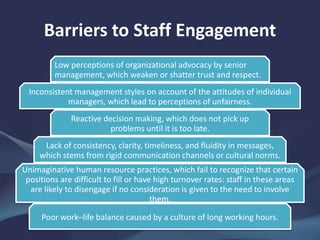
Low perceptions of organizational advocacy by senior
management, which weaken or shatter trust and respect.
Inconsistent management styles on account of the attitudes of individual
managers, which lead to perceptions of unfairness.
Reactive decision making, which does not pick up
problems until it is too late.
Lack of consistency, clarity, timeliness, and fluidity in messages,
which stems from rigid communication channels or cultural norms.
Unimaginative human resource practices, which fail to recognize that certain
positions are difficult to fill or have high turnover rates: staff in these areas
are likely to disengage if no consideration is given to the need to involve
them.
Poor work–life balance caused by a culture of long working hours.
Driving Engagement
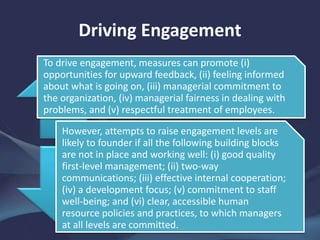
To drive engagement, measures can promote (i)
opportunities for upward feedback, (ii) feeling informed
about what is going on, (iii) managerial commitment to
the organization, (iv) managerial fairness in dealing with
problems, and (v) respectful treatment of employees.
However, attempts to raise engagement levels are
likely to founder if all the following building blocks
are not in place and working well: (i) good quality
first-level management; (ii) two-way
communications; (iii) effective internal cooperation;
(iv) a development focus; (v) commitment to staff
well-being; and (vi) clear, accessible human
resource policies and practices, to which managers
at all levels are committed.
12 Elements of Critical Business
Outcomes
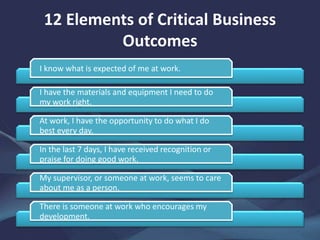
I know what is expected of me at work.
I have the materials and equipment I need to do
my work right.
At work, I have the opportunity to do what I do
best every day.
In the last 7 days, I have received recognition or
praise for doing good work.
My supervisor, or someone at work, seems to care
about me as a person.
There is someone at work who encourages my
development.
12 Elements of Critical Business
Outcomes
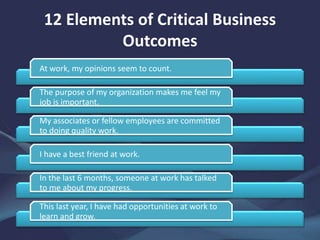
At work, my opinions seem to count.
The purpose of my organization makes me feel my
job is important.
My associates or fellow employees are committed
to doing quality work.
I have a best friend at work.
In the last 6 months, someone at work has talked
to me about my progress.
This last year, I have had opportunities at work to
learn and grow.
Further Reading
• ADB. 2009. Understanding and Developing Emotional
Intelligence. Manila.
www.adb.org/publications/understanding-developing-
emotional-intelligence
• ——. 2009. Building Trust in the Workplace. Manila.
www.adb.org/publications/building-trust-in-the-workplace
• ——. 2009. Harnessing Creativity and Innovation in the
Workplace. Manila. www.adb.org/publications/harnessing-
creativity-and-innovation-in-the-workplace
• ——. 2009. Leading in the Workplace. Manila.
www.adb.org/publications/leading-in-the-workplace
Further Reading
• ADB. 2009. Exercising Servant Leadership. Manila.
www.adb.org/publications/exercising-servant-leadership
• ——. 2009. Distributing Leadership. Manila.
www.adb.org/publications/distributing-leadership
• ——. 2010. New-Age Branding and the Public Sector. Manila.
www.adb.org/publications/new-age-branding-and-the-public-
sector
• ——. 2010. A Primer on Talent Management. Manila.
www.adb.org/publications/primer-on-talent-management
• ——. 2010. A Primer on Corporate Values. Manila.
www.adb.org/publications/primer-on-corporate-values
Further Reading
• ADB. 2010. Bridging Organizational Silos. Manila.
www.adb.org/publications/bridging-organizational-silos
• ——. 2010. A Primer on Social Neuroscience. Manila.
www.adb.org/publications/primer-on-social-neuroscience
• ——. 2010. Informal Authority in the Workplace. Manila.
www.adb.org/publications/informal-authority-in-the-
workplace
• ——. 2010. Engaging Staff in the Workplace. Manila.
www.adb.org/publications/engaging-staff-workplace
Videos
• ADB. 2011. Building a Knowledge-Centric Organization:
Organization, People, Knowledge, and Technology for
Learning. Manila. vimeo.com/72471320
• ——. 2012. Harvesting Knowledge. Manila.
vimeo.com/67185512
• ——. 2012. Showcasing Knowledge. Manila.
vimeo.com/67185514
• ——. 2013. Managing Knowledge in Project Environments.
Manila. vimeo.com/77666878
• ——. 2013. The Empowerment of ADB-Hosted Communities of
Practice. Manila. vimeo.com/77752558
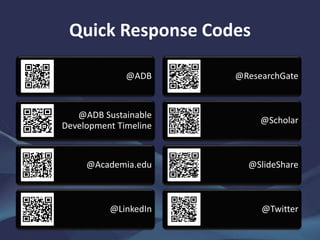
Quick Response Codes
@ADB
@ADB Sustainable
Development Timeline
@Academia.edu
@LinkedIn
@ResearchGate
@Scholar
@SlideShare
@Twitter

Driving Staff Engagement

  • 1.
    The views expressedin this presentation are the views of the author/s and do not necessarily reflect the views or policies of the Asian Development Bank, or its Board of Governors, or the governments they represent. ADB does not guarantee the accuracy of the data included in this presentation and accepts no responsibility for any consequence of their use. The countries listed in this presentation do not imply any view on ADB's part as to sovereignty or independent status or necessarily conform to ADB's terminology. Driving Staff Engagement Olivier Serrat 2014
  • 2.
    Coming of Age Acommitted and willing workforce brings substantial benefits: lest we forget, organizations are communities, the members of which want worthwhile jobs that inspire them. However, formal relationships cannot by themselves be expected to conduce these entirely: implicit employer–employee exchanges matter. Belatedly, we concede that perceptions of an organization's rules, ethos, and capabilities, not just the experience staff have of human resource practices, drive levels of effort and associated degrees of job satisfaction.
  • 3.
    The Dimensions ofEngagement There are four dimensions to engagement: (i) cognitive (or intellectual)—thinking hard about one's profession and how one might perform it better; (ii) emotional (or affective)—feeling good about doing a good job; (iii) social—taking opportunities to discuss work-related improvements with others; and, even if literature rarely mentions it, (iv) physical—mustering the stamina to "go the extra mile".
  • 4.
    The Benefits ofEngagement Personnel engage when they feel appreciated and involved: this encourages correct focus and enthusiasm about work as well as mindful proactivity and persistence in the conduct of it. Not surprisingly, high levels of engagement benefit organizations: in the absence of barriers, outcome range widely but include increased profitability, higher productivity, contributions to innovation, and lower staff turnover.
  • 5.
    Barriers to StaffEngagement Low perceptions of organizational advocacy by senior management, which weaken or shatter trust and respect. Inconsistent management styles on account of the attitudes of individual managers, which lead to perceptions of unfairness. Reactive decision making, which does not pick up problems until it is too late. Lack of consistency, clarity, timeliness, and fluidity in messages, which stems from rigid communication channels or cultural norms. Unimaginative human resource practices, which fail to recognize that certain positions are difficult to fill or have high turnover rates: staff in these areas are likely to disengage if no consideration is given to the need to involve them. Poor work–life balance caused by a culture of long working hours.
  • 6.
    Driving Engagement To driveengagement, measures can promote (i) opportunities for upward feedback, (ii) feeling informed about what is going on, (iii) managerial commitment to the organization, (iv) managerial fairness in dealing with problems, and (v) respectful treatment of employees. However, attempts to raise engagement levels are likely to founder if all the following building blocks are not in place and working well: (i) good quality first-level management; (ii) two-way communications; (iii) effective internal cooperation; (iv) a development focus; (v) commitment to staff well-being; and (vi) clear, accessible human resource policies and practices, to which managers at all levels are committed.
  • 7.
    12 Elements ofCritical Business Outcomes I know what is expected of me at work. I have the materials and equipment I need to do my work right. At work, I have the opportunity to do what I do best every day. In the last 7 days, I have received recognition or praise for doing good work. My supervisor, or someone at work, seems to care about me as a person. There is someone at work who encourages my development.
  • 8.
    12 Elements ofCritical Business Outcomes At work, my opinions seem to count. The purpose of my organization makes me feel my job is important. My associates or fellow employees are committed to doing quality work. I have a best friend at work. In the last 6 months, someone at work has talked to me about my progress. This last year, I have had opportunities at work to learn and grow.
  • 9.
    Further Reading • ADB.2009. Understanding and Developing Emotional Intelligence. Manila. www.adb.org/publications/understanding-developing- emotional-intelligence • ——. 2009. Building Trust in the Workplace. Manila. www.adb.org/publications/building-trust-in-the-workplace • ——. 2009. Harnessing Creativity and Innovation in the Workplace. Manila. www.adb.org/publications/harnessing- creativity-and-innovation-in-the-workplace • ——. 2009. Leading in the Workplace. Manila. www.adb.org/publications/leading-in-the-workplace
  • 10.
    Further Reading • ADB.2009. Exercising Servant Leadership. Manila. www.adb.org/publications/exercising-servant-leadership • ——. 2009. Distributing Leadership. Manila. www.adb.org/publications/distributing-leadership • ——. 2010. New-Age Branding and the Public Sector. Manila. www.adb.org/publications/new-age-branding-and-the-public- sector • ——. 2010. A Primer on Talent Management. Manila. www.adb.org/publications/primer-on-talent-management • ——. 2010. A Primer on Corporate Values. Manila. www.adb.org/publications/primer-on-corporate-values
  • 11.
    Further Reading • ADB.2010. Bridging Organizational Silos. Manila. www.adb.org/publications/bridging-organizational-silos • ——. 2010. A Primer on Social Neuroscience. Manila. www.adb.org/publications/primer-on-social-neuroscience • ——. 2010. Informal Authority in the Workplace. Manila. www.adb.org/publications/informal-authority-in-the- workplace • ——. 2010. Engaging Staff in the Workplace. Manila. www.adb.org/publications/engaging-staff-workplace
  • 12.
    Videos • ADB. 2011.Building a Knowledge-Centric Organization: Organization, People, Knowledge, and Technology for Learning. Manila. vimeo.com/72471320 • ——. 2012. Harvesting Knowledge. Manila. vimeo.com/67185512 • ——. 2012. Showcasing Knowledge. Manila. vimeo.com/67185514 • ——. 2013. Managing Knowledge in Project Environments. Manila. vimeo.com/77666878 • ——. 2013. The Empowerment of ADB-Hosted Communities of Practice. Manila. vimeo.com/77752558
  • 13.
    Quick Response Codes @ADB @ADBSustainable Development Timeline @Academia.edu @LinkedIn @ResearchGate @Scholar @SlideShare @Twitter