Most Missed Questions
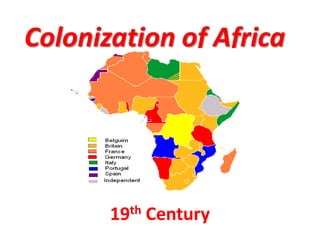
Colonization of Africa


       19th Century
Colonialism
Colonialism is forced control of one nation by another nation.
Colony is when a nation establishes a government under its rule
in a foreign territory.
Imperialism is empire building by taking over other countries’
government’s trade, and culture.

  • Beginning in the early 19th Century, Europeans aggressively
    tried to establish colonies in Africa.
  • European civilization experienced a period of unprecedented
    rapid expansion around the globe during the last third of the
    nineteenth century.
Reasons for Colonialism
• Despite Europeans involvement in the Slave
  Trade Europeans usually relied on Africans to
  trade slaves instead of colonizing the
  continent.
• By the 1880s every major nation in the world
  had abolished the institution of slavery.
• Europeans found a new interest in Africa.
• Africa is a continent of vast wealth.
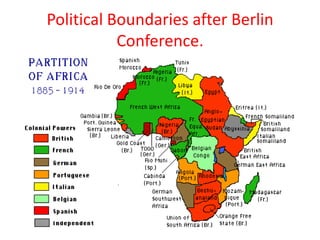
Political Boundaries after Berlin
           Conference.
Who were the European colonial powers that
 took control of the African tribes land and their
 way of life?
     Belgium
         Britain
            France
               Germany
                 Italy
                   Portugal
                      Spain
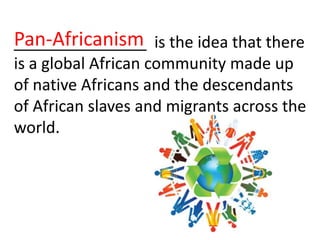
Pan-Africanism is the idea that there
_______________
is a global African community made up
of native Africans and the descendants
of African slaves and migrants across the
world.
Pan- African Movement
• Began in the late 1800’s to early 1900’s as way to secure equal
  rights, self-government, independence, and unity for African
  peoples.
 • Inspired by Marcus Garvey, it encouraged self-awareness on
   the part of Africans by encouraging the study of their history
   and culture.
• The Pan-African Movement marked the beginning of the
  Nationalist Movements that started to sweep across the
  continent.
Pan- African Movement
• Pan-African movement led to the founding of the African
  Union in 2001.
• African Union: sought to unite Africans to improve conditions
  across the continent.
• GOALS OF AU
   – Economic growth
   – End poverty and starvation
   – Advancement of women’s rights, improve education
   – End African wars
South Africa
• In 1948 the racist Nationalist Party defeated English-
  speaking whites and was elected to power. Now the
  Afrikaners had complete control of South Africa’s
  government.
• Afrikaners established “Apartheid”. This is an Afrikaan
  word meaning “separateness” an official policy of
  racial discrimination.
• Apartheid stripped black Africans of the few rights
  they enjoyed and required segregation. The South
  African government tried to completely separate the
  small number of whites from the black majority.
African National Congress (ANC)
• Founded in 1912, goal was to unite people of all
  races to fight for rights and freedoms.
• Nelson Mandela in 1944 founded the ANC Youth
  League.
• Purpose was to raise up a new generation to fight
  against racism and apartheid.
• Nelson Mandela became the leader of the ANC in
  1961. Mandela was an anti-apartheid activist.
• Afrikaners passed laws outlawing the ANC and
  other groups. Mandela will be imprisoned for 27
  years for his involvement with the ANC.
Key Vocabulary
Civil War: A war between groups or regions of the same country in order to gain political
power.
 Genocide: systematic and planned extermination of an entire national, racial, political, or
  ethnic group.

 HIV/AIDS: human immunodeficiency virus- virus that causes AIDS

 AIDS-acquired immunodeficiency syndrome: a disease of the immune system caused by HIV
  which makes the infected person vulnerable to other diseases and which can result in death.


 Malaria-a tropical disease spread by mosquitoes.

 Famine- widespread food shortage that causes malnutrition and starvation.

 Refugees-people who flee a country, often to escape war or persecution.

 Epidemic diseases-diseases which spread quickly and become widely prevalent throughout a
  given region.
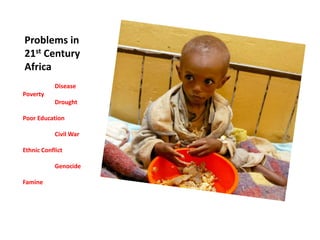
Problems in
21st Century
Africa
            Disease
Poverty
            Drought

Poor Education

            Civil War

Ethnic Conflict

            Genocide

Famine
Issues facing Africa Today
• Independence brought freedom but it also ushered in a
  new era of hardships.
• One of the biggest issues facing Africa today is famine.
  What is famine?
• Large portions of Africa are dealing with droughts that
  cause mass starvation.
• The population of Africa grows at a faster rate than
  many countries can industrialize, therefore leaving
  many countries unable to feed all of their people.
• In Ethiopia, Somalia, and the Sudan starvation is
  common place.
Disease
 HIV/AIDS is one of the leading causes of death in Africa.
 Acquired Immunodeficiency Syndrome
 No known cure for the disease, the rate of infection is due largely to
  poverty and poor education.
 Better education on the disease and how it spreads would help
  reduce the number of new cases.
 Malaria is a tropical disease spreading throughout the region carried
  by mosquitoes.
 Each year more than 1 million die from this disease. Children in Sub-
  Saharan Africa are most at risk.
 For instance malaria is the leading cause of death in children under
  five in Uganda.
 Insecticides and mosquito nets can drastically lower the number of
  infections.
Origins of Judaism
Judaism is the oldest of the three religions.
It began as a set of beliefs and laws practiced by
 ancient Hebrew people in Southwest Asia.
Its book is the Hebrew Bible – aka The Torah.
Jews believe that one day a human leader will come
 as a messenger of God and bring about a golden age.
They call this leader the messiah. In Greek versions of
 the Bible, messiah is written as christos, the anointed
 one.
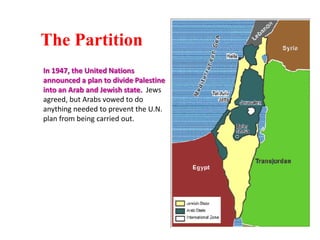
The Partition
In 1947, the United Nations
announced a plan to divide Palestine
into an Arab and Jewish state. Jews
agreed, but Arabs vowed to do
anything needed to prevent the U.N.
plan from being carried out.
Six DayWar-1967
 Israel captures territories that were under the control of the
 Palestinians. These areas include________________,
 _____________, and ________________.
                        Gaza
 These territories are still under dispute by the Palestinians who
      The West Bank
 view any Jewish settlement hereEast invasion of their land.
                                    as an Jerusalem
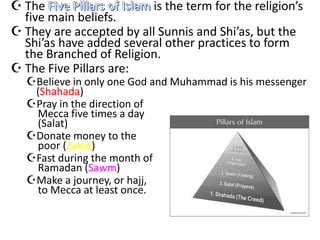
 The Five Pillars of Islam is the term for the religion’s
  five main beliefs.
 They are accepted by all Sunnis and Shi’as, but the
  Shi’as have added several other practices to form
  the Branched of Religion.
 The Five Pillars are:
   Believe in only one God and Muhammad is his messenger
    (Shahada)
   Pray in the direction of
    Mecca five times a day
    (Salat)
   Donate money to the
    poor (Zakat)
   Fast during the month of
    Ramadan (Sawm)
   Make a journey, or hajj,
    to Mecca at least once.
Origins of Christianity
In 30 CE, a Jew named Jesus began preaching
 new ideas about Judaism in Roman-controlled
 Judea.
The later title of Jesus Christ given to Jesus is a
 reference to the belief by his followers that he
 is the Jewish messiah.
 According to the Christian New Testament, Jesus
  preached only to his fellow Jews.
 His idea was that the old laws of Judaism should be
  replaced by a simpler system based on love of one's
  fellow human beings.
 He began to grow popular.
 Jewish leaders did not want Jesus to threaten their
  power and asked the Romans to arrest him.
 The Romans found him guilty of speaking against
  Jewish laws and sentenced him to death by
  crucifixion, or being hung on a cross.
 He died in 33 CE, after preaching for only three years.
Before India became an independent country,


 India’s Muslims were afraid they would not have a say in the new
 government, once Britain granted independence.

 To avoid a civil war, the British government agreed to the
 partition of India.

 In 1947, India gained independence, and the country of Pakistan
 was formed for Muslims. About 10 million people crossed the
 border into Pakistan.

 Soon after these 2 countries were formed, other countries in the
 region gained their independence from Britain as well.
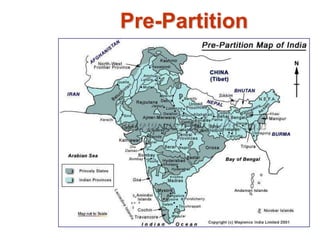
Pre-Partition
Great Leap
            Forward, 1958
► Set   up a command economy which is what?

►5 year plan to increase agriculture
 and industry
Communes
    Groups of people who live and work
     together
    Property held in common
    Had production quotas

► Failed due to poor quality of
  products, poor weather hurt
  agriculture
►Millions of Chinese starved during this period due to improper
economic planning.
Communist China
      Under Mao
► Industrialized China
► Increased literacy
► Class privileges ended
► Rural Chinese received health
  care
► One-party dictatorship
► Denied people basic rights and
  freedoms --> Inner Mongolia,
  Tibet
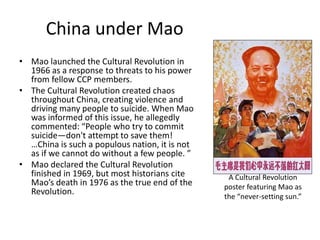
China under Mao
• Mao launched the Cultural Revolution in
  1966 as a response to threats to his power
  from fellow CCP members.
• The Cultural Revolution created chaos
  throughout China, creating violence and
  driving many people to suicide. When Mao
  was informed of this issue, he allegedly
  commented: “People who try to commit
  suicide—don't attempt to save them!
  …China is such a populous nation, it is not
  as if we cannot do without a few people. ”
• Mao declared the Cultural Revolution
  finished in 1969, but most historians cite     A Cultural Revolution
  Mao’s death in 1976 as the true end of the    poster featuring Mao as
  Revolution.
                                                the “never-setting sun.”
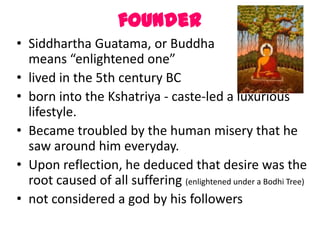
founder
• Siddhartha Guatama, or Buddha                 which
  means “enlightened one”
• lived in the 5th century BC
• born into the Kshatriya - caste-led a luxurious
  lifestyle.
• Became troubled by the human misery that he
  saw around him everyday.
• Upon reflection, he deduced that desire was the
  root caused of all suffering (enlightened under a Bodhi Tree)
• not considered a god by his followers
Four Noble Truths
1. There is suffering in the
  world. To live is to
  suffer. (Dukkha)
  The Buddha found this
    out when he was young
    and experienced
    suffering and death in
    others.
Four Noble Truths
2. The cause of
  suffering is self-
  centered desire and
  attachments. (Tanha)
Question from your reading:

• What is the term for a state of
  “Perfect Peace”?

           Nirvana
Four Noble Truths
3. The solution is to
  eliminate desire and
  attachments.
  (Nirvana = “extinction”)
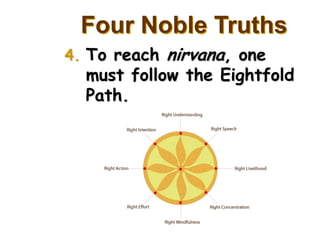
Four Noble Truths
4. To reach nirvana, one
  must follow the Eightfold
  Path.
Major Beliefs
1. The Four Noble Truths Siddhartha's            philosophy of
    the nature of human suffering and its relation to desire is
    articulated by these four statements:
•   Life is full of pain and suffering.
•   Human desire causes this suffering.
•   By putting an end to desire, humans can end
    suffering.
•   Humans can end desire by following the Eightfold
    Path.
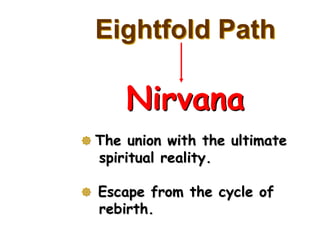
Eightfold Path

      Nirvana
 The union with the ultimate
  spiritual reality.

 Escape from the cycle of
  rebirth.
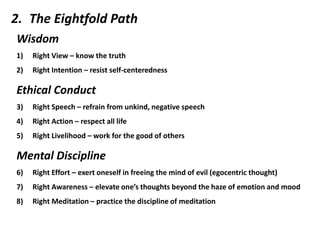
2. The Eightfold Path
Wisdom
1)   Right View – know the truth
2)   Right Intention – resist self-centeredness

Ethical Conduct
3)   Right Speech – refrain from unkind, negative speech
4)   Right Action – respect all life
5)   Right Livelihood – work for the good of others

Mental Discipline
6)   Right Effort – exert oneself in freeing the mind of evil (egocentric thought)
7)   Right Awareness – elevate one’s thoughts beyond the haze of emotion and mood
8)   Right Meditation – practice the discipline of meditation
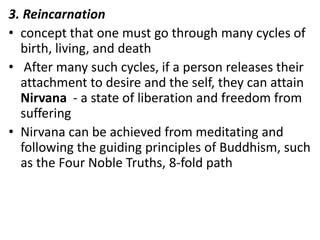
3. Reincarnation
• concept that one must go through many cycles of
  birth, living, and death
• After many such cycles, if a person releases their
  attachment to desire and the self, they can attain
  Nirvana - a state of liberation and freedom from
  suffering
• Nirvana can be achieved from meditating and
  following the guiding principles of Buddhism, such
  as the Four Noble Truths, 8-fold path
4. Karma - the law that every cause has an
  effect, i.e., our actions have results. This explains a
  number of things: inequality in the world, why some are born
  handicapped and some gifted, why some live only a short life. Buddhists
  believe that our are past actions have an effect on who or what we are in
  our next life.

5. Caste System is rejected by Buddhists
Causes of Pollution
• China’s and India’s economic and urban growth has
  caused serious issues for the environment.
• Seven of the ten most polluted cities are located in
  China.
• And India’s more than 1 billion people make it the
  second most populous country behind China
  – Pollution-
      • Caused by the increased number of cars and factories
        and also the burning of coal for electricity in China.
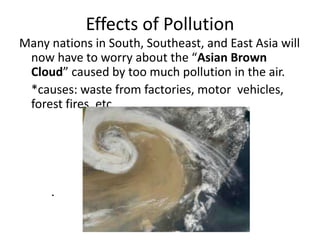
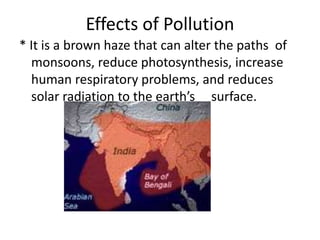
Effects of Pollution
Many nations in South, Southeast, and East Asia will
 now have to worry about the “Asian Brown
 Cloud” caused by too much pollution in the air.
 *causes: waste from factories, motor vehicles,
 forest fires, etc.


     .
Effects of Pollution
* It is a brown haze that can alter the paths of
  monsoons, reduce photosynthesis, increase
  human respiratory problems, and reduces
  solar radiation to the earth’s surface.
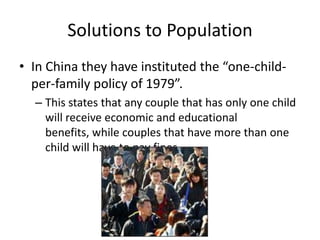
Solutions to Population
• In China they have instituted the “one-child-
  per-family policy of 1979”.
  – This states that any couple that has only one child
    will receive economic and educational
    benefits, while couples that have more than one
    child will have to pay fines.
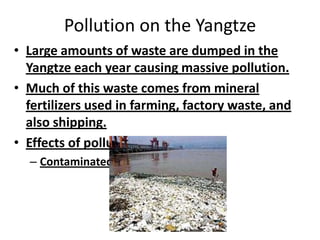
Pollution on the Yangtze
• Large amounts of waste are dumped in the
  Yangtze each year causing massive pollution.
• Much of this waste comes from mineral
  fertilizers used in farming, factory waste, and
  also shipping.
• Effects of pollution:
  – Contaminated drinking water
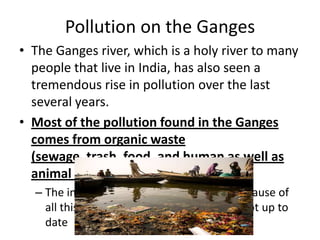
Pollution on the Ganges
• The Ganges river, which is a holy river to many
  people that live in India, has also seen a
  tremendous rise in pollution over the last
  several years.
• Most of the pollution found in the Ganges
  comes from organic waste
  (sewage, trash, food, and human as well as
  animal remains)
  – The increase in India’s population is the cause of
    all this waste– the sewage systems are not up to
    date
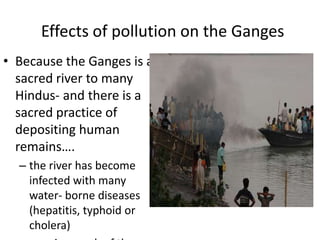
Effects of pollution on the Ganges
• Because the Ganges is a
  sacred river to many
  Hindus- and there is a
  sacred practice of
  depositing human
  remains….
  – the river has become
    infected with many
    water- borne diseases
    (hepatitis, typhoid or
    cholera)

Most missed questions review

  • 1.
  • 2.
  • 3.
    Colonialism Colonialism is forcedcontrol of one nation by another nation. Colony is when a nation establishes a government under its rule in a foreign territory. Imperialism is empire building by taking over other countries’ government’s trade, and culture. • Beginning in the early 19th Century, Europeans aggressively tried to establish colonies in Africa. • European civilization experienced a period of unprecedented rapid expansion around the globe during the last third of the nineteenth century.
  • 4.
    Reasons for Colonialism •Despite Europeans involvement in the Slave Trade Europeans usually relied on Africans to trade slaves instead of colonizing the continent. • By the 1880s every major nation in the world had abolished the institution of slavery. • Europeans found a new interest in Africa. • Africa is a continent of vast wealth.
  • 5.
    Political Boundaries afterBerlin Conference.
  • 6.
    Who were theEuropean colonial powers that took control of the African tribes land and their way of life? Belgium Britain France Germany Italy Portugal Spain
  • 7.
    Pan-Africanism is theidea that there _______________ is a global African community made up of native Africans and the descendants of African slaves and migrants across the world.
  • 8.
    Pan- African Movement •Began in the late 1800’s to early 1900’s as way to secure equal rights, self-government, independence, and unity for African peoples. • Inspired by Marcus Garvey, it encouraged self-awareness on the part of Africans by encouraging the study of their history and culture. • The Pan-African Movement marked the beginning of the Nationalist Movements that started to sweep across the continent.
  • 9.
    Pan- African Movement •Pan-African movement led to the founding of the African Union in 2001. • African Union: sought to unite Africans to improve conditions across the continent. • GOALS OF AU – Economic growth – End poverty and starvation – Advancement of women’s rights, improve education – End African wars
  • 10.
    South Africa • In1948 the racist Nationalist Party defeated English- speaking whites and was elected to power. Now the Afrikaners had complete control of South Africa’s government. • Afrikaners established “Apartheid”. This is an Afrikaan word meaning “separateness” an official policy of racial discrimination. • Apartheid stripped black Africans of the few rights they enjoyed and required segregation. The South African government tried to completely separate the small number of whites from the black majority.
  • 11.
    African National Congress(ANC) • Founded in 1912, goal was to unite people of all races to fight for rights and freedoms. • Nelson Mandela in 1944 founded the ANC Youth League. • Purpose was to raise up a new generation to fight against racism and apartheid. • Nelson Mandela became the leader of the ANC in 1961. Mandela was an anti-apartheid activist. • Afrikaners passed laws outlawing the ANC and other groups. Mandela will be imprisoned for 27 years for his involvement with the ANC.
  • 12.
    Key Vocabulary Civil War:A war between groups or regions of the same country in order to gain political power.  Genocide: systematic and planned extermination of an entire national, racial, political, or ethnic group.  HIV/AIDS: human immunodeficiency virus- virus that causes AIDS  AIDS-acquired immunodeficiency syndrome: a disease of the immune system caused by HIV which makes the infected person vulnerable to other diseases and which can result in death.  Malaria-a tropical disease spread by mosquitoes.  Famine- widespread food shortage that causes malnutrition and starvation.  Refugees-people who flee a country, often to escape war or persecution.  Epidemic diseases-diseases which spread quickly and become widely prevalent throughout a given region.
  • 13.
    Problems in 21st Century Africa Disease Poverty Drought Poor Education Civil War Ethnic Conflict Genocide Famine
  • 14.
    Issues facing AfricaToday • Independence brought freedom but it also ushered in a new era of hardships. • One of the biggest issues facing Africa today is famine. What is famine? • Large portions of Africa are dealing with droughts that cause mass starvation. • The population of Africa grows at a faster rate than many countries can industrialize, therefore leaving many countries unable to feed all of their people. • In Ethiopia, Somalia, and the Sudan starvation is common place.
  • 15.
    Disease  HIV/AIDS isone of the leading causes of death in Africa.  Acquired Immunodeficiency Syndrome  No known cure for the disease, the rate of infection is due largely to poverty and poor education.  Better education on the disease and how it spreads would help reduce the number of new cases.  Malaria is a tropical disease spreading throughout the region carried by mosquitoes.  Each year more than 1 million die from this disease. Children in Sub- Saharan Africa are most at risk.  For instance malaria is the leading cause of death in children under five in Uganda.  Insecticides and mosquito nets can drastically lower the number of infections.
  • 16.
    Origins of Judaism Judaismis the oldest of the three religions. It began as a set of beliefs and laws practiced by ancient Hebrew people in Southwest Asia. Its book is the Hebrew Bible – aka The Torah. Jews believe that one day a human leader will come as a messenger of God and bring about a golden age. They call this leader the messiah. In Greek versions of the Bible, messiah is written as christos, the anointed one.
  • 17.
    The Partition In 1947,the United Nations announced a plan to divide Palestine into an Arab and Jewish state. Jews agreed, but Arabs vowed to do anything needed to prevent the U.N. plan from being carried out.
  • 18.
    Six DayWar-1967 Israelcaptures territories that were under the control of the Palestinians. These areas include________________, _____________, and ________________. Gaza These territories are still under dispute by the Palestinians who The West Bank view any Jewish settlement hereEast invasion of their land. as an Jerusalem
  • 19.
     The FivePillars of Islam is the term for the religion’s five main beliefs.  They are accepted by all Sunnis and Shi’as, but the Shi’as have added several other practices to form the Branched of Religion.  The Five Pillars are: Believe in only one God and Muhammad is his messenger (Shahada) Pray in the direction of Mecca five times a day (Salat) Donate money to the poor (Zakat) Fast during the month of Ramadan (Sawm) Make a journey, or hajj, to Mecca at least once.
  • 20.
    Origins of Christianity In30 CE, a Jew named Jesus began preaching new ideas about Judaism in Roman-controlled Judea. The later title of Jesus Christ given to Jesus is a reference to the belief by his followers that he is the Jewish messiah.
  • 21.
     According tothe Christian New Testament, Jesus preached only to his fellow Jews.  His idea was that the old laws of Judaism should be replaced by a simpler system based on love of one's fellow human beings.  He began to grow popular.  Jewish leaders did not want Jesus to threaten their power and asked the Romans to arrest him.  The Romans found him guilty of speaking against Jewish laws and sentenced him to death by crucifixion, or being hung on a cross.  He died in 33 CE, after preaching for only three years.
  • 22.
    Before India becamean independent country, India’s Muslims were afraid they would not have a say in the new government, once Britain granted independence. To avoid a civil war, the British government agreed to the partition of India. In 1947, India gained independence, and the country of Pakistan was formed for Muslims. About 10 million people crossed the border into Pakistan. Soon after these 2 countries were formed, other countries in the region gained their independence from Britain as well.
  • 23.
  • 24.
    Great Leap Forward, 1958 ► Set up a command economy which is what? ►5 year plan to increase agriculture and industry Communes  Groups of people who live and work together  Property held in common  Had production quotas ► Failed due to poor quality of products, poor weather hurt agriculture ►Millions of Chinese starved during this period due to improper economic planning.
  • 25.
    Communist China Under Mao ► Industrialized China ► Increased literacy ► Class privileges ended ► Rural Chinese received health care ► One-party dictatorship ► Denied people basic rights and freedoms --> Inner Mongolia, Tibet
  • 26.
    China under Mao •Mao launched the Cultural Revolution in 1966 as a response to threats to his power from fellow CCP members. • The Cultural Revolution created chaos throughout China, creating violence and driving many people to suicide. When Mao was informed of this issue, he allegedly commented: “People who try to commit suicide—don't attempt to save them! …China is such a populous nation, it is not as if we cannot do without a few people. ” • Mao declared the Cultural Revolution finished in 1969, but most historians cite A Cultural Revolution Mao’s death in 1976 as the true end of the poster featuring Mao as Revolution. the “never-setting sun.”
  • 27.
    founder • Siddhartha Guatama,or Buddha which means “enlightened one” • lived in the 5th century BC • born into the Kshatriya - caste-led a luxurious lifestyle. • Became troubled by the human misery that he saw around him everyday. • Upon reflection, he deduced that desire was the root caused of all suffering (enlightened under a Bodhi Tree) • not considered a god by his followers
  • 28.
    Four Noble Truths 1.There is suffering in the world. To live is to suffer. (Dukkha)  The Buddha found this out when he was young and experienced suffering and death in others.
  • 29.
    Four Noble Truths 2.The cause of suffering is self- centered desire and attachments. (Tanha)
  • 30.
    Question from yourreading: • What is the term for a state of “Perfect Peace”? Nirvana
  • 31.
    Four Noble Truths 3.The solution is to eliminate desire and attachments. (Nirvana = “extinction”)
  • 32.
    Four Noble Truths 4.To reach nirvana, one must follow the Eightfold Path.
  • 33.
    Major Beliefs 1. TheFour Noble Truths Siddhartha's philosophy of the nature of human suffering and its relation to desire is articulated by these four statements: • Life is full of pain and suffering. • Human desire causes this suffering. • By putting an end to desire, humans can end suffering. • Humans can end desire by following the Eightfold Path.
  • 34.
    Eightfold Path Nirvana  The union with the ultimate spiritual reality.  Escape from the cycle of rebirth.
  • 35.
    2. The EightfoldPath Wisdom 1) Right View – know the truth 2) Right Intention – resist self-centeredness Ethical Conduct 3) Right Speech – refrain from unkind, negative speech 4) Right Action – respect all life 5) Right Livelihood – work for the good of others Mental Discipline 6) Right Effort – exert oneself in freeing the mind of evil (egocentric thought) 7) Right Awareness – elevate one’s thoughts beyond the haze of emotion and mood 8) Right Meditation – practice the discipline of meditation
  • 36.
    3. Reincarnation • conceptthat one must go through many cycles of birth, living, and death • After many such cycles, if a person releases their attachment to desire and the self, they can attain Nirvana - a state of liberation and freedom from suffering • Nirvana can be achieved from meditating and following the guiding principles of Buddhism, such as the Four Noble Truths, 8-fold path
  • 37.
    4. Karma -the law that every cause has an effect, i.e., our actions have results. This explains a number of things: inequality in the world, why some are born handicapped and some gifted, why some live only a short life. Buddhists believe that our are past actions have an effect on who or what we are in our next life. 5. Caste System is rejected by Buddhists
  • 38.
    Causes of Pollution •China’s and India’s economic and urban growth has caused serious issues for the environment. • Seven of the ten most polluted cities are located in China. • And India’s more than 1 billion people make it the second most populous country behind China – Pollution- • Caused by the increased number of cars and factories and also the burning of coal for electricity in China.
  • 39.
    Effects of Pollution Manynations in South, Southeast, and East Asia will now have to worry about the “Asian Brown Cloud” caused by too much pollution in the air. *causes: waste from factories, motor vehicles, forest fires, etc. .
  • 40.
    Effects of Pollution *It is a brown haze that can alter the paths of monsoons, reduce photosynthesis, increase human respiratory problems, and reduces solar radiation to the earth’s surface.
  • 41.
    Solutions to Population •In China they have instituted the “one-child- per-family policy of 1979”. – This states that any couple that has only one child will receive economic and educational benefits, while couples that have more than one child will have to pay fines.
  • 42.
    Pollution on theYangtze • Large amounts of waste are dumped in the Yangtze each year causing massive pollution. • Much of this waste comes from mineral fertilizers used in farming, factory waste, and also shipping. • Effects of pollution: – Contaminated drinking water
  • 43.
    Pollution on theGanges • The Ganges river, which is a holy river to many people that live in India, has also seen a tremendous rise in pollution over the last several years. • Most of the pollution found in the Ganges comes from organic waste (sewage, trash, food, and human as well as animal remains) – The increase in India’s population is the cause of all this waste– the sewage systems are not up to date
  • 44.
    Effects of pollutionon the Ganges • Because the Ganges is a sacred river to many Hindus- and there is a sacred practice of depositing human remains…. – the river has become infected with many water- borne diseases (hepatitis, typhoid or cholera)