Most Essential Learning
Competencies
(Science - Matter)
Grade 3
• Q1/Week 1-2 Classify objects and materials as solid, liquid, and
gas based on some observable characteristics (S3MT-Ic-d-2);
• Q1/Week 3-5 Describe changes in materials based on the effect of
temperature (S3MT-Ih-j-4):
• 1 solid to liquid
• 2 liquid to solid
• 3 liquid to gas
• 4 solid to gas
Science (Matter) Most Essential Learning Competencies 2
Grade 4
• Q1/Week 1 Classify materials based on the ability to absorb water,
float, sink, undergo decay (S4MTIa-1);
• Q1/Week 2-3 Describe changes in solid materials when they are
bent, pressed, hammered, or cut (S4MTIe-f-5);
• Q1/Week 4-5 Describe changes in properties of materials when
exposed to certain conditions such as temperature or when mixed
with other materials (S4MTIg-h-6)
• Q1/Week 6-7 Identify changes in materials whether useful or
harmful to one’s environment (S4MTIi-j-7).
Science (Matter) Most Essential Learning Competencies 3
Grade 5
• Q1/Week 1-2 Use the properties of materials whether they are
useful or harmful (S5MTIa-b-1)
• Q1/Week 3-4 Investigate changes that happen in materials under
the following conditions (S5MTIc-d-2):
• 1 presence or lack of oxygen
• 2 application of heat
• Q1/Week 5-6 Design a product out of local, recyclable solid and/
or liquid materials in making useful products (S5MTIh-i-4).
Science (Matter) Most Essential Learning Competencies 4
Grade 6
• Q1/Week 1-3 Describe the appearance and uses of homogeneous
and heterogeneous mixtures (S6MT-Iac-1)
• Q1/Week 4-6 Describe techniques in separating mixtures such as
decantation, evaporation, filtering, sieving and using magnet
(S6MTId-f-2)
Science (Matter) Most Essential Learning Competencies 5
Grade 7
• Q1/Week 1 Describe the components of a scientific investigation
(S7MT-Ia-1)
• Q1/Week 2-3 Recognize that substances are classified into
elements and compounds (S7MT-Ig-h-5)
• Q1/Week 4-5 Distinguish mixtures from substances based on a set
of properties (S7MT-Ie-f-4)
• Q1/Week 6 Investigate properties of unsaturated or saturated
solutions (S7MT-Ic-2)
• Q1/Week 7 Express concentrations of solutions quantitatively by
preparing different concentrations of mixtures according to uses
and availability of materials (S7MT-Id-3)
Science (Matter) Most Essential Learning Competencies 6
Grade 8
• Q3/Week 1-2 Explain the properties of solids, liquids, and gases
based on the particle nature of matter; (S8MT-IIIab-8)
• Q3/Week 3-4 Explain physical changes in terms of the
arrangement and motion of atoms and molecules; (S8MT-IIIcd-9)
• Q3/Week 5-6 Determine the number of protons, neutrons, and
electrons in a particular atom; (S8MT-IIIef-10)
• Q3/Week 7-8 Use the periodic table to predict the chemical
behavior of an element. (S8MT-IIIij-12)
Science (Matter) Most Essential Learning Competencies 7
Grade 9
• Q2/Week 1 Explain how the Quantum Mechanical Model of the atom
describes the energies and positions of the electrons (S9MT-IIa-22)
• Q2/Week 2 Recognize different types of compounds (ionic or covalent)
based on their properties such as melting point, hardness, polarity, and
electrical and thermal conductivity; (S9MT-IIb-14)
• Q2/Week 3 Explain how ions are formed; (S9MT-IIef-16)
• Q2/Week 4-5 Explain how the structure of the carbon atom affects the
type of bonds it forms; (S9MT-IIg-17)
• Q2/Week 6 Recognize the general classes and uses of organic
compounds; (S9MT-IIh-18)
• Q2/Week 7 Use the mole concept to express mass of substances; (S9MT-
IIi-19) and
• Q2/Week 8 Determine the percentage composition of a compound given
its chemical formula and vice versa. (S9MT-IIj-20)
Science (Matter) Most Essential Learning Competencies 8
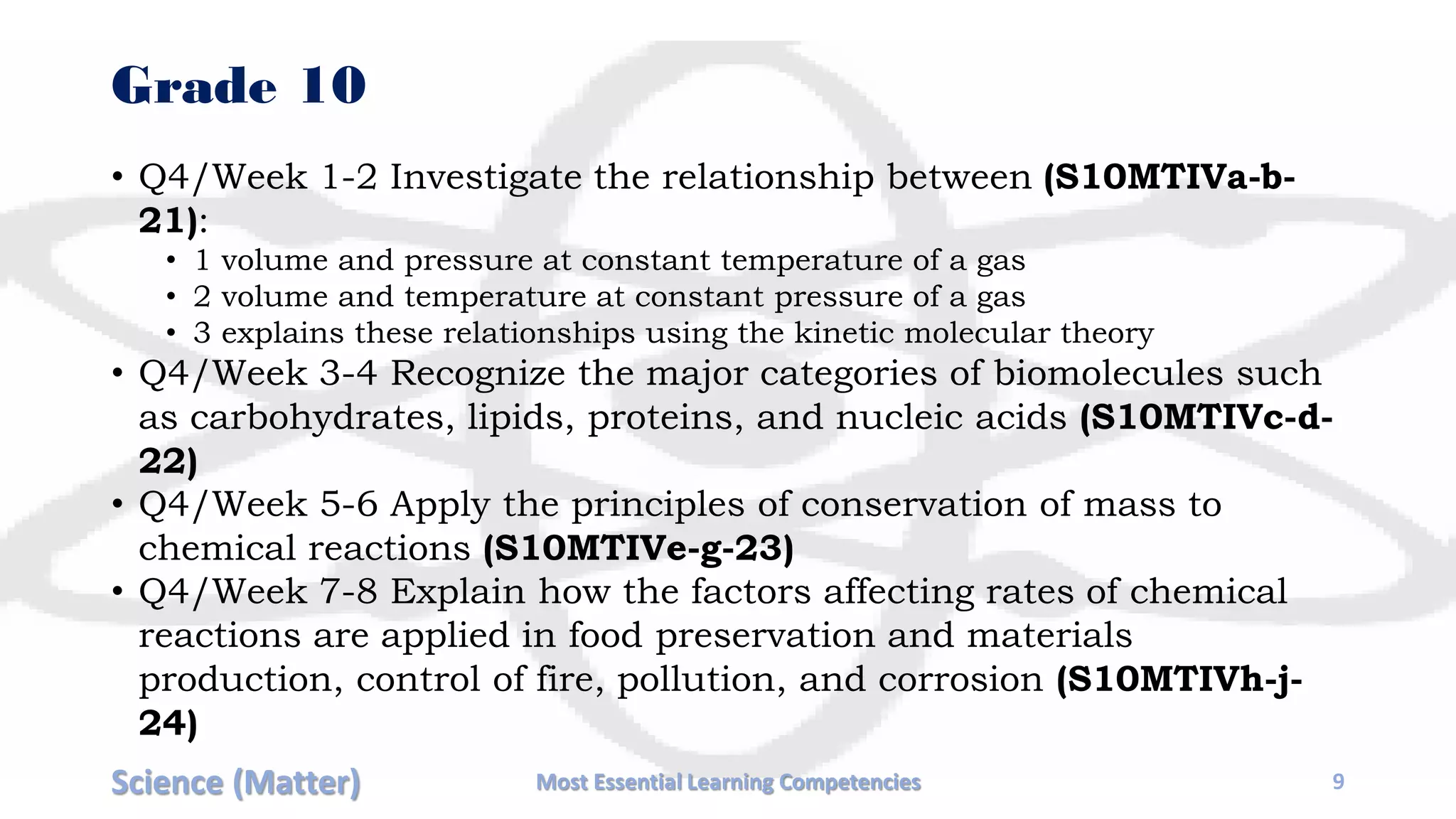
Grade 10
• Q4/Week 1-2 Investigate the relationship between (S10MTIVa-b-
21):
• 1 volume and pressure at constant temperature of a gas
• 2 volume and temperature at constant pressure of a gas
• 3 explains these relationships using the kinetic molecular theory
• Q4/Week 3-4 Recognize the major categories of biomolecules such
as carbohydrates, lipids, proteins, and nucleic acids (S10MTIVc-d-
22)
• Q4/Week 5-6 Apply the principles of conservation of mass to
chemical reactions (S10MTIVe-g-23)
• Q4/Week 7-8 Explain how the factors affecting rates of chemical
reactions are applied in food preservation and materials
production, control of fire, pollution, and corrosion (S10MTIVh-j-
24)
Science (Matter) Most Essential Learning Competencies 9
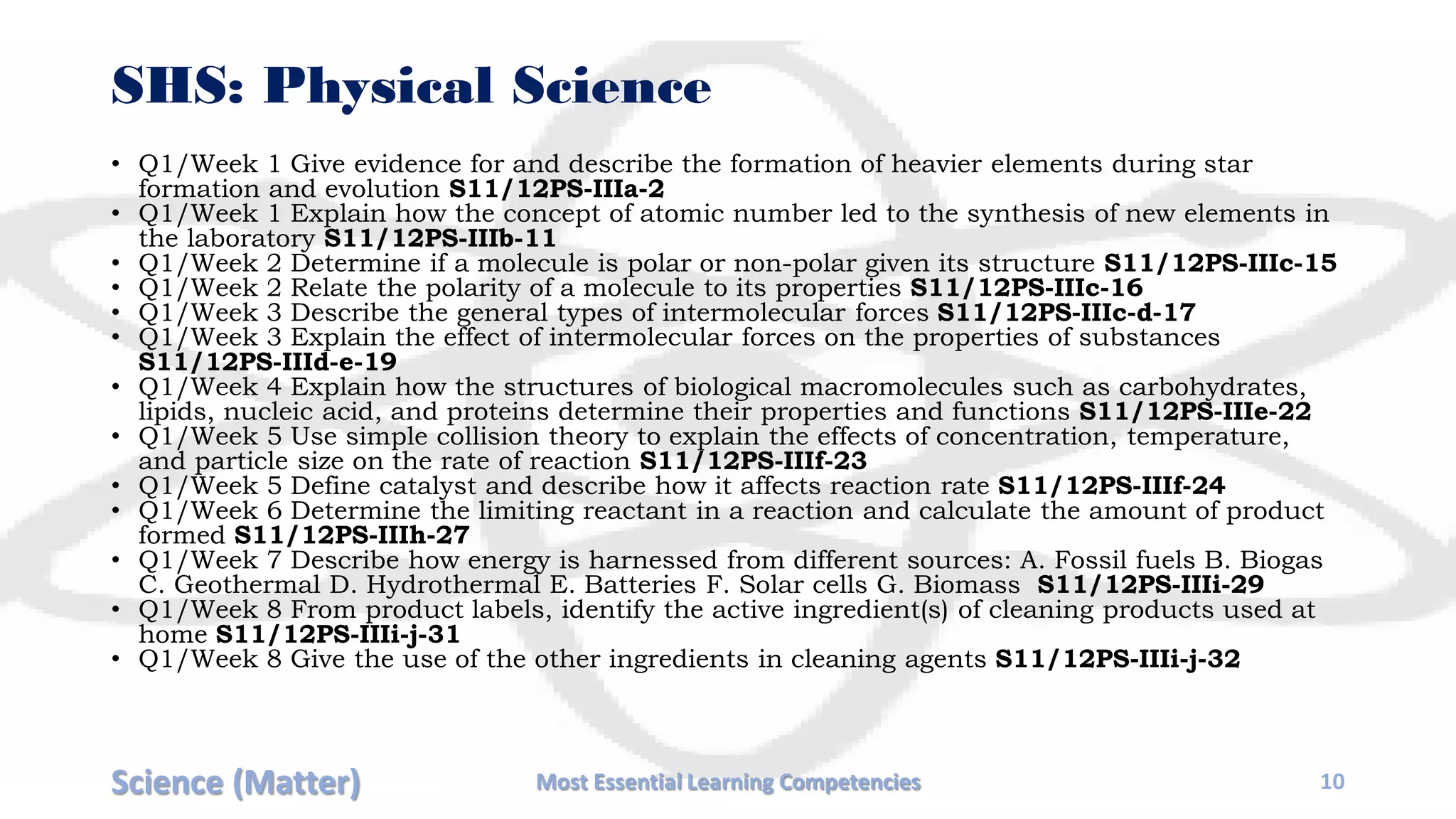
SHS: Physical Science
• Q1/Week 1 Give evidence for and describe the formation of heavier elements during star
formation and evolution S11/12PS-IIIa-2
• Q1/Week 1 Explain how the concept of atomic number led to the synthesis of new elements in
the laboratory S11/12PS-IIIb-11
• Q1/Week 2 Determine if a molecule is polar or non-polar given its structure S11/12PS-IIIc-15
• Q1/Week 2 Relate the polarity of a molecule to its properties S11/12PS-IIIc-16
• Q1/Week 3 Describe the general types of intermolecular forces S11/12PS-IIIc-d-17
• Q1/Week 3 Explain the effect of intermolecular forces on the properties of substances
S11/12PS-IIId-e-19
• Q1/Week 4 Explain how the structures of biological macromolecules such as carbohydrates,
lipids, nucleic acid, and proteins determine their properties and functions S11/12PS-IIIe-22
• Q1/Week 5 Use simple collision theory to explain the effects of concentration, temperature,
and particle size on the rate of reaction S11/12PS-IIIf-23
• Q1/Week 5 Define catalyst and describe how it affects reaction rate S11/12PS-IIIf-24
• Q1/Week 6 Determine the limiting reactant in a reaction and calculate the amount of product
formed S11/12PS-IIIh-27
• Q1/Week 7 Describe how energy is harnessed from different sources: A. Fossil fuels B. Biogas
C. Geothermal D. Hydrothermal E. Batteries F. Solar cells G. Biomass S11/12PS-IIIi-29
• Q1/Week 8 From product labels, identify the active ingredient(s) of cleaning products used at
home S11/12PS-IIIi-j-31
• Q1/Week 8 Give the use of the other ingredients in cleaning agents S11/12PS-IIIi-j-32
Science (Matter) Most Essential Learning Competencies 10
Science (Matter) Most Essential Learning Competencies 11

Most Essential Learning Competencies in Science (Matter)

  • 1.
  • 2.
    Grade 3 • Q1/Week1-2 Classify objects and materials as solid, liquid, and gas based on some observable characteristics (S3MT-Ic-d-2); • Q1/Week 3-5 Describe changes in materials based on the effect of temperature (S3MT-Ih-j-4): • 1 solid to liquid • 2 liquid to solid • 3 liquid to gas • 4 solid to gas Science (Matter) Most Essential Learning Competencies 2
  • 3.
    Grade 4 • Q1/Week1 Classify materials based on the ability to absorb water, float, sink, undergo decay (S4MTIa-1); • Q1/Week 2-3 Describe changes in solid materials when they are bent, pressed, hammered, or cut (S4MTIe-f-5); • Q1/Week 4-5 Describe changes in properties of materials when exposed to certain conditions such as temperature or when mixed with other materials (S4MTIg-h-6) • Q1/Week 6-7 Identify changes in materials whether useful or harmful to one’s environment (S4MTIi-j-7). Science (Matter) Most Essential Learning Competencies 3
  • 4.
    Grade 5 • Q1/Week1-2 Use the properties of materials whether they are useful or harmful (S5MTIa-b-1) • Q1/Week 3-4 Investigate changes that happen in materials under the following conditions (S5MTIc-d-2): • 1 presence or lack of oxygen • 2 application of heat • Q1/Week 5-6 Design a product out of local, recyclable solid and/ or liquid materials in making useful products (S5MTIh-i-4). Science (Matter) Most Essential Learning Competencies 4
  • 5.
    Grade 6 • Q1/Week1-3 Describe the appearance and uses of homogeneous and heterogeneous mixtures (S6MT-Iac-1) • Q1/Week 4-6 Describe techniques in separating mixtures such as decantation, evaporation, filtering, sieving and using magnet (S6MTId-f-2) Science (Matter) Most Essential Learning Competencies 5
  • 6.
    Grade 7 • Q1/Week1 Describe the components of a scientific investigation (S7MT-Ia-1) • Q1/Week 2-3 Recognize that substances are classified into elements and compounds (S7MT-Ig-h-5) • Q1/Week 4-5 Distinguish mixtures from substances based on a set of properties (S7MT-Ie-f-4) • Q1/Week 6 Investigate properties of unsaturated or saturated solutions (S7MT-Ic-2) • Q1/Week 7 Express concentrations of solutions quantitatively by preparing different concentrations of mixtures according to uses and availability of materials (S7MT-Id-3) Science (Matter) Most Essential Learning Competencies 6
  • 7.
    Grade 8 • Q3/Week1-2 Explain the properties of solids, liquids, and gases based on the particle nature of matter; (S8MT-IIIab-8) • Q3/Week 3-4 Explain physical changes in terms of the arrangement and motion of atoms and molecules; (S8MT-IIIcd-9) • Q3/Week 5-6 Determine the number of protons, neutrons, and electrons in a particular atom; (S8MT-IIIef-10) • Q3/Week 7-8 Use the periodic table to predict the chemical behavior of an element. (S8MT-IIIij-12) Science (Matter) Most Essential Learning Competencies 7
  • 8.
    Grade 9 • Q2/Week1 Explain how the Quantum Mechanical Model of the atom describes the energies and positions of the electrons (S9MT-IIa-22) • Q2/Week 2 Recognize different types of compounds (ionic or covalent) based on their properties such as melting point, hardness, polarity, and electrical and thermal conductivity; (S9MT-IIb-14) • Q2/Week 3 Explain how ions are formed; (S9MT-IIef-16) • Q2/Week 4-5 Explain how the structure of the carbon atom affects the type of bonds it forms; (S9MT-IIg-17) • Q2/Week 6 Recognize the general classes and uses of organic compounds; (S9MT-IIh-18) • Q2/Week 7 Use the mole concept to express mass of substances; (S9MT- IIi-19) and • Q2/Week 8 Determine the percentage composition of a compound given its chemical formula and vice versa. (S9MT-IIj-20) Science (Matter) Most Essential Learning Competencies 8
  • 9.
    Grade 10 • Q4/Week1-2 Investigate the relationship between (S10MTIVa-b- 21): • 1 volume and pressure at constant temperature of a gas • 2 volume and temperature at constant pressure of a gas • 3 explains these relationships using the kinetic molecular theory • Q4/Week 3-4 Recognize the major categories of biomolecules such as carbohydrates, lipids, proteins, and nucleic acids (S10MTIVc-d- 22) • Q4/Week 5-6 Apply the principles of conservation of mass to chemical reactions (S10MTIVe-g-23) • Q4/Week 7-8 Explain how the factors affecting rates of chemical reactions are applied in food preservation and materials production, control of fire, pollution, and corrosion (S10MTIVh-j- 24) Science (Matter) Most Essential Learning Competencies 9
  • 10.
    SHS: Physical Science •Q1/Week 1 Give evidence for and describe the formation of heavier elements during star formation and evolution S11/12PS-IIIa-2 • Q1/Week 1 Explain how the concept of atomic number led to the synthesis of new elements in the laboratory S11/12PS-IIIb-11 • Q1/Week 2 Determine if a molecule is polar or non-polar given its structure S11/12PS-IIIc-15 • Q1/Week 2 Relate the polarity of a molecule to its properties S11/12PS-IIIc-16 • Q1/Week 3 Describe the general types of intermolecular forces S11/12PS-IIIc-d-17 • Q1/Week 3 Explain the effect of intermolecular forces on the properties of substances S11/12PS-IIId-e-19 • Q1/Week 4 Explain how the structures of biological macromolecules such as carbohydrates, lipids, nucleic acid, and proteins determine their properties and functions S11/12PS-IIIe-22 • Q1/Week 5 Use simple collision theory to explain the effects of concentration, temperature, and particle size on the rate of reaction S11/12PS-IIIf-23 • Q1/Week 5 Define catalyst and describe how it affects reaction rate S11/12PS-IIIf-24 • Q1/Week 6 Determine the limiting reactant in a reaction and calculate the amount of product formed S11/12PS-IIIh-27 • Q1/Week 7 Describe how energy is harnessed from different sources: A. Fossil fuels B. Biogas C. Geothermal D. Hydrothermal E. Batteries F. Solar cells G. Biomass S11/12PS-IIIi-29 • Q1/Week 8 From product labels, identify the active ingredient(s) of cleaning products used at home S11/12PS-IIIi-j-31 • Q1/Week 8 Give the use of the other ingredients in cleaning agents S11/12PS-IIIi-j-32 Science (Matter) Most Essential Learning Competencies 10
  • 11.
    Science (Matter) MostEssential Learning Competencies 11