

MOSQUITOES
Genre (Aedes, Anopholes and Culex)
Distribution
 2,700 species worldwide.
 Common genera are Aedes, Culex and Anopheles
Food
 Nectar
 Blood of warm blooded animals
Morphology
Adult
Anopheles: White and black or rusty-red spotting on the wings. When biting or resting the long
axis of the body is at angle to the surface on which it is sitting
 Culex: Is dark brown to black in color . when biting or resting the long axis of the body
is parallel to the surface on which it is sitting
 Aedes: Peculiar white lyre like pattern on the thorax, when biting or resting the long
axis of the body is parallel to the surface on which it is sitting
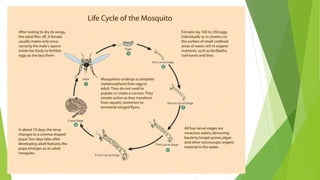
Egg
 Anopheles
 Expanded at the middle and pointed at both ends.
 laid singly in the water
 Culex
 Eggs are laid in batches,
 float on the surface of water and look like rafts
 Aedes
 laid singly in the water
Larvae
 Head large, chewing type of mouth parts, thorax swollen, without legs, abdomen
slender and bears on 8th segment or next to last abdominal segment a tube called as
siphon (a tubular organ in an aquatic animal through which water can be taken in or
expelled), siphon is short.
Larvae (Continued)
 In case of Anopheles, larvae lie parallel to the surface of water while
breathing
 In case of Culex and Aedes, the larvae lie hanging in the water with head
down wards while breathing
Pupae
 Pupae of three genera are almost similar .
 very un-usual, the actively swim, breath through two trumpet like tubes on
the thorax, eyes large, wings and legs can be seen developing through the
body wall.
Damage
 Irritation
 Carriers of important diseases
Malaria
 There are several kinds of malaria caused by microscopic organisms i.e.
Plasmodium vivax, P. malaria, P. falciparum and P. ovale (Phylum Protozoa:
class Sporozoa).
 They destroy the red corpuscles and causing anemia accompanied by fever
and sweating
Dengue
 Dengue fever is carried by Aedes spp. The casual organism of this disease is
virus
Management
 1. Wear long sleeved clothes to avoid biting
 2. Eliminate breeding places by draining and pumping out the water
 3. Mosquito net
 4. Mosquito repellents
 5. Spray Deltamethrin
 6. Bio-control through Gambusia spp for larvae

Mosquitoes presentation

  • 1.
  • 2.
    Distribution  2,700 speciesworldwide.  Common genera are Aedes, Culex and Anopheles Food  Nectar  Blood of warm blooded animals Morphology Adult Anopheles: White and black or rusty-red spotting on the wings. When biting or resting the long axis of the body is at angle to the surface on which it is sitting
  • 3.
     Culex: Isdark brown to black in color . when biting or resting the long axis of the body is parallel to the surface on which it is sitting  Aedes: Peculiar white lyre like pattern on the thorax, when biting or resting the long axis of the body is parallel to the surface on which it is sitting
  • 4.
    Egg  Anopheles  Expandedat the middle and pointed at both ends.  laid singly in the water  Culex  Eggs are laid in batches,  float on the surface of water and look like rafts  Aedes  laid singly in the water
  • 5.
    Larvae  Head large,chewing type of mouth parts, thorax swollen, without legs, abdomen slender and bears on 8th segment or next to last abdominal segment a tube called as siphon (a tubular organ in an aquatic animal through which water can be taken in or expelled), siphon is short.
  • 6.
    Larvae (Continued)  Incase of Anopheles, larvae lie parallel to the surface of water while breathing  In case of Culex and Aedes, the larvae lie hanging in the water with head down wards while breathing
  • 7.
    Pupae  Pupae ofthree genera are almost similar .  very un-usual, the actively swim, breath through two trumpet like tubes on the thorax, eyes large, wings and legs can be seen developing through the body wall.
  • 9.
    Damage  Irritation  Carriersof important diseases Malaria  There are several kinds of malaria caused by microscopic organisms i.e. Plasmodium vivax, P. malaria, P. falciparum and P. ovale (Phylum Protozoa: class Sporozoa).  They destroy the red corpuscles and causing anemia accompanied by fever and sweating Dengue  Dengue fever is carried by Aedes spp. The casual organism of this disease is virus
  • 10.
    Management  1. Wearlong sleeved clothes to avoid biting  2. Eliminate breeding places by draining and pumping out the water  3. Mosquito net  4. Mosquito repellents  5. Spray Deltamethrin  6. Bio-control through Gambusia spp for larvae