











Architecture 3.0:
How to Build a Profitable Disruptive Practice
WE100
Wednesday 5/16/2012 8AM - 12PM
This presentation is protected by US and International Copyright laws.
Reproduction, distribution, display and use of the presentation
without written permission of the speaker is prohibited.
Cliff Moser, AIA

• 35 years in the Design and Construction Industry.
• Executive Vice President of AECCatalyst
• Past Chair of ASQ Design and Construction Division
  www.asq.org/design
• Past Chair of the AIA Practice Management
  Knowledge Community (PMKC) www.aia.org/pm
AIA PMKC
             Advancing the Practice of Architecture

Mission
The Practice Management Knowledge Community’s mission is to
discover, generate, organize, and share insights, resources, and tools
that enable architects to practice more effectively.
Vision
To serve as the essential resource for advancing the practice of
architecture.
AIA/CES Quality Statement
This program is registered with the AIA/CES for continuing
professional education. As such, it does not include content that
may be deemed or construed to constitute approval, sponsorship
or endorsement by the AIA of any method, product, service,
enterprise or organization. The statements expressed by speakers,
panelists, and other participants reflect their own views and do
not necessarily reflect the views or positions of The American
Institute of Architects or of AIA components, or those of their
respective officers, directors, members, employees, or other
organizations, groups or individuals associated with them.
Questions related to specific products, publications, and services
may be addressed at the conclusion of this presentation.
learning objectives
1. Learn to provide new solutions for creating a successful
   design practice that utilizes innovative and disruptive
   processes to leverage a firm’s existing markets as well as
   identify new opportunities.
2. Outline how to develop a business and client base that
   supports disruptive processes.
3. Detail how to build a successful disruptive eco-system of
   staff, consultants and vendors.
4. Develop supportive but disruptive relationships with allied
   professional such as builders and agencies.
innovation and disruption

• an innovation is a new idea or process that
  helps create a new market and value
  network-
• and eventually goes on to disrupt an existing
  market and value network (over a few years
  or decades),
• displacing an earlier technology.
why disruption?

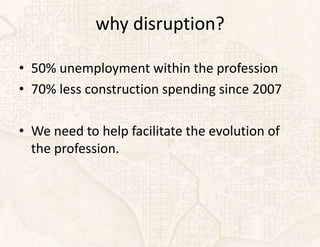
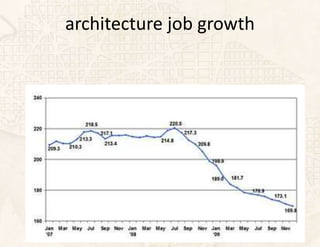
• 50% unemployment within the profession
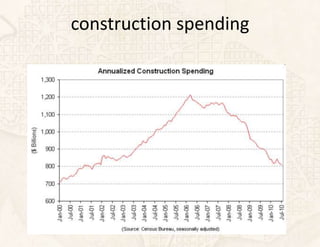
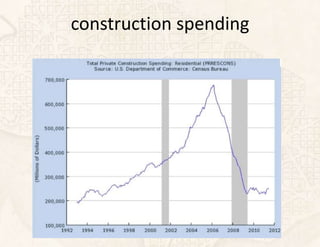
• 70% less construction spending since 2007

• We need to help facilitate the evolution of
  the profession.
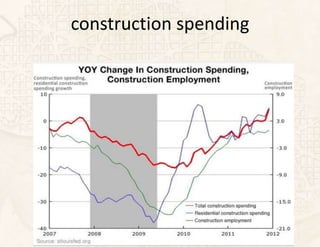
construction spending
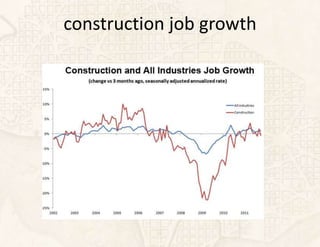
construction job growth
architecture job growth
construction unemployment

• According to the Labor Department, the
  construction industry slashed 2.27 million
  jobs from its prerecession peak in 2007 to the
  trough of construction employment in
  January 2011.
• Just 95,000 jobs have returned, or less than 5
  percent of those lost.
lost generation

• Many express concerns that these job losses
  may be permanent, that there may not be a
  sustained economic rebound for years to
  come.
• If these concerns are realized, we risk losing
  an entire generation of architects to other
  careers.
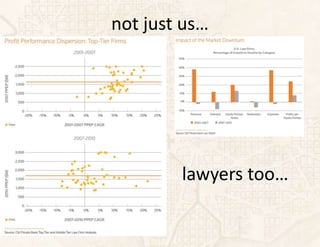
not just us…


        lawyers too…
lawyers

• But the problems that began in the recession
  were not a momentary blip.
• Rather, they seem to have been the
  beginning of a long term shift within the
  profession...
disrupted lawyers

• … where companies are simply not willing to
  spend as much on lawyers.
• Legal outsourcing firms, the use of
  inexpensive contract attorneys, the decision
  by companies to bring more work in-house,
• and demands for cheaper rates have all put
  permanent pressure on profits.
disrupted professionals

• The march of improved information
  technology will only slim margins further
• Substitution will continue to eliminate jobs
• Expertise is now distributed
first

• Learn to provide new solutions for creating a
  successful design practice that
  – utilizes innovative and disruptive processes to
    leverage a firm’s existing markets and
  – identify new opportunities
  – maintain existing value streams
types of disruption

•   iPod and iPhone
•   cds & records, mp3s & cds, streaming & mp3s
•   local computing, cloud computing
•   hand drafting, cad, and bim
•   design bid build, design-build, ipd
disruption is the only way to evolve

•   innovation
•   disruption
•   new business models
•   upset the incumbent
types of disruption

• Level One Disruption –
  – New Market
• Level Two Disruption
  – Enhance Value of Existing Processes
level one disruption

• Create new processes
  – Identify a new market that can utilize design-
    thinking.
for example

• New Software
  – BIM
• New Services
  – Transition Planning
  – Program Management
level two disruption

• enhance existing processes.
  – leverage your existing services and processes by
    adding new activities and tasks
  – focus on creating an additive that may replace the
    technology you’re adding to.
for example

• Existing Conditions – look beyond sketch pad
  and photos. Work with a 3d Imager to scan
  the building and build smart objects in BIM.
• Create BIM Execution Plan and Requirements
  for Owners
diffusion of innovations

• Learn from the bad bets, make part of your
  research and development.
• Strive for Ideality incrementation, evolution
  and less friction
  – Examples
     • Billboard Faxes vs PLTs and PDFs
     • Portable hard drives vs Drop Box
     • Fleet of Blackberries vs Bring your own Device (BYOD)
low end nibbler

•   netflix and blockbuster
•   creating queue online, waiting for delivery vs.
•   going to the store and picking a video out
•   soon Blockbuster was trying to compete
•   Blockbuster on my android phone
    – can’t use it, can’t get rid of it…
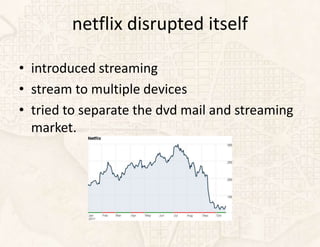
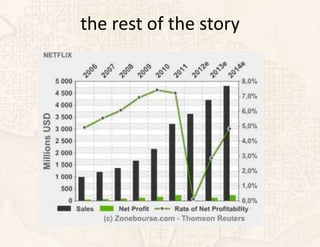
netflix disrupted itself

• introduced streaming
• stream to multiple devices
• tried to separate the dvd mail and streaming
  market.
the rest of the story
we don’t like disruption

• but then we say WTF?
• kodak, polaroid..

• tried to innovate, tried disruption
• but their shareholders wouldn’t give them
  enough leeway to make netflix mistakes…
case studies

• Level One Disruptions
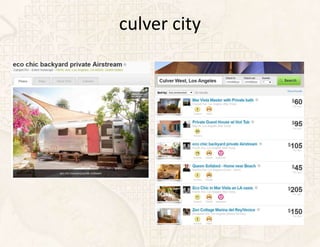
AirBnB.com
RISD Industrial Design
& Fine Art Graduates
Kernel of an idea-
  -Rent out spare
  bedrooms to travelers.
  -Started out as “Air
  Bed” and Breakfast in
  their loft apartment
  for attendees of ICSID
  Conference in San
  Francisco in 2007
culver city
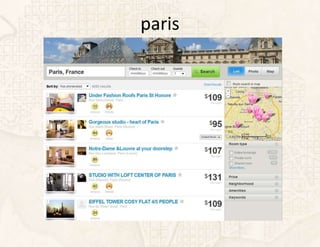
paris
5 million nights booked
level two disruption

• cloud services
• renting software
• outsourcing construction documents
second

• how to develop a new business base
• through level one disruption
second

• Outline how to develop a business and client
  base that supports disruptive processes.
  – Design for problem-solving
  – Design for building
• Measuring the performance of your
  disruption
  – Balanced Scorecard Metrics
two professions

• Design for Problem-Solving
• Design for Building
design for problem-solving

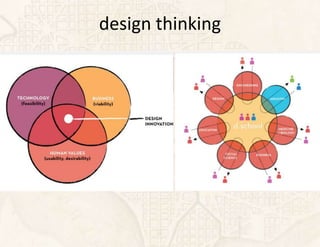
• framed by design-thinking theories
• focuses your architectural training on
  developing system and network solutions to
  client problems
• design for problem-solving is main business
  model for Arch3.0
• design for building is a specialized activity of
  Arch3.0
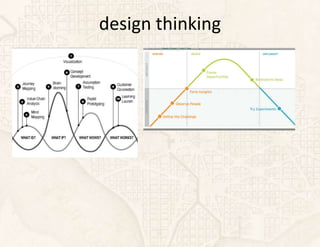
design thinking

• architects own the origins of design thinking
  – Bryan Lawson -Architects vs. Engineers-
     • In 1972, psychologist, architect and design researcher
       Bryan Lawson, undertook research to understand the
       difference between problem-based solvers and
       solution-based solvers.
     • used two groups of students – final year students in
       architecture and post-graduate science students – and
       asked them to create one-story structures from a set
       of colored blocks.
design thinking

• architects are the original design thinkers
  – Bryan Lawson Architects vs. Engineers, 1979
     • perimeter of the building was to optimize either the
       red or the blue color.
     • rules were unspecified regarding the placement and
       relationship of the blocks.
     • engineers used many different blocks and
       combinations of blocks as possible as quickly as
       possible.
     • maximized information available to them about the
       allowed combinations, hoping to discover a formula.
design thinking

• architects are the original design thinkers
  – Bryan Lawson Architects vs. Engineers, 1979
     • architects selected blocks in order to achieve the
       appropriately colored perimeter.
     • If this proved not to be an acceptable combination,
       then the next most favorably colored block
       combination would be substituted and so on until an
       acceptable solution was found.
     • Engineers (traditional) problem-solving is done by
       analysis.
     • Design problem-solving is solve through synthesis.
analysis vs. synthesis

• analysis is a breaking down of a whole into
  parts or components.
• synthesis is a combining of separate elements
  or components in order to form a coherent
  whole.
divergent & convergent thinking

• divergent thinking- ability to offer different,
  unique & variant ideas for one theme.
• convergent thinking- ability to find the
  “correct” solution to the given problem.
• design thinking uses divergent thinking to
  ideate many solutions (possible & impossible)
• then convergent thinking to prefer and realize
  the best resolution.
what happened?

• we created “design-thinking”
• but then abandoned it to the Industrial
  Designers.
• “d-Schools”
• Stanford, Art Center
we take it back

• we’re the original synthesizers
• holistically understand clients needs-

• Beyond Buildings
• Beyond Construction
design for problem-solving

• seven steps
  – Define –Decide, Agree, Prioritize, Determine.
  – Research –Review, Collect, Outline.
  – Ideation –Brainstorm, Identify, Generate.
  – Prototype –Combine, Expand, Feedback, Present.
  – Objectives –Review, Set-Aside, Select.
  – Implement –Task, Plan, Resource, Execute, Present
  – Learn –Feedback, Discuss, Measure, Document.
design for problem-solving

• posits that design for building is a separate
  specialized activity within the practice.
• …that design for problem-solving is the core
  activity of the profession.
• states that you first build a practice based on
  design for problem-solving
• …then create a specialized group for design for
  building (if at all).
design thinking
design thinking
how to measure success

• Balanced scorecard metrics
  – A focus on more than financial performance and
    information within your practice.
     • People, Processes, Customers, Financial
  – Use to support strategy around your
    competencies and then add to the edges.
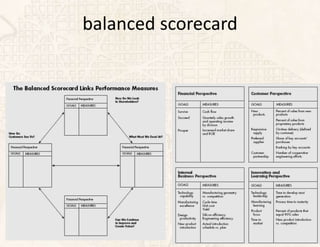
balanced scorecard

•   People – the people in your practice
•   Processes – the way you do your work
•   Customers – not just clients –external/internal
•   Financial – the way you get paid
balanced scorecard
Why a Balanced Scorecard?
• To ensure that all parts of the organization
  are measured.
• To identify and manage people, processes,
  customers and financial perspectives.
• To capture knowledge and information.
• To identify and measure intangible assets.
• To align organizational goals to strategy.
3 Types of Balanced Scorecards
• Project-Based Balanced Scorecard
   – Project Specific. Implement at particular phase, or
     through project start to finish.
• Initiative-Based Balanced Scorecard
   – Build around a specific initiative:
      • Quality Assurance/Quality Control
      • Marketing or Business Development Initiative
• Organization-Based Balanced Scorecard
   – Holistic metrics for entire organization
Project-Based Balanced Scorecard

•   Implement at any project phase.
•   Establish Mission/Vision Statements.
•   Create Goals.
•   Identify Strategy.
•   Create Tactics for Achieving Strategy.
•   Identify and weigh indicators/metrics.
Project-Based Balanced Scorecard
• Construction Administration Phase BSC.
   –   Mission & Vision
   –   Identify Leading/Lagging Indicators
   –   Weigh by using Analytical Hierarchy Method
   –   Determine Reporting Period
   –   Set goals.
   –   Measure/report goals
   –   Re-set goals.
   –   Modify Measures. (PDCA)
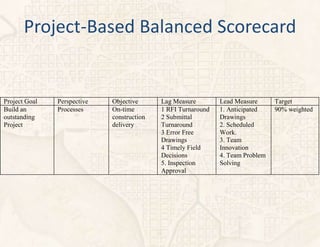
Project-Based Balanced Scorecard


Project Goal   Perspective   Objective      Lag Measure        Lead Measure      Target
Build an       Processes     On-time        1 RFI Turnaround   1. Anticipated    90% weighted
outstanding                  construction   2 Submittal        Drawings
Project                      delivery       Turnaround         2. Scheduled
                                            3 Error Free       Work.
                                            Drawings           3. Team
                                            4 Timely Field     Innovation
                                            Decisions          4. Team Problem
                                            5. Inspection      Solving
                                            Approval
Project-Based Balanced Scorecard


                                                                                       Timely Field Decisions
                         Submittal Turnaround


                                                                                                                Inspection Approval
                                                                 Error Free Drawings
                                                                                                                                      •Submittal Turnaround


                                                RFI Turnaround
                                                                                                                                      •RFI Turnaround
                                                                                                                                      •Error Free Drawings
                                                                                                                                      •Timely Field Decisions
                                                                                                                                      •Inspection Approval
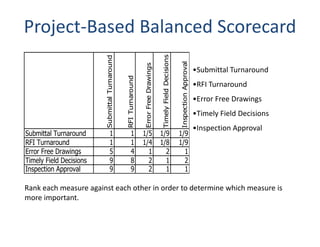
Submittal Turnaround               1                   1         1/5                   1/9                      1/9
RFI Turnaround                     1                   1         1/4                   1/8                      1/9
Error Free Drawings                5                   4           1                     2                        1
Timely Field Decisions             9                   8           2                     1                        2
Inspection Approval                9                   9           2                     1                        1

Rank each measure against each other in order to determine which measure is
more important.
Project-Based Balanced Scorecard


                                                                                            Timely Field Decisions
                           Submittal Turnaround


                                                                                                                      Inspection Approval
                                                                     Error Free Drawings
                                                                                                                                            •Submittal Turnaround


                                                   RFI Turnaround
                                                                                                                                            •RFI Turnaround
                                                                                                                                            •Error Free Drawings
                                                                                                                                            •Timely Field Decisions
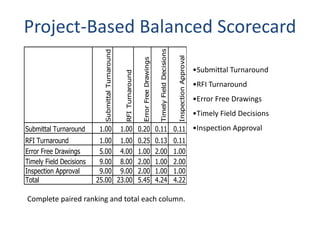
Submittal Turnaround      1.00                    1.00 0.20 0.11 0.11 •Inspection Approval
RFI Turnaround            1.00 1.00                                 0.25                   0.13                      0.11
Error Free Drawings       5.00 4.00                                 1.00                   2.00                      1.00
Timely Field Decisions    9.00 8.00                                 2.00                   1.00                      2.00
Inspection Approval       9.00 9.00                                 2.00                   1.00                      1.00
Total                    25.00 23.00                                5.45                   4.24                      4.22

Complete paired ranking and total each column.
Project-Based Balanced Scorecard


                                                                                           Timely Field Decisions
                          Submittal Turnaround
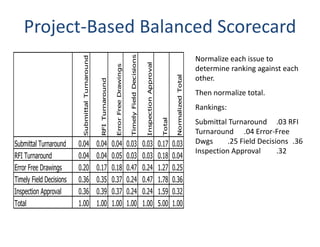
                                                                                                                                                                        Normalize each issue to


                                                                                                                     Inspection Approval
                                                                    Error Free Drawings
                                                                                                                                                                        determine ranking against each


                                                                                                                                                     Normalized Total
                                                                                                                                                                        other.


                                                  RFI Turnaround
                                                                                                                                                                        Then normalize total.
                                                                                                                                                                        Rankings:


                                                                                                                                            Total
                                                                                                                                                                        Submittal Turnaround .03 RFI
                                                                                                                                                                        Turnaround .04 Error-Free
Submittal Turnaround     0.04                    0.04              0.04                   0.03                      0.03                   0.17     0.03                Dwgs      .25 Field Decisions .36
                                                                                                                                                                        Inspection Approval       .32
RFI Turnaround           0.04                    0.04              0.05                   0.03                      0.03                   0.18     0.04
Error Free Drawings      0.20                    0.17              0.18                   0.47                      0.24                   1.27     0.25
Timely Field Decisions   0.36                    0.35              0.37                   0.24                      0.47                   1.78     0.36
Inspection Approval      0.36                    0.39              0.37                   0.24                      0.24                   1.59     0.32
Total                    1.00                    1.00              1.00                   1.00                      1.00                   5.00     1.00
Project-Based Balanced Scorecard
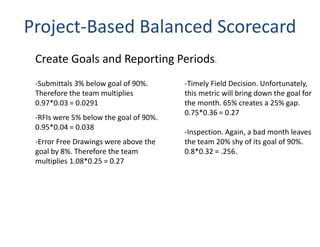
 Create Goals and Reporting Periods.
 -Submittals 3% below goal of 90%.      -Timely Field Decision. Unfortunately,
 Therefore the team multiplies          this metric will bring down the goal for
 0.97*0.03 = 0.0291                     the month. 65% creates a 25% gap.
                                        0.75*0.36 = 0.27
 -RFIs were 5% below the goal of 90%.
 0.95*0.04 = 0.038
                                        -Inspection. Again, a bad month leaves
 -Error Free Drawings were above the    the team 20% shy of its goal of 90%.
 goal by 8%. Therefore the team         0.8*0.32 = .256.
 multiplies 1.08*0.25 = 0.27
Project-Based Balanced Scorecard
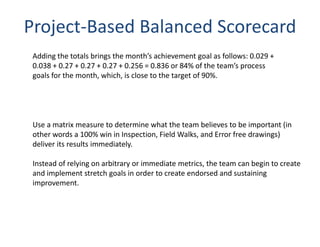
 Adding the totals brings the month’s achievement goal as follows: 0.029 +
 0.038 + 0.27 + 0.27 + 0.27 + 0.256 = 0.836 or 84% of the team’s process
 goals for the month, which, is close to the target of 90%.


 Use a matrix measure to determine what the team believes to be important (in
 other words a 100% win in Inspection, Field Walks, and Error free drawings)
 deliver its results immediately.

 Instead of relying on arbitrary or immediate metrics, the team can begin to create
 and implement stretch goals in order to create endorsed and sustaining
 improvement.
people

• Measures the activities of the stakeholders in
  your network
  – all staff
     • modelers, architects, and admin
  – consultants
  – vendors
Arch3.0 people

• Flexible workforce
• Contractors, Partners and Consultants
• Bring your own device
processes

• The activities you use to perform your work
Arch3.0 processes

•   no longer beholden to an incumbent
•   autodesk, google, bentley, archicad
•   cloud-based services
•   focus on deliverable not the tool
•   bring your own device
customers

• These are the stakeholders within your
  network with a focus on their needs as
  customers and clients.
Arch3.0 customers

• everyone is a customer
  – staff, consultants, building contractors, agencies
• channel partners
  – strengthen supply chain
financial

• These are the traditional series of metrics for
  identifying the performance of your
  organization, including Profit/Loss, booked
  work, etc.
• The disruptive practice focuses on creating
  new metrics with alternate performance
  requirements.
Arch3.0 financial

•   fee from downloads
•   new approach to intellectual property
•   collaborative model
•   no longer focus on fee for labor
ideo case study

• the disruptive practice pioneer
  – industrial design firm that formed design thinking
third

• Detail how to build a successful disruptive
  eco-system of staff, consultants and vendors.
  – How to leverage your relationships with your
    stakeholders
  – Open network innovation
     • Design for Problem-Solving
     • Design for Building
recognizing your networks

• Arch2.0 was based on ownership and hiding
• Arch3.0 is based on sharing and transparency
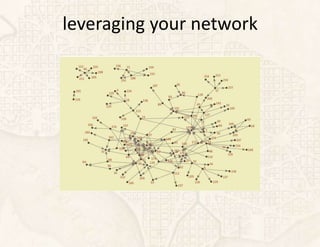
• identify and leverage your networks
  – multiple networks within your profession,
    personal and social life
leveraging your network
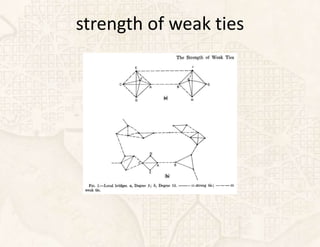
strength of weak ties
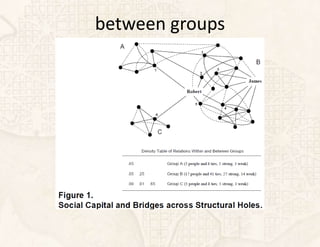
structural holes

• these are the breaks between networks

• you make yourself the bridge between the
  networks
between groups
open innovation networks

• The challenge-
  – How to use new social networks to be more than
    repositories?
  – How to engage your staff/stakeholders to
    participate in the network conversations?
  – How to use social networks to leverage your weak
    ties and bridge structural holes
facebook
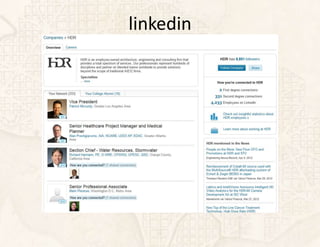
linkedin
new flavor of the month

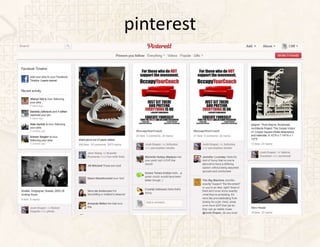
•   Pinterest
•   Tumblr
•   Plaxo
•   Google+
•   MySpace
•   ?
tumblr
pinterest
social media
• Create a blog tailored to a specific market. If you are a leader in a
  given market, chances are you see things about your client's
  industry that they can't see on their own. Creative approaches,
  common mistakes, insight into the clients they are chasing or simply
  lessons unique to their built environment. People enjoy reading
  about themselves. Creating the blog from a journalistic perspective
  helps cut down the natural resistance to over-branded pieces and it
  is possible to build an audience of consistent followers.
• Tag the photos you post. When clients first start dreaming about
  their projects they typically start looking for similar projects that
  have already been built. When you post your photos—either as part
  of your website or on a social media platform like Flickr—take the
  time to tag them in the ways that your clients would look for them.
social media
• Add your high-profile projects to Wikipedia. Wikipedia provides the
  opportunity to create a public record. Stadiums, theatres and other
  high profile projects frequently have entries. Make sure that
  statistics are entered for your projects
• Coach your team to use LinkedIn. If someone is searching for one of
  your employees, chances are that LinkedIn will come up in search
  ahead of their profile on your company’s website. Make sure your
  team has fully completed profiles and that their corporate e-mail
  address is listed so they are easily found. Coach them on building a
  network that helps them expand into your client’s world.
• Social media gives the opportunity to let client’s see behind the
  curtain and the glossy portfolio.
design for problem-solving and
        design for building
• HOK
  – Blended practice
  – Specialists in social media, sustainability, client
    management
design for building

• Barker Rinker Seacat
  – Community Center and Natatorium designers
  – Problem-Solving became consultancy as well as
    architect of record.
fourth

• develop supportive but disruptive
  relationships with allied professionals such as
  builders and agencies.
  – how can you earn fee in these traditionally
    adversarial relationships?
  – how can you expand the Arch3.0 two practice
    model to successfully create and engage this
    market.
fourth

• Design for Problem Solving
  – BIM Execution and Management Plan
  – Teaching
  – Board Member Role
• Design for Building
  – Design-Build
  – IPD
  – Design Assist
design for problem solving

• design for problem-solving
  – focus on identifying your client’s needs and
    requirements
  – assist them in the seven step process
design for building

• design for building
  – Collaborative models
  – IPD, Design-Build, Design Assist
  – Scoping Documents
Activity
design a disruption

• Break into balanced scorecard groups
• People, processes, customers, finance
  – one group-
  – Identify a Design for Problem Solving Activity
  – another group
  – Identify a Design for Building Activity
• Identify a level one or level two innovation
  for each perspective
and then

• Identify performance metrics
• That will ensure the disruption is nurtured.
for example

• I’m in the financial new disruption group
• identify a new disruption
  – I pay the client to work for them
  – what?
  – Arcosanti, habitat for humanity, church missions


• then identify performance metrics for
  people, processes, customer, and financial
  that support the new disruption
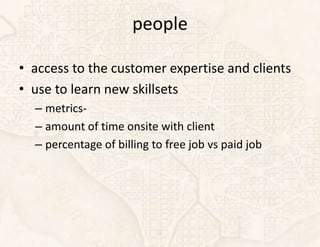
people

• access to the customer expertise and clients
• use to learn new skillsets
  – metrics-
  – amount of time onsite with client
  – percentage of billing to free job vs paid job
processes

• use the customers hardware and software
• no local office
customers

• identify the internal and external customers
  – internal
     • your staff, the consultants
  – external
     • the client’s staff and consultants
financial

• how do we manage costs?
  – do we get paid for expenses, do we pay our
    consultants?
CASE STUDIES
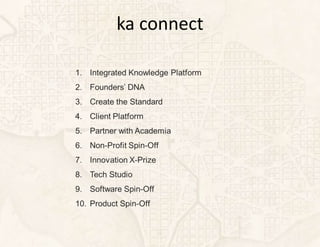
KA Connect
ka connect
ka connect
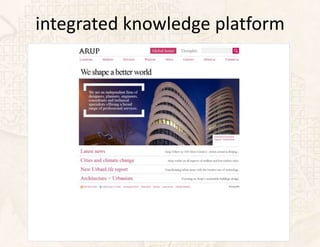
integrated knowledge platform
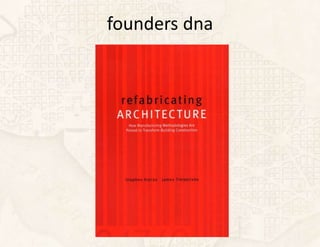
founders dna
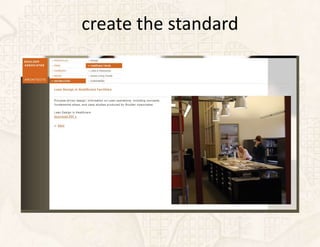
create the standard
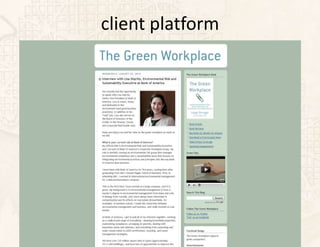
client platform
partner with academia
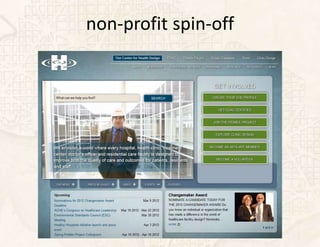
non-profit spin-off
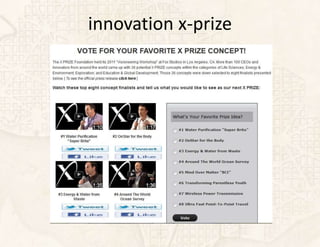
innovation x-prize
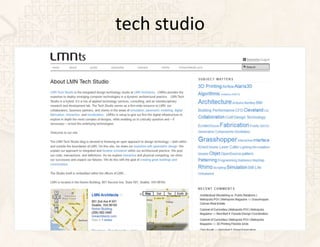
tech studio
software spin-off
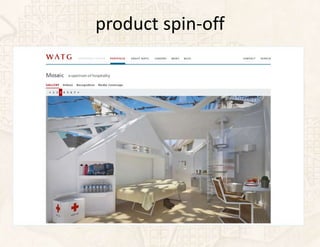
product spin-off
summary

• Arch3.0
  – disruption
     • level one and level two
  – two practices
     • design for problem-solving
     • design for building
  – network effects
     • manage your weak ties and structural holes
  – recognize and leverage your strengths
Speaker
[List alphabetically by last name regardless of speaking order]


 • Cliff Moser, AIA


                                                                  1
                                                                  2
Contact Information
Cliff Moser, AIA
310.947.8509
cliff.moser@gmail.com
cliffm@aeccatalyst.com

Moser disruptive practice-arch3.0-2012

  • 1.
    Architecture 3.0: How toBuild a Profitable Disruptive Practice WE100 Wednesday 5/16/2012 8AM - 12PM
  • 2.
    This presentation isprotected by US and International Copyright laws. Reproduction, distribution, display and use of the presentation without written permission of the speaker is prohibited.
  • 3.
    Cliff Moser, AIA •35 years in the Design and Construction Industry. • Executive Vice President of AECCatalyst • Past Chair of ASQ Design and Construction Division www.asq.org/design • Past Chair of the AIA Practice Management Knowledge Community (PMKC) www.aia.org/pm
  • 4.
    AIA PMKC Advancing the Practice of Architecture Mission The Practice Management Knowledge Community’s mission is to discover, generate, organize, and share insights, resources, and tools that enable architects to practice more effectively. Vision To serve as the essential resource for advancing the practice of architecture.
  • 5.
    AIA/CES Quality Statement Thisprogram is registered with the AIA/CES for continuing professional education. As such, it does not include content that may be deemed or construed to constitute approval, sponsorship or endorsement by the AIA of any method, product, service, enterprise or organization. The statements expressed by speakers, panelists, and other participants reflect their own views and do not necessarily reflect the views or positions of The American Institute of Architects or of AIA components, or those of their respective officers, directors, members, employees, or other organizations, groups or individuals associated with them. Questions related to specific products, publications, and services may be addressed at the conclusion of this presentation.
  • 6.
    learning objectives 1. Learnto provide new solutions for creating a successful design practice that utilizes innovative and disruptive processes to leverage a firm’s existing markets as well as identify new opportunities. 2. Outline how to develop a business and client base that supports disruptive processes. 3. Detail how to build a successful disruptive eco-system of staff, consultants and vendors. 4. Develop supportive but disruptive relationships with allied professional such as builders and agencies.
  • 7.
    innovation and disruption •an innovation is a new idea or process that helps create a new market and value network- • and eventually goes on to disrupt an existing market and value network (over a few years or decades), • displacing an earlier technology.
  • 8.
    why disruption? • 50%unemployment within the profession • 70% less construction spending since 2007 • We need to help facilitate the evolution of the profession.
  • 9.
  • 10.
  • 11.
  • 12.
  • 13.
  • 14.
    construction unemployment • Accordingto the Labor Department, the construction industry slashed 2.27 million jobs from its prerecession peak in 2007 to the trough of construction employment in January 2011. • Just 95,000 jobs have returned, or less than 5 percent of those lost.
  • 15.
    lost generation • Manyexpress concerns that these job losses may be permanent, that there may not be a sustained economic rebound for years to come. • If these concerns are realized, we risk losing an entire generation of architects to other careers.
  • 16.
    not just us… lawyers too…
  • 17.
    lawyers • But theproblems that began in the recession were not a momentary blip. • Rather, they seem to have been the beginning of a long term shift within the profession...
  • 18.
    disrupted lawyers • …where companies are simply not willing to spend as much on lawyers. • Legal outsourcing firms, the use of inexpensive contract attorneys, the decision by companies to bring more work in-house, • and demands for cheaper rates have all put permanent pressure on profits.
  • 19.
    disrupted professionals • Themarch of improved information technology will only slim margins further • Substitution will continue to eliminate jobs • Expertise is now distributed
  • 20.
    first • Learn toprovide new solutions for creating a successful design practice that – utilizes innovative and disruptive processes to leverage a firm’s existing markets and – identify new opportunities – maintain existing value streams
  • 21.
    types of disruption • iPod and iPhone • cds & records, mp3s & cds, streaming & mp3s • local computing, cloud computing • hand drafting, cad, and bim • design bid build, design-build, ipd
  • 22.
    disruption is theonly way to evolve • innovation • disruption • new business models • upset the incumbent
  • 23.
    types of disruption •Level One Disruption – – New Market • Level Two Disruption – Enhance Value of Existing Processes
  • 24.
    level one disruption •Create new processes – Identify a new market that can utilize design- thinking.
  • 25.
    for example • NewSoftware – BIM • New Services – Transition Planning – Program Management
  • 26.
    level two disruption •enhance existing processes. – leverage your existing services and processes by adding new activities and tasks – focus on creating an additive that may replace the technology you’re adding to.
  • 27.
    for example • ExistingConditions – look beyond sketch pad and photos. Work with a 3d Imager to scan the building and build smart objects in BIM. • Create BIM Execution Plan and Requirements for Owners
  • 28.
    diffusion of innovations •Learn from the bad bets, make part of your research and development. • Strive for Ideality incrementation, evolution and less friction – Examples • Billboard Faxes vs PLTs and PDFs • Portable hard drives vs Drop Box • Fleet of Blackberries vs Bring your own Device (BYOD)
  • 29.
    low end nibbler • netflix and blockbuster • creating queue online, waiting for delivery vs. • going to the store and picking a video out • soon Blockbuster was trying to compete • Blockbuster on my android phone – can’t use it, can’t get rid of it…
  • 30.
    netflix disrupted itself •introduced streaming • stream to multiple devices • tried to separate the dvd mail and streaming market.
  • 32.
    the rest ofthe story
  • 33.
    we don’t likedisruption • but then we say WTF? • kodak, polaroid.. • tried to innovate, tried disruption • but their shareholders wouldn’t give them enough leeway to make netflix mistakes…
  • 34.
    case studies • LevelOne Disruptions
  • 35.
    AirBnB.com RISD Industrial Design &Fine Art Graduates Kernel of an idea- -Rent out spare bedrooms to travelers. -Started out as “Air Bed” and Breakfast in their loft apartment for attendees of ICSID Conference in San Francisco in 2007
  • 36.
  • 37.
  • 38.
  • 39.
    level two disruption •cloud services • renting software • outsourcing construction documents
  • 40.
    second • how todevelop a new business base • through level one disruption
  • 41.
    second • Outline howto develop a business and client base that supports disruptive processes. – Design for problem-solving – Design for building • Measuring the performance of your disruption – Balanced Scorecard Metrics
  • 42.
    two professions • Designfor Problem-Solving • Design for Building
  • 43.
    design for problem-solving •framed by design-thinking theories • focuses your architectural training on developing system and network solutions to client problems • design for problem-solving is main business model for Arch3.0 • design for building is a specialized activity of Arch3.0
  • 44.
    design thinking • architectsown the origins of design thinking – Bryan Lawson -Architects vs. Engineers- • In 1972, psychologist, architect and design researcher Bryan Lawson, undertook research to understand the difference between problem-based solvers and solution-based solvers. • used two groups of students – final year students in architecture and post-graduate science students – and asked them to create one-story structures from a set of colored blocks.
  • 45.
    design thinking • architectsare the original design thinkers – Bryan Lawson Architects vs. Engineers, 1979 • perimeter of the building was to optimize either the red or the blue color. • rules were unspecified regarding the placement and relationship of the blocks. • engineers used many different blocks and combinations of blocks as possible as quickly as possible. • maximized information available to them about the allowed combinations, hoping to discover a formula.
  • 46.
    design thinking • architectsare the original design thinkers – Bryan Lawson Architects vs. Engineers, 1979 • architects selected blocks in order to achieve the appropriately colored perimeter. • If this proved not to be an acceptable combination, then the next most favorably colored block combination would be substituted and so on until an acceptable solution was found. • Engineers (traditional) problem-solving is done by analysis. • Design problem-solving is solve through synthesis.
  • 47.
    analysis vs. synthesis •analysis is a breaking down of a whole into parts or components. • synthesis is a combining of separate elements or components in order to form a coherent whole.
  • 48.
    divergent & convergentthinking • divergent thinking- ability to offer different, unique & variant ideas for one theme. • convergent thinking- ability to find the “correct” solution to the given problem. • design thinking uses divergent thinking to ideate many solutions (possible & impossible) • then convergent thinking to prefer and realize the best resolution.
  • 49.
    what happened? • wecreated “design-thinking” • but then abandoned it to the Industrial Designers. • “d-Schools” • Stanford, Art Center
  • 50.
    we take itback • we’re the original synthesizers • holistically understand clients needs- • Beyond Buildings • Beyond Construction
  • 51.
    design for problem-solving •seven steps – Define –Decide, Agree, Prioritize, Determine. – Research –Review, Collect, Outline. – Ideation –Brainstorm, Identify, Generate. – Prototype –Combine, Expand, Feedback, Present. – Objectives –Review, Set-Aside, Select. – Implement –Task, Plan, Resource, Execute, Present – Learn –Feedback, Discuss, Measure, Document.
  • 52.
    design for problem-solving •posits that design for building is a separate specialized activity within the practice. • …that design for problem-solving is the core activity of the profession. • states that you first build a practice based on design for problem-solving • …then create a specialized group for design for building (if at all).
  • 53.
  • 54.
  • 55.
    how to measuresuccess • Balanced scorecard metrics – A focus on more than financial performance and information within your practice. • People, Processes, Customers, Financial – Use to support strategy around your competencies and then add to the edges.
  • 56.
    balanced scorecard • People – the people in your practice • Processes – the way you do your work • Customers – not just clients –external/internal • Financial – the way you get paid
  • 57.
  • 58.
    Why a BalancedScorecard? • To ensure that all parts of the organization are measured. • To identify and manage people, processes, customers and financial perspectives. • To capture knowledge and information. • To identify and measure intangible assets. • To align organizational goals to strategy.
  • 59.
    3 Types ofBalanced Scorecards • Project-Based Balanced Scorecard – Project Specific. Implement at particular phase, or through project start to finish. • Initiative-Based Balanced Scorecard – Build around a specific initiative: • Quality Assurance/Quality Control • Marketing or Business Development Initiative • Organization-Based Balanced Scorecard – Holistic metrics for entire organization
  • 60.
    Project-Based Balanced Scorecard • Implement at any project phase. • Establish Mission/Vision Statements. • Create Goals. • Identify Strategy. • Create Tactics for Achieving Strategy. • Identify and weigh indicators/metrics.
  • 61.
    Project-Based Balanced Scorecard •Construction Administration Phase BSC. – Mission & Vision – Identify Leading/Lagging Indicators – Weigh by using Analytical Hierarchy Method – Determine Reporting Period – Set goals. – Measure/report goals – Re-set goals. – Modify Measures. (PDCA)
  • 62.
    Project-Based Balanced Scorecard ProjectGoal Perspective Objective Lag Measure Lead Measure Target Build an Processes On-time 1 RFI Turnaround 1. Anticipated 90% weighted outstanding construction 2 Submittal Drawings Project delivery Turnaround 2. Scheduled 3 Error Free Work. Drawings 3. Team 4 Timely Field Innovation Decisions 4. Team Problem 5. Inspection Solving Approval
  • 63.
    Project-Based Balanced Scorecard Timely Field Decisions Submittal Turnaround Inspection Approval Error Free Drawings •Submittal Turnaround RFI Turnaround •RFI Turnaround •Error Free Drawings •Timely Field Decisions •Inspection Approval Submittal Turnaround 1 1 1/5 1/9 1/9 RFI Turnaround 1 1 1/4 1/8 1/9 Error Free Drawings 5 4 1 2 1 Timely Field Decisions 9 8 2 1 2 Inspection Approval 9 9 2 1 1 Rank each measure against each other in order to determine which measure is more important.
  • 64.
    Project-Based Balanced Scorecard Timely Field Decisions Submittal Turnaround Inspection Approval Error Free Drawings •Submittal Turnaround RFI Turnaround •RFI Turnaround •Error Free Drawings •Timely Field Decisions Submittal Turnaround 1.00 1.00 0.20 0.11 0.11 •Inspection Approval RFI Turnaround 1.00 1.00 0.25 0.13 0.11 Error Free Drawings 5.00 4.00 1.00 2.00 1.00 Timely Field Decisions 9.00 8.00 2.00 1.00 2.00 Inspection Approval 9.00 9.00 2.00 1.00 1.00 Total 25.00 23.00 5.45 4.24 4.22 Complete paired ranking and total each column.
  • 65.
    Project-Based Balanced Scorecard Timely Field Decisions Submittal Turnaround Normalize each issue to Inspection Approval Error Free Drawings determine ranking against each Normalized Total other. RFI Turnaround Then normalize total. Rankings: Total Submittal Turnaround .03 RFI Turnaround .04 Error-Free Submittal Turnaround 0.04 0.04 0.04 0.03 0.03 0.17 0.03 Dwgs .25 Field Decisions .36 Inspection Approval .32 RFI Turnaround 0.04 0.04 0.05 0.03 0.03 0.18 0.04 Error Free Drawings 0.20 0.17 0.18 0.47 0.24 1.27 0.25 Timely Field Decisions 0.36 0.35 0.37 0.24 0.47 1.78 0.36 Inspection Approval 0.36 0.39 0.37 0.24 0.24 1.59 0.32 Total 1.00 1.00 1.00 1.00 1.00 5.00 1.00
  • 66.
    Project-Based Balanced Scorecard Create Goals and Reporting Periods. -Submittals 3% below goal of 90%. -Timely Field Decision. Unfortunately, Therefore the team multiplies this metric will bring down the goal for 0.97*0.03 = 0.0291 the month. 65% creates a 25% gap. 0.75*0.36 = 0.27 -RFIs were 5% below the goal of 90%. 0.95*0.04 = 0.038 -Inspection. Again, a bad month leaves -Error Free Drawings were above the the team 20% shy of its goal of 90%. goal by 8%. Therefore the team 0.8*0.32 = .256. multiplies 1.08*0.25 = 0.27
  • 67.
    Project-Based Balanced Scorecard Adding the totals brings the month’s achievement goal as follows: 0.029 + 0.038 + 0.27 + 0.27 + 0.27 + 0.256 = 0.836 or 84% of the team’s process goals for the month, which, is close to the target of 90%. Use a matrix measure to determine what the team believes to be important (in other words a 100% win in Inspection, Field Walks, and Error free drawings) deliver its results immediately. Instead of relying on arbitrary or immediate metrics, the team can begin to create and implement stretch goals in order to create endorsed and sustaining improvement.
  • 68.
    people • Measures theactivities of the stakeholders in your network – all staff • modelers, architects, and admin – consultants – vendors
  • 69.
    Arch3.0 people • Flexibleworkforce • Contractors, Partners and Consultants • Bring your own device
  • 70.
    processes • The activitiesyou use to perform your work
  • 71.
    Arch3.0 processes • no longer beholden to an incumbent • autodesk, google, bentley, archicad • cloud-based services • focus on deliverable not the tool • bring your own device
  • 72.
    customers • These arethe stakeholders within your network with a focus on their needs as customers and clients.
  • 73.
    Arch3.0 customers • everyoneis a customer – staff, consultants, building contractors, agencies • channel partners – strengthen supply chain
  • 74.
    financial • These arethe traditional series of metrics for identifying the performance of your organization, including Profit/Loss, booked work, etc. • The disruptive practice focuses on creating new metrics with alternate performance requirements.
  • 75.
    Arch3.0 financial • fee from downloads • new approach to intellectual property • collaborative model • no longer focus on fee for labor
  • 76.
    ideo case study •the disruptive practice pioneer – industrial design firm that formed design thinking
  • 77.
    third • Detail howto build a successful disruptive eco-system of staff, consultants and vendors. – How to leverage your relationships with your stakeholders – Open network innovation • Design for Problem-Solving • Design for Building
  • 78.
    recognizing your networks •Arch2.0 was based on ownership and hiding • Arch3.0 is based on sharing and transparency • identify and leverage your networks – multiple networks within your profession, personal and social life
  • 79.
  • 80.
  • 81.
    structural holes • theseare the breaks between networks • you make yourself the bridge between the networks
  • 82.
  • 83.
    open innovation networks •The challenge- – How to use new social networks to be more than repositories? – How to engage your staff/stakeholders to participate in the network conversations? – How to use social networks to leverage your weak ties and bridge structural holes
  • 84.
  • 85.
  • 86.
    new flavor ofthe month • Pinterest • Tumblr • Plaxo • Google+ • MySpace • ?
  • 87.
  • 88.
  • 89.
    social media • Createa blog tailored to a specific market. If you are a leader in a given market, chances are you see things about your client's industry that they can't see on their own. Creative approaches, common mistakes, insight into the clients they are chasing or simply lessons unique to their built environment. People enjoy reading about themselves. Creating the blog from a journalistic perspective helps cut down the natural resistance to over-branded pieces and it is possible to build an audience of consistent followers. • Tag the photos you post. When clients first start dreaming about their projects they typically start looking for similar projects that have already been built. When you post your photos—either as part of your website or on a social media platform like Flickr—take the time to tag them in the ways that your clients would look for them.
  • 90.
    social media • Addyour high-profile projects to Wikipedia. Wikipedia provides the opportunity to create a public record. Stadiums, theatres and other high profile projects frequently have entries. Make sure that statistics are entered for your projects • Coach your team to use LinkedIn. If someone is searching for one of your employees, chances are that LinkedIn will come up in search ahead of their profile on your company’s website. Make sure your team has fully completed profiles and that their corporate e-mail address is listed so they are easily found. Coach them on building a network that helps them expand into your client’s world. • Social media gives the opportunity to let client’s see behind the curtain and the glossy portfolio.
  • 91.
    design for problem-solvingand design for building • HOK – Blended practice – Specialists in social media, sustainability, client management
  • 92.
    design for building •Barker Rinker Seacat – Community Center and Natatorium designers – Problem-Solving became consultancy as well as architect of record.
  • 93.
    fourth • develop supportivebut disruptive relationships with allied professionals such as builders and agencies. – how can you earn fee in these traditionally adversarial relationships? – how can you expand the Arch3.0 two practice model to successfully create and engage this market.
  • 94.
    fourth • Design forProblem Solving – BIM Execution and Management Plan – Teaching – Board Member Role • Design for Building – Design-Build – IPD – Design Assist
  • 95.
    design for problemsolving • design for problem-solving – focus on identifying your client’s needs and requirements – assist them in the seven step process
  • 96.
    design for building •design for building – Collaborative models – IPD, Design-Build, Design Assist – Scoping Documents
  • 97.
  • 98.
    design a disruption •Break into balanced scorecard groups • People, processes, customers, finance – one group- – Identify a Design for Problem Solving Activity – another group – Identify a Design for Building Activity • Identify a level one or level two innovation for each perspective
  • 99.
    and then • Identifyperformance metrics • That will ensure the disruption is nurtured.
  • 100.
    for example • I’min the financial new disruption group • identify a new disruption – I pay the client to work for them – what? – Arcosanti, habitat for humanity, church missions • then identify performance metrics for people, processes, customer, and financial that support the new disruption
  • 101.
    people • access tothe customer expertise and clients • use to learn new skillsets – metrics- – amount of time onsite with client – percentage of billing to free job vs paid job
  • 102.
    processes • use thecustomers hardware and software • no local office
  • 103.
    customers • identify theinternal and external customers – internal • your staff, the consultants – external • the client’s staff and consultants
  • 104.
    financial • how dowe manage costs? – do we get paid for expenses, do we pay our consultants?
  • 105.
  • 106.
  • 107.
  • 108.
  • 109.
  • 110.
  • 111.
  • 112.
  • 113.
  • 114.
  • 115.
  • 116.
  • 117.
  • 118.
  • 119.
    summary • Arch3.0 – disruption • level one and level two – two practices • design for problem-solving • design for building – network effects • manage your weak ties and structural holes – recognize and leverage your strengths
  • 120.
    Speaker [List alphabetically bylast name regardless of speaking order] • Cliff Moser, AIA 1 2
  • 121.
    Contact Information Cliff Moser,AIA 310.947.8509 cliff.moser@gmail.com cliffm@aeccatalyst.com