Memory, Teaching, and Learning EDCI 500-Educational Psychology Chapter 7: Cognitive Views of Learning Julie Moring October 20, 2008
Memory More than one type of memory Sensory memory: processes environmental stimuli to senses Perception-environmental stimuli combined with prior knowledge Bottom-up processing-stimuli arranged into patterns Top-down processing-recognition of patterns/parts already known Large capacity, short duration (1-3 seconds)
Memory Working Memory Where new information is held Temporary, combined with long-term memory knowledge Easier and quicker to retrieve Consists of: Central Executive-controls attention/other mental resources Phonological Loop-holds verbal/acoustical information Visuospatial Sketchpad-visual/spatial information Duration 5 to 20 seconds, unless rehearsed, practiced
Memory Long-Term Memory Holds information that is well learned Capacity is unlimited Info remains permanently, but requires time/effort to retrieve Contents Declarative knowledge- “knowing that” something is the case Procedural knowledge- “knowing how” to do something Conditional knowledge- “knowing when/why” to apply type of knowledge Can be either general or domain-specific knowledge
Memory Contents (cont.) Words/Images Information stored verbally/visually Easier to learn if stored both ways Two types of long-term memory Explicit Memory (for meaning) Semantic-not connected to events/experiences Episodic-connected to events/experiences Implicit Memory  Procedural Memory-how to do things Priming-using info by unconscious process (Also, classical conditioning; 1 st  type of implicit memory)
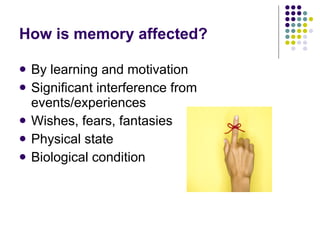
How is memory affected? By learning and motivation Significant interference from events/experiences Wishes, fears, fantasies Physical state Biological condition
What can teachers do to help students? Help students develop metacognitive skills Teach learning strategies to assist learning Ex. : “DEFENDS” writing strategy “ LINCS” vocabulary strategy Metacognitive skills enable students to: Choose best approach to learning task Set goals Organize tasks Change strategies if necessary
Developing Declarative Knowledge Make lessons meaningful Link current knowledge to new information Effective devices Visual images-graphic organizers Mnemonics-loci method, acronyms, keyword method Part learning, distributed practice
Keys to effective learning Attention to learning Get and maintain students attention Motivation to learning Teach self-motivation; role model Link current knowledge to new information Find out what they know first; establish relationship between past/new knowledge Make lessons meaningful Employ various learning strategies/methods of teaching
References Video: Remembering and Forgetting from Learner.org Woolfolk, A.(2007). Educational Psychology. (10 th  ed.). Boston: Allyn and Bacon

Moring Memory, Teaching, And Learning Edci 500 Wk 7

  • 1.
    Memory, Teaching, andLearning EDCI 500-Educational Psychology Chapter 7: Cognitive Views of Learning Julie Moring October 20, 2008
  • 2.
    Memory More thanone type of memory Sensory memory: processes environmental stimuli to senses Perception-environmental stimuli combined with prior knowledge Bottom-up processing-stimuli arranged into patterns Top-down processing-recognition of patterns/parts already known Large capacity, short duration (1-3 seconds)
  • 3.
    Memory Working MemoryWhere new information is held Temporary, combined with long-term memory knowledge Easier and quicker to retrieve Consists of: Central Executive-controls attention/other mental resources Phonological Loop-holds verbal/acoustical information Visuospatial Sketchpad-visual/spatial information Duration 5 to 20 seconds, unless rehearsed, practiced
  • 4.
    Memory Long-Term MemoryHolds information that is well learned Capacity is unlimited Info remains permanently, but requires time/effort to retrieve Contents Declarative knowledge- “knowing that” something is the case Procedural knowledge- “knowing how” to do something Conditional knowledge- “knowing when/why” to apply type of knowledge Can be either general or domain-specific knowledge
  • 5.
    Memory Contents (cont.)Words/Images Information stored verbally/visually Easier to learn if stored both ways Two types of long-term memory Explicit Memory (for meaning) Semantic-not connected to events/experiences Episodic-connected to events/experiences Implicit Memory Procedural Memory-how to do things Priming-using info by unconscious process (Also, classical conditioning; 1 st type of implicit memory)
  • 6.
    How is memoryaffected? By learning and motivation Significant interference from events/experiences Wishes, fears, fantasies Physical state Biological condition
  • 7.
    What can teachersdo to help students? Help students develop metacognitive skills Teach learning strategies to assist learning Ex. : “DEFENDS” writing strategy “ LINCS” vocabulary strategy Metacognitive skills enable students to: Choose best approach to learning task Set goals Organize tasks Change strategies if necessary
  • 8.
    Developing Declarative KnowledgeMake lessons meaningful Link current knowledge to new information Effective devices Visual images-graphic organizers Mnemonics-loci method, acronyms, keyword method Part learning, distributed practice
  • 9.
    Keys to effectivelearning Attention to learning Get and maintain students attention Motivation to learning Teach self-motivation; role model Link current knowledge to new information Find out what they know first; establish relationship between past/new knowledge Make lessons meaningful Employ various learning strategies/methods of teaching
  • 10.
    References Video: Rememberingand Forgetting from Learner.org Woolfolk, A.(2007). Educational Psychology. (10 th ed.). Boston: Allyn and Bacon