This document provides an overview of emotional intelligence (EI), including its historical roots, need and importance, current status and applications, ways to measure EI, and how EI relates to workplace performance. Some key points:
- EI builds on early research recognizing the importance of non-cognitive factors like social and emotional skills. Researchers in the 1930s-40s studied concepts like social intelligence.
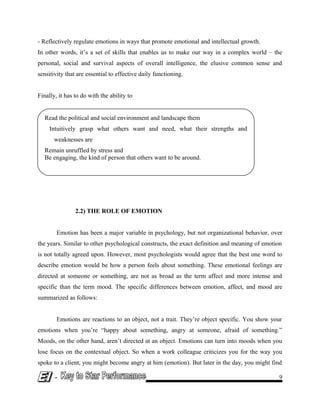
- EI refers to an individual's ability to identify and understand their own emotions and those of others to guide thinking and decision-making. In contrast, IQ measures cognitive and analytical abilities.
- Emotions play an important role in psychology and influence behaviors. Both personality traits and mood states impact emotional
![TABLE OF CONTENTS
SR.
NO
PARTICULARS SUB
TOPIC
PAGE
NO.
1
INTRODUCTION
1.1) HISTORICAL ROOTS OF EMOTIONAL
INTELLIGENCE
1.2) EMOTIONAL NORMS [TABLE]
4-7
2
NEED AND IMPORTANCE
NEED
2.1) WHAT IS EQ AND IQ?
2.2)ROLE OF EMOTION
2.3) EMOTIONAL PROCESSING
2.4) TYPES OF EMOTIONS
IMPORTANCE
2.5)EI VERSUS IQ WORKPLACE
PERFORMANCE
2.6) EI LEADERSHIP, CLIMATE, AND
ORGANIZATIONAL PERFORMANCE
2.7) PROFILE OF INDIAN EXECUTIVES [E
I]
8-16
3
CURRENT STATUS AND
FUTURE APPLICATION
3.1)FRAMEWORK OF EMOTIONAL
COMPETENCIES
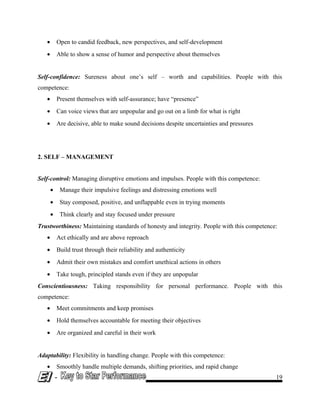
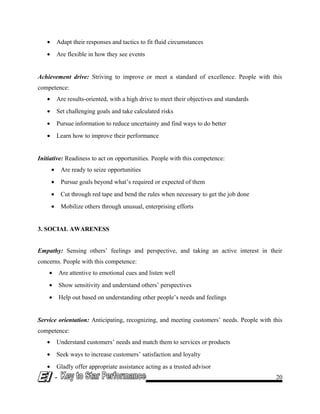
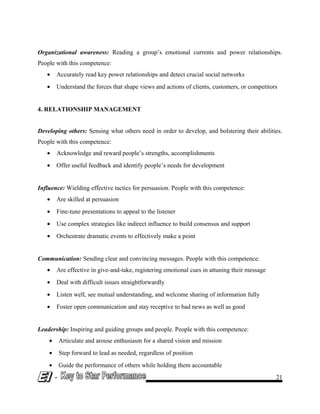
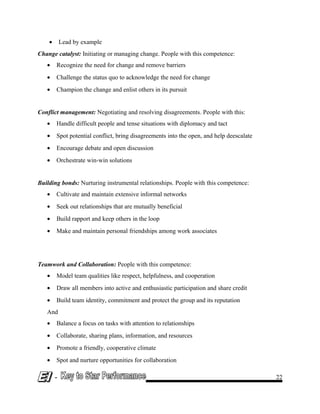
3.2) EMOTIONAL COMPETENCIES
17-23
4
MEASURING E I
4.1) MEANING OF E I
4.2) BUILDING E I OF GROUPS
4.3) BAR-ON MODEL OF E I
4.4) SIGNS OF HIGH AND LOW EQ
4.5) MINI EMOTIONAL TEST
4.6) HOW TO RAISE E I
24-38
METHODOLOGY 5.1) DATA COLLECTION SAMPLE 39-40
- 1](https://image.slidesharecdn.com/6emotionalquotient-140320114401-phpapp02/85/emotional-quotient-1-320.jpg)
![TABLE OF CONTENTS
SR.
NO
PARTICULARS SUB
TOPIC
PAGE
NO.
1
INTRODUCTION
1.1) HISTORICAL ROOTS OF EMOTIONAL
INTELLIGENCE
1.2) EMOTIONAL NORMS [TABLE]
4-7
2
NEED AND IMPORTANCE
NEED
2.1) WHAT IS EQ AND IQ?
2.2)ROLE OF EMOTION
2.3) EMOTIONAL PROCESSING
2.4) TYPES OF EMOTIONS
IMPORTANCE
2.5)EI VERSUS IQ WORKPLACE
PERFORMANCE
2.6) EI LEADERSHIP, CLIMATE, AND
ORGANIZATIONAL PERFORMANCE
2.7) PROFILE OF INDIAN EXECUTIVES [E
I]
8-16
3
CURRENT STATUS AND
FUTURE APPLICATION
3.1)FRAMEWORK OF EMOTIONAL
COMPETENCIES
3.2) EMOTIONAL COMPETENCIES
17-23
4
MEASURING E I
4.1) MEANING OF E I
4.2) BUILDING E I OF GROUPS
4.3) BAR-ON MODEL OF E I
4.4) SIGNS OF HIGH AND LOW EQ
4.5) MINI EMOTIONAL TEST
4.6) HOW TO RAISE E I
24-38
METHODOLOGY 5.1) DATA COLLECTION SAMPLE 39-40
- 1](https://image.slidesharecdn.com/6emotionalquotient-140320114401-phpapp02/75/emotional-quotient-1-2048.jpg)
![5
6
EI AT THE WORKPLACE 6.1)TYPES OF LEARNING
6.2) INDIVIDUAL BEHAVIOUR CURVE
[ KUBLER – ROSS CHANGE CURVE]
6.3) GUIDELINES FOR EFFECTIVE
SOCIAL AND EMOTIONAL LEARNING
41-46
7
USES 7.1) EQ – USEFULNESS IN MODERN HR
PRACTICES
47-48
8
OBJECTIVES 49
9
TOOLS 49
10
CASE STUDY 10.1) INTERVIEW
10.2) BUSSINESS CASE FOR EI
49-55
11
RECOMMENDATIONS 56
12
SUPPLEMENTARY 12.1) ACKNOWLEDGEMENT 57
13 CONCLUSION 58
14 BIBLIOGRAPHY 59
- 2](https://image.slidesharecdn.com/6emotionalquotient-140320114401-phpapp02/85/emotional-quotient-2-320.jpg)
![1 ] INTRODUCTION
Ever since the publication of Daniel Goleman’s first book on the topic in 1995, emotional
intelligence has become one of the hottest buzzwords in the corporate world. For instance, when
the Harvard Business Review published an article on the topic two years ago, it attracted a
higher percentage of readers than any other article published in that periodical in the last 40
years. When the CEO of Johnson & Johnson read that article, he was so impressed that he had
copies sent out to the 400 top executives in the company worldwide.
Given that emotional intelligence is so popular in the corporate world, it is important to
understand what it really means. Thus briefly laying out the history of the concept as an area of
research and describing how it has come to be defined and measured. So let’s begin with some
history.
Education is the ability to meet life’s situation. It is a character-building process.
Enhancing one’s personality and making him/her rational, capable, responsive and intelligently
independent, it generates the will to refashion one’s heart, head and life. But does education
make a person emotionally independent? Today’s curriculum aims at all round formation,
training and development of students. But does the curriculum include the training to make
students emotionally mature? These are crucial questions to answer, which we need to shift our
attention to the emotional aspects of students for full, complete and wholistic formation of
students.
Emotion
The word emotion comes from Latin word ‘motere’, which means to move. The Oxford English
Dictionary defines emotion as ‘any agitation or disturbance of mind, feeling, passion any
vehement or excited mental state’. Emotions refer to motions, movements feelings etc. Every
emotion has an impulse to act. They are also complex and contagious, e.g. anger, sadness, fear,
enjoyment, love, disgust, shame etc. All our emotions usually depend on the information our
- 4](https://image.slidesharecdn.com/6emotionalquotient-140320114401-phpapp02/85/emotional-quotient-4-320.jpg)
![2] NEED AND IMPORTANCE :
-
Individual Group Cross-Boundary
Norms That Create Awareness of Emotions
Interpersonal Undertaking
1. Take time away from group
tasks to get to know one
another.
2. Have a “check in” at the
beginning of the meeting-that
is, ask how everyone is
doing.
3. Assume that undesirable
behavior takes place for a
reason. Find out what that
reason is. Ask questions
and listen. Avoid negative
attributions.
4. Tell your teammates what
you’re thinking and how
you’re feeling.
Perspective Taking
1. Ask whether everyone
agrees with a decision.
2. Ask quiet members what
they think.
3. Question decisions that
come too quickly.
4. Appoint a devil’s advocate.
Team self-Evaluation
1. Schedule time to examine team
effectiveness.
2. Create measurable task and process
objectives and then measure them.
3. Acknowledge and discuss group
moods.
4. Communicate your sense of what is
transpiring in the team.
5. Allow members to call a “process
check.” (for instance, a team member
might say, “Process check: is this the
most effective use of our time right
now?”)
Seeking Feedback
1. Ask your “customers” how you are
doing.
2. Post your work and invite comments.
3. Benchmark your process.
Organizational Understanding
1. Find out the concerns and needs
of others in the organization.
2. Consider who can influence the
team’s ability to accomplish its
goals.
3. Discuss the culture and politics in
the organization.
4. Ask whether proposed team
actions are congruent with the
organization’s culture and politics.
Norms That Help Regular Emotions
Confronting
1. Set ground rules and use
them to point out errant
behavior.
2. Call members on errant
behavior.
3. Create playful devices for
pointing out such behavior.
These often emerge from the
group spontaneously
reinforce them.
Caring
1. Support members: volunteer
to help them if they need it,
be flexible, and provide
emotional support.
2. Validate members’
contributions. Let members
know they are valued.
3. Protect members from
attack.
4. Respect individuality and
difference in perspectives.
Listen.
5. Never be derogatory or
demeaning.
Creating Resources for
Working with Emotion
1. Make time to discuss difficult issues,
and address the emotions that
surround them.
2. Find creative, shorthand ways to
acknowledge and express the
emotion in the group.
3. Create fun ways to acknowledge and
relieve stress and tension.
4. Express acceptance of members’
emotions.
Creating on Affirmative Environment
1. Reinforce that the team can meet a
challenge. Be optimistic. For example
say things like, “We can get through
this” or nothing will stop us.”
2. Focus on what you can control.
3. Remind members of the group’s
important and positive mission.
4. Remind the group how it solved a
similar problem before.
5. Focus on problem solving, not
blaming
Building External Relationships
1. Create opportunities for
networking and interaction.
2. Ask about the needs of other
teams.
3. Provide support for other teams.
4. Invite others to team meetings if
they might have a stake in what
you are doing.
7](https://image.slidesharecdn.com/6emotionalquotient-140320114401-phpapp02/85/emotional-quotient-7-320.jpg)
![As for IQ’s relevance in the workplace, studies have shown that it can
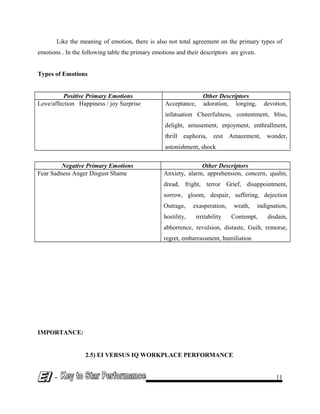
serve to predict between 1 and 20 % (the average is 6%) of success in a given job.
EQ, on the other hand, has been found to be directly responsible for between 27 and 45 % of job
success, depending on which field is under study.
IQ is pretty much set. It tends to peak when a person is 17, remains
constant throughout adulthood, and wanes during old age.EQ however is not fixed.
A study of almost 4,000 people in Canada and United States concluded
that EQ rises steadily from an average of 95.3 (when you’re in the late teens) to an average of
102.7 (where it remains throughout your 40’s). Once you’re past 50, it tapers off a bit, to an
average of 101.5 – not exactly a precipitous decline. [See Figure]
This does not come as surprise: we get older but wiser. We live and
learn, and one of the things we learn is to balance emotion and reason.
EQ Over The Age Span
95.3
96.8
100
101.8
102.7
101.5
90
92
94
96
98
100
102
104
16-19 20-29 Average
EQ
30-39 40-49 50+
Age
EQscores
Column 1
- 12
In short, the position is that IQ will be a more powerful predictor
than EI of individuals’ career success in studies of large populations
over the career course because it sorts people before they embark on
a career, determining which fields or professions they can enter. But
when studies look within a job or profession to learn which
individuals rise to the top and which plateau or fail, EI proves to be
a more powerful predictor of success than IQ.](https://image.slidesharecdn.com/6emotionalquotient-140320114401-phpapp02/85/emotional-quotient-12-320.jpg)
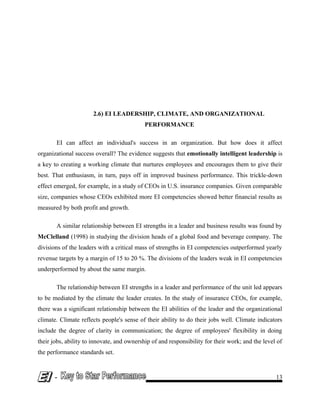
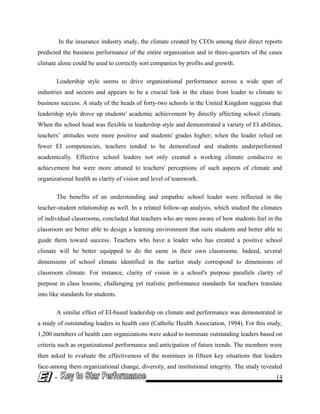
![that the more effective leaders in the health care industry were also more adept at integrating key
EI competencies such as Organizational Awareness and relationship skills like persuasion and
influence.
The link between EI strengths in a leader and the organization's climate is important for
EI theory. A Hay/McBer analysis of data on 3,781 executives, correlated with climate surveys
filled out by those who worked for them, suggests that 50 to 70 % of employees' perception of
working climate is linked to the EI characteristics of the leader. Research drawing on that same
database sheds light on the role of EI competencies in leadership effectiveness, identifying how
six distinct styles of EI-based leadership affect climate. Four styles-the visionary (sometimes
called the "authoritative"), the affiliative, the democratic, and the coaching-generally drive
climate in a positive direction. Two styles-the coercive and the pacesetting-tend to drive climate
downward, particularly when leaders overuse them (though each of these two can have positive
impact if applied in appropriate situations).
2.7) PROFILE OF INDIAN EXECUTIVES [E I]
For years, educationalists, human resource professionals, corporate trainers, recruiters, managers
and others have known that what sets apart average performers and stars isn’t the technical skills,
not necessarily the intelligence either. They have felt the existence of something in addition – a
capacity which pervades and fades other abilities into background and stands out. They have
come up with various terms like human relations or human resource approaches, people skills,
etc. It is felt that a more objective measurable term - Emotional Intelligence can be termed as the
skill which makes people shine at the work place. Also EI plays an important role in many areas
of our lives.
We can sum up by saying that:
- 15
EI is an important component relating to
workplace success, career satisfaction and
managerial effectiveness](https://image.slidesharecdn.com/6emotionalquotient-140320114401-phpapp02/85/emotional-quotient-15-320.jpg)
![Here, an attempt has been made to profile emotional intelligence of Indian executives, with a
view to evolve strategies to improve their emotional intelligence quotient.
3] CURRENT STATUS AND FUTURE APPLICATION:
Although emotions are given primary attention in psychology, in the organizational
- 16](https://image.slidesharecdn.com/6emotionalquotient-140320114401-phpapp02/85/emotional-quotient-16-320.jpg)
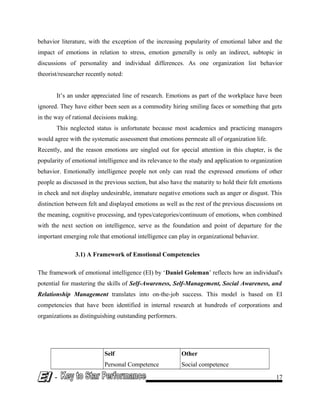
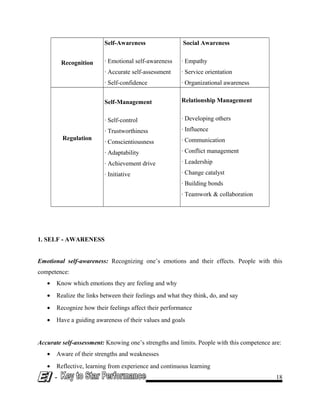
![4] MEASURING E I :
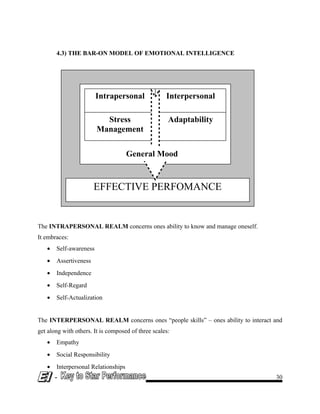
4.1) THE MEANING OF EMOTIONAL INTELLIGENCE
As a point of departure for the important role that emotions have played in psychology over the
years and Gardner’s recognition of multiple intelligences is the recent emergence of emotional
intelligence. Although its roots are usually considered to go back
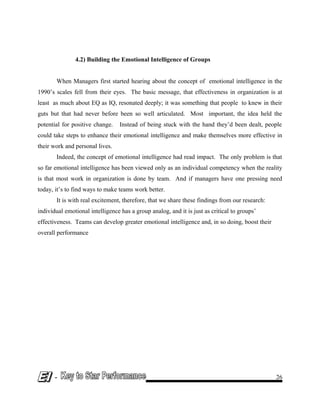
Goleman’s Dimensions of Emotional Intelligence in the workplace
EI Dimensons Characteristics Workplace Example
Self-awareness
Self-management
Self-motivation
Empathy
Self-understanding: knowledge of true
feeling at the moment
Handle one’s emotion to facilitate rather
than hinder the task at hand; shake off
negative emotions and get back on
constructive track for problem solution
Stay the course toward desired goal;
overcome negative emotional impulses and
delay gratification to attain the desired
outcome
Understand and be sensitive to the feelings
of others: being able to sense what others
feel and want
John recognizes that he is angry
so he will wait to cool down and
gather more information before
making an important personnel
decision.
Amber holds back her impulse to
become visibly upset and raise
her voice at the customer’s unfair
complaint and tries to get more
facts of what happened. Pat
persisted to successful project
completion in spite of the many
frustrations from the lack of
resources and top management
support. Because the head of the
team knew her members were
mentally if not physically
exhausted, she took everyone
bowling during an afternoon
- 24](https://image.slidesharecdn.com/6emotionalquotient-140320114401-phpapp02/85/emotional-quotient-24-320.jpg)
![5] METHODOLOGY
5.1) Data Collection / Sample
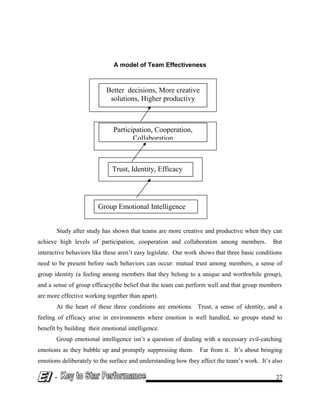
Data collection was done on a Sample of 219 executives by using the EI scale developed
by Dr. Cooper & Prof. Sawaf (1996).
The questionnaire covers 21 variables (e.g. life events, work pressures, personal
pressures, emotional self awareness, emotional awareness of others, creativity, resilience,
interpersonal connections, compassion intuition, trust radius, personnel power, quality of life,
etc.) and leads to mapping of Emotional Quotient (EQ) and it’s inherent competencies. The
instrument is extensively researched and found statistically reliable and valid in USA and
CANADA.
The Questionnaire is already in use for training programs conducted for Indian
Executives and is a basis for personal feedback and counseling. Here the same has been pilot
tested on Indian executive population. Data was collected on the sample of 250 executives who
were attending the Professional Managerial Programs; out of which 219 are considered for
analysis (based on the completeness of their response).
The characteristics of sample in terms of age, gender, qualification, functional areas
and work experience is given below.
AGE GENDER FUNCTIONAL AREAS
QUALIFICATION WORK EXPERIENCE
-
20-30 yrs – 73 %
31-50 yrs – 27 %
Male – 80 %
Female – 20 %
Graduates – 78 %
Post Graduates – 18 %
Professional – 2 %
Doctorate – 2 %
Marketing – 54 %
Finance – 22 %
HR – 24 %
0-5 yrs – 53 %
6-10 yrs – 33 %
11-15 yrs – 6 %
16-20 yrs – 5 %
21 + yrs – 3 %](https://image.slidesharecdn.com/6emotionalquotient-140320114401-phpapp02/85/emotional-quotient-40-320.jpg)
![Analysis:
The data collected was analyzed qualitatively and quantitatively to arrive at an EQ map of Indian
Executives. The score on 21 variables is analyzed to get an Emotional Quotient (EQ) Profile
using 5 competencies.
Profile of EQ competencies
Components Category Interpretation Strategy To Improve
Current environment Low
Current environment is not
perceived as very helpful. Work
& personal pressures are high
Training for awareness,
coping & stress
management
Emotional Literacy Average
Average self-awareness,
emotional expression &
awareness for others
Training for assertiveness,
giving & accepting
feedback
EQ Competency Average
Average purposefulness,
adjustment, creativity,
resilience and self-control,
avoid confrontation &
interpersonal connection
Training for goal setting,
developing creativity &
overcoming adversities
EQ Values & Beliefs Low
Dissatisfaction with life, low on
compassion, intuition, trust,
personal power & integrity
Training for teambuilding,
conflict management &
adaptation to change
EQ Outcomes Low
Not happy with the quality of
life, quality of relationship &
other health related issues
Holistic training covering
psychosomatic issues
(training in yoga, reiki,
stress management, etc.)
Conclusion:
Here we may say that this test is applicable to Indian managerial population and helps in arriving
at their EQ profile. However further analyses and research is essential for getting a better insight
into the construct of emotional intelligence. Also there is a need for preparing a shortened
version of the scale to check its reliability and validity.
6] EMOTIONAL INTELLIGENCE AT WORKPLACE
-](https://image.slidesharecdn.com/6emotionalquotient-140320114401-phpapp02/85/emotional-quotient-41-320.jpg)
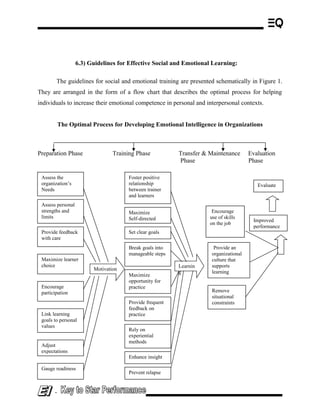
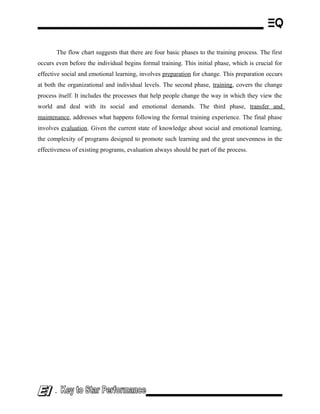
![7] USES:
7.1) EQ - USEFULNESS IN HR PRACTICES
Emotional intelligence/quotient plays a very important role as a tool in organizations. It
contributes to the bottom line in any work organization. It can also be a valuable tool for HR
practitioners and managers who need to bring revolution in their organizations.
Companies Contacted:
1. Godrej Boyce India Limited
HR manager – T.P. Vaishnav
Question – What role does EQ play in your company?
Response – EQ is yet not practiced as a tool to improve and measure performance in the
company. But we have started an EQ / EI awareness program, which is very preliminary.
2. Reliance Infocom
HR manager – Ravi Ranganathan
Question – Is EQ used as a tool to measure performance in your company?
Response – EQ as a tool is not used explicitly in our company. We check the EI levels in the
candidates through few indirect questions during the recruitment and selection processes.
3. Jhonson & Jhonson
HR manager – Shruti Chaterjee
Response given by her was similar to that given by HR manager of Reliance Infocom
-](https://image.slidesharecdn.com/6emotionalquotient-140320114401-phpapp02/85/emotional-quotient-48-320.jpg)
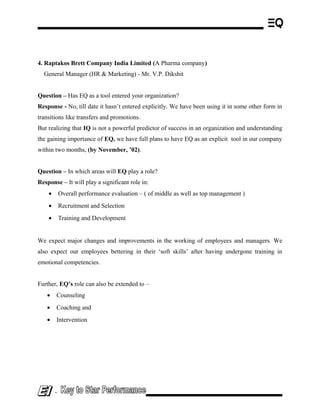
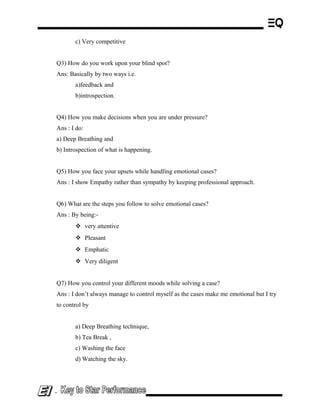
![8] OBJECTIVES
1) To understand the meaning of EQ
2) To find out its uses in different areas.
3) To evalute its importance through case study.
9] TOOLS
1) Books .
2) Questionnaire .
3) Interview.
10] CASE STUDY
10.1) Interview
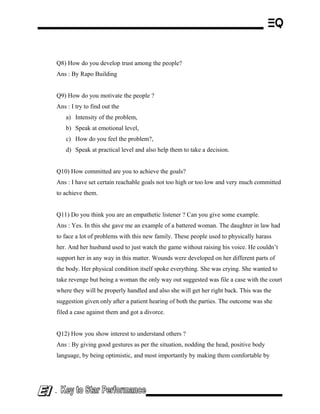
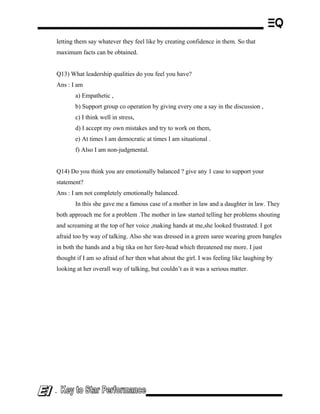
Q1) What do you understand by Emotional Intelligence?
Ans : According to me E.I is understanding the emotions and feelings of others
by being empathetic and knowing yourself..
Q2) What are your strengths and weaknesses ?
Ans : Strengths
a) extremely patient ,
b) can connect people easily(networking),
c) aware of my own-self (introspection),
d) art of saying “NO”
Weaknesses:
a) Sensitive,
b) Extra anxious,
-](https://image.slidesharecdn.com/6emotionalquotient-140320114401-phpapp02/85/emotional-quotient-50-320.jpg)
![11] RECOMMENDATIONS
1) Individual level – Every individual to become more successful in his life should
try to evaluate his EI connected to his working areas so that he can increase his
productivity.
2) Group level – In the companies, they should develop in-service training module
for evaluating and improving emotional intelligence of workers form the point of
view of productivity.
3) Managerial level – The emotional intelligence can be evaluated even for the
managerial category at a particular time intervals to get optimum use of human
resources.
-](https://image.slidesharecdn.com/6emotionalquotient-140320114401-phpapp02/85/emotional-quotient-57-320.jpg)
![12 ] SUPPLEMENTARY
12.1) Acknowledgement
I am thankful to N.E.S.Ratnam college for giving me an opportunity to work on the project of
Emotional Intelligence Quotient. I am highly thankful to my esteemed guide Mr.Subramanium
for his support throughout the completion of this project.
I am also thankful to Stri.Chetana Shakti,collector colony ,chembur for assisting me in
this project and allowing me to do a case study form their staff. I am thankful to Ms.Mitali
(psychiatrist), who works there as a counsellor ,for answering to my questionnaire.
-](https://image.slidesharecdn.com/6emotionalquotient-140320114401-phpapp02/85/emotional-quotient-58-320.jpg)
![13] CONCLUSION
So is there anything new about emotional intelligence? In some ways, emotional
intelligence really is not new. In fact, it is based on a long history of research and theory in
personality and social psychology. Furthermore, Goleman has never claimed otherwise. In fact,
one of his main points was that psychologists have studied the abilities associated with emotional
intelligence for many years, and there is an impressive, and growing, body of research
suggesting that these abilities are important for success in many areas of life.
However, rather than arguing about whether emotional intelligence is new, it is more
useful and interesting to consider how important it is for effective performance at work. There
now is a considerable body of research suggesting that a person’s ability to perceive, identify,
and manage emotion provides the basis for the kinds of social and emotional competencies that
are important for success in almost any job. Furthermore, as the pace of change increases and
the world of work makes ever-greater demands on a person’s cognitive, emotional, and physical
resources, this particular set of abilities has become increasingly important.
Use of Emotional Intelligence has become imperative to improve both productivity and
psychological well being in the workplace of tomorrow.
At present, there is little in the way of published, fundamental research that examines
either emotional intelligence or its measurement. However, This is a very interesting and
potentially powerful area that bears watching. It is not without controversy. It is a long way to
go. No doubt, the emotional intelligence will contribute much to a happy living of an individual
and the community.
Emotional intelligence allows us to think more creatively and use our emotions to solve
problem. Emotional intelligence appears to be an important set of psychological abilities that
relate to life success. It is empathy and communication skills as well as social and leadership
skills that will be central to your success in life and personal relationships. Rather than a high IQ,
purpose that it is far better to have a high E-IQ, emotional intelligence, if you want to be a valued
and a productive member of the society.
Men particularly need to develop emotional skills, and there are many examples of men
with high intelligence who were not successful because they had problems with there people
skills. It is found from this research that people with high emotional intelligence generally have
-](https://image.slidesharecdn.com/6emotionalquotient-140320114401-phpapp02/85/emotional-quotient-59-320.jpg)