Moodle as a Community of Learning or Practice or neither??Raymond WatsonOpen Training CollegeDublin
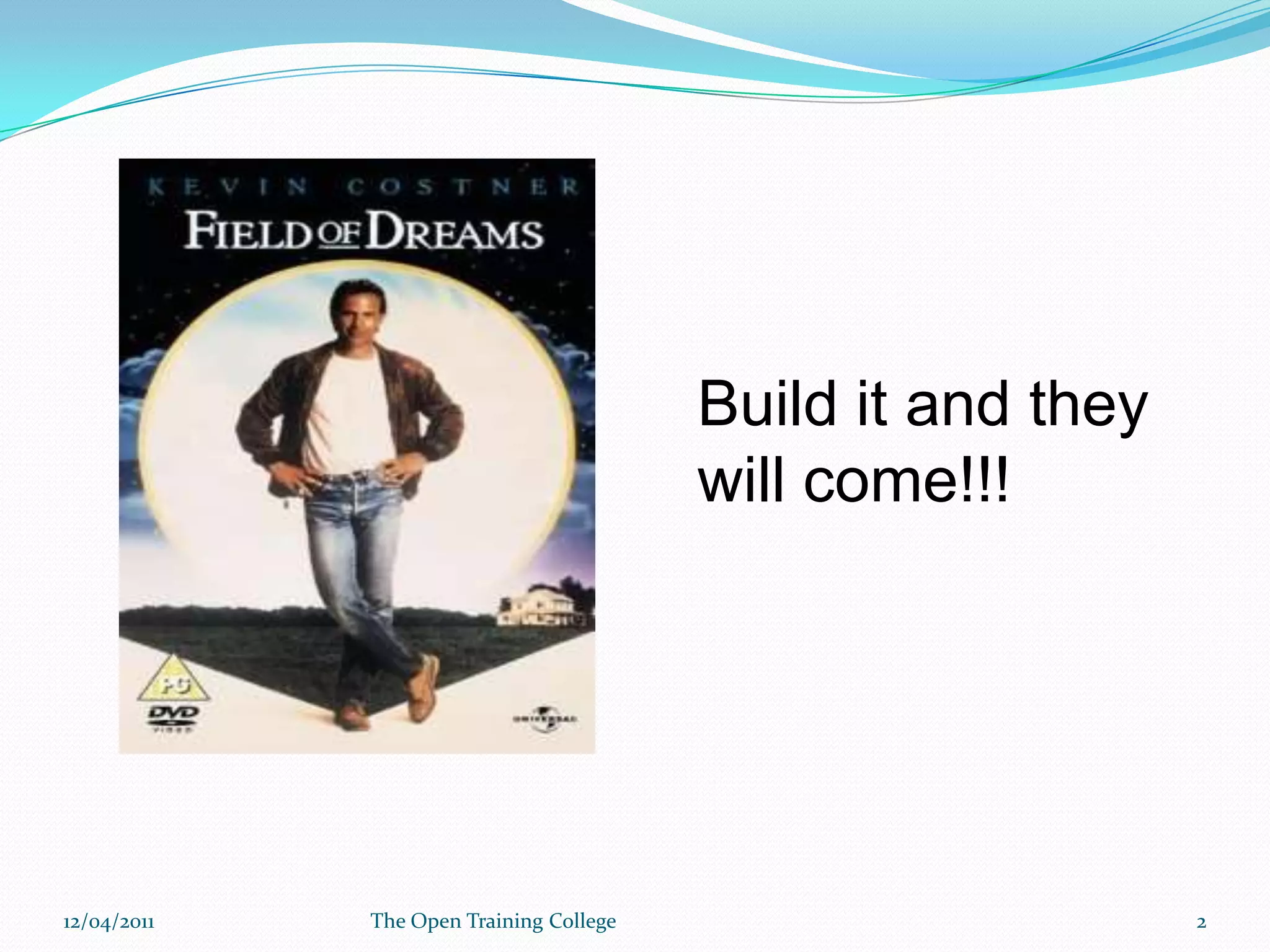
09/03/2011The Open Training College2Build it and they will come!!!
The Research QuestionAn illuminative evaluation of an online community of practice as an element of curriculum design for work based social care students.Does the innovation operate effectively as a community of practice?Does the innovation contribute to students learning?What benefits were there for the student?09/03/20113The Open Training College
09/03/2011The Open Training College4Facilitation ParticipationAssessmentCommunity
The Open Training CollegeA College that developed as a sub division of a human service in Dublin- St. Michaels House.Delivers ordinary and honours degrees to frontline staff and managers in human services and the non profit sector Courses in Social Care / Management / Supported EmploymentAll accredited by HETAC (Level 7/8)09/03/2011The Open Training College5
MissionTo provide educational opportunities to frontline workers and managers in social care (specifically the disability sector) that:Is accessibleIs flexibleIs accreditedFocuses on best practice09/03/20116The Open Training College
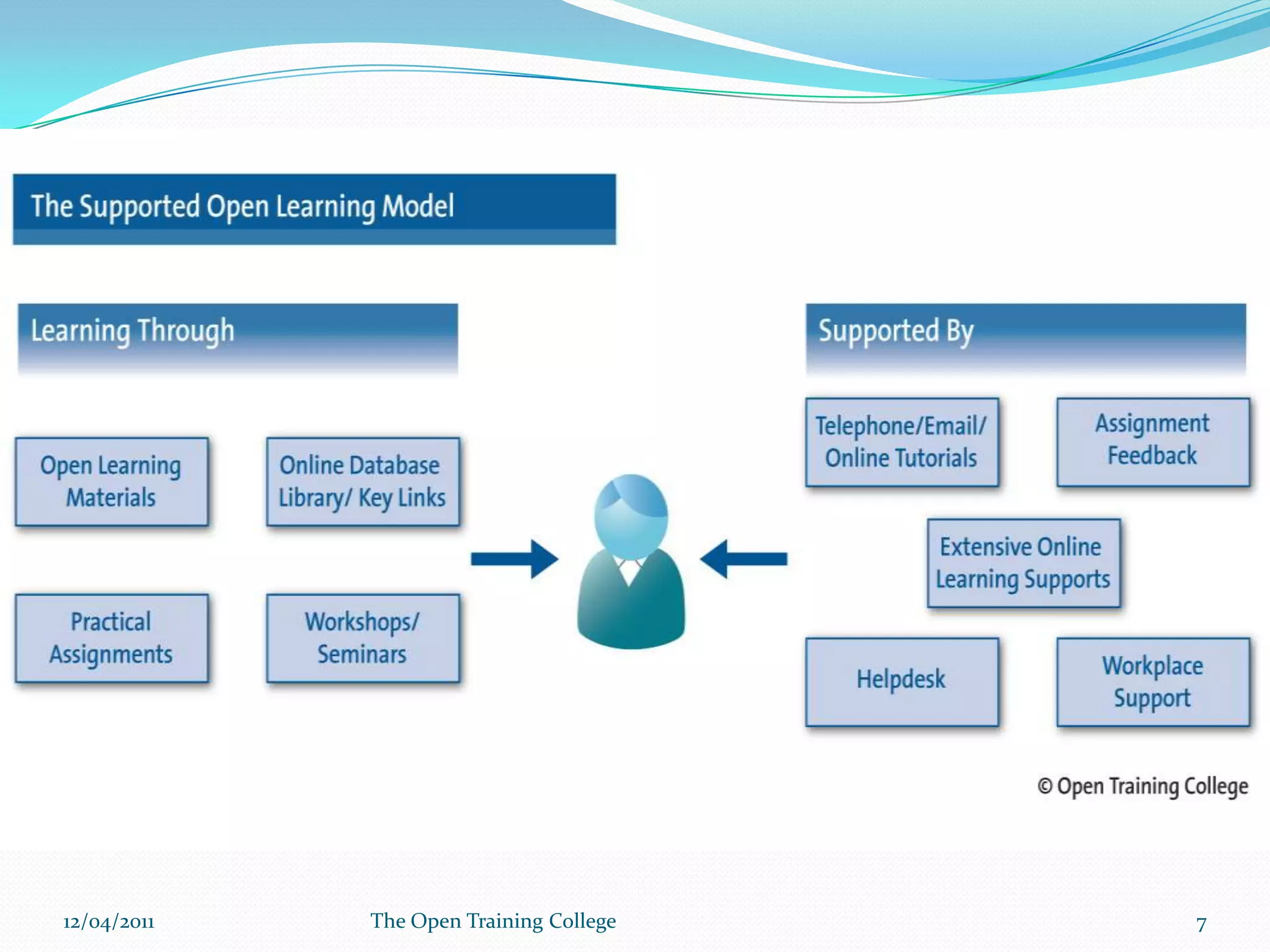
09/03/2011The Open Training College7
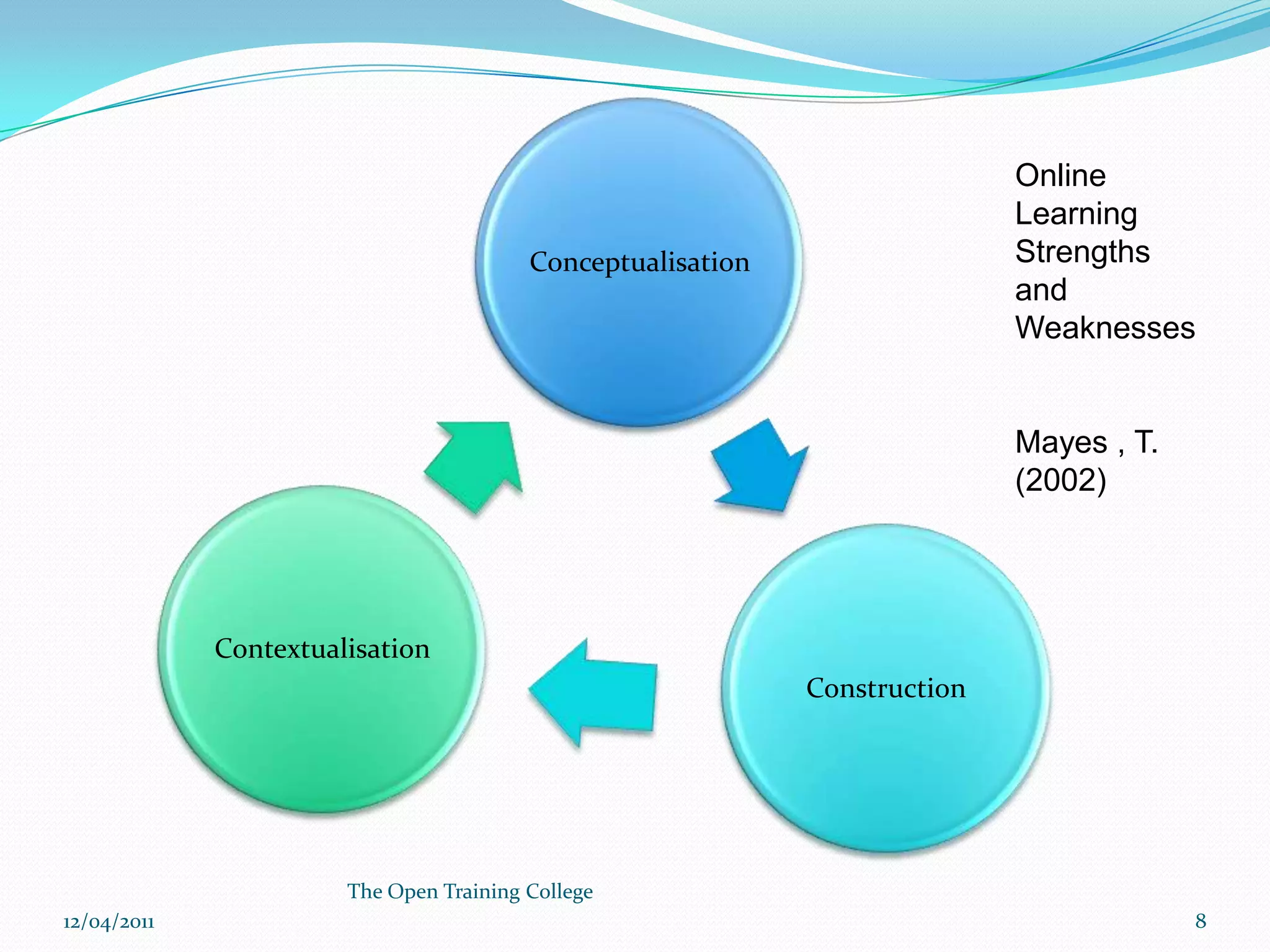
09/03/2011Online Learning Strengths and WeaknessesMayes , T. (2002)The Open Training College8
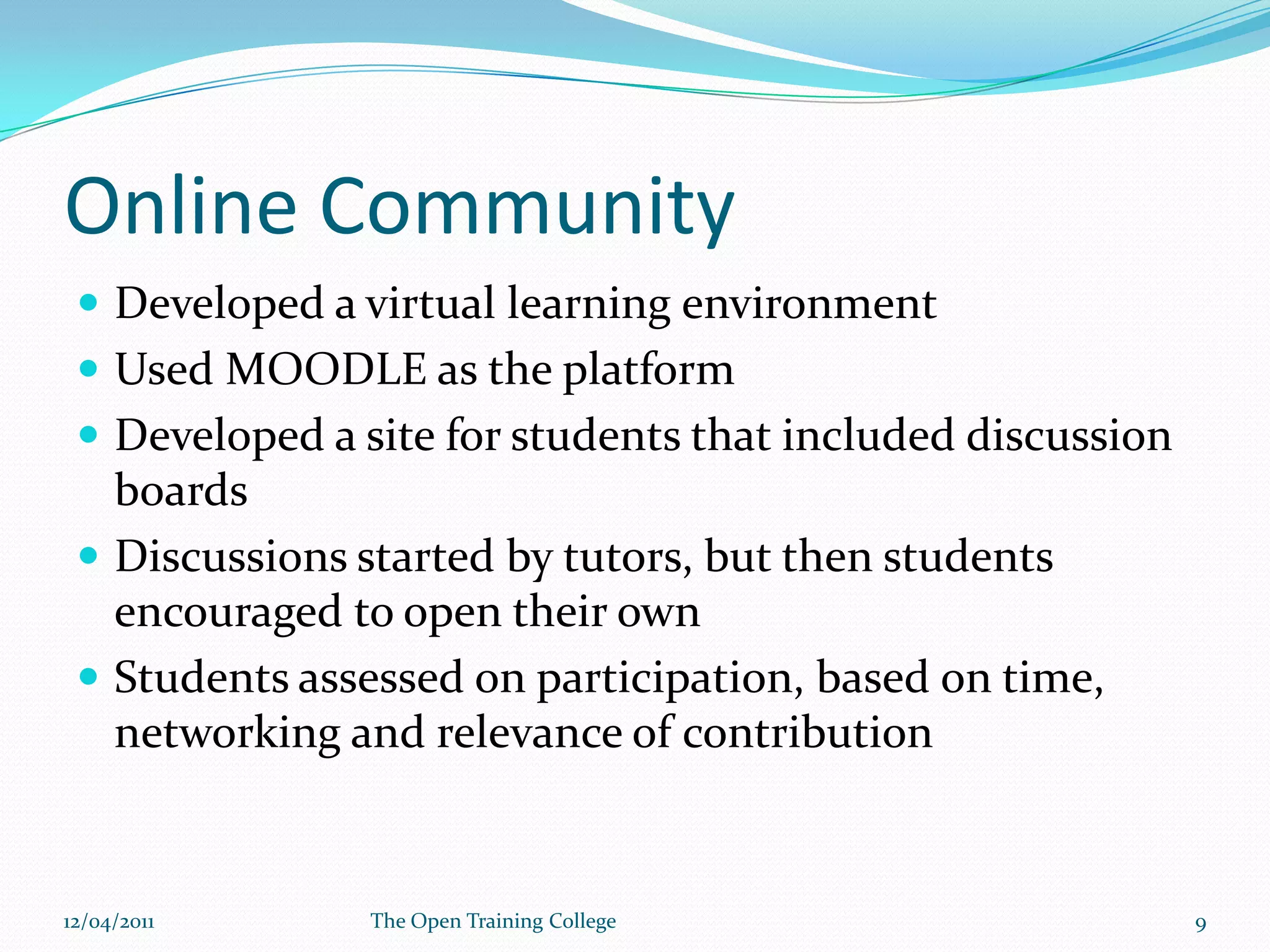
Online CommunityDeveloped a virtual learning environmentUsed MOODLE as the platformDeveloped a site for students that included discussion boardsDiscussions started by tutors, but then students encouraged to open their ownStudents assessed on participation, based on time, networking and relevance of contribution09/03/2011The Open Training College9
Community of PracticeDefinition:‘a group of people who do not necessarily work together everyday but find value in their interactions....they typically share information, insight and advice’.Wenger (2002)09/03/201110The Open Training College
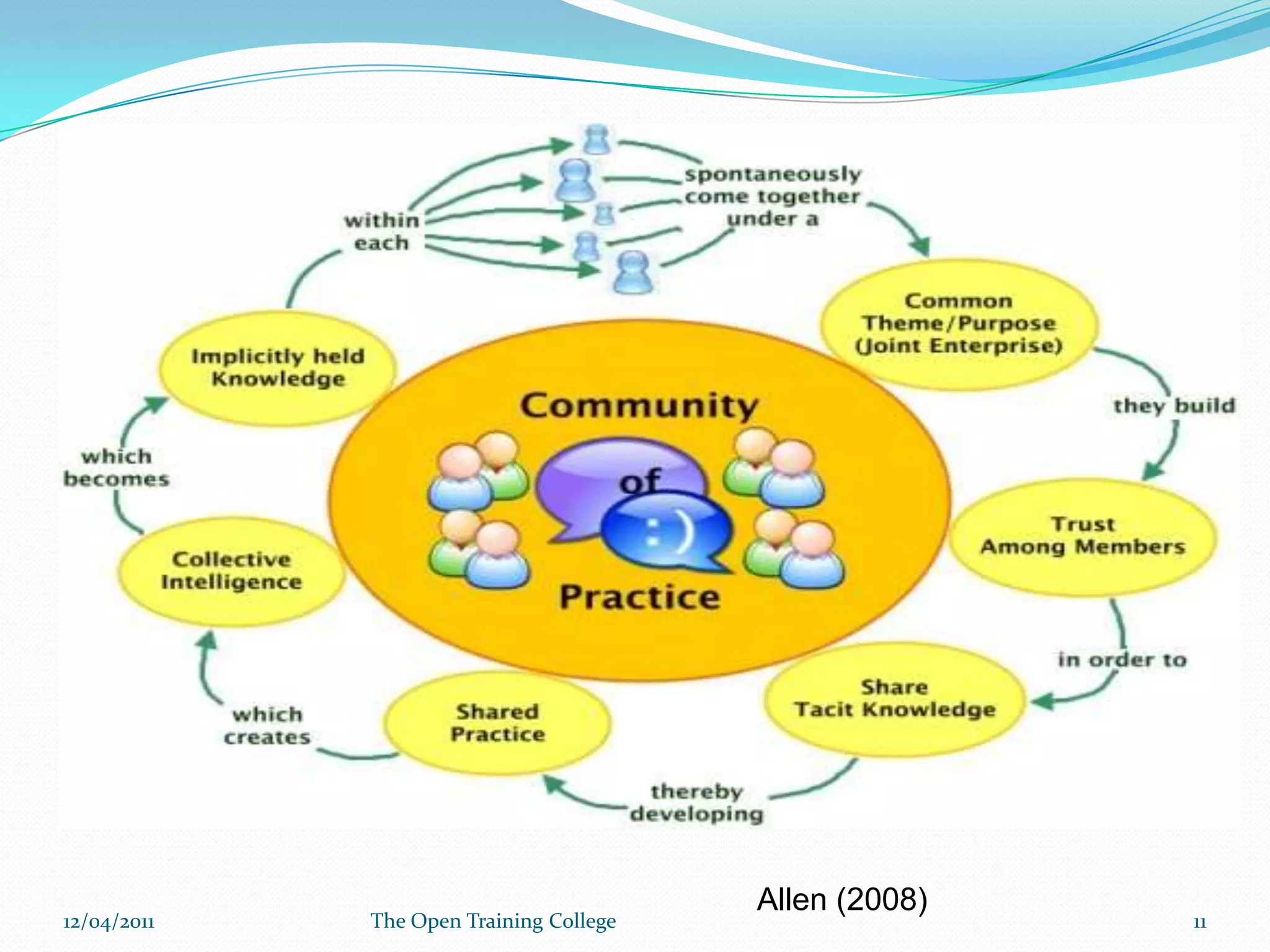
09/03/2011The Open Training College11Allen (2008)
Learning or Practice?Are the student ‘legitimate participants’ in a community of practice or are they still learners??09/03/201112The Open Training College
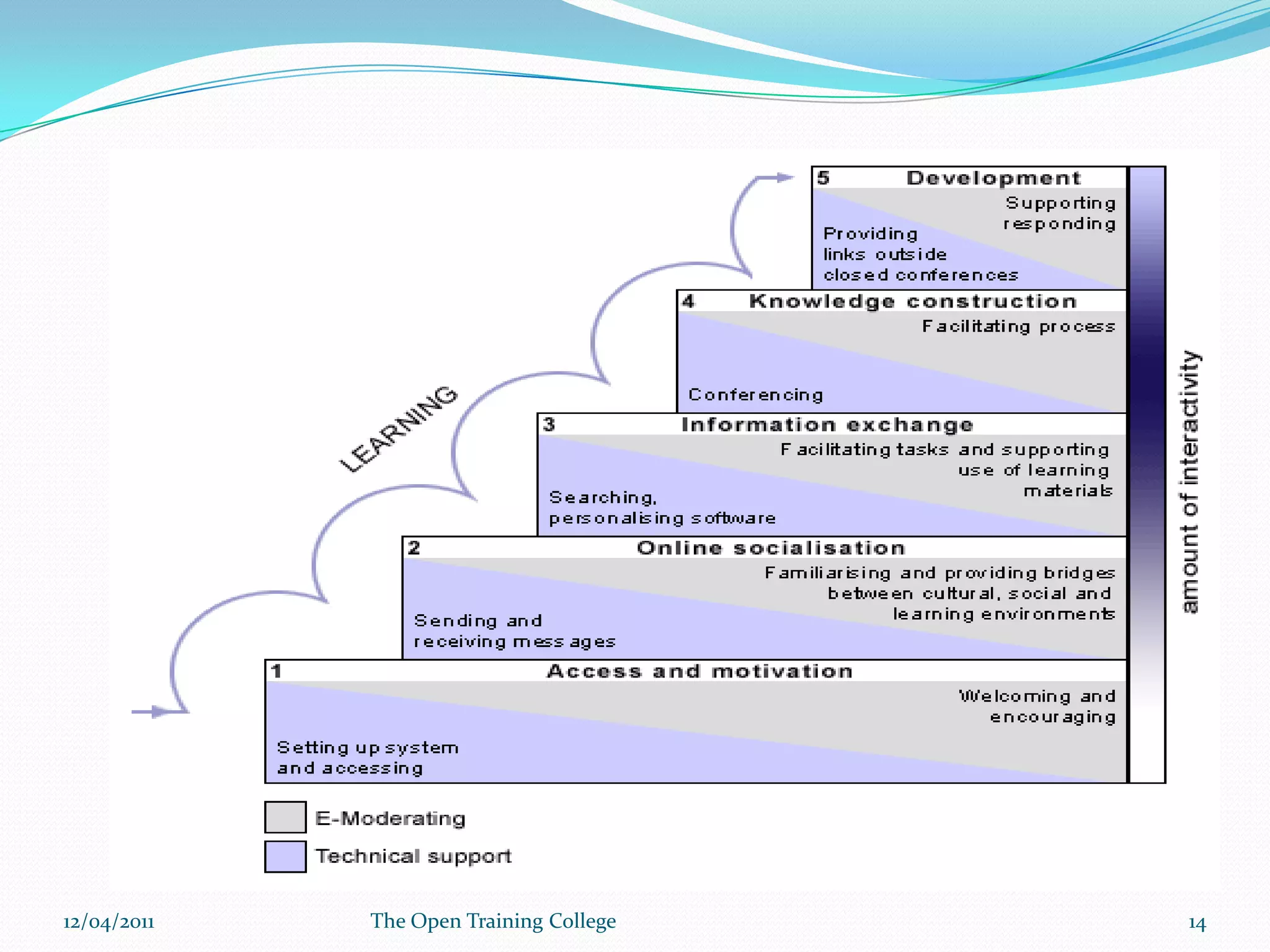
What we needed to find out?Was the student participating?Salmon’s (2004) five levels of e participationIf  participating, were the key components of CoP present?Saint-Onge and Wallace’s (2003) 5 characteristics of CoPs.09/03/201113The Open Training College
09/03/2011The Open Training College14
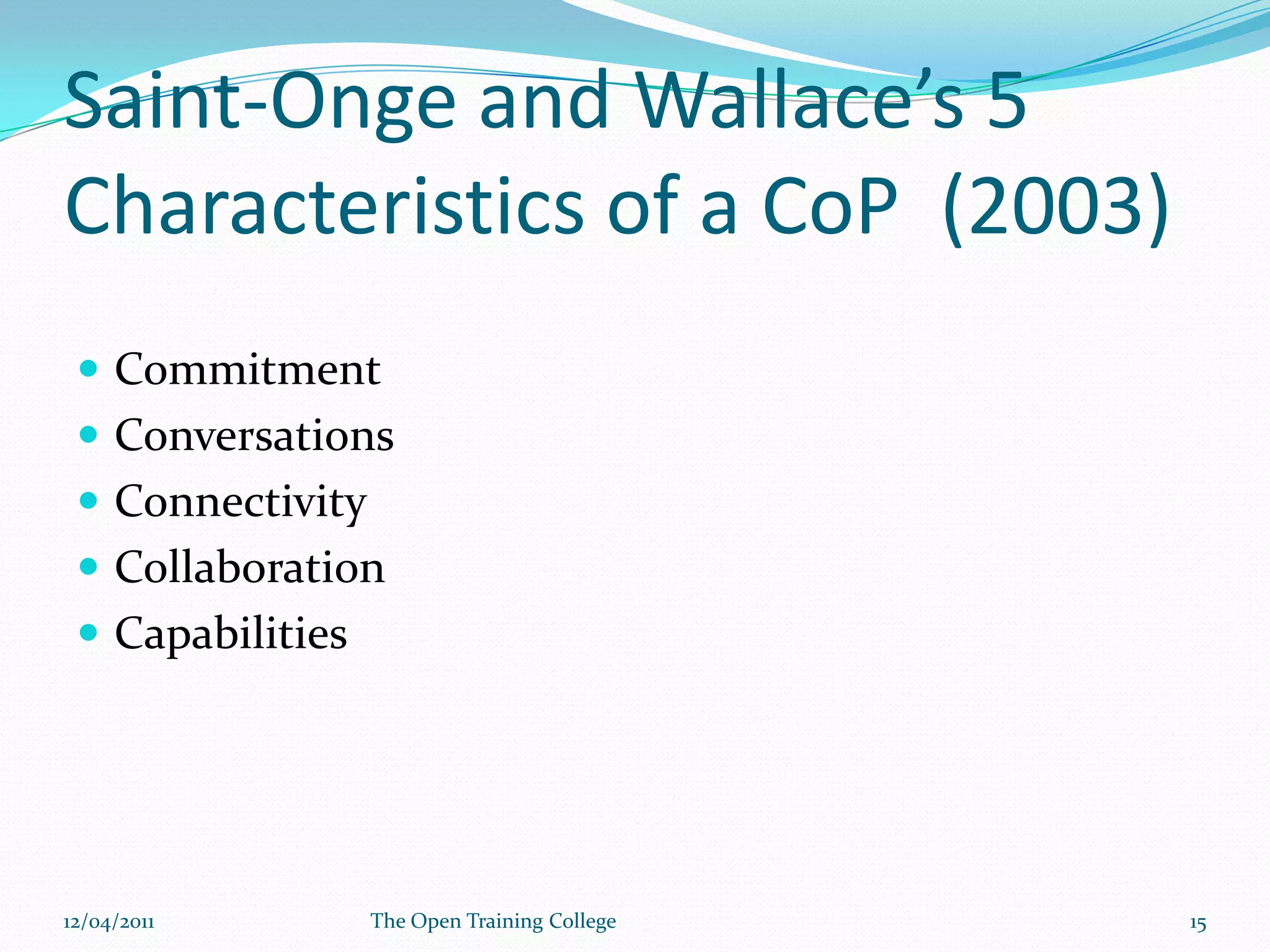
Saint-Onge and Wallace’s 5 Characteristics of a CoP  (2003)CommitmentConversationsConnectivityCollaborationCapabilities09/03/201115The Open Training College
InstrumentsStudent questionnaires – identify key information on the students taking part and to explore their experience of  being a member of the online communityInterviews with the tutors involvedTracking of  the student’s online activity09/03/201116The Open Training College
TrackingBy labelling the students  based on their experience of  accessing, networking and sharing and then identifying how the experience was for each group09/03/201117The Open Training College
Saint-Onge and Wallace’s 5 CharacteristicsEvidence of each characteristic being present.But what was the motivation behind this participation?The questionnaires had shown that while professional development was a motivator, the main motivation was the generation of new ideas  for assessment purposes.09/03/201118The Open Training College
Key BenefitsShare others experienceIdentify new ideasExchange ideasReduce isolationSolutions for Assignments09/03/201119The Open Training College
The AssessmentAssessment looked at how their organisation planned for individual service users?Assessed on a rubricRubric looked at amount (750 words), over 3 postings, to 3 different people, content (practice ideas and linkage to key theory)10%09/03/2011The Open Training College20
Some of The Student Driven TopicsPerson Centred PlanningDealing with FamiliesDealing with ManagersPlanning for ChildrenPlanning for People within the Autistic SpectrumLanguageTopical IssuesWhat do you do when....?Finance09/03/2011The Open Training College21
Examples of CollaborationWorking with Families – Do organisations give training to parents? What would the curriculum be?Language – moved from medical model language like the use of terms like sever and profound to identifying that for PCPs to work that the language must be more collegial like partner.09/03/2011The Open Training College22
Examples of CapabilitiesExploring Person Centred Planning against other planning systems in organisations and their role in themSupporting someone who was not a self advocate in the process09/03/2011The Open Training College23
Authentic Assessment?Thorny issue?Shifts instruction from a teaching environment to a learning environment with a focus on practice centred learningMeaningful dialogue it supports ‘deep learning’Meaningful interaction with both tutor and peerDialogue with a  wide community of learnersProvision of formative feedbackImmediate response to real time issues09/03/2011The Open Training College24
Discourse CommunityThe community was not a community of practice.The tool had two characteristics that diluted its power as a community of  practice.OnlinePedagogical rationale09/03/201125The Open Training College
Students were not self  selecting and the community was too structured.Participation was limited to the level required to reach assessment criteria. Did not have that key characteristic of a COP as a defined by Wenger- it was not a fuzzy, organic structure based on passion for practice.09/03/201126The Open Training College
09/03/2011The Open Training College27Sharp (1997) stated that generally online communities produced a weaker form of community of practice, calledDISCOURSE COMMUNITIES.
What had we learned?The devise did have benefits as a pedagogical tool.The devise does support meaningful conversation on practice.Support for students needed to ensure everyone accessed the community , networked and shared.Engagement with the innovation was not dependent on gender, previous computer skills or age.Engagement was based on the students motivation to learn.09/03/201128The Open Training College
The FutureWhere the innovation may blossom into a Community of Practice is in the wider field of social care in Ireland.Deepen ongoing professional learningDevelop practice through participationCreate a valid platform for CPDCollective experience of many social care workers would produce a valid reference point and  align people to be effective beyond their own practice.09/03/201129The Open Training College
09/03/2011The Open Training College30Facilitation ParticipationAssessmentCommunity

Moodle as a community of learning or practice or not raymond watson open training college

  • 1.
    Moodle as aCommunity of Learning or Practice or neither??Raymond WatsonOpen Training CollegeDublin
  • 2.
    09/03/2011The Open TrainingCollege2Build it and they will come!!!
  • 3.
    The Research QuestionAnilluminative evaluation of an online community of practice as an element of curriculum design for work based social care students.Does the innovation operate effectively as a community of practice?Does the innovation contribute to students learning?What benefits were there for the student?09/03/20113The Open Training College
  • 4.
    09/03/2011The Open TrainingCollege4Facilitation ParticipationAssessmentCommunity
  • 5.
    The Open TrainingCollegeA College that developed as a sub division of a human service in Dublin- St. Michaels House.Delivers ordinary and honours degrees to frontline staff and managers in human services and the non profit sector Courses in Social Care / Management / Supported EmploymentAll accredited by HETAC (Level 7/8)09/03/2011The Open Training College5
  • 6.
    MissionTo provide educationalopportunities to frontline workers and managers in social care (specifically the disability sector) that:Is accessibleIs flexibleIs accreditedFocuses on best practice09/03/20116The Open Training College
  • 7.
  • 8.
    09/03/2011Online Learning Strengthsand WeaknessesMayes , T. (2002)The Open Training College8
  • 9.
    Online CommunityDeveloped avirtual learning environmentUsed MOODLE as the platformDeveloped a site for students that included discussion boardsDiscussions started by tutors, but then students encouraged to open their ownStudents assessed on participation, based on time, networking and relevance of contribution09/03/2011The Open Training College9
  • 10.
    Community of PracticeDefinition:‘agroup of people who do not necessarily work together everyday but find value in their interactions....they typically share information, insight and advice’.Wenger (2002)09/03/201110The Open Training College
  • 11.
    09/03/2011The Open TrainingCollege11Allen (2008)
  • 12.
    Learning or Practice?Arethe student ‘legitimate participants’ in a community of practice or are they still learners??09/03/201112The Open Training College
  • 13.
    What we neededto find out?Was the student participating?Salmon’s (2004) five levels of e participationIf participating, were the key components of CoP present?Saint-Onge and Wallace’s (2003) 5 characteristics of CoPs.09/03/201113The Open Training College
  • 14.
  • 15.
    Saint-Onge and Wallace’s5 Characteristics of a CoP (2003)CommitmentConversationsConnectivityCollaborationCapabilities09/03/201115The Open Training College
  • 16.
    InstrumentsStudent questionnaires –identify key information on the students taking part and to explore their experience of being a member of the online communityInterviews with the tutors involvedTracking of the student’s online activity09/03/201116The Open Training College
  • 17.
    TrackingBy labelling thestudents based on their experience of accessing, networking and sharing and then identifying how the experience was for each group09/03/201117The Open Training College
  • 18.
    Saint-Onge and Wallace’s5 CharacteristicsEvidence of each characteristic being present.But what was the motivation behind this participation?The questionnaires had shown that while professional development was a motivator, the main motivation was the generation of new ideas for assessment purposes.09/03/201118The Open Training College
  • 19.
    Key BenefitsShare othersexperienceIdentify new ideasExchange ideasReduce isolationSolutions for Assignments09/03/201119The Open Training College
  • 20.
    The AssessmentAssessment lookedat how their organisation planned for individual service users?Assessed on a rubricRubric looked at amount (750 words), over 3 postings, to 3 different people, content (practice ideas and linkage to key theory)10%09/03/2011The Open Training College20
  • 21.
    Some of TheStudent Driven TopicsPerson Centred PlanningDealing with FamiliesDealing with ManagersPlanning for ChildrenPlanning for People within the Autistic SpectrumLanguageTopical IssuesWhat do you do when....?Finance09/03/2011The Open Training College21
  • 22.
    Examples of CollaborationWorkingwith Families – Do organisations give training to parents? What would the curriculum be?Language – moved from medical model language like the use of terms like sever and profound to identifying that for PCPs to work that the language must be more collegial like partner.09/03/2011The Open Training College22
  • 23.
    Examples of CapabilitiesExploringPerson Centred Planning against other planning systems in organisations and their role in themSupporting someone who was not a self advocate in the process09/03/2011The Open Training College23
  • 24.
    Authentic Assessment?Thorny issue?Shiftsinstruction from a teaching environment to a learning environment with a focus on practice centred learningMeaningful dialogue it supports ‘deep learning’Meaningful interaction with both tutor and peerDialogue with a wide community of learnersProvision of formative feedbackImmediate response to real time issues09/03/2011The Open Training College24
  • 25.
    Discourse CommunityThe communitywas not a community of practice.The tool had two characteristics that diluted its power as a community of practice.OnlinePedagogical rationale09/03/201125The Open Training College
  • 26.
    Students were notself selecting and the community was too structured.Participation was limited to the level required to reach assessment criteria. Did not have that key characteristic of a COP as a defined by Wenger- it was not a fuzzy, organic structure based on passion for practice.09/03/201126The Open Training College
  • 27.
    09/03/2011The Open TrainingCollege27Sharp (1997) stated that generally online communities produced a weaker form of community of practice, calledDISCOURSE COMMUNITIES.
  • 28.
    What had welearned?The devise did have benefits as a pedagogical tool.The devise does support meaningful conversation on practice.Support for students needed to ensure everyone accessed the community , networked and shared.Engagement with the innovation was not dependent on gender, previous computer skills or age.Engagement was based on the students motivation to learn.09/03/201128The Open Training College
  • 29.
    The FutureWhere theinnovation may blossom into a Community of Practice is in the wider field of social care in Ireland.Deepen ongoing professional learningDevelop practice through participationCreate a valid platform for CPDCollective experience of many social care workers would produce a valid reference point and align people to be effective beyond their own practice.09/03/201129The Open Training College
  • 30.
    09/03/2011The Open TrainingCollege30Facilitation ParticipationAssessmentCommunity
  • 31.
    ReferencesMayes, T. (2002)The Technology of Learning in a Social World. London, OUP.Salmon, G. (2004) e-moderating-The Key to Teaching and Learning Online, UK, Routledge-FalmerSaint-Onge, H. & Wallace, D. (2003) Leveraging Communities of Practice for Strategic Advantage, Boston, Butterworth-HeinemannSchwen, T. & Hara, N. (2003) Community of Practice: A Metaphor for Online Design in The Information Society Vol. 19Wenger, E. (1998) Communities of Practice: Learning, Meaning and Identity, New York, Cambridge University PressWenger, E; McDermott, R. 7Snyder, W. (2002) Cultivating Communities of Practice, Boston, HBS Press09/03/2011The Open Training College31