“… as a platform that comes with a
 great set of bricks”-Tomaz Lasic
What is Moodle?
• Moodle is a software package for producing
  internet-based courses and websites.
  (www.moodle.org).
• It is a “free source e-learning software
  platform, also known as Course Management
  System, Learning Management System, or
  Virtual Learning Environment”
  (http://en.wikipedia.org/wiki/Moodle).
Community Users
• It supports 50, 000 learning communities
• Over 9 million users in over 200 countries
• It is offered in over 80 languages
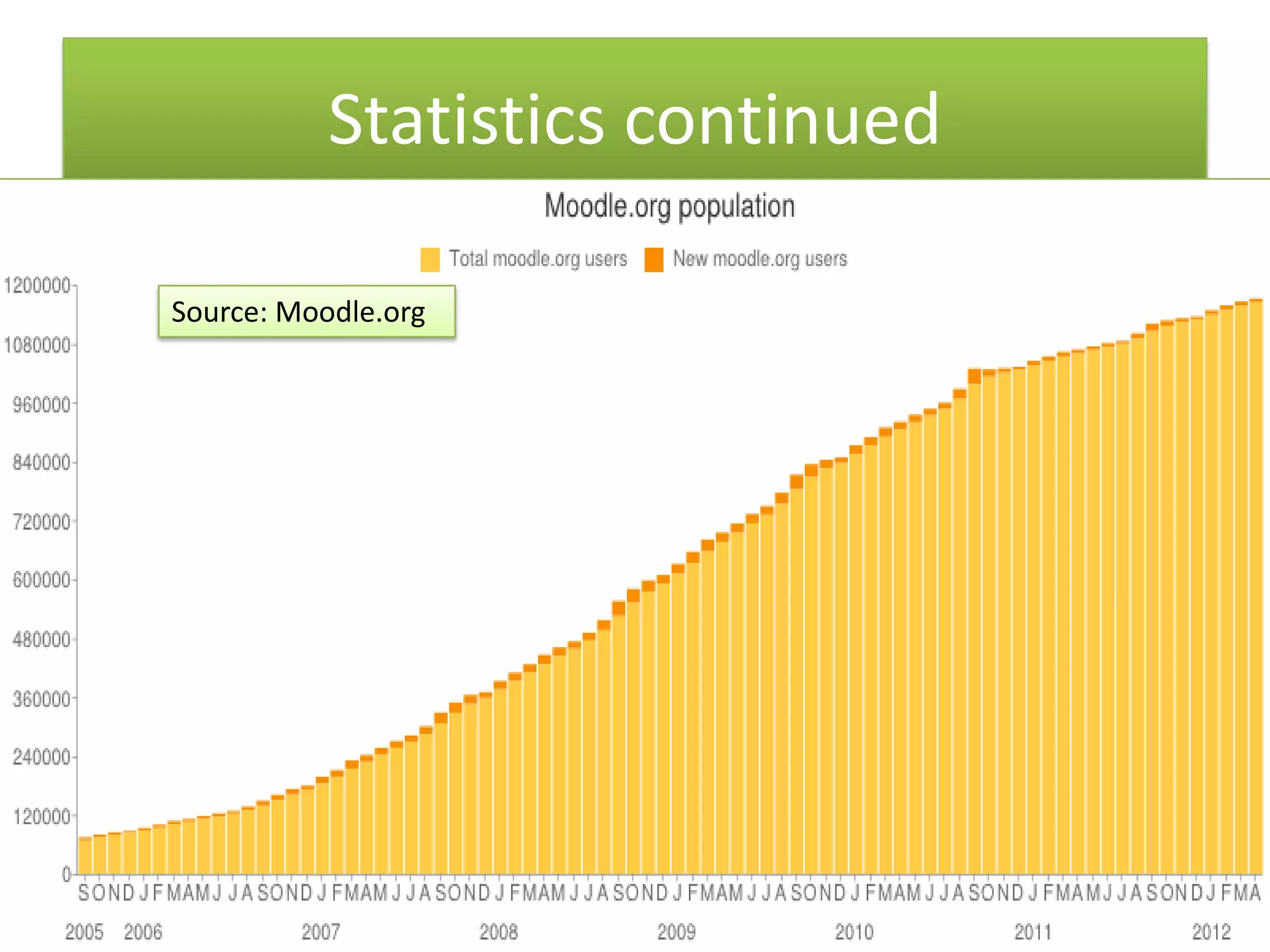
Statistics continued

Source: Moodle.org
Philosophy
• Moodle, or Modular-Object Oriented Dynamic
  Learning Environment, is a well-known and
  widely-used Learning Management System
  that embraces a social constructionist frame
  of education. It is designed with pedagogy and
  technology in mind to allow educators to
  deliver quality online courses (Momani, 2010).
Philosophy Continued…
• The social constructivist theory postulates that
  learning is a social activity and that learners
  construct new knowledge by interacting with
  their environment (Aranda, 2010). According
  to this approach, teachers are facilitators of
  information and not the source of
  information.
Constructionism vs. Constructivism
• Constructionism holds that learning is
  effective when constructing something for
  others to experience (Moodle, 2012).Bers
  (2012) argues that “constructionism carries an
  interventionist perspective because it not only
  aims at understanding how knowledge is
  constructed, but also aims at designing
  learning environments to produce a mindset
  change” (p.2).
Moodle Origins
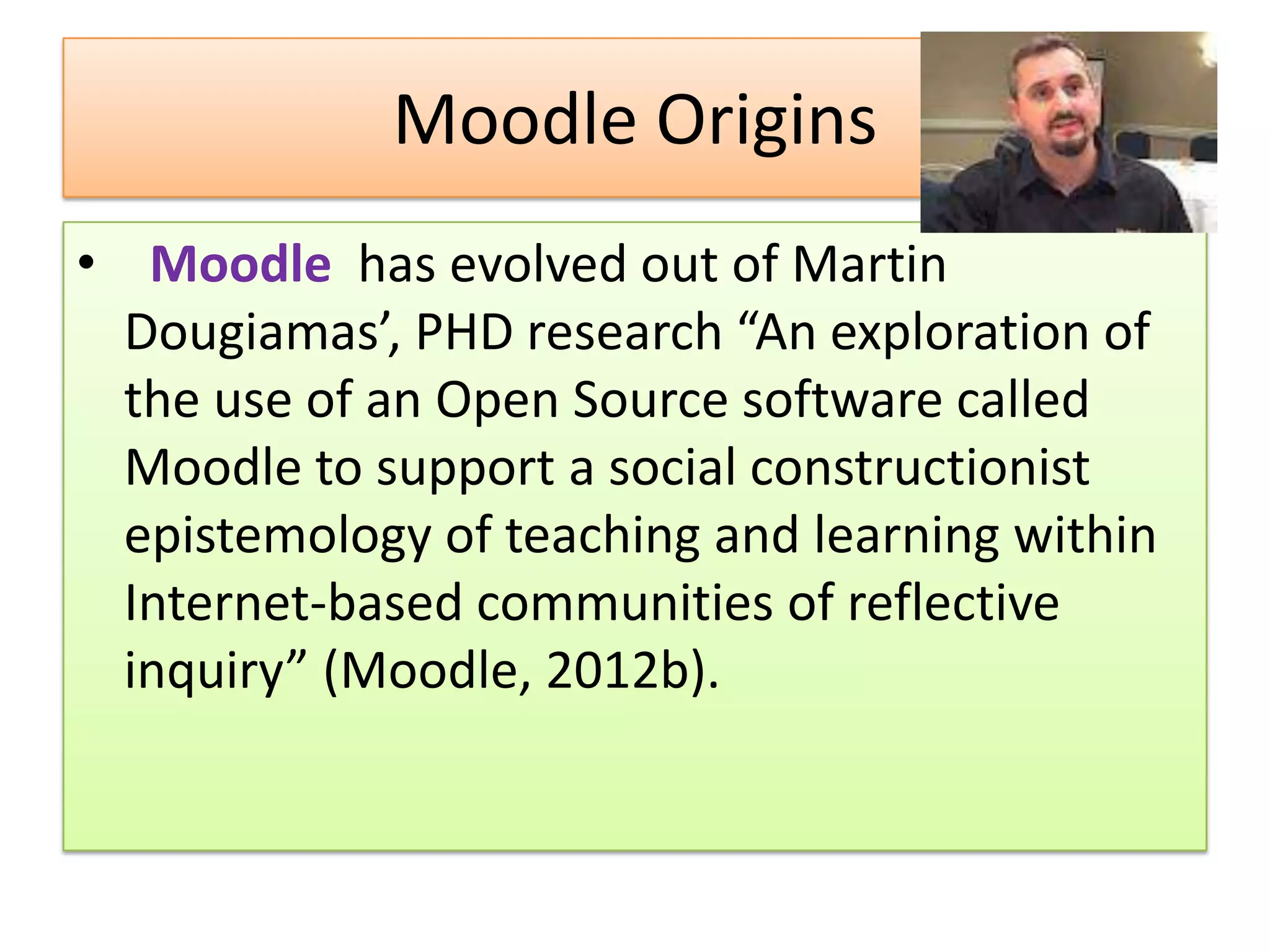
• Moodle has evolved out of Martin
  Dougiamas’, PHD research “An exploration of
  the use of an Open Source software called
  Moodle to support a social constructionist
  epistemology of teaching and learning within
  Internet-based communities of reflective
  inquiry” (Moodle, 2012b).
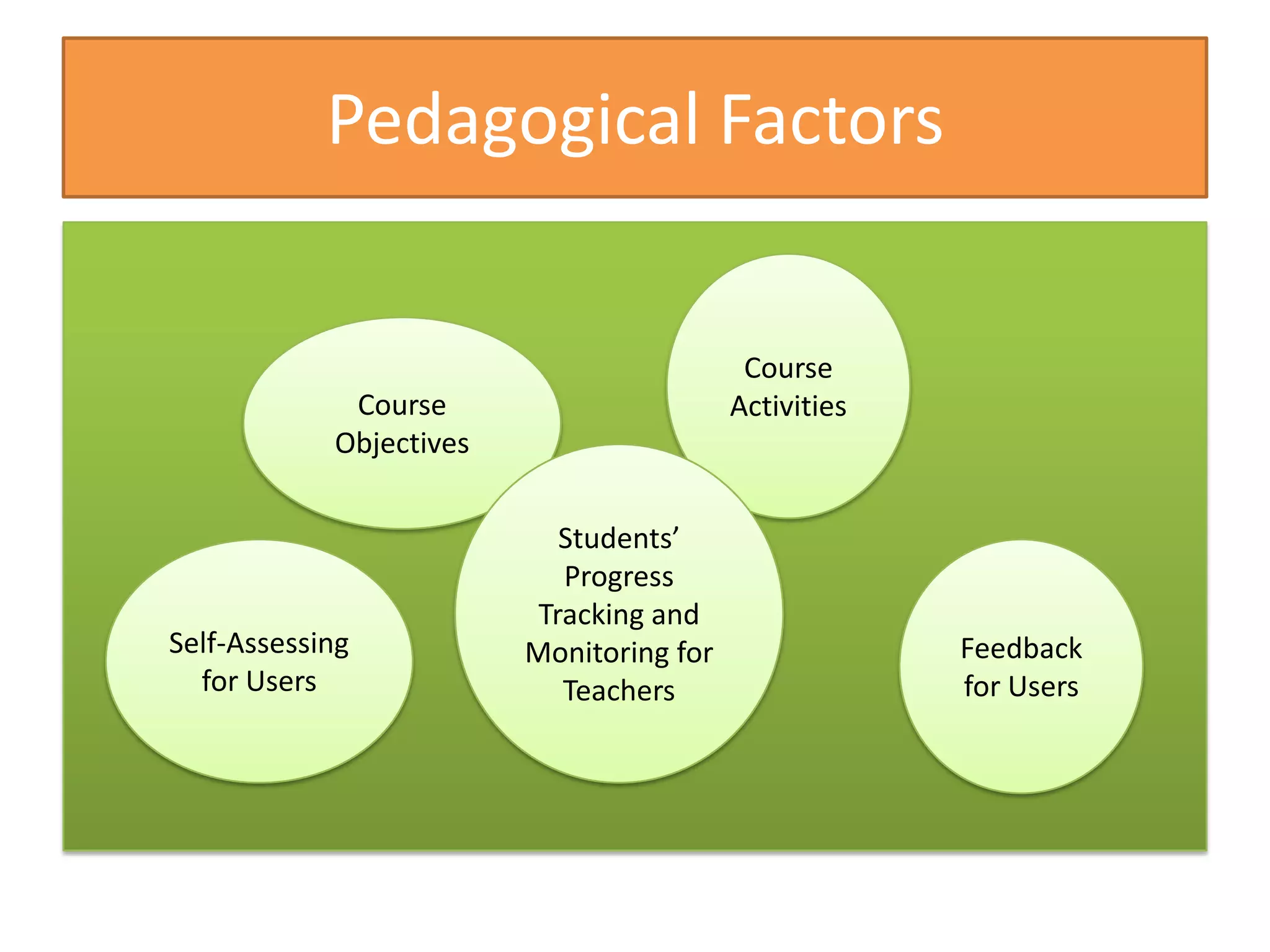
Pedagogical Factors


                                           Course
             Course                       Activities
            Objectives


                            Students’
                            Progress
                          Tracking and
Self-Assessing           Monitoring for                Feedback
  for Users                 Teachers                   for Users
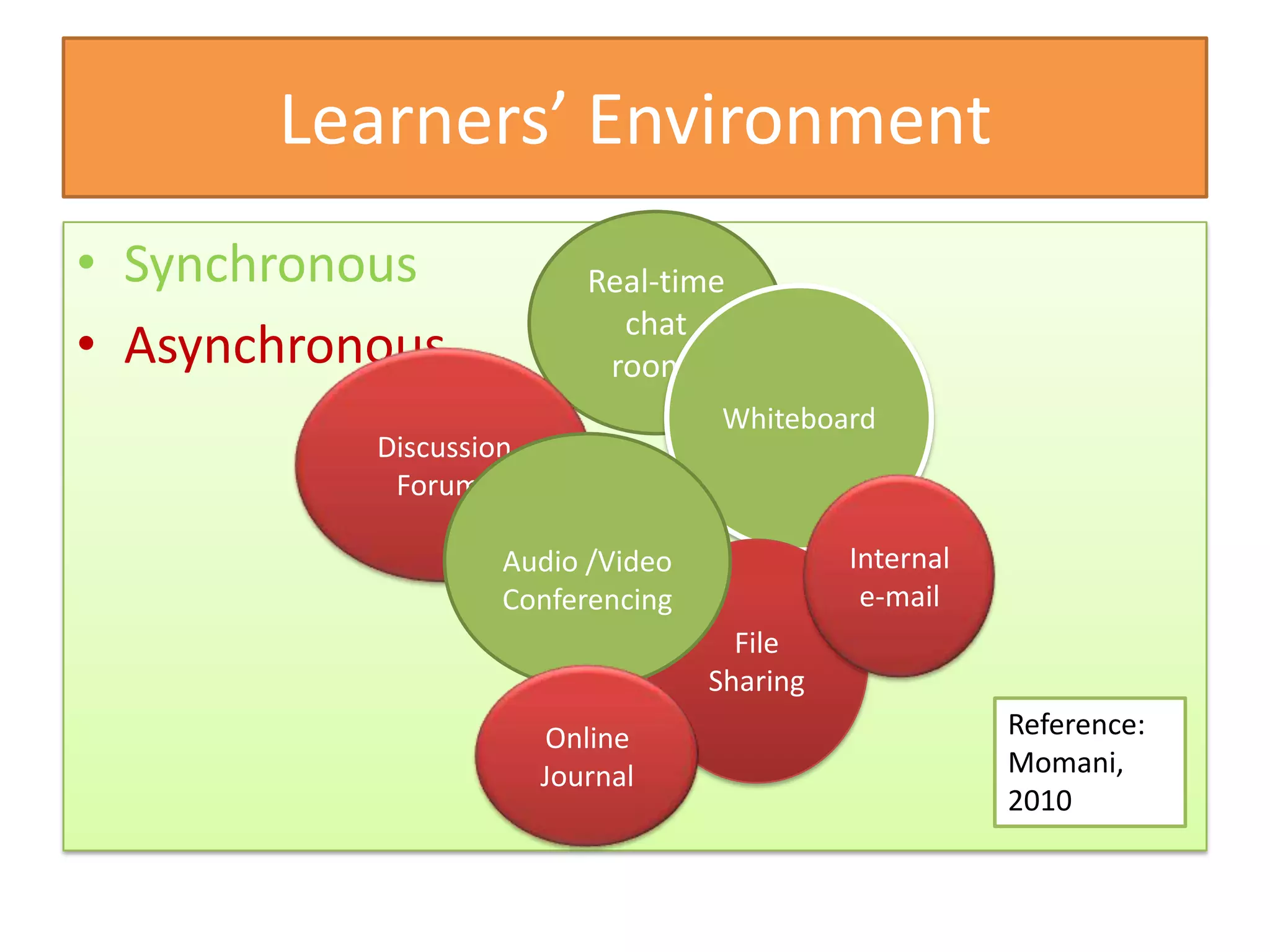
Learners’ Environment
• Synchronous              Real-time
                             chat
• Asynchronous              rooms
                                        Whiteboard
           Discussion
            Forums

                    Audio /Video  wit           Internal
                    Conferencing                 e-mail
                                      File
                                    Sharing
                        Online                             Reference:
                        Journal                            Momani,
                                                           2010
♦Areas of Improvement
• “Some development may be needed for robust
  handling of MathML and enhanced tracking features”
  (Momani, p.1, 2010).
• According to Dougimas, “as the technical infrastructure
  of Moodle stabilizes, further improvement in
  pedagogical support will be a major direction for
  Moodle development” (Moodle, 2012).
• Konstantinidis et al. (2011) suggested that the
  Moodle’s layout has to be changed and “an
  improvement of the user interface is necessary” (p.24).
Benefits and Criticisms: What Does
             Research Say
• Konstantinidis et al. (2011) conducted a study on
  the teachers’ and students’ perceptions on the
  effectiveness of Moodle.
• The instructor-based evaluation of Moodle
  revealed that “Moodle was highly accepted by
  the instructors as a helpful and useful system for
  their educational needs” (p.23). The instructors
  that participated in the study outlined possible
  issues that need to be addressed such as help
  with how to post and organize their materials and
  Moodle’s screen layout.
Assessing Moodle: What does
              Research Say
• The student-based evaluation revealed that
  attendance is high among the participants
  registered for courses in the Moodle platform.
  “More students use Moodle to download
  material and be informed of a course than
  attending the course lectures in class”
  (Konstantinidis, 2011, p.25).
• The weaknesses identified by the students in the
  study were“the on-screen organization of
  information, the appeal of the user interface, and
  the slow response time from instructors” (p.26).
Research continued…
• Commenting on this last issue, the Moodle’s
  interface, Konstantinidis et al. (2011) argued
  that “if students do not like the interface, they
  are more likely to abandon the system” (p.28).
Comparison between Moodle and
 other Learning Management Systems
• “The eCASE environment was developed by the
  MultiMedia Lab fulfilling research needs. Its
  design follows the principles of cognitive
  flexibility theory’ (Konstantinidis, et al., 2011, p.
  21). There is a difference in encoding between
  the two LMS. eCASE uses ISO-8859-7 and Moodle
  uses UTF-8 (Konstantinidis, 2011).
• A study conducted by Beatty & Ulasewicz(2010)
  revealed that students that had prior experience
  using Blackboard favoured the use of Moodle
  over Blackboard.
Suggestions for the use in the
                classroom
• Since it is free to use, the teacher can post
  supplemental readings for the students as well as
  interactive homework quizzes. According to Maikish
  (2006) “In using Moodle this way, students are learning
  how to operate various online modules such as online
  quizzes, online discussions, and online journals” (p.32).
• Makish (2006) suggested other uses of Moodle: as an
  assessment tool for teachers, as a mechanism for
  communication and to track their progress, and as a
  tool to post class handouts and PowerPoint
  presentations
References:

• Aranda, A.D. (2010). “Moodle for Distance Education.”
  Disatnce Leanring, 8(2), pp. 25-28.
• Beatty, B. and Ulasewicz. “Online Teaching and
  Learning in Transition: Faculty Perspectives on Moving
  from Blackboard to the Moodle Learning Manageemnt
  System.” TechTrends. 50(4), pp.36-45.
• Bers, M. U. (2012). “A Constructionist Approach to
  Values through On-line narrative Tools.” Retrieved May
  08, 2012 from
  http://aumni.media.mit.edu/~marinau/ICLS98.html.
References:
• Konstandinidis, A., K., Papadopoulos, P.A.,
  Tsiatsos, T., and Demetriadis, S. (2011). “Selecting
  and Evaluating a Learning Management System: A
  Moodle Evaluation Based on Instructors and
  Students.” International Journal of Distance
  Education Technologies, 9(3), pp. 13-30.
• Maikish, A. (2006). “Moodle: A Free, Easy, and
  Constructivist Online Learning Tool.” MultiMedia
  and Internet Schools. 13(3), p26-28.
• Moodle. Retrived from
  http://en.wikipedia.org/wiki/Moodle
References:
• Moodle. (2012a). Background. Retrieved May 08,
  2012 from
  http://docs.moodle.org/en/Background.
• Moodle. (2012b). Philosophy. Retrieved May 08,
  2012 from http:docs.moodle.org/en/Philosophy.
• Momani, A. (2010). “Comparison between two
  Learning Management Systems: Moodle and
  Blackboard.” Online submission. Retrieved May
  08, 2012 from
  http://www.eric.ed.gov/PDFS/ED509728.pdf

Moodle

  • 1.
    “… as aplatform that comes with a great set of bricks”-Tomaz Lasic
  • 2.
    What is Moodle? •Moodle is a software package for producing internet-based courses and websites. (www.moodle.org). • It is a “free source e-learning software platform, also known as Course Management System, Learning Management System, or Virtual Learning Environment” (http://en.wikipedia.org/wiki/Moodle).
  • 3.
    Community Users • Itsupports 50, 000 learning communities • Over 9 million users in over 200 countries • It is offered in over 80 languages
  • 4.
  • 5.
    Philosophy • Moodle, orModular-Object Oriented Dynamic Learning Environment, is a well-known and widely-used Learning Management System that embraces a social constructionist frame of education. It is designed with pedagogy and technology in mind to allow educators to deliver quality online courses (Momani, 2010).
  • 6.
    Philosophy Continued… • Thesocial constructivist theory postulates that learning is a social activity and that learners construct new knowledge by interacting with their environment (Aranda, 2010). According to this approach, teachers are facilitators of information and not the source of information.
  • 7.
    Constructionism vs. Constructivism •Constructionism holds that learning is effective when constructing something for others to experience (Moodle, 2012).Bers (2012) argues that “constructionism carries an interventionist perspective because it not only aims at understanding how knowledge is constructed, but also aims at designing learning environments to produce a mindset change” (p.2).
  • 8.
    Moodle Origins • Moodlehas evolved out of Martin Dougiamas’, PHD research “An exploration of the use of an Open Source software called Moodle to support a social constructionist epistemology of teaching and learning within Internet-based communities of reflective inquiry” (Moodle, 2012b).
  • 9.
    Pedagogical Factors Course Course Activities Objectives Students’ Progress Tracking and Self-Assessing Monitoring for Feedback for Users Teachers for Users
  • 10.
    Learners’ Environment • Synchronous Real-time chat • Asynchronous rooms Whiteboard Discussion Forums Audio /Video wit Internal Conferencing e-mail File Sharing Online Reference: Journal Momani, 2010
  • 11.
    ♦Areas of Improvement •“Some development may be needed for robust handling of MathML and enhanced tracking features” (Momani, p.1, 2010). • According to Dougimas, “as the technical infrastructure of Moodle stabilizes, further improvement in pedagogical support will be a major direction for Moodle development” (Moodle, 2012). • Konstantinidis et al. (2011) suggested that the Moodle’s layout has to be changed and “an improvement of the user interface is necessary” (p.24).
  • 12.
    Benefits and Criticisms:What Does Research Say • Konstantinidis et al. (2011) conducted a study on the teachers’ and students’ perceptions on the effectiveness of Moodle. • The instructor-based evaluation of Moodle revealed that “Moodle was highly accepted by the instructors as a helpful and useful system for their educational needs” (p.23). The instructors that participated in the study outlined possible issues that need to be addressed such as help with how to post and organize their materials and Moodle’s screen layout.
  • 13.
    Assessing Moodle: Whatdoes Research Say • The student-based evaluation revealed that attendance is high among the participants registered for courses in the Moodle platform. “More students use Moodle to download material and be informed of a course than attending the course lectures in class” (Konstantinidis, 2011, p.25). • The weaknesses identified by the students in the study were“the on-screen organization of information, the appeal of the user interface, and the slow response time from instructors” (p.26).
  • 14.
    Research continued… • Commentingon this last issue, the Moodle’s interface, Konstantinidis et al. (2011) argued that “if students do not like the interface, they are more likely to abandon the system” (p.28).
  • 15.
    Comparison between Moodleand other Learning Management Systems • “The eCASE environment was developed by the MultiMedia Lab fulfilling research needs. Its design follows the principles of cognitive flexibility theory’ (Konstantinidis, et al., 2011, p. 21). There is a difference in encoding between the two LMS. eCASE uses ISO-8859-7 and Moodle uses UTF-8 (Konstantinidis, 2011). • A study conducted by Beatty & Ulasewicz(2010) revealed that students that had prior experience using Blackboard favoured the use of Moodle over Blackboard.
  • 16.
    Suggestions for theuse in the classroom • Since it is free to use, the teacher can post supplemental readings for the students as well as interactive homework quizzes. According to Maikish (2006) “In using Moodle this way, students are learning how to operate various online modules such as online quizzes, online discussions, and online journals” (p.32). • Makish (2006) suggested other uses of Moodle: as an assessment tool for teachers, as a mechanism for communication and to track their progress, and as a tool to post class handouts and PowerPoint presentations
  • 17.
    References: • Aranda, A.D.(2010). “Moodle for Distance Education.” Disatnce Leanring, 8(2), pp. 25-28. • Beatty, B. and Ulasewicz. “Online Teaching and Learning in Transition: Faculty Perspectives on Moving from Blackboard to the Moodle Learning Manageemnt System.” TechTrends. 50(4), pp.36-45. • Bers, M. U. (2012). “A Constructionist Approach to Values through On-line narrative Tools.” Retrieved May 08, 2012 from http://aumni.media.mit.edu/~marinau/ICLS98.html.
  • 18.
    References: • Konstandinidis, A.,K., Papadopoulos, P.A., Tsiatsos, T., and Demetriadis, S. (2011). “Selecting and Evaluating a Learning Management System: A Moodle Evaluation Based on Instructors and Students.” International Journal of Distance Education Technologies, 9(3), pp. 13-30. • Maikish, A. (2006). “Moodle: A Free, Easy, and Constructivist Online Learning Tool.” MultiMedia and Internet Schools. 13(3), p26-28. • Moodle. Retrived from http://en.wikipedia.org/wiki/Moodle
  • 19.
    References: • Moodle. (2012a).Background. Retrieved May 08, 2012 from http://docs.moodle.org/en/Background. • Moodle. (2012b). Philosophy. Retrieved May 08, 2012 from http:docs.moodle.org/en/Philosophy. • Momani, A. (2010). “Comparison between two Learning Management Systems: Moodle and Blackboard.” Online submission. Retrieved May 08, 2012 from http://www.eric.ed.gov/PDFS/ED509728.pdf