The Cell
THE BASIC UNIT OF LIFE
Engage: Cell History
 Cytology- study of cells
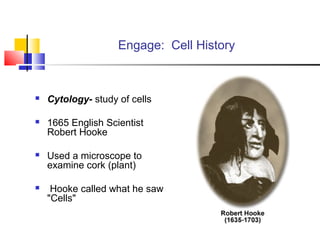
 1665 English Scientist
Robert Hooke
 Used a microscope to
examine cork (plant)
 Hooke called what he saw
"Cells"
Cell History
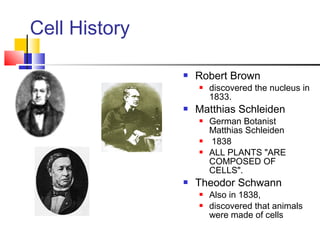
 Robert Brown
 discovered the nucleus in
1833.
 Matthias Schleiden
 German Botanist
Matthias Schleiden
 1838
 ALL PLANTS "ARE
COMPOSED OF
CELLS".
 Theodor Schwann
 Also in 1838,
 discovered that animals
were made of cells
Cell History
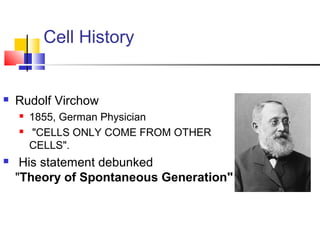
 Rudolf Virchow
 1855, German Physician
 "CELLS ONLY COME FROM OTHER
CELLS".
 His statement debunked
"Theory of Spontaneous Generation"
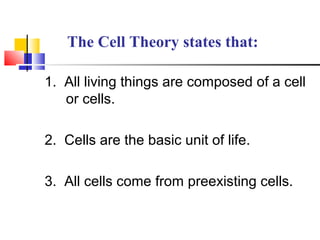
Cell Theory
 The COMBINED
work of Schleiden,
Schwann, and
Virchow make up
the modern
CELL
THEORY.
1. All living things are composed of a cell
or cells.
2. Cells are the basic unit of life.
3. All cells come from preexisting cells.
The Cell Theory states that:
Explore
 Plant vs. Animal Lab
 You will observe different types of plant and animal cells
under the microscope and record your observations.
 Gel Cells for Diffusion
 You will build a model of a cell to understand why cells
when they reach a certain size stop growing.
Explain: Cell Diversity
 Cells within the same organism show
Enormous Diversity in:
 Size
 Shape
 Internal Organization
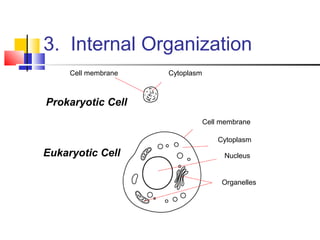
Prokaryotic Cell
Cell membrane
Cell membrane
Cytoplasm
Cytoplasm
Nucleus
Organelles
Eukaryotic Cell
3. Internal Organization
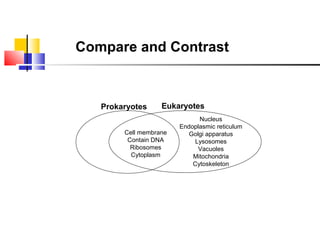
Prokaryotes Eukaryotes
Cell membrane
Contain DNA
Ribosomes
Cytoplasm
Nucleus
Endoplasmic reticulum
Golgi apparatus
Lysosomes
Vacuoles
Mitochondria
Cytoskeleton
Compare and Contrast
CELLS
Two Kinds:
Plant and Animal
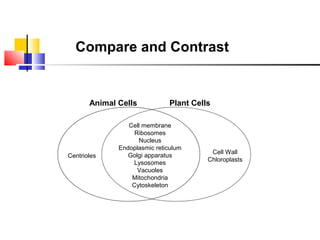
Animal Cells Plant Cells
Centrioles
Cell membrane
Ribosomes
Nucleus
Endoplasmic reticulum
Golgi apparatus
Lysosomes
Vacuoles
Mitochondria
Cytoskeleton
Cell Wall
Chloroplasts
Compare and Contrast
Venn Diagrams

Information about the cell

  • 1.
    The Cell THE BASICUNIT OF LIFE
  • 2.
    Engage: Cell History Cytology- study of cells  1665 English Scientist Robert Hooke  Used a microscope to examine cork (plant)  Hooke called what he saw "Cells"
  • 3.
    Cell History  RobertBrown  discovered the nucleus in 1833.  Matthias Schleiden  German Botanist Matthias Schleiden  1838  ALL PLANTS "ARE COMPOSED OF CELLS".  Theodor Schwann  Also in 1838,  discovered that animals were made of cells
  • 4.
    Cell History  RudolfVirchow  1855, German Physician  "CELLS ONLY COME FROM OTHER CELLS".  His statement debunked "Theory of Spontaneous Generation"
  • 5.
    Cell Theory  TheCOMBINED work of Schleiden, Schwann, and Virchow make up the modern CELL THEORY.
  • 6.
    1. All livingthings are composed of a cell or cells. 2. Cells are the basic unit of life. 3. All cells come from preexisting cells. The Cell Theory states that:
  • 7.
    Explore  Plant vs.Animal Lab  You will observe different types of plant and animal cells under the microscope and record your observations.  Gel Cells for Diffusion  You will build a model of a cell to understand why cells when they reach a certain size stop growing.
  • 8.
    Explain: Cell Diversity Cells within the same organism show Enormous Diversity in:  Size  Shape  Internal Organization
  • 9.
    Prokaryotic Cell Cell membrane Cellmembrane Cytoplasm Cytoplasm Nucleus Organelles Eukaryotic Cell 3. Internal Organization
  • 10.
    Prokaryotes Eukaryotes Cell membrane ContainDNA Ribosomes Cytoplasm Nucleus Endoplasmic reticulum Golgi apparatus Lysosomes Vacuoles Mitochondria Cytoskeleton Compare and Contrast
  • 11.
  • 12.
    Animal Cells PlantCells Centrioles Cell membrane Ribosomes Nucleus Endoplasmic reticulum Golgi apparatus Lysosomes Vacuoles Mitochondria Cytoskeleton Cell Wall Chloroplasts Compare and Contrast Venn Diagrams