By: Bri Frys and Rachael Swenson
Evolution of the Clock
The First Clock
 The first recorded
clock was invented in
1300 BC by the
Egyptians, they used
a sundial, which
works by the sun
casting a shadow on a
triangular pointer
(much like the hour
hand on our modern
clocks). The dial is
numbered all the way
around to account for
the hours, the number
the shadow falls on, is
what time it is.
Clocks that Followed…
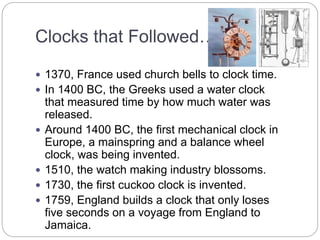
 1370, France used church bells to clock time.
 In 1400 BC, the Greeks used a water clock
that measured time by how much water was
released.
 Around 1400 BC, the first mechanical clock in
Europe, a mainspring and a balance wheel
clock, was being invented.
 1510, the watch making industry blossoms.
 1730, the first cuckoo clock is invented.
 1759, England builds a clock that only loses
five seconds on a voyage from England to
Jamaica.
Clocks that Followed…(cont.)
 1840, in the USA, a time ball at
the Naval Observatory is dropped
at noon for the ships to set their
clocks.
 1886, R.W Sears Watch Company
(now known as Sears and
Roebuck and Company) started
selling affordable wrist watches in
America.
 1945, Isador Rabi makes a clock
based on the study of atoms,
using a method called the atomic-
beam magnetic resonance.
 1949, NIST (National Institute of
Standards and Technology) built
the first atomic clock, using
ammonia.
Product Lifestyle
Most people
would find that
it is cheaper to
replace the
watch in their
battery rather
than buy a
new watch.
Jewelry stores
or other stores
or
organizations,
promote
recycling your
old watch and
its battery.
Bibliography
 Timeline. (n.d.). Time For Time. Retrieved
September 7, 2010, from www.time-for-
time.com/timeline.html
 Endick, M. (n.d.). Recycling Old Watch Batteries
Helps The Environment. ArticleSnatch.com.
Retrieved September 7, 2010, from
www.articlesnatch.com/Article/Recycling-Old-
Watch-Batteries-Helps-The-Environment/399423
 Learn How Sundials Work. (n.d.). Liverpool
museums - National Museums Liverpool.
Retrieved September 7, 2010, from
http://www.liverpoolmuseums.org.

Evolution of the clock

  • 1.
    By: Bri Frysand Rachael Swenson Evolution of the Clock
  • 2.
    The First Clock The first recorded clock was invented in 1300 BC by the Egyptians, they used a sundial, which works by the sun casting a shadow on a triangular pointer (much like the hour hand on our modern clocks). The dial is numbered all the way around to account for the hours, the number the shadow falls on, is what time it is.
  • 3.
    Clocks that Followed… 1370, France used church bells to clock time.  In 1400 BC, the Greeks used a water clock that measured time by how much water was released.  Around 1400 BC, the first mechanical clock in Europe, a mainspring and a balance wheel clock, was being invented.  1510, the watch making industry blossoms.  1730, the first cuckoo clock is invented.  1759, England builds a clock that only loses five seconds on a voyage from England to Jamaica.
  • 4.
    Clocks that Followed…(cont.) 1840, in the USA, a time ball at the Naval Observatory is dropped at noon for the ships to set their clocks.  1886, R.W Sears Watch Company (now known as Sears and Roebuck and Company) started selling affordable wrist watches in America.  1945, Isador Rabi makes a clock based on the study of atoms, using a method called the atomic- beam magnetic resonance.  1949, NIST (National Institute of Standards and Technology) built the first atomic clock, using ammonia.
  • 5.
    Product Lifestyle Most people wouldfind that it is cheaper to replace the watch in their battery rather than buy a new watch. Jewelry stores or other stores or organizations, promote recycling your old watch and its battery.
  • 6.
    Bibliography  Timeline. (n.d.).Time For Time. Retrieved September 7, 2010, from www.time-for- time.com/timeline.html  Endick, M. (n.d.). Recycling Old Watch Batteries Helps The Environment. ArticleSnatch.com. Retrieved September 7, 2010, from www.articlesnatch.com/Article/Recycling-Old- Watch-Batteries-Helps-The-Environment/399423  Learn How Sundials Work. (n.d.). Liverpool museums - National Museums Liverpool. Retrieved September 7, 2010, from http://www.liverpoolmuseums.org.