

PRE-
EMPTION
(SHUFA)
-SHIVANI SHARMA
-ASSISTANT PROFESSOR
-SARDAR PATEL SUBHARTI INSTITUTE OF LAW
PRE-EMPTION
The doctrine of Pre-emption is based upon the Muslim Law
Texts and it is well founded principle in India.
In the words of Mulla, “The right of shufaa or pre-emption is a
right which the owner of an immovable property possesses to
acquire by purchase another immovable property which has
been sold to another person”.
The foundation of the right of pre-emption is the human
desire to avoid the inconvenience and disturbance which is
likely to be caused by the introduction of a stranger into the
land
CONT..
The Muslim law of pre-emption is to be looked at in
the light of the Muslim law of succession.
Under Muslim law, death of a person results in the
division of his property into fractions. If an heir is
allowed to dispose of his share without offering it to
other co-heirs, then it is likely to lead to the
introduction of strangers into a part of the estate with
resultant difficulties and inconveniences.
ORIGIN OF PRE-EMPTION
 Hedaya -
“A neighbour has a right , superior to that of a stranger, in lands adjacent to
his own”
“ The right of Shufa holds in a partner who has not divided off and taken
separately his share”
“ The neighbour of a house, and the neighbour of the land has a superior
right to those lands and if he be absent, the seller must wait his return”
 But according to Imam Shafi, Shufa is repugnant to Qiyas.
 Thus the right of shufa is feeble right and it is granted in India only after
looking into the circumstances and completion of formalities
C.S. Tiwari v R.P. Dubey, 1949
“It is a ritual. If a ritual is defective, the jinn will not
emerge from his bottle. Unless the words are ‘Khulja
simm simm’ the door will not open. If the ceremonies
are in way incomplete or erroneous, the right of Shufa
does not take form but remains unsubstantial”
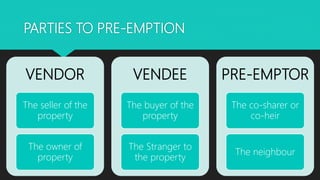
PARTIES TO PRE-EMPTION
VENDOR
The seller of the
property
The owner of
property
VENDEE
The buyer of the
property
The Stranger to
the property
PRE-EMPTOR
The co-sharer or
co-heir
The neighbour
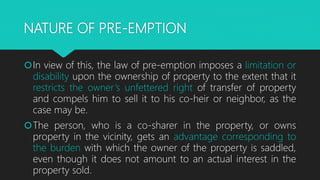
NATURE OF PRE-EMPTION
In view of this, the law of pre-emption imposes a limitation or
disability upon the ownership of property to the extent that it
restricts the owner’s unfettered right of transfer of property
and compels him to sell it to his co-heir or neighbor, as the
case may be.
The person, who is a co-sharer in the property, or owns
property in the vicinity, gets an advantage corresponding to
the burden with which the owner of the property is saddled,
even though it does not amount to an actual interest in the
property sold.
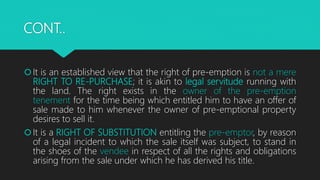
CONT..
It is an established view that the right of pre-emption is not a mere
RIGHT TO RE-PURCHASE; it is akin to legal servitude running with
the land. The right exists in the owner of the pre-emption
tenement for the time being which entitled him to have an offer of
sale made to him whenever the owner of pre-emptional property
desires to sell it.
It is a RIGHT OF SUBSTITUTION entitling the pre-emptor, by reason
of a legal incident to which the sale itself was subject, to stand in
the shoes of the vendee in respect of all the rights and obligations
arising from the sale under which he has derived his title.
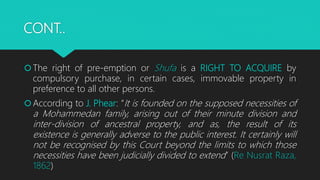
CONT..
The right of pre-emption or Shufa is a RIGHT TO ACQUIRE by
compulsory purchase, in certain cases, immovable property in
preference to all other persons.
According to J. Phear: “It is founded on the supposed necessities of
a Mohammedan family, arising out of their minute division and
inter-division of ancestral property, and as, the result of its
existence is generally adverse to the public interest. It certainly will
not be recognised by this Court beyond the limits to which those
necessities have been judicially divided to extend” (Re Nusrat Raza,
1862)
CONT..
It is, in effect, as if in a sale-deed the vendee’s name was
rubbed out and the pre-emptor’s name substituted. Or, in the
words of Mahmood J. “…..a right, which the owner of a certain
immovable property possesses, as such, for the quite
enjoyment of an immovable property, to obtain, in
substitution for the buyer, proprietary possession of certain
other immovable property, not his own, on such terms as
those on which such latter immovable property, is sold to
another person”.
CONT..
 Mukerjee, J. very aptly says that “the crux of the whole thing is that the
benefit as well as the burden of the right of pre-emption runs with the
land and can be enforced by or against the owner of the land for the
time being although the right of pre-emption does not amount to an
interest in the land itself.”
The law of pre-emption creates a right which attaches
to the property and on that footing only it can be
enforced against the purchaser. Thus, the right of pre-
emption in that sense is right in rem, its exercise, from
the time it arises up to the time of the decree, is
restricted as a personal right.
RIGHTS UNDER PRE-EMPTION AND ITS
ESSENTIALS
 The right of ‘pre-emption’ is given to the owner of immovable property to
acquire another immovable property that has been sold to some other
person. It is the purchase by one person before all others. Therefore, it is a
right of substitution and not of re-purchase. The objective behind this right is
to maintain privacy and prevent strangers to come in neighbor or in a family.
(Bishan Singh v. Khazan Singh AIR 1958 SC 838.)
 The pre-emption has also been defined by Justice Syed Mahmood as a right
given to the owners of an immovable property for quiet enjoyment of that
immovable property to obtain in substitution for the buyer, possession of
certain other immovable property, on such term that as those on which such
latter immovable property is sold to any other person. (Govind Dayal v.
Inayatullah ILR 7 All 755.)
CONT..
1. The right is possessed by certain owner of an immovable
property to obtain possession of certain other immovable
property
2. The right is obtained in substitution for the buyer (who has
already purchased the property)
3. The right of possession is obtained on the same terms on
which that other immovable property is sold to the purchaser
4. The right is given by law for quite enjoyment f the property.
CONT..
 CONDITIONS FOR PRE-EMPTION:
1. ownership over an immovable property,
2. sale of the property which is not of the person exercising the right of
pre-emption
3. there should be some relation with respect to the property between the
pre-emptor and the seller of the land,
4. possession of the other property is given to the pre-emptor on the same
terms as on which the other person is given the right.
-MULLA
CONSTITUTIONAL VALIDITY
 In the case of Pyare Mohan v. Rameshwar, the Court observed that the right of
pre-emption is a very weak right and a bona fide purchaser cannot buy land
which he is legally entitled to own. Before 1978, the Indian Constitution also
recognizes the right to property as a fundamental right under section 19(1)(f).
Therefore, pre-emption is not favored by the law as it seizes the property
merely on the apprehension of inconvenience.
 Though, the right to pre-emption was in direct contravention with the
fundamental right to property. However, the challenge to the right was justified
on the basis of article 19(5). It was contended that reasonable restriction can be
put on the fundamental right to property. Also, holding it unconstitutional will
go against one of the important principles of Islamic law as the practice of pre-
emption is a part of Muslim personal law.
CONT..
 In 1962, the Supreme Court got an opportunity to decide the question of
constitutionality in the case of Bhau Ram v. Baji Nath, wherein the Supreme Court held
the statutory provision of pre-emption on the basis of vicinage is unconstitutional. Later,
in the year 1965, in the case of Sant Ram v. Labh Singh, the Court with similar line holds
the customary practice of pre-emption by vicinage is unconstitutional.
 The entire debate over the constitutionality got altered after 1978 due to the
introduction of 44th amendment and application of the previous laws has to be dealt
with carefully. It rendered the right to property merely a constitutional right and not a
fundamental right.
 However, the legality of pre-emption continues to remain under judicial scrutiny. Since,
the right to property was there as a constitutional right, its reasonableness was checked
under article 14 and 15 of the constitution.
CONT..
 After the amendment, the validity of the Punjab Pre-emption Act, 1923
was challenged in two important cases. Firstly, in the case of Atam
Prasad v. State of Haryana, 1986 the Supreme Court has to deal with s.
15(1)(c) of the Punjab Pre-emption Act, which provided for the right of
pre-emption to the co-sharer or kinfolks of the vendor. In that case, the
Apex Court held pre-emption on the basis of consanguinity is
unconstitutional.
 Secondly, in the case of Krishna v. State of Haryana, 1994 the
constitutional validity of s. 15(1)(b) was challenged, and the court
declared that the pre-emption on the basis of co-sharer is
constitutionally valid.
WHEN THE RIGHT ARISES?
1. The right arises only in cases of SALE (does
not include Sadqah, Hiba, Inheritance, Bequest
of Lease in perpetuity, Waqf, Wasiyat)
2. Only when the SALE IS COMPLETE- when the
price is paid to the seller by the purchaser
NAUTURE OF RIGHT
 IT IS A PREFERENCIAL RIGHT
 IT IS NOT A RIGHT TO RE-PURCHASE
 IT IS A RIGHT OF SUBSTITUTION
 IT IS ATTACHED WITH THE LAND LIKE RIGHT TO
EASEMENT
 A LEGAL SERVITUDE RUNNING WITH THE LAND
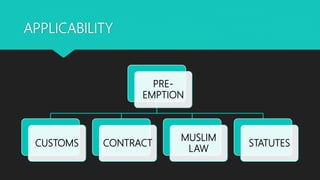
APPLICABILITY
PRE-
EMPTION
CUSTOMS CONTRACT
MUSLIM
LAW
STATUTES
APPLICABILITY ON HINDUS
IN MUSLIM LAW HINDUS ARE ENTITLED TO EXERCISE
THE RIGHT OF PRE-EMPTION AS MUSLIMS UNDER
FOLLOWING CIRCUMSTANCES:
1.BY LEGISLATION – PUNJAB AND AVADH
2.BY CUSTOM- BIHAR AND GUJARAT
3.BY CONTRACT
WHO CAN PRE-EMPT?
 SHAFI-I-SHARIK- (only person in Shias)
Co-sharer of the property
 SHAFI-I-KHALIT –
a participator in the immunities and
appendages
 SHAFI-I-JAR –
a neighbour
RULES FOR PRE-EMPTION
1. SHAFI-I-KHALIT gets preference over SHAFI-I-JAR
PROBLEM- The owner of a plot of land X, is entitled to
irrigate X by water from channel running over plot Y. Plot Y
adjoins plot Z. y is sold. The owners of X and Z claim pre-
emption?
PROBLEM- A owns a house which he sells to B. M owns a
house in north of A and has a right to way through A. N
owns a house to the south of A where the houses share a
CONT..
2. The Right arises after the sale:
PROBLEM- K, a Muslim, offers to sell his share of a house
to D, a shafee to which D refuses. K thereafter sells it to M.
can D claim Pre-emption?
PROBLEM- A co-owner transfers his share to his wife as
dower. Can another co-sharer claim Pre-emption?
3. The Right does not arise if Suit is Brought with an
incompetent party
APPLICATION OF PRE-EMPTION
WHEN THERE IS DIFFERENCE IN RELIGION
1.The Vendor must be a Muslim, no right can be claimed
against a Hindu
2.The pre-emptor should be a Muslim
3.The Vendee should be a Muslim according to Calcutta
and Bombay H.C. and not according to Allahabad and
Patna H.C.
CONT..
 WHEN THERE IS DIFFERENCE IN SECT
1. If vendor and pre-emptor are Sunnis, Sunni law will apply, if are Shias
then Shia law will be applied.
2. The Sect of Vendee is immaterial
3. If any one of the vendor or pre-emptor is Shia, Shia law will apply -
Because according to Shia law no Sunni can claim pre-emption against a
Shia. And with right of pre-emption comes obligation and reciprocity. If a
Sunni can’t Pre-empt against Shia then Shia should also not be able to
Pre-empt a Sunni.
4. Acc. To Shia Law- no pre-emption if more than 2 co-sharers.
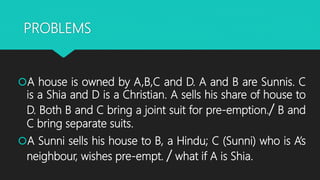
PROBLEMS
A house is owned by A,B,C and D. A and B are Sunnis. C
is a Shia and D is a Christian. A sells his share of house to
D. Both B and C bring a joint suit for pre-emption./ B and
C bring separate suits.
A Sunni sells his house to B, a Hindu; C (Sunni) who is A’s
neighbour, wishes pre-empt. / what if A is Shia.
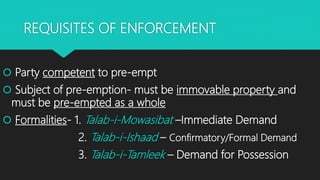
REQUISITES OF ENFORCEMENT
 Party competent to pre-empt
 Subject of pre-emption- must be immovable property and
must be pre-empted as a whole
 Formalities- 1. Talab-i-Mowasibat –Immediate Demand
2. Talab-i-Ishaad – Confirmatory/Formal Demand
3. Talab-i-Tamleek – Demand for Possession
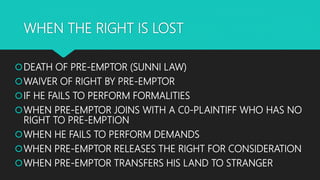
WHEN THE RIGHT IS LOST
DEATH OF PRE-EMPTOR (SUNNI LAW)
WAIVER OF RIGHT BY PRE-EMPTOR
IF HE FAILS TO PERFORM FORMALITIES
WHEN PRE-EMPTOR JOINS WITH A C0-PLAINTIFF WHO HAS NO
RIGHT TO PRE-EMPTION
WHEN HE FAILS TO PERFORM DEMANDS
WHEN PRE-EMPTOR RELEASES THE RIGHT FOR CONSIDERATION
WHEN PRE-EMPTOR TRANSFERS HIS LAND TO STRANGER
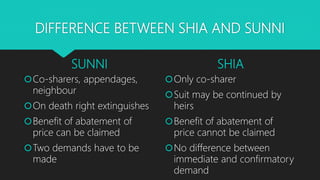
DIFFERENCE BETWEEN SHIA AND SUNNI
SUNNI
Co-sharers, appendages,
neighbour
On death right extinguishes
Benefit of abatement of
price can be claimed
Two demands have to be
made
SHIA
Only co-sharer
Suit may be continued by
heirs
Benefit of abatement of
price cannot be claimed
No difference between
immediate and confirmatory
demand

Pre emption

  • 1.
  • 2.
    PRE-EMPTION The doctrine ofPre-emption is based upon the Muslim Law Texts and it is well founded principle in India. In the words of Mulla, “The right of shufaa or pre-emption is a right which the owner of an immovable property possesses to acquire by purchase another immovable property which has been sold to another person”. The foundation of the right of pre-emption is the human desire to avoid the inconvenience and disturbance which is likely to be caused by the introduction of a stranger into the land
  • 3.
    CONT.. The Muslim lawof pre-emption is to be looked at in the light of the Muslim law of succession. Under Muslim law, death of a person results in the division of his property into fractions. If an heir is allowed to dispose of his share without offering it to other co-heirs, then it is likely to lead to the introduction of strangers into a part of the estate with resultant difficulties and inconveniences.
  • 4.
    ORIGIN OF PRE-EMPTION Hedaya - “A neighbour has a right , superior to that of a stranger, in lands adjacent to his own” “ The right of Shufa holds in a partner who has not divided off and taken separately his share” “ The neighbour of a house, and the neighbour of the land has a superior right to those lands and if he be absent, the seller must wait his return”  But according to Imam Shafi, Shufa is repugnant to Qiyas.  Thus the right of shufa is feeble right and it is granted in India only after looking into the circumstances and completion of formalities
  • 5.
    C.S. Tiwari vR.P. Dubey, 1949 “It is a ritual. If a ritual is defective, the jinn will not emerge from his bottle. Unless the words are ‘Khulja simm simm’ the door will not open. If the ceremonies are in way incomplete or erroneous, the right of Shufa does not take form but remains unsubstantial”
  • 6.
    PARTIES TO PRE-EMPTION VENDOR Theseller of the property The owner of property VENDEE The buyer of the property The Stranger to the property PRE-EMPTOR The co-sharer or co-heir The neighbour
  • 7.
    NATURE OF PRE-EMPTION Inview of this, the law of pre-emption imposes a limitation or disability upon the ownership of property to the extent that it restricts the owner’s unfettered right of transfer of property and compels him to sell it to his co-heir or neighbor, as the case may be. The person, who is a co-sharer in the property, or owns property in the vicinity, gets an advantage corresponding to the burden with which the owner of the property is saddled, even though it does not amount to an actual interest in the property sold.
  • 8.
    CONT.. It is anestablished view that the right of pre-emption is not a mere RIGHT TO RE-PURCHASE; it is akin to legal servitude running with the land. The right exists in the owner of the pre-emption tenement for the time being which entitled him to have an offer of sale made to him whenever the owner of pre-emptional property desires to sell it. It is a RIGHT OF SUBSTITUTION entitling the pre-emptor, by reason of a legal incident to which the sale itself was subject, to stand in the shoes of the vendee in respect of all the rights and obligations arising from the sale under which he has derived his title.
  • 9.
    CONT.. The right ofpre-emption or Shufa is a RIGHT TO ACQUIRE by compulsory purchase, in certain cases, immovable property in preference to all other persons. According to J. Phear: “It is founded on the supposed necessities of a Mohammedan family, arising out of their minute division and inter-division of ancestral property, and as, the result of its existence is generally adverse to the public interest. It certainly will not be recognised by this Court beyond the limits to which those necessities have been judicially divided to extend” (Re Nusrat Raza, 1862)
  • 10.
    CONT.. It is, ineffect, as if in a sale-deed the vendee’s name was rubbed out and the pre-emptor’s name substituted. Or, in the words of Mahmood J. “…..a right, which the owner of a certain immovable property possesses, as such, for the quite enjoyment of an immovable property, to obtain, in substitution for the buyer, proprietary possession of certain other immovable property, not his own, on such terms as those on which such latter immovable property, is sold to another person”.
  • 11.
    CONT..  Mukerjee, J.very aptly says that “the crux of the whole thing is that the benefit as well as the burden of the right of pre-emption runs with the land and can be enforced by or against the owner of the land for the time being although the right of pre-emption does not amount to an interest in the land itself.” The law of pre-emption creates a right which attaches to the property and on that footing only it can be enforced against the purchaser. Thus, the right of pre- emption in that sense is right in rem, its exercise, from the time it arises up to the time of the decree, is restricted as a personal right.
  • 12.
    RIGHTS UNDER PRE-EMPTIONAND ITS ESSENTIALS  The right of ‘pre-emption’ is given to the owner of immovable property to acquire another immovable property that has been sold to some other person. It is the purchase by one person before all others. Therefore, it is a right of substitution and not of re-purchase. The objective behind this right is to maintain privacy and prevent strangers to come in neighbor or in a family. (Bishan Singh v. Khazan Singh AIR 1958 SC 838.)  The pre-emption has also been defined by Justice Syed Mahmood as a right given to the owners of an immovable property for quiet enjoyment of that immovable property to obtain in substitution for the buyer, possession of certain other immovable property, on such term that as those on which such latter immovable property is sold to any other person. (Govind Dayal v. Inayatullah ILR 7 All 755.)
  • 13.
    CONT.. 1. The rightis possessed by certain owner of an immovable property to obtain possession of certain other immovable property 2. The right is obtained in substitution for the buyer (who has already purchased the property) 3. The right of possession is obtained on the same terms on which that other immovable property is sold to the purchaser 4. The right is given by law for quite enjoyment f the property.
  • 14.
    CONT..  CONDITIONS FORPRE-EMPTION: 1. ownership over an immovable property, 2. sale of the property which is not of the person exercising the right of pre-emption 3. there should be some relation with respect to the property between the pre-emptor and the seller of the land, 4. possession of the other property is given to the pre-emptor on the same terms as on which the other person is given the right. -MULLA
  • 15.
    CONSTITUTIONAL VALIDITY  Inthe case of Pyare Mohan v. Rameshwar, the Court observed that the right of pre-emption is a very weak right and a bona fide purchaser cannot buy land which he is legally entitled to own. Before 1978, the Indian Constitution also recognizes the right to property as a fundamental right under section 19(1)(f). Therefore, pre-emption is not favored by the law as it seizes the property merely on the apprehension of inconvenience.  Though, the right to pre-emption was in direct contravention with the fundamental right to property. However, the challenge to the right was justified on the basis of article 19(5). It was contended that reasonable restriction can be put on the fundamental right to property. Also, holding it unconstitutional will go against one of the important principles of Islamic law as the practice of pre- emption is a part of Muslim personal law.
  • 16.
    CONT..  In 1962,the Supreme Court got an opportunity to decide the question of constitutionality in the case of Bhau Ram v. Baji Nath, wherein the Supreme Court held the statutory provision of pre-emption on the basis of vicinage is unconstitutional. Later, in the year 1965, in the case of Sant Ram v. Labh Singh, the Court with similar line holds the customary practice of pre-emption by vicinage is unconstitutional.  The entire debate over the constitutionality got altered after 1978 due to the introduction of 44th amendment and application of the previous laws has to be dealt with carefully. It rendered the right to property merely a constitutional right and not a fundamental right.  However, the legality of pre-emption continues to remain under judicial scrutiny. Since, the right to property was there as a constitutional right, its reasonableness was checked under article 14 and 15 of the constitution.
  • 17.
    CONT..  After theamendment, the validity of the Punjab Pre-emption Act, 1923 was challenged in two important cases. Firstly, in the case of Atam Prasad v. State of Haryana, 1986 the Supreme Court has to deal with s. 15(1)(c) of the Punjab Pre-emption Act, which provided for the right of pre-emption to the co-sharer or kinfolks of the vendor. In that case, the Apex Court held pre-emption on the basis of consanguinity is unconstitutional.  Secondly, in the case of Krishna v. State of Haryana, 1994 the constitutional validity of s. 15(1)(b) was challenged, and the court declared that the pre-emption on the basis of co-sharer is constitutionally valid.
  • 18.
    WHEN THE RIGHTARISES? 1. The right arises only in cases of SALE (does not include Sadqah, Hiba, Inheritance, Bequest of Lease in perpetuity, Waqf, Wasiyat) 2. Only when the SALE IS COMPLETE- when the price is paid to the seller by the purchaser
  • 19.
    NAUTURE OF RIGHT IT IS A PREFERENCIAL RIGHT  IT IS NOT A RIGHT TO RE-PURCHASE  IT IS A RIGHT OF SUBSTITUTION  IT IS ATTACHED WITH THE LAND LIKE RIGHT TO EASEMENT  A LEGAL SERVITUDE RUNNING WITH THE LAND
  • 20.
  • 21.
    APPLICABILITY ON HINDUS INMUSLIM LAW HINDUS ARE ENTITLED TO EXERCISE THE RIGHT OF PRE-EMPTION AS MUSLIMS UNDER FOLLOWING CIRCUMSTANCES: 1.BY LEGISLATION – PUNJAB AND AVADH 2.BY CUSTOM- BIHAR AND GUJARAT 3.BY CONTRACT
  • 22.
    WHO CAN PRE-EMPT? SHAFI-I-SHARIK- (only person in Shias) Co-sharer of the property  SHAFI-I-KHALIT – a participator in the immunities and appendages  SHAFI-I-JAR – a neighbour
  • 23.
    RULES FOR PRE-EMPTION 1.SHAFI-I-KHALIT gets preference over SHAFI-I-JAR PROBLEM- The owner of a plot of land X, is entitled to irrigate X by water from channel running over plot Y. Plot Y adjoins plot Z. y is sold. The owners of X and Z claim pre- emption? PROBLEM- A owns a house which he sells to B. M owns a house in north of A and has a right to way through A. N owns a house to the south of A where the houses share a
  • 24.
    CONT.. 2. The Rightarises after the sale: PROBLEM- K, a Muslim, offers to sell his share of a house to D, a shafee to which D refuses. K thereafter sells it to M. can D claim Pre-emption? PROBLEM- A co-owner transfers his share to his wife as dower. Can another co-sharer claim Pre-emption? 3. The Right does not arise if Suit is Brought with an incompetent party
  • 25.
    APPLICATION OF PRE-EMPTION WHENTHERE IS DIFFERENCE IN RELIGION 1.The Vendor must be a Muslim, no right can be claimed against a Hindu 2.The pre-emptor should be a Muslim 3.The Vendee should be a Muslim according to Calcutta and Bombay H.C. and not according to Allahabad and Patna H.C.
  • 26.
    CONT..  WHEN THEREIS DIFFERENCE IN SECT 1. If vendor and pre-emptor are Sunnis, Sunni law will apply, if are Shias then Shia law will be applied. 2. The Sect of Vendee is immaterial 3. If any one of the vendor or pre-emptor is Shia, Shia law will apply - Because according to Shia law no Sunni can claim pre-emption against a Shia. And with right of pre-emption comes obligation and reciprocity. If a Sunni can’t Pre-empt against Shia then Shia should also not be able to Pre-empt a Sunni. 4. Acc. To Shia Law- no pre-emption if more than 2 co-sharers.
  • 27.
    PROBLEMS A house isowned by A,B,C and D. A and B are Sunnis. C is a Shia and D is a Christian. A sells his share of house to D. Both B and C bring a joint suit for pre-emption./ B and C bring separate suits. A Sunni sells his house to B, a Hindu; C (Sunni) who is A’s neighbour, wishes pre-empt. / what if A is Shia.
  • 28.
    REQUISITES OF ENFORCEMENT Party competent to pre-empt  Subject of pre-emption- must be immovable property and must be pre-empted as a whole  Formalities- 1. Talab-i-Mowasibat –Immediate Demand 2. Talab-i-Ishaad – Confirmatory/Formal Demand 3. Talab-i-Tamleek – Demand for Possession
  • 29.
    WHEN THE RIGHTIS LOST DEATH OF PRE-EMPTOR (SUNNI LAW) WAIVER OF RIGHT BY PRE-EMPTOR IF HE FAILS TO PERFORM FORMALITIES WHEN PRE-EMPTOR JOINS WITH A C0-PLAINTIFF WHO HAS NO RIGHT TO PRE-EMPTION WHEN HE FAILS TO PERFORM DEMANDS WHEN PRE-EMPTOR RELEASES THE RIGHT FOR CONSIDERATION WHEN PRE-EMPTOR TRANSFERS HIS LAND TO STRANGER
  • 30.
    DIFFERENCE BETWEEN SHIAAND SUNNI SUNNI Co-sharers, appendages, neighbour On death right extinguishes Benefit of abatement of price can be claimed Two demands have to be made SHIA Only co-sharer Suit may be continued by heirs Benefit of abatement of price cannot be claimed No difference between immediate and confirmatory demand