The Growing Role of Big Data in HR

Bernie Schiemer
Chief Executive Officer
HRBoss
Click on the twitter button to
follow him on Twitter:
@bernieschiemer
About HRBoss
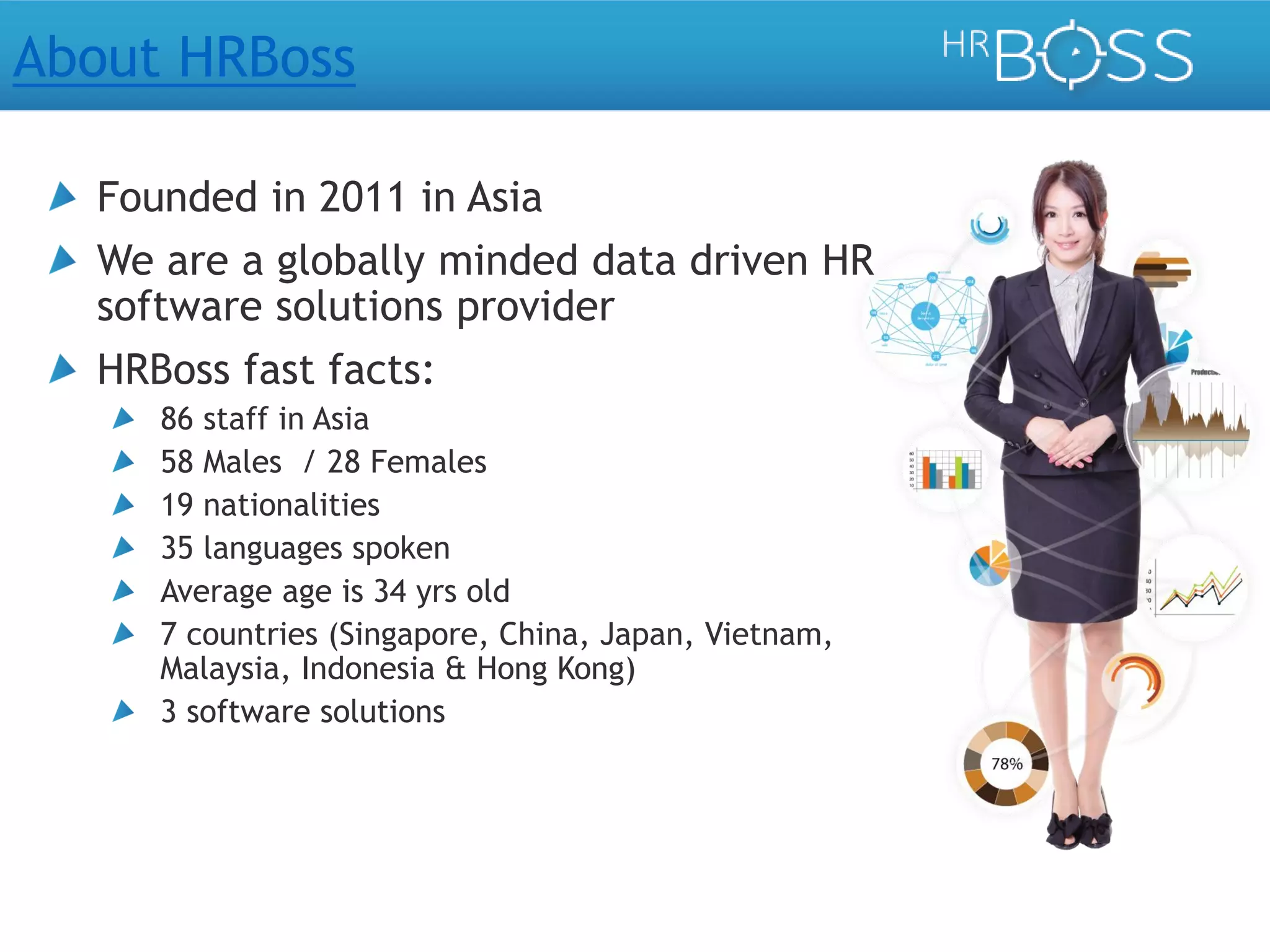
Founded in 2011 in Asia
We are a globally minded data driven HR
software solutions provider
HRBoss fast facts:
86 staff in Asia
58 Males / 28 Females
19 nationalities
35 languages spoken
Average age is 34 yrs old
7 countries (Singapore, China, Japan, Vietnam,
Malaysia, Indonesia & Hong Kong)
3 software solutions
Award winning solutions
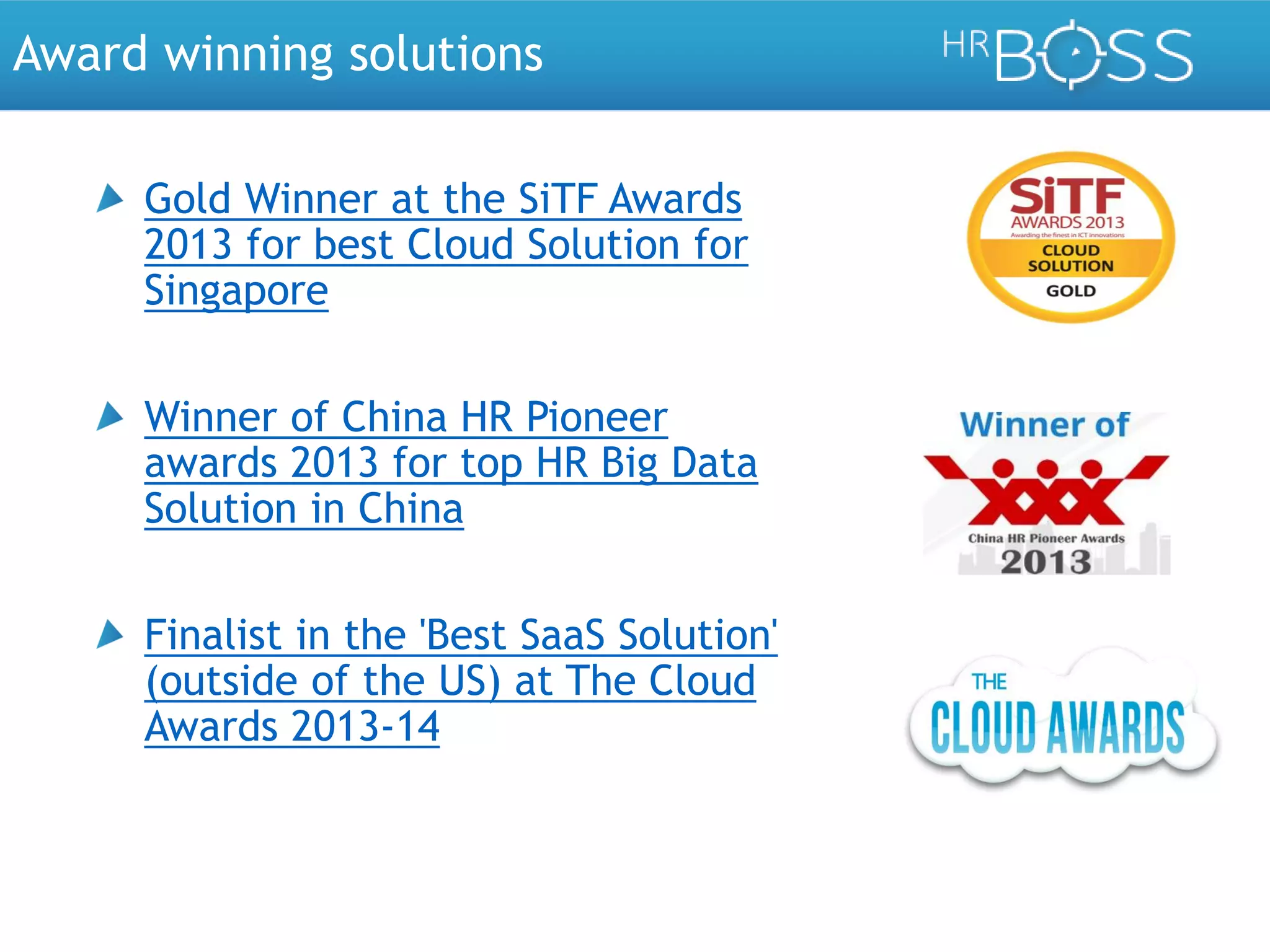
Gold Winner at the SiTF Awards
2013 for best Cloud Solution for
Singapore
Winner of China HR Pioneer
awards 2013 for top HR Big Data
Solution in China

Finalist in the 'Best SaaS Solution'
(outside of the US) at The Cloud
Awards 2013-14
Big Data
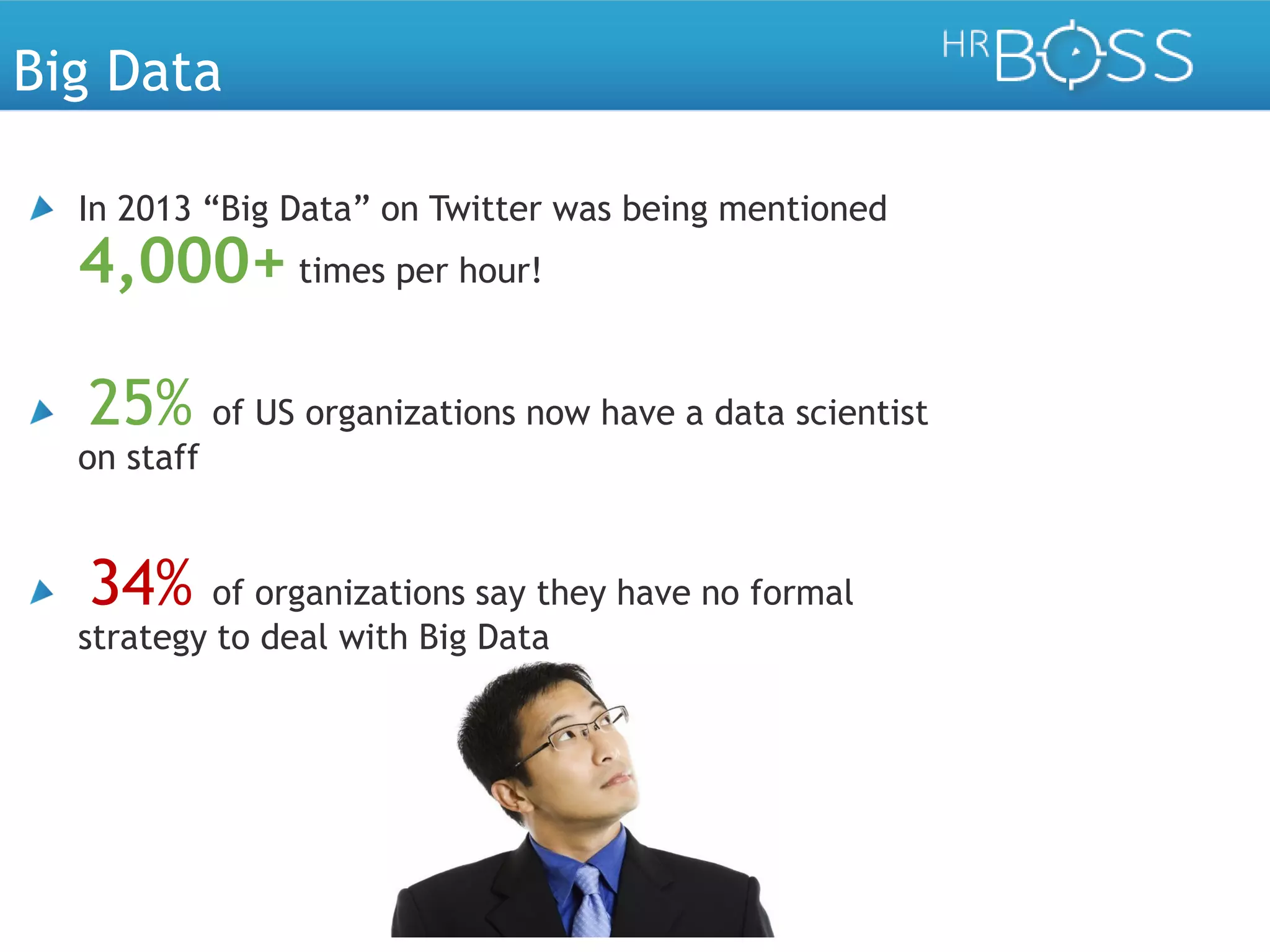
In 2013 “Big Data” on Twitter was being mentioned

4,000+ times per hour!
25%

of US organizations now have a data scientist

on staff

34%

of organizations say they have no formal
strategy to deal with Big Data
DATA, DATA,

….

38%

BIG DATA

of organizations don’t understand what Big
Data is according to CIO Magazine

75%

of companies say they will increase
investments in Big Data within the next year
according to Avanade
Agenda
Concepts of big data, analytics, Moneyball as they relate to
HR and recruiting
How facts become our friends and how this drives
competitive advantages through fact based decision making
The road to predictive analytics
Obstacles faced with data management
EmployeeBoss solution
Why now? - Time to value
Next steps
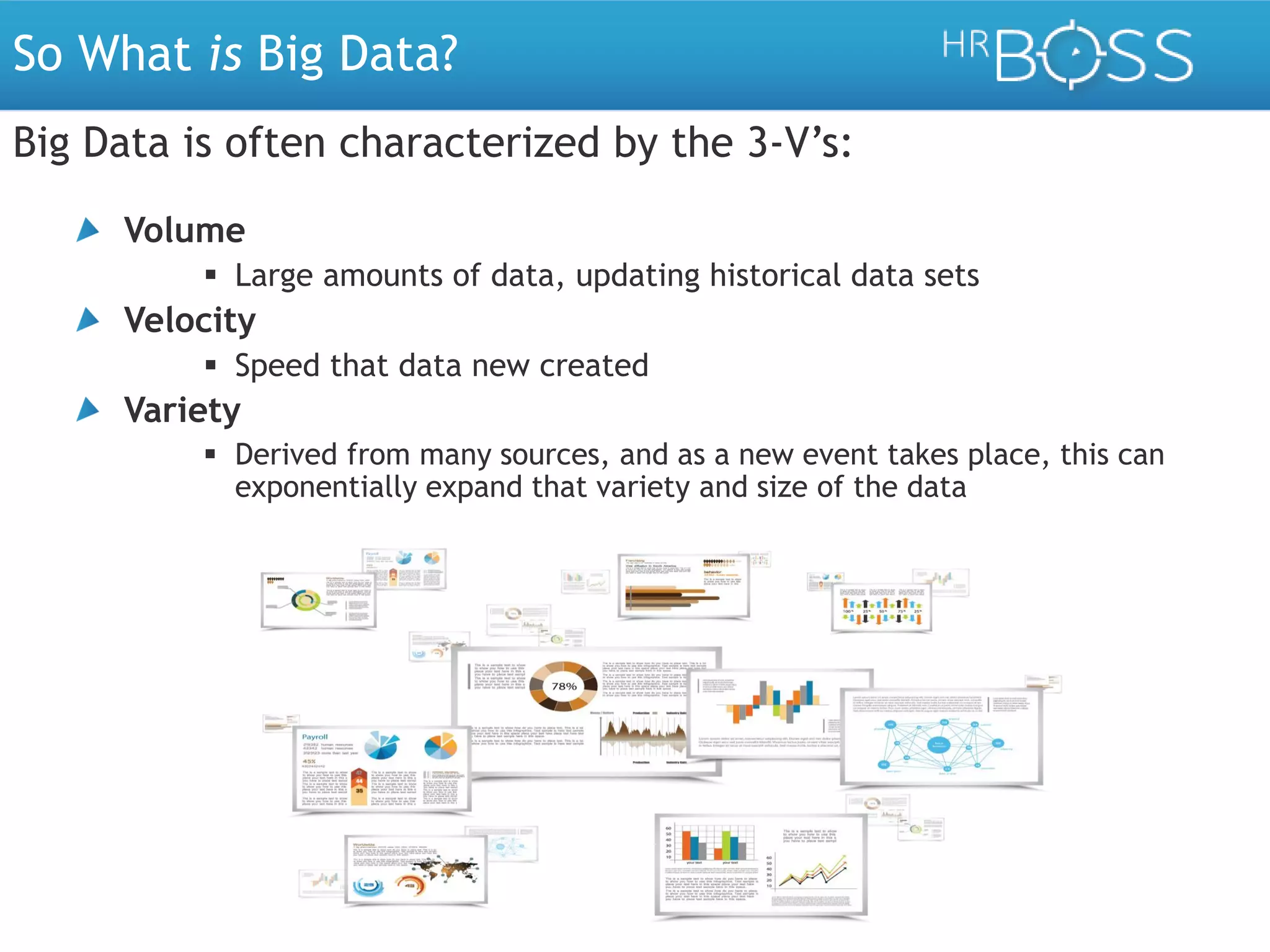
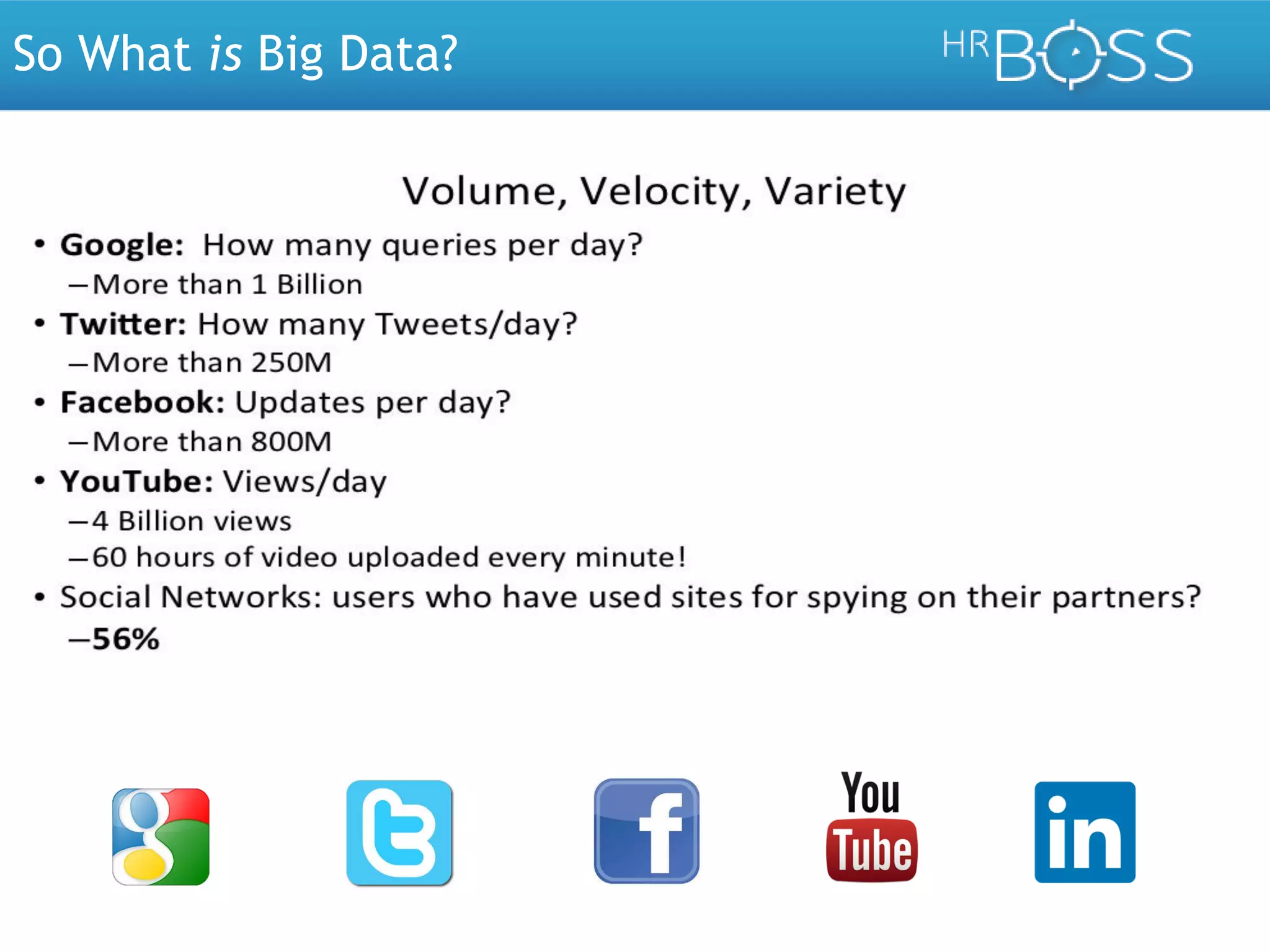
So What is Big Data?
Big Data is often characterized by the 3-V’s:
Volume
 Large amounts of data, updating historical data sets

Velocity
 Speed at which new data is created

Variety
 Derived from many sources, and as a new event takes place, this can
exponentially expand that variety and size of the data
Analytics versus Big Data
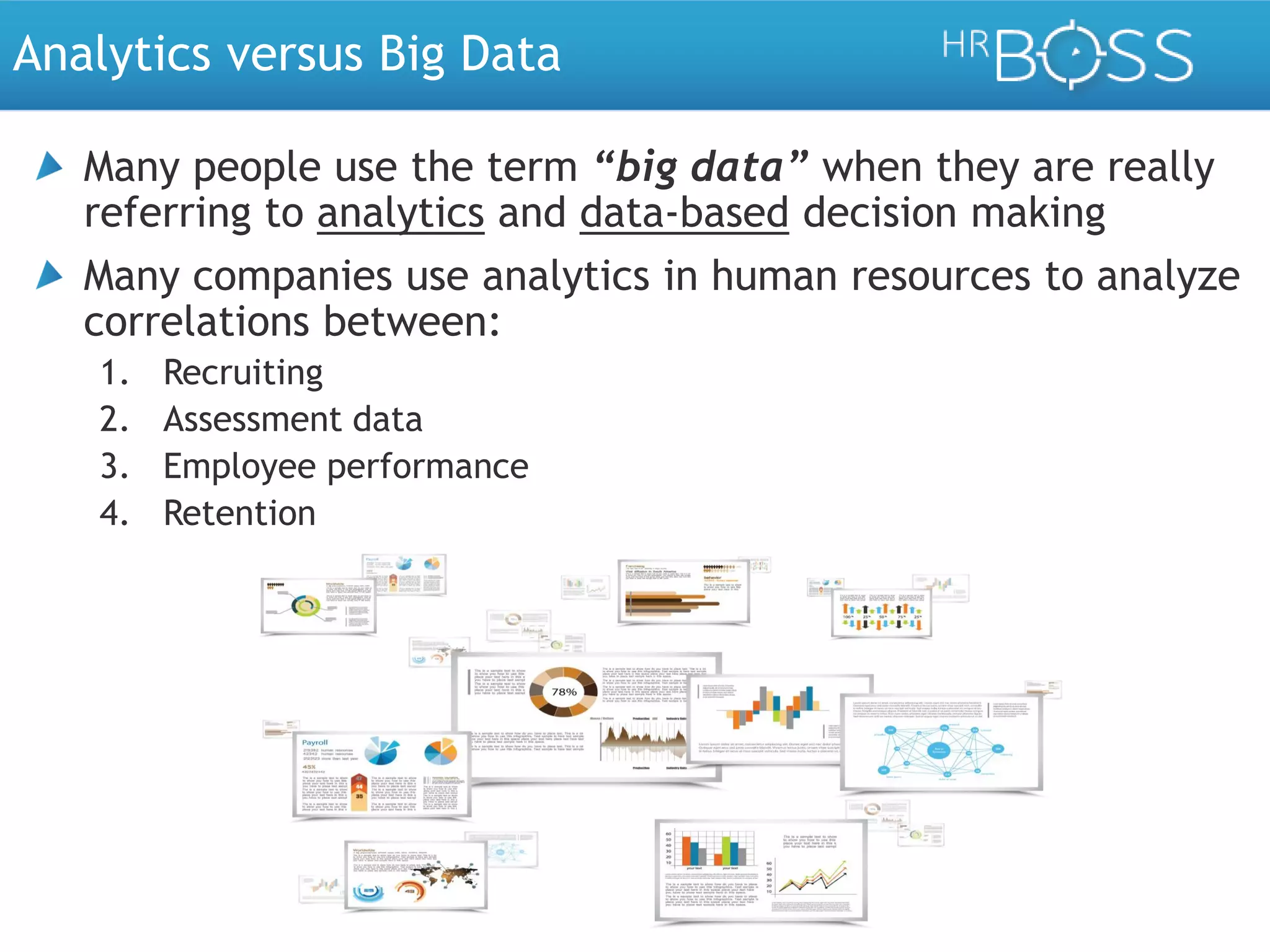
Many people use the term “big data” when they are really
referring to analytics and data-based decision making
Many companies use analytics in human resources to analyze
correlations between:
1.
2.
3.
4.

Recruiting
Assessment data
Employee performance
Retention
Analytics versus Big Data
data-based decisions alone doesn’t correlate with “big
data”… unless the data being analyzed meets certain
criteria
Grasping the concept of big data, there is still confusion as
to exactly what “big data” is and what it is not
So What is Big Data?
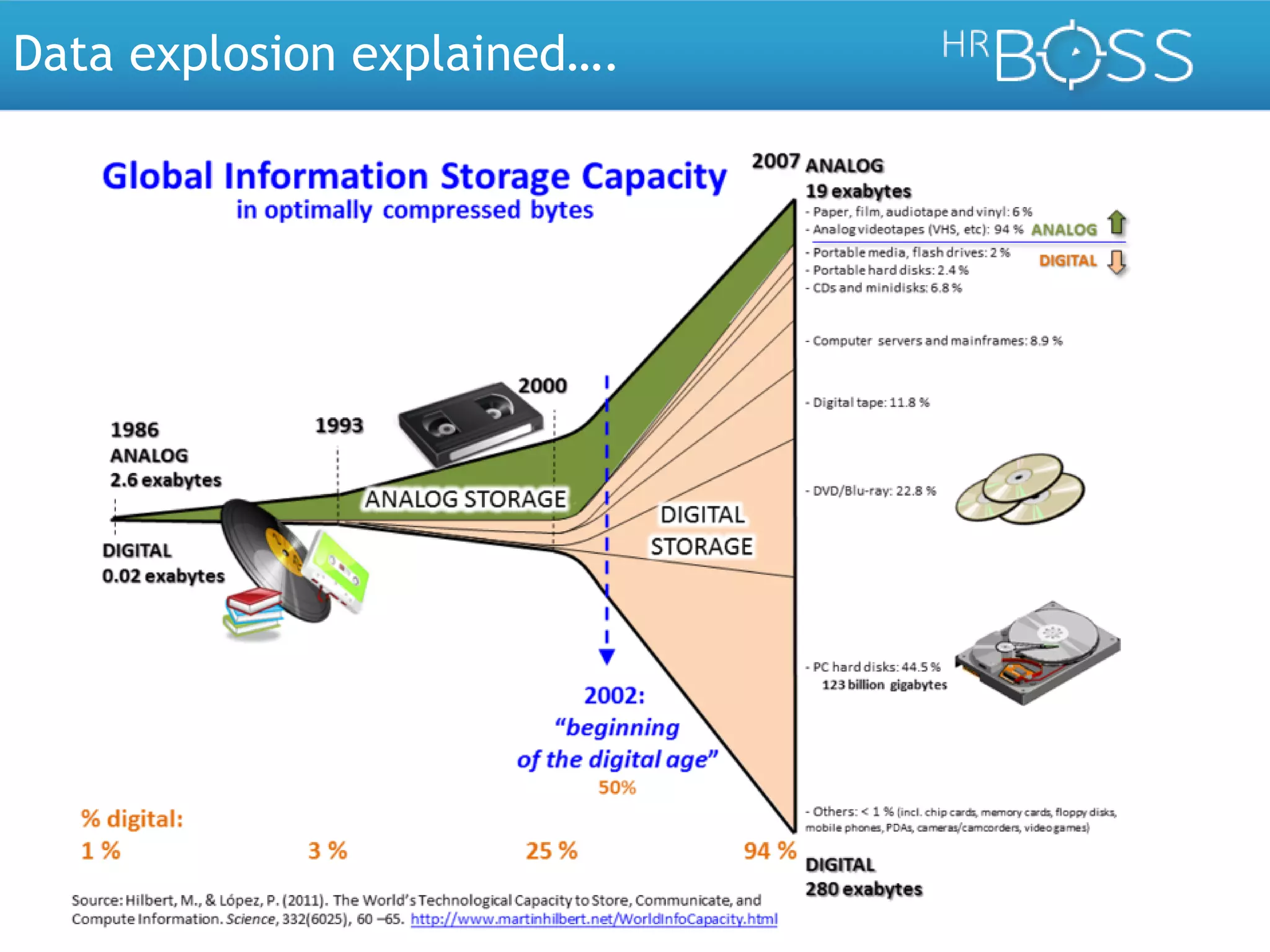
Data explosion explained….
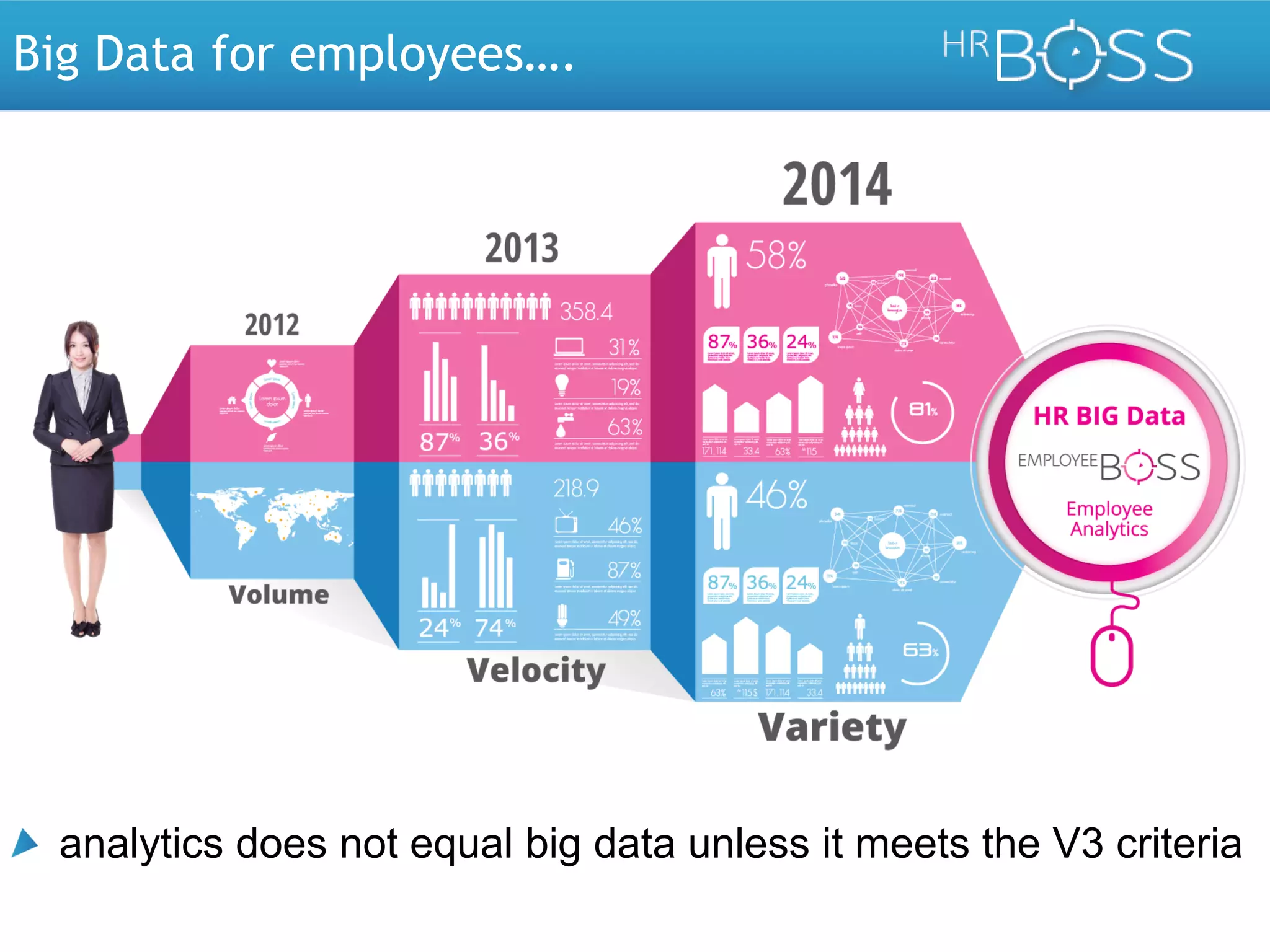
Big Data for employees….

analytics does not equal big data unless it meets the V3 criteria
What is Moneyball?

Moneyball: The Art of Winning an Unfair Game by Michael Lewis
The premise of the book is that the collected wisdom of baseball
insiders is subjective and often flawed

The Oakland A’s didn’t have the money to buy top players, so they
had to find another way to be competitive
In 2002 they took a sabermetric approach to assembling their team,
picking players based on qualities that defied conventional wisdom
Sabermetrics was originally defined by Bill James in 1980, as "the search for
objective knowledge about baseball"
Facts become your friends
They found that on-base percentage and slugging
percentage are better indicators of offensive success than
batting averages
These qualities were cheaper to obtain on the open market
than more historically valued qualities such as speed and
contact
They often picked players that other scouts and teams
would overlook because the players didn’t have the right
body type or they had a funny swing
So what happened?
2002 Facts
In 2002 the salary cap of the Oakland A’s was $41 million
The A’s finished 1st in the American League West and set an
American League record of 20 consecutive wins
New York Yankees spent over $125 million in payroll that
same season
Though the Yankees made the World series finals they were
swept by the Anaheim Angels in 4 four games
2002 Facts
The essence of “Moneyball” lies in using data and statistics to:
“arbitrage miscalculated pay rates” to avoid overvalued skills/experience
to identify undervalued skills when building teams
and to develop a competitive advantage without having to “buy” expensive
talent

Though the A’s did not win the World Series, Moneyball allowed them to
remain competitive and profitable in a market that was becoming
dominated by big spenders
2013 Facts
The NY Yankees now employee a whole team of
sabermetric analysts
There is a real focus now on using historical data sets
to analyze and predict future player performance
The Boston Red Sox embraced the analytic Moneyball
approach when they tried to poach Billy Beane from
the Oakland A’s in 2002
Though Billy did not accept their offer, since 2003,
they have won 3 World series titles
These are the banners you see today on the Oakland
A’s and New York Yankees websites...
Talent Analytics Maturity Model
The ultimate aim of a big data solution is to reach the
holy grail of insight called predictive analytics
To be able to accurately forecast events before they occur

Bersin at Deloitte forecasts 5 years to achieve this goal

Of the 480 companies they spoke with only 4% have
achieved any kind of predictive analytics capabilities
Why now?
Now is the time to focus on talent analytics. Key drivers for some
of our clients include:
Employee retention – what creates high levels of engagement and
retention?
Sales performance – what factors drive high-performing sales
professionals?
Leadership pipeline – who are the most successful leaders and why are
some being developed and others are not?
Customer retention – what talent factors drive high levels of customer
satisfaction and retention?
Expected leadership and talent gaps – where are our current talent gaps
in the organization and what gaps can we predict in coming years?
Candidate pipeline – what is the quality of our candidate pipeline?
How do we better attract and select people who we know will succeed
in our organization?
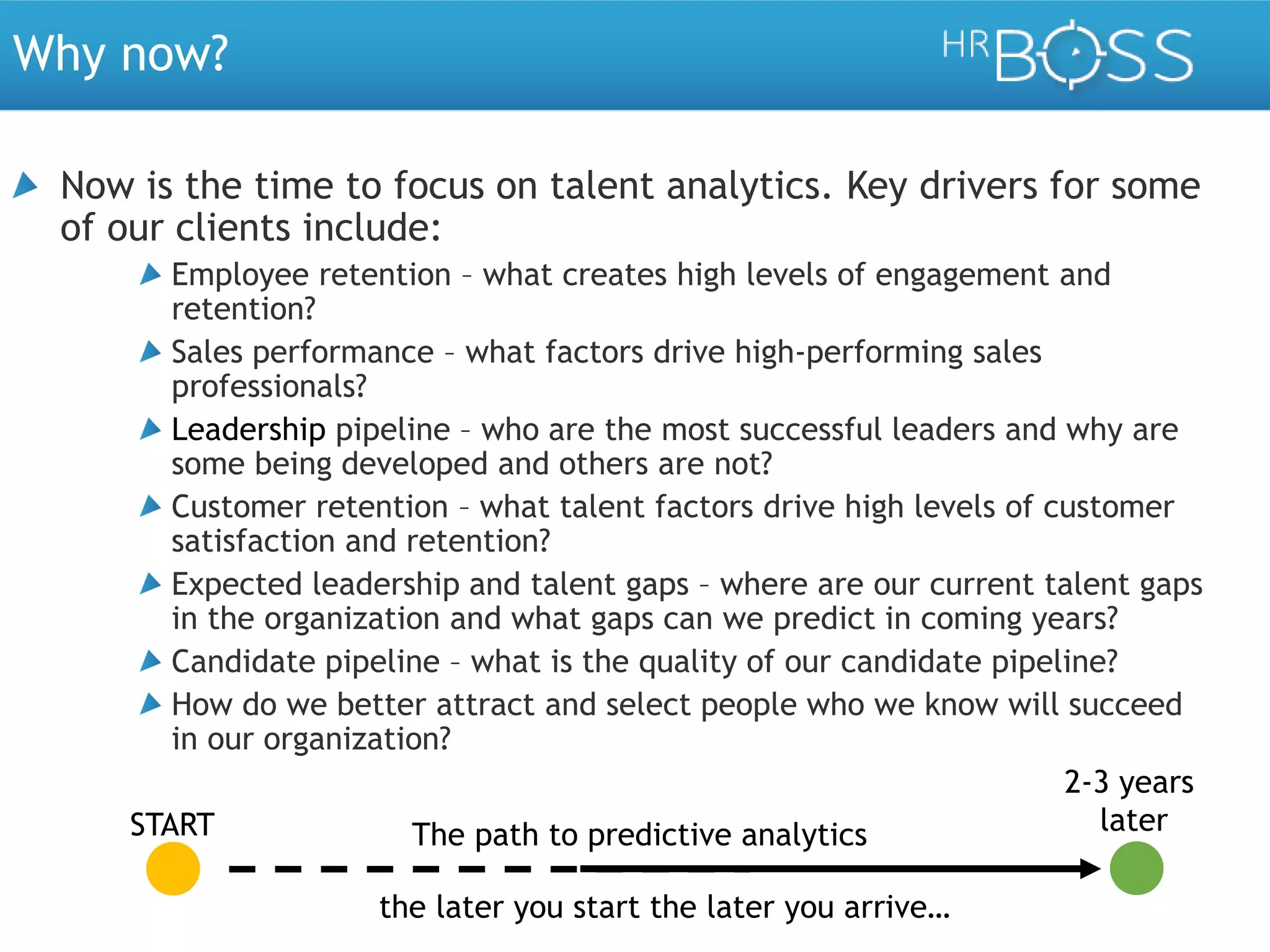
2-3 years
later
START
The path to predictive analytics
the later you start the later you arrive…
Next Steps

Click here to
learn More about
EmployeeBoss
Click here to read
the Data Analytics
post-event blog

Moneyball & Data Analytics

  • 1.
    The Growing Roleof Big Data in HR Bernie Schiemer Chief Executive Officer HRBoss Click on the twitter button to follow him on Twitter: @bernieschiemer
  • 2.
    About HRBoss Founded in2011 in Asia We are a globally minded data driven HR software solutions provider HRBoss fast facts: 86 staff in Asia 58 Males / 28 Females 19 nationalities 35 languages spoken Average age is 34 yrs old 7 countries (Singapore, China, Japan, Vietnam, Malaysia, Indonesia & Hong Kong) 3 software solutions
  • 3.
    Award winning solutions GoldWinner at the SiTF Awards 2013 for best Cloud Solution for Singapore Winner of China HR Pioneer awards 2013 for top HR Big Data Solution in China Finalist in the 'Best SaaS Solution' (outside of the US) at The Cloud Awards 2013-14
  • 4.
    Big Data In 2013“Big Data” on Twitter was being mentioned 4,000+ times per hour! 25% of US organizations now have a data scientist on staff 34% of organizations say they have no formal strategy to deal with Big Data
  • 5.
    DATA, DATA, …. 38% BIG DATA oforganizations don’t understand what Big Data is according to CIO Magazine 75% of companies say they will increase investments in Big Data within the next year according to Avanade
  • 6.
    Agenda Concepts of bigdata, analytics, Moneyball as they relate to HR and recruiting How facts become our friends and how this drives competitive advantages through fact based decision making The road to predictive analytics Obstacles faced with data management EmployeeBoss solution Why now? - Time to value Next steps
  • 7.
    So What isBig Data? Big Data is often characterized by the 3-V’s: Volume  Large amounts of data, updating historical data sets Velocity  Speed at which new data is created Variety  Derived from many sources, and as a new event takes place, this can exponentially expand that variety and size of the data
  • 8.
    Analytics versus BigData Many people use the term “big data” when they are really referring to analytics and data-based decision making Many companies use analytics in human resources to analyze correlations between: 1. 2. 3. 4. Recruiting Assessment data Employee performance Retention
  • 9.
    Analytics versus BigData data-based decisions alone doesn’t correlate with “big data”… unless the data being analyzed meets certain criteria Grasping the concept of big data, there is still confusion as to exactly what “big data” is and what it is not
  • 10.
    So What isBig Data?
  • 11.
  • 12.
    Big Data foremployees…. analytics does not equal big data unless it meets the V3 criteria
  • 13.
    What is Moneyball? Moneyball:The Art of Winning an Unfair Game by Michael Lewis The premise of the book is that the collected wisdom of baseball insiders is subjective and often flawed The Oakland A’s didn’t have the money to buy top players, so they had to find another way to be competitive In 2002 they took a sabermetric approach to assembling their team, picking players based on qualities that defied conventional wisdom Sabermetrics was originally defined by Bill James in 1980, as "the search for objective knowledge about baseball"
  • 14.
    Facts become yourfriends They found that on-base percentage and slugging percentage are better indicators of offensive success than batting averages These qualities were cheaper to obtain on the open market than more historically valued qualities such as speed and contact They often picked players that other scouts and teams would overlook because the players didn’t have the right body type or they had a funny swing
  • 15.
  • 16.
    2002 Facts In 2002the salary cap of the Oakland A’s was $41 million The A’s finished 1st in the American League West and set an American League record of 20 consecutive wins New York Yankees spent over $125 million in payroll that same season Though the Yankees made the World series finals they were swept by the Anaheim Angels in 4 four games
  • 17.
    2002 Facts The essenceof “Moneyball” lies in using data and statistics to: “arbitrage miscalculated pay rates” to avoid overvalued skills/experience to identify undervalued skills when building teams and to develop a competitive advantage without having to “buy” expensive talent Though the A’s did not win the World Series, Moneyball allowed them to remain competitive and profitable in a market that was becoming dominated by big spenders
  • 18.
    2013 Facts The NYYankees now employee a whole team of sabermetric analysts There is a real focus now on using historical data sets to analyze and predict future player performance The Boston Red Sox embraced the analytic Moneyball approach when they tried to poach Billy Beane from the Oakland A’s in 2002 Though Billy did not accept their offer, since 2003, they have won 3 World series titles These are the banners you see today on the Oakland A’s and New York Yankees websites...
  • 19.
    Talent Analytics MaturityModel The ultimate aim of a big data solution is to reach the holy grail of insight called predictive analytics To be able to accurately forecast events before they occur Bersin at Deloitte forecasts 5 years to achieve this goal Of the 480 companies they spoke with only 4% have achieved any kind of predictive analytics capabilities
  • 20.
    Why now? Now isthe time to focus on talent analytics. Key drivers for some of our clients include: Employee retention – what creates high levels of engagement and retention? Sales performance – what factors drive high-performing sales professionals? Leadership pipeline – who are the most successful leaders and why are some being developed and others are not? Customer retention – what talent factors drive high levels of customer satisfaction and retention? Expected leadership and talent gaps – where are our current talent gaps in the organization and what gaps can we predict in coming years? Candidate pipeline – what is the quality of our candidate pipeline? How do we better attract and select people who we know will succeed in our organization? 2-3 years later START The path to predictive analytics the later you start the later you arrive…
  • 21.
    Next Steps Click hereto learn More about EmployeeBoss Click here to read the Data Analytics post-event blog