PRESENTED BY
SHAMBHAVI B R
TATA
GROUPS
TrainingAndDevelopment
Training:
Training is the formal and systematic modification of behavior
through learning which occurs as a result of education, instruction, development
and planned experience.
Development:
Development is any learning activity, which is directed towards
future needs rather than present needs and which is concerned more with career
growth than immediate performance.
BenefitsfromTrainingandDevelopment
 Increased job satisfaction and morale among employees
 Increased employee motivation
 Increased efficiencies in processes, resulting in financial gain
 Increased capacity to adopt new technologies and methods
 Increased innovation in strategies and products
 Reduced employee turnover
 Enhanced company image.
Introduction
 Tata group is India’s largest and most trusted Multinational Conglomerate.
 Tata group has operations in over 80 countries and across 6 continents.
 Its companies export products and services to more than 120 nations.
 Tata group comprises of 114 companies in seven business sectors:
1) Information System and Communication;
2) Engineering;
3) Materials;
4) Services;
5) Energy;
6) Consumer Product;
7) Chemicals.
Training&DevelopmentofTATAGROUP
 The Tata group's commitment to enhance the knowledge and leadership
quotient of its people has resulted in the establishment of various Development
and Training Programs such as Tata Administrative Services (TAS) and
Tata Management Training Center(TMTC)
 Tata Management Training Center(TMTC):
Set up by JRD Tata in 1959 with the mission of creating and
grooming leaders for the future.
It aims to provide training to high performers within the
group and act as a catalyst of change for Tata executives.
 Offering around 250 programs a year, conducted by in house senior faculty
from academics and business, supported by experts from the best of Indian and
international B schools.
 TMTC started its e-learning programs in 2009.Every year, more than 4000 Tata
Managers and Leaders go through the training programs.
Objectives of TMTC:
 Improvement of organizational performance through dissemination of the latest
knowledge and skills among practicing managers.
 Facilitation of attitudinal and behavioral changes.
 Facilitation of solutions for organizational issues.
 Development of learning organizations
TataAdministrativeServices(TAS)
 This managerial development program was conceived by JRD Tata, the late
chairman of the Tata group, in the 1950s.
 The idea was to select and groom young managers, provide them opportunities
for professional growth, and make them part of a talent pool that could be
tapped by companies across the Tata organization.
 To grow and renew the Tata talent pool continuously, TAS recruits young
postgraduates from leading business schools each year and puts them through
an intensive 12-month program.
Tata Values:
 The TAS recruitment process at campuses strives to associate the Tata brand
with values such as integrity, excellence and nation building, while highlighting
the group's entrepreneurial spirit.
 TAS has been recast in recent years, with an increased focus on facilitating
mobility across group companies.
 Over the past years, concentrated communication, consistent engagement and
competitive compensation packages have helped TAS regain and strengthen its
position as an attractive employment destination for top talent.
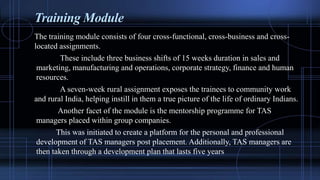
Training Module
The training module consists of four cross-functional, cross-business and cross-
located assignments.
These include three business shifts of 15 weeks duration in sales and
marketing, manufacturing and operations, corporate strategy, finance and human
resources.
A seven-week rural assignment exposes the trainees to community work
and rural India, helping instill in them a true picture of the life of ordinary Indians.
Another facet of the module is the mentorship programme for TAS
managers placed within group companies.
This was initiated to create a platform for the personal and professional
development of TAS managers post placement. Additionally, TAS managers are
then taken through a development plan that lasts five years
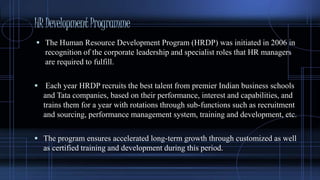
HRDevelopmentProgramme
 The Human Resource Development Program (HRDP) was initiated in 2006 in
recognition of the corporate leadership and specialist roles that HR managers
are required to fulfill.
 Each year HRDP recruits the best talent from premier Indian business schools
and Tata companies, based on their performance, interest and capabilities, and
trains them for a year with rotations through sub-functions such as recruitment
and sourcing, performance management system, training and development, etc.
 The program ensures accelerated long-term growth through customized as well
as certified training and development during this period.
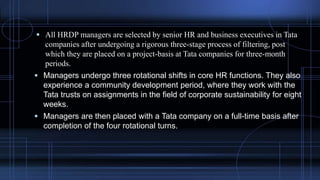
 All HRDP managers are selected by senior HR and business executives in Tata
companies after undergoing a rigorous three-stage process of filtering, post
which they are placed on a project-basis at Tata companies for three-month
periods.
 Managers undergo three rotational shifts in core HR functions. They also
experience a community development period, where they work with the
Tata trusts on assignments in the field of corporate sustainability for eight
weeks.
 Managers are then placed with a Tata company on a full-time basis after
completion of the four rotational turns.
THANK YOU...

Tata groups training md development

  • 1.
  • 2.
    TrainingAndDevelopment Training: Training is theformal and systematic modification of behavior through learning which occurs as a result of education, instruction, development and planned experience. Development: Development is any learning activity, which is directed towards future needs rather than present needs and which is concerned more with career growth than immediate performance.
  • 3.
    BenefitsfromTrainingandDevelopment  Increased jobsatisfaction and morale among employees  Increased employee motivation  Increased efficiencies in processes, resulting in financial gain  Increased capacity to adopt new technologies and methods  Increased innovation in strategies and products  Reduced employee turnover  Enhanced company image.
  • 4.
    Introduction  Tata groupis India’s largest and most trusted Multinational Conglomerate.  Tata group has operations in over 80 countries and across 6 continents.  Its companies export products and services to more than 120 nations.  Tata group comprises of 114 companies in seven business sectors: 1) Information System and Communication; 2) Engineering; 3) Materials; 4) Services; 5) Energy; 6) Consumer Product; 7) Chemicals.
  • 5.
    Training&DevelopmentofTATAGROUP  The Tatagroup's commitment to enhance the knowledge and leadership quotient of its people has resulted in the establishment of various Development and Training Programs such as Tata Administrative Services (TAS) and Tata Management Training Center(TMTC)  Tata Management Training Center(TMTC): Set up by JRD Tata in 1959 with the mission of creating and grooming leaders for the future. It aims to provide training to high performers within the group and act as a catalyst of change for Tata executives.
  • 6.
     Offering around250 programs a year, conducted by in house senior faculty from academics and business, supported by experts from the best of Indian and international B schools.  TMTC started its e-learning programs in 2009.Every year, more than 4000 Tata Managers and Leaders go through the training programs. Objectives of TMTC:  Improvement of organizational performance through dissemination of the latest knowledge and skills among practicing managers.  Facilitation of attitudinal and behavioral changes.  Facilitation of solutions for organizational issues.  Development of learning organizations
  • 7.
    TataAdministrativeServices(TAS)  This managerialdevelopment program was conceived by JRD Tata, the late chairman of the Tata group, in the 1950s.  The idea was to select and groom young managers, provide them opportunities for professional growth, and make them part of a talent pool that could be tapped by companies across the Tata organization.  To grow and renew the Tata talent pool continuously, TAS recruits young postgraduates from leading business schools each year and puts them through an intensive 12-month program.
  • 8.
    Tata Values:  TheTAS recruitment process at campuses strives to associate the Tata brand with values such as integrity, excellence and nation building, while highlighting the group's entrepreneurial spirit.  TAS has been recast in recent years, with an increased focus on facilitating mobility across group companies.  Over the past years, concentrated communication, consistent engagement and competitive compensation packages have helped TAS regain and strengthen its position as an attractive employment destination for top talent.
  • 9.
    Training Module The trainingmodule consists of four cross-functional, cross-business and cross- located assignments. These include three business shifts of 15 weeks duration in sales and marketing, manufacturing and operations, corporate strategy, finance and human resources. A seven-week rural assignment exposes the trainees to community work and rural India, helping instill in them a true picture of the life of ordinary Indians. Another facet of the module is the mentorship programme for TAS managers placed within group companies. This was initiated to create a platform for the personal and professional development of TAS managers post placement. Additionally, TAS managers are then taken through a development plan that lasts five years
  • 10.
    HRDevelopmentProgramme  The HumanResource Development Program (HRDP) was initiated in 2006 in recognition of the corporate leadership and specialist roles that HR managers are required to fulfill.  Each year HRDP recruits the best talent from premier Indian business schools and Tata companies, based on their performance, interest and capabilities, and trains them for a year with rotations through sub-functions such as recruitment and sourcing, performance management system, training and development, etc.  The program ensures accelerated long-term growth through customized as well as certified training and development during this period.
  • 11.
     All HRDPmanagers are selected by senior HR and business executives in Tata companies after undergoing a rigorous three-stage process of filtering, post which they are placed on a project-basis at Tata companies for three-month periods.  Managers undergo three rotational shifts in core HR functions. They also experience a community development period, where they work with the Tata trusts on assignments in the field of corporate sustainability for eight weeks.  Managers are then placed with a Tata company on a full-time basis after completion of the four rotational turns.
  • 12.