13-1
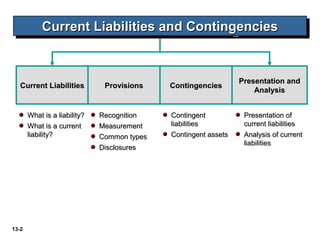
Current Liabilities and Contingencies
            Current Liabilities and Contingencies


                                                                 Presentation and
   Current Liabilities         Provisions    Contingencies
                                                                     Analysis


       What is a liability?   Recognition    Contingent           Presentation of
       What is a current      Measurement    liabilities          current liabilities
       liability?             Common types   Contingent assets    Analysis of current
                                                                  liabilities
                              Disclosures


13-2
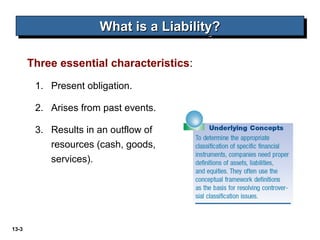
What is a Liability?
                      What is a Liability?

       Three essential characteristics:

        1. Present obligation.

        2. Arises from past events.

        3. Results in an outflow of
           resources (cash, goods,
           services).


13-3
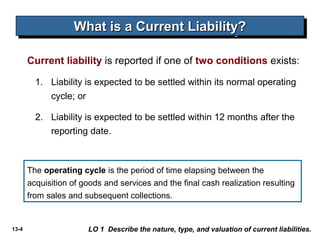
What is a Current Liability?
                   What is a Current Liability?

       Current liability is reported if one of two conditions exists:

         1. Liability is expected to be settled within its normal operating
            cycle; or

         2. Liability is expected to be settled within 12 months after the
            reporting date.


       The operating cycle is the period of time elapsing between the
       acquisition of goods and services and the final cash realization resulting
       from sales and subsequent collections.


13-4                   LO 1 Describe the nature, type, and valuation of current liabilities.
What is a Current Liability?
                  What is a Current Liability?

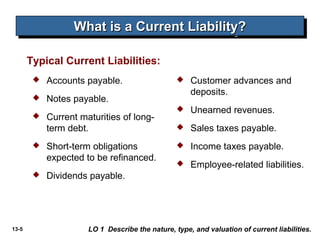
       Typical Current Liabilities:
           Accounts payable.                       Customer advances and
                                                     deposits.
           Notes payable.
                                                    Unearned revenues.
           Current maturities of long-
            term debt.                              Sales taxes payable.
           Short-term obligations                  Income taxes payable.
            expected to be refinanced.
                                                    Employee-related liabilities.
           Dividends payable.


13-5                  LO 1 Describe the nature, type, and valuation of current liabilities.
What is a Current Liability?
                 What is a Current Liability?

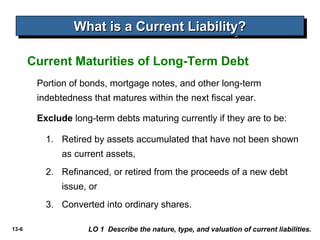
       Current Maturities of Long-Term Debt
        Portion of bonds, mortgage notes, and other long-term
        indebtedness that matures within the next fiscal year.

        Exclude long-term debts maturing currently if they are to be:

          1. Retired by assets accumulated that have not been shown
              as current assets,
          2. Refinanced, or retired from the proceeds of a new debt
              issue, or
          3. Converted into ordinary shares.

13-6                LO 1 Describe the nature, type, and valuation of current liabilities.
What is a Current Liability?
                 What is a Current Liability?

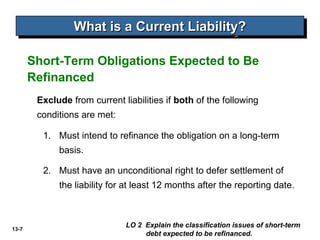
       Short-Term Obligations Expected to Be
       Refinanced
        Exclude from current liabilities if both of the following
        conditions are met:

         1. Must intend to refinance the obligation on a long-term
             basis.

         2. Must have an unconditional right to defer settlement of
             the liability for at least 12 months after the reporting date.


13-7
                              LO 2 Explain the classification issues of short-term
                                   debt expected to be refinanced.
What is a Current Liability?
                   What is a Current Liability?
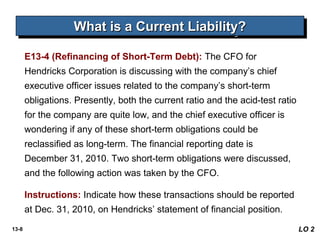
       E13-4 (Refinancing of Short-Term Debt): The CFO for
       Hendricks Corporation is discussing with the company’s chief
       executive officer issues related to the company’s short-term
       obligations. Presently, both the current ratio and the acid-test ratio
       for the company are quite low, and the chief executive officer is
       wondering if any of these short-term obligations could be
       reclassified as long-term. The financial reporting date is
       December 31, 2010. Two short-term obligations were discussed,
       and the following action was taken by the CFO.

       Instructions: Indicate how these transactions should be reported
       at Dec. 31, 2010, on Hendricks’ statement of financial position.
13-8                                                                            LO 2
What is a Current Liability?
                   What is a Current Liability?
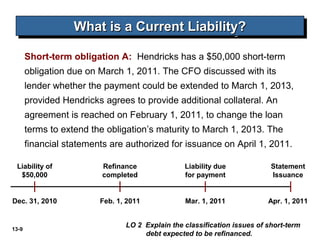
       Short-term obligation A: Hendricks has a $50,000 short-term
       obligation due on March 1, 2011. The CFO discussed with its
       lender whether the payment could be extended to March 1, 2013,
       provided Hendricks agrees to provide additional collateral. An
       agreement is reached on February 1, 2011, to change the loan
       terms to extend the obligation’s maturity to March 1, 2013. The
       financial statements are authorized for issuance on April 1, 2011.

 Liability of             Refinance              Liability due             Statement
  $50,000                 completed              for payment               Issuance


Dec. 31, 2010            Feb. 1, 2011            Mar. 1, 2011             Apr. 1, 2011


13-9
                                LO 2 Explain the classification issues of short-term
                                     debt expected to be refinanced.
What is a Current Liability?
                    What is a Current Liability?
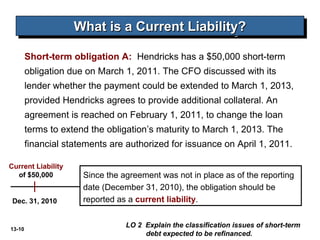
        Short-term obligation A: Hendricks has a $50,000 short-term
        obligation due on March 1, 2011. The CFO discussed with its
        lender whether the payment could be extended to March 1, 2013,
        provided Hendricks agrees to provide additional collateral. An
        agreement is reached on February 1, 2011, to change the loan
        terms to extend the obligation’s maturity to March 1, 2013. The
        financial statements are authorized for issuance on April 1, 2011.

Current Liability
  of $50,000          Since the agreement was not in place as of the reporting
                      date (December 31, 2010), the obligation should be
 Dec. 31, 2010        reported as a current liability.


13-10
                                 LO 2 Explain the classification issues of short-term
                                      debt expected to be refinanced.
What is a Current Liability?
                    What is a Current Liability?
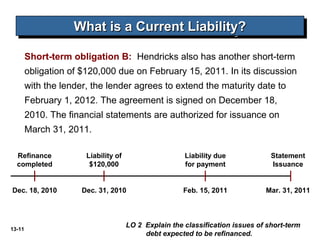
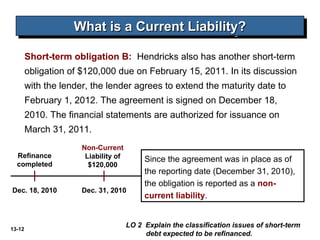
        Short-term obligation B: Hendricks also has another short-term
        obligation of $120,000 due on February 15, 2011. In its discussion
        with the lender, the lender agrees to extend the maturity date to
        February 1, 2012. The agreement is signed on December 18,
        2010. The financial statements are authorized for issuance on
        March 31, 2011.

  Refinance            Liability of                    Liability due             Statement
  completed             $120,000                       for payment               Issuance


Dec. 18, 2010         Dec. 31, 2010                    Feb. 15, 2011           Mar. 31, 2011


13-11
                                      LO 2 Explain the classification issues of short-term
                                           debt expected to be refinanced.
What is a Current Liability?
                    What is a Current Liability?
        Short-term obligation B: Hendricks also has another short-term
        obligation of $120,000 due on February 15, 2011. In its discussion
        with the lender, the lender agrees to extend the maturity date to
        February 1, 2012. The agreement is signed on December 18,
        2010. The financial statements are authorized for issuance on
        March 31, 2011.
                      Non-Current
  Refinance            Liability of        Since the agreement was in place as of
  completed             $120,000
                                           the reporting date (December 31, 2010),
                                           the obligation is reported as a non-
Dec. 18, 2010         Dec. 31, 2010
                                           current liability.


13-12
                                      LO 2 Explain the classification issues of short-term
                                           debt expected to be refinanced.
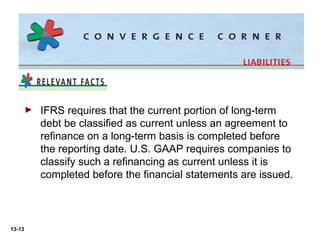
►   IFRS requires that the current portion of long-term
            debt be classified as current unless an agreement to
            refinance on a long-term basis is completed before
            the reporting date. U.S. GAAP requires companies to
            classify such a refinancing as current unless it is
            completed before the financial statements are issued.


13-13
Long-Term Liabilities
                             Long-Term Liabilities


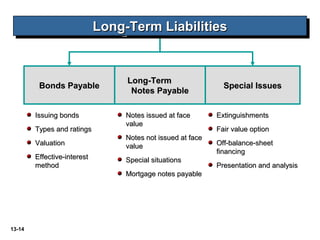
                                  Long-Term
         Bonds Payable                                         Special Issues
                                   Notes Payable

        Issuing bonds             Notes issued at face       Extinguishments
                                  value
        Types and ratings                                    Fair value option
                                  Notes not issued at face
        Valuation                 value                      Off-balance-sheet
                                                             financing
        Effective-interest        Special situations
        method                                               Presentation and analysis
                                  Mortgage notes payable


13-14
Off-Balance-Sheet Financing
                Off-Balance-Sheet Financing

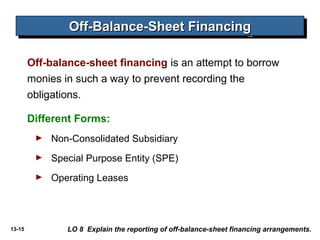
        Off-balance-sheet financing is an attempt to borrow
        monies in such a way to prevent recording the
        obligations.

        Different Forms:
         ►   Non-Consolidated Subsidiary
         ►   Special Purpose Entity (SPE)
         ►   Operating Leases


13-15           LO 8 Explain the reporting of off-balance-sheet financing arrangements.

Slide 3 liabilities ifrs

  • 1.
  • 2.
    Current Liabilities andContingencies Current Liabilities and Contingencies Presentation and Current Liabilities Provisions Contingencies Analysis What is a liability? Recognition Contingent Presentation of What is a current Measurement liabilities current liabilities liability? Common types Contingent assets Analysis of current liabilities Disclosures 13-2
  • 3.
    What is aLiability? What is a Liability? Three essential characteristics: 1. Present obligation. 2. Arises from past events. 3. Results in an outflow of resources (cash, goods, services). 13-3
  • 4.
    What is aCurrent Liability? What is a Current Liability? Current liability is reported if one of two conditions exists: 1. Liability is expected to be settled within its normal operating cycle; or 2. Liability is expected to be settled within 12 months after the reporting date. The operating cycle is the period of time elapsing between the acquisition of goods and services and the final cash realization resulting from sales and subsequent collections. 13-4 LO 1 Describe the nature, type, and valuation of current liabilities.
  • 5.
    What is aCurrent Liability? What is a Current Liability? Typical Current Liabilities:  Accounts payable.  Customer advances and deposits.  Notes payable.  Unearned revenues.  Current maturities of long- term debt.  Sales taxes payable.  Short-term obligations  Income taxes payable. expected to be refinanced.  Employee-related liabilities.  Dividends payable. 13-5 LO 1 Describe the nature, type, and valuation of current liabilities.
  • 6.
    What is aCurrent Liability? What is a Current Liability? Current Maturities of Long-Term Debt Portion of bonds, mortgage notes, and other long-term indebtedness that matures within the next fiscal year. Exclude long-term debts maturing currently if they are to be: 1. Retired by assets accumulated that have not been shown as current assets, 2. Refinanced, or retired from the proceeds of a new debt issue, or 3. Converted into ordinary shares. 13-6 LO 1 Describe the nature, type, and valuation of current liabilities.
  • 7.
    What is aCurrent Liability? What is a Current Liability? Short-Term Obligations Expected to Be Refinanced Exclude from current liabilities if both of the following conditions are met: 1. Must intend to refinance the obligation on a long-term basis. 2. Must have an unconditional right to defer settlement of the liability for at least 12 months after the reporting date. 13-7 LO 2 Explain the classification issues of short-term debt expected to be refinanced.
  • 8.
    What is aCurrent Liability? What is a Current Liability? E13-4 (Refinancing of Short-Term Debt): The CFO for Hendricks Corporation is discussing with the company’s chief executive officer issues related to the company’s short-term obligations. Presently, both the current ratio and the acid-test ratio for the company are quite low, and the chief executive officer is wondering if any of these short-term obligations could be reclassified as long-term. The financial reporting date is December 31, 2010. Two short-term obligations were discussed, and the following action was taken by the CFO. Instructions: Indicate how these transactions should be reported at Dec. 31, 2010, on Hendricks’ statement of financial position. 13-8 LO 2
  • 9.
    What is aCurrent Liability? What is a Current Liability? Short-term obligation A: Hendricks has a $50,000 short-term obligation due on March 1, 2011. The CFO discussed with its lender whether the payment could be extended to March 1, 2013, provided Hendricks agrees to provide additional collateral. An agreement is reached on February 1, 2011, to change the loan terms to extend the obligation’s maturity to March 1, 2013. The financial statements are authorized for issuance on April 1, 2011. Liability of Refinance Liability due Statement $50,000 completed for payment Issuance Dec. 31, 2010 Feb. 1, 2011 Mar. 1, 2011 Apr. 1, 2011 13-9 LO 2 Explain the classification issues of short-term debt expected to be refinanced.
  • 10.
    What is aCurrent Liability? What is a Current Liability? Short-term obligation A: Hendricks has a $50,000 short-term obligation due on March 1, 2011. The CFO discussed with its lender whether the payment could be extended to March 1, 2013, provided Hendricks agrees to provide additional collateral. An agreement is reached on February 1, 2011, to change the loan terms to extend the obligation’s maturity to March 1, 2013. The financial statements are authorized for issuance on April 1, 2011. Current Liability of $50,000 Since the agreement was not in place as of the reporting date (December 31, 2010), the obligation should be Dec. 31, 2010 reported as a current liability. 13-10 LO 2 Explain the classification issues of short-term debt expected to be refinanced.
  • 11.
    What is aCurrent Liability? What is a Current Liability? Short-term obligation B: Hendricks also has another short-term obligation of $120,000 due on February 15, 2011. In its discussion with the lender, the lender agrees to extend the maturity date to February 1, 2012. The agreement is signed on December 18, 2010. The financial statements are authorized for issuance on March 31, 2011. Refinance Liability of Liability due Statement completed $120,000 for payment Issuance Dec. 18, 2010 Dec. 31, 2010 Feb. 15, 2011 Mar. 31, 2011 13-11 LO 2 Explain the classification issues of short-term debt expected to be refinanced.
  • 12.
    What is aCurrent Liability? What is a Current Liability? Short-term obligation B: Hendricks also has another short-term obligation of $120,000 due on February 15, 2011. In its discussion with the lender, the lender agrees to extend the maturity date to February 1, 2012. The agreement is signed on December 18, 2010. The financial statements are authorized for issuance on March 31, 2011. Non-Current Refinance Liability of Since the agreement was in place as of completed $120,000 the reporting date (December 31, 2010), the obligation is reported as a non- Dec. 18, 2010 Dec. 31, 2010 current liability. 13-12 LO 2 Explain the classification issues of short-term debt expected to be refinanced.
  • 13.
    IFRS requires that the current portion of long-term debt be classified as current unless an agreement to refinance on a long-term basis is completed before the reporting date. U.S. GAAP requires companies to classify such a refinancing as current unless it is completed before the financial statements are issued. 13-13
  • 14.
    Long-Term Liabilities Long-Term Liabilities Long-Term Bonds Payable Special Issues Notes Payable Issuing bonds Notes issued at face Extinguishments value Types and ratings Fair value option Notes not issued at face Valuation value Off-balance-sheet financing Effective-interest Special situations method Presentation and analysis Mortgage notes payable 13-14
  • 15.
    Off-Balance-Sheet Financing Off-Balance-Sheet Financing Off-balance-sheet financing is an attempt to borrow monies in such a way to prevent recording the obligations. Different Forms: ► Non-Consolidated Subsidiary ► Special Purpose Entity (SPE) ► Operating Leases 13-15 LO 8 Explain the reporting of off-balance-sheet financing arrangements.