Overview
Hello this is the overview page for this presentation.

In this presentation I want to showcase the evidence that I’ve come across that
supports the main thesis and which has influenced the modified sub-thesis.

                                              Parts:
Overview
A - Without public debt what happens?
B - Who’s holding all the public debt?
C - Why government growth would be much more difficult without debt.


Main thesis:
• Most of what the government does that is immoral would be impossible without fiat
   currency.
Sub-thesis:
• It is impossible to sustain the IMC (industrial military complex) at the size and power it is
   now without fiat currency.
• Growth of the IMC is much more difficult without fiat currency.
A. Without public debt, what happens?

• What happens is that all current aspects of the government
  must shrink by an average of 1/3. Take 2011 for example:
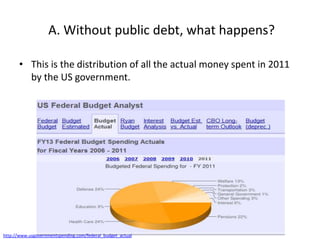
A. Without public debt, what happens?

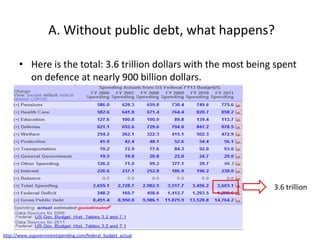
       • This is the distribution of all the actual money spent in 2011
         by the US government.


http://www.usgovernmentspending.com/federal_budget_actual
A. Without public debt, what happens?

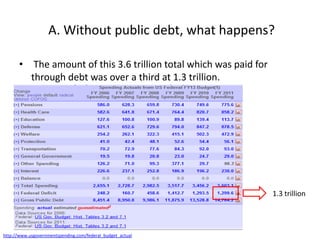
       • Here is the total: 3.6 trillion dollars with the most being spent
         on defence at nearly 900 billion dollars.


                                                                    3.6 trillion


http://www.usgovernmentspending.com/federal_budget_actual
A. Without public debt, what happens?

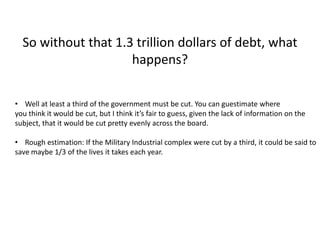
       • The amount of this 3.6 trillion total which was paid for
         through debt was over a third at 1.3 trillion.


                                                                    1.3 trillion


http://www.usgovernmentspending.com/federal_budget_actual
So without that 1.3 trillion dollars of debt, what
                     happens?

• Well at least a third of the government must be cut. You can guestimate where
you think it would be cut, but I think it’s fair to guess, given the lack of information on the
subject, that it would be cut pretty evenly across the board.

• Rough estimation: If the Military Industrial complex were cut by a third, it could be said to
save maybe 1/3 of the lives it takes each year.
B. Who’s holding all the public debt that
          makes this happen?
B. Who’s holding all the public debt that
                    makes this happen?
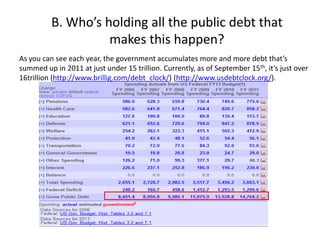
As you can see each year, the government accumulates more and more debt that’s
summed up in 2011 at just under 15 trillion. Currently, as of September 15th, it’s just over
16trillion (http://www.brillig.com/debt_clock/) (http://www.usdebtclock.org/).
B. Who’s holding all the public debt that
                  makes this happen?
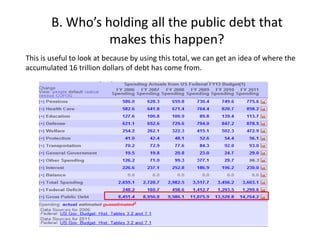
This is useful to look at because by using this total, we can get an idea of where the
accumulated 16 trillion dollars of debt has come from.
B. Who’s holding all the public debt that
                    makes this happen?
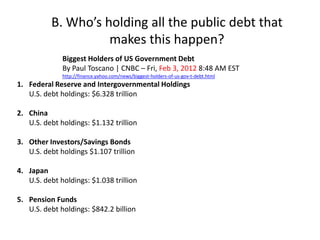
              Biggest Holders of US Government Debt
              By Paul Toscano | CNBC – Fri, Feb 3, 2012 8:48 AM EST
              http://finance.yahoo.com/news/biggest-holders-of-us-gov-t-debt.html
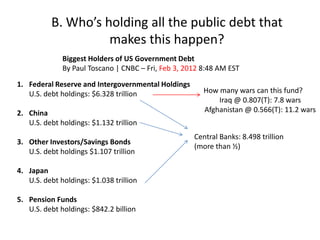
1. Federal Reserve and Intergovernmental Holdings
   U.S. debt holdings: $6.328 trillion

2. China
   U.S. debt holdings: $1.132 trillion

3. Other Investors/Savings Bonds
   U.S. debt holdings $1.107 trillion

4. Japan
   U.S. debt holdings: $1.038 trillion

5. Pension Funds
   U.S. debt holdings: $842.2 billion
B. Who’s holding all the public debt that
                    makes this happen?
              Biggest Holders of US Government Debt
              By Paul Toscano | CNBC – Fri, Feb 3, 2012 8:48 AM EST

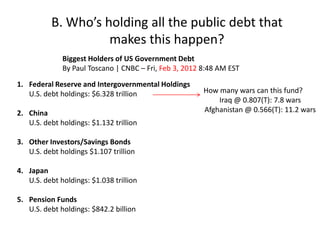
1. Federal Reserve and Intergovernmental Holdings
   U.S. debt holdings: $6.328 trillion                  How many wars can this fund?
                                                            Iraq @ 0.807(T): 7.8 wars
2. China                                                Afghanistan @ 0.566(T): 11.2 wars
   U.S. debt holdings: $1.132 trillion

3. Other Investors/Savings Bonds
   U.S. debt holdings $1.107 trillion

4. Japan
   U.S. debt holdings: $1.038 trillion

5. Pension Funds
   U.S. debt holdings: $842.2 billion
B. Who’s holding all the public debt that
                    makes this happen?
              Biggest Holders of US Government Debt
              By Paul Toscano | CNBC – Fri, Feb 3, 2012 8:48 AM EST

1. Federal Reserve and Intergovernmental Holdings
   U.S. debt holdings: $6.328 trillion                  How many wars can this fund?
                                                            Iraq @ 0.807(T): 7.8 wars
2. China                                                Afghanistan @ 0.566(T): 11.2 wars
   U.S. debt holdings: $1.132 trillion
                                                     Central Banks: 8.498 trillion
3. Other Investors/Savings Bonds
                                                     (more than ½)
   U.S. debt holdings $1.107 trillion

4. Japan
   U.S. debt holdings: $1.038 trillion

5. Pension Funds
   U.S. debt holdings: $842.2 billion
Part C – Why government growth would be
     much more difficult without debt.
•   The main reason for this is that people don’t have much to any incentive to
    stop the growth of the government when the increase in spending is done
    through debt. People’s price of living goes up because the central banks are
    debasing the currency to buy most of the debt and their children are being
    born into an impossible amount of debt. But this does not make the majority
    of the population riot. However in 2011, if the spending was paid for directly
    through taxation , their taxes would have to be raised by 56.5% of what they
    are now to accommodate the increase from 2.3 trillion in tax revenue the 3.6
    trillion spent. I can see the riots happening now.

•   The government knows this because we can observe that, in the last 6 years,
    almost no new tax based spending has been done even though total fiscal
    spending has risen nearly 1 trillion per year.
Part C – Why government growth would be
     much more difficult without debt.
•   The main reason for this is that people don’t have much to any incentive to
    stop the growth of the government when the increase in spending is done
    through debt. People’s price of living goes up because the central banks are
    debasing the currency to buy most of the debt and their children are being
    born into an impossible amount of debt. But this does not make the majority
    of the population riot. However in 2011, if the spending was paid for directly
    through taxation , their taxes would have to be raised by 56.5% of what they
    are now to accommodate the increase from 2.3 trillion in tax revenue the 3.6
    trillion spent. I can see the riots happening now.

•   The government knows this because we can observe that, in the last 6 years,
    almost no new tax based spending has been done even though total fiscal
    spending has risen nearly 1 trillion per year. Here’s why:
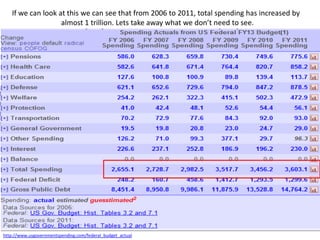
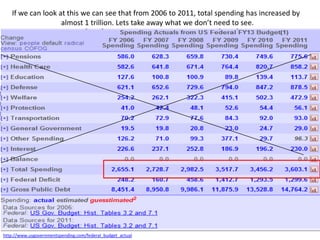
If we can look at this we can see that from 2006 to 2011, total spending has increased by
                   almost 1 trillion. Lets take away what we don’t need to see.


http://www.usgovernmentspending.com/federal_budget_actual
If we can look at this we can see that from 2006 to 2011, total spending has increased by
                   almost 1 trillion. Lets take away what we don’t need to see.


http://www.usgovernmentspending.com/federal_budget_actual
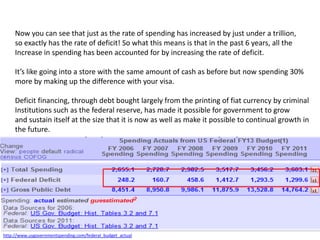
Now you can see that just as the rate of spending has increased by just under a trillion,
     so exactly has the rate of deficit! So what this means is that in the past 6 years, all the
     Increase in spending has been accounted for by increasing the rate of deficit.

     It’s like going into a store with the same amount of cash as before but now spending 30%
     more by making up the difference with your visa.

     Deficit financing, through debt bought largely from the printing of fiat currency by criminal
     Institutions such as the federal reserve, has made it possible for government to grow
     and sustain itself at the size that it is now as well as make it possible to continual growth in
     the future.


http://www.usgovernmentspending.com/federal_budget_actual
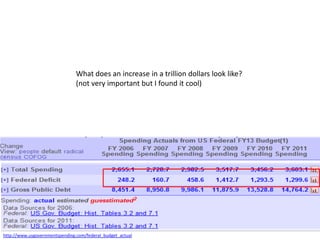
What does an increase in a trillion dollars look like?
                                (not very important but I found it cool)


http://www.usgovernmentspending.com/federal_budget_actual
http://www.pagetutor.com/trillion/index.html


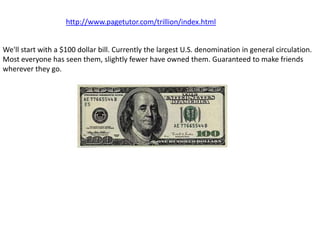
We'll start with a $100 dollar bill. Currently the largest U.S. denomination in general circulation.
Most everyone has seen them, slightly fewer have owned them. Guaranteed to make friends
wherever they go.
http://www.pagetutor.com/trillion/index.html


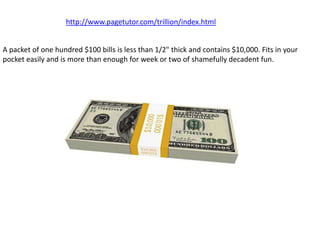
A packet of one hundred $100 bills is less than 1/2" thick and contains $10,000. Fits in your
pocket easily and is more than enough for week or two of shamefully decadent fun.
http://www.pagetutor.com/trillion/index.html


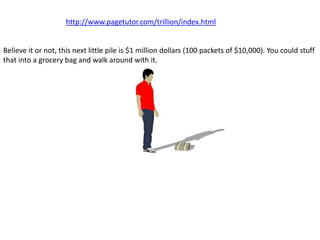
Believe it or not, this next little pile is $1 million dollars (100 packets of $10,000). You could stuff
that into a grocery bag and walk around with it.
http://www.pagetutor.com/trillion/index.html


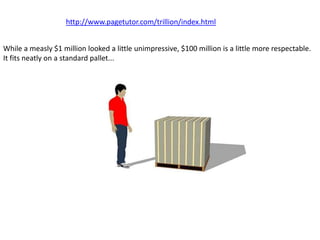
While a measly $1 million looked a little unimpressive, $100 million is a little more respectable.
It fits neatly on a standard pallet...
http://www.pagetutor.com/trillion/index.html


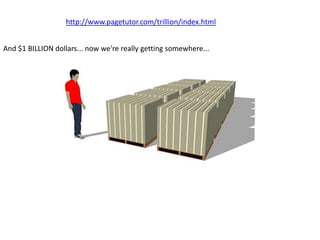
And $1 BILLION dollars... now we're really getting somewhere...
http://www.pagetutor.com/trillion/index.html


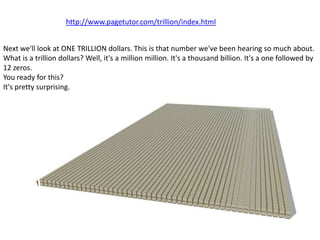
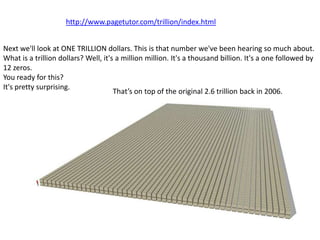
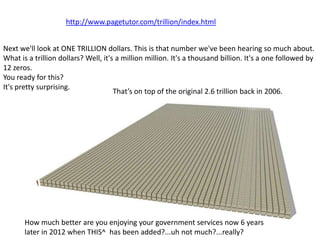
Next we'll look at ONE TRILLION dollars. This is that number we've been hearing so much about.
What is a trillion dollars? Well, it's a million million. It's a thousand billion. It's a one followed by
12 zeros.
You ready for this?
It's pretty surprising.
http://www.pagetutor.com/trillion/index.html


Next we'll look at ONE TRILLION dollars. This is that number we've been hearing so much about.
What is a trillion dollars? Well, it's a million million. It's a thousand billion. It's a one followed by
12 zeros.
You ready for this?
It's pretty surprising.
http://www.pagetutor.com/trillion/index.html


Next we'll look at ONE TRILLION dollars. This is that number we've been hearing so much about.
What is a trillion dollars? Well, it's a million million. It's a thousand billion. It's a one followed by
12 zeros.
You ready for this?
It's pretty surprising.
                                      That’s on top of the original 2.6 trillion back in 2006.
http://www.pagetutor.com/trillion/index.html


Next we'll look at ONE TRILLION dollars. This is that number we've been hearing so much about.
What is a trillion dollars? Well, it's a million million. It's a thousand billion. It's a one followed by
12 zeros.
You ready for this?
It's pretty surprising.
                                      That’s on top of the original 2.6 trillion back in 2006.


       How much better are you enjoying your government services now 6 years
       later in 2012 when THIS^ has been added?...uh not much?...really?

Brady's power-point on Public Debt

  • 1.
    Overview Hello this isthe overview page for this presentation. In this presentation I want to showcase the evidence that I’ve come across that supports the main thesis and which has influenced the modified sub-thesis. Parts: Overview A - Without public debt what happens? B - Who’s holding all the public debt? C - Why government growth would be much more difficult without debt. Main thesis: • Most of what the government does that is immoral would be impossible without fiat currency. Sub-thesis: • It is impossible to sustain the IMC (industrial military complex) at the size and power it is now without fiat currency. • Growth of the IMC is much more difficult without fiat currency.
  • 2.
    A. Without publicdebt, what happens? • What happens is that all current aspects of the government must shrink by an average of 1/3. Take 2011 for example:
  • 3.
    A. Without publicdebt, what happens? • This is the distribution of all the actual money spent in 2011 by the US government. http://www.usgovernmentspending.com/federal_budget_actual
  • 4.
    A. Without publicdebt, what happens? • Here is the total: 3.6 trillion dollars with the most being spent on defence at nearly 900 billion dollars. 3.6 trillion http://www.usgovernmentspending.com/federal_budget_actual
  • 5.
    A. Without publicdebt, what happens? • The amount of this 3.6 trillion total which was paid for through debt was over a third at 1.3 trillion. 1.3 trillion http://www.usgovernmentspending.com/federal_budget_actual
  • 6.
    So without that1.3 trillion dollars of debt, what happens? • Well at least a third of the government must be cut. You can guestimate where you think it would be cut, but I think it’s fair to guess, given the lack of information on the subject, that it would be cut pretty evenly across the board. • Rough estimation: If the Military Industrial complex were cut by a third, it could be said to save maybe 1/3 of the lives it takes each year.
  • 7.
    B. Who’s holdingall the public debt that makes this happen?
  • 8.
    B. Who’s holdingall the public debt that makes this happen? As you can see each year, the government accumulates more and more debt that’s summed up in 2011 at just under 15 trillion. Currently, as of September 15th, it’s just over 16trillion (http://www.brillig.com/debt_clock/) (http://www.usdebtclock.org/).
  • 9.
    B. Who’s holdingall the public debt that makes this happen? This is useful to look at because by using this total, we can get an idea of where the accumulated 16 trillion dollars of debt has come from.
  • 10.
    B. Who’s holdingall the public debt that makes this happen? Biggest Holders of US Government Debt By Paul Toscano | CNBC – Fri, Feb 3, 2012 8:48 AM EST http://finance.yahoo.com/news/biggest-holders-of-us-gov-t-debt.html 1. Federal Reserve and Intergovernmental Holdings U.S. debt holdings: $6.328 trillion 2. China U.S. debt holdings: $1.132 trillion 3. Other Investors/Savings Bonds U.S. debt holdings $1.107 trillion 4. Japan U.S. debt holdings: $1.038 trillion 5. Pension Funds U.S. debt holdings: $842.2 billion
  • 11.
    B. Who’s holdingall the public debt that makes this happen? Biggest Holders of US Government Debt By Paul Toscano | CNBC – Fri, Feb 3, 2012 8:48 AM EST 1. Federal Reserve and Intergovernmental Holdings U.S. debt holdings: $6.328 trillion How many wars can this fund? Iraq @ 0.807(T): 7.8 wars 2. China Afghanistan @ 0.566(T): 11.2 wars U.S. debt holdings: $1.132 trillion 3. Other Investors/Savings Bonds U.S. debt holdings $1.107 trillion 4. Japan U.S. debt holdings: $1.038 trillion 5. Pension Funds U.S. debt holdings: $842.2 billion
  • 12.
    B. Who’s holdingall the public debt that makes this happen? Biggest Holders of US Government Debt By Paul Toscano | CNBC – Fri, Feb 3, 2012 8:48 AM EST 1. Federal Reserve and Intergovernmental Holdings U.S. debt holdings: $6.328 trillion How many wars can this fund? Iraq @ 0.807(T): 7.8 wars 2. China Afghanistan @ 0.566(T): 11.2 wars U.S. debt holdings: $1.132 trillion Central Banks: 8.498 trillion 3. Other Investors/Savings Bonds (more than ½) U.S. debt holdings $1.107 trillion 4. Japan U.S. debt holdings: $1.038 trillion 5. Pension Funds U.S. debt holdings: $842.2 billion
  • 13.
    Part C –Why government growth would be much more difficult without debt. • The main reason for this is that people don’t have much to any incentive to stop the growth of the government when the increase in spending is done through debt. People’s price of living goes up because the central banks are debasing the currency to buy most of the debt and their children are being born into an impossible amount of debt. But this does not make the majority of the population riot. However in 2011, if the spending was paid for directly through taxation , their taxes would have to be raised by 56.5% of what they are now to accommodate the increase from 2.3 trillion in tax revenue the 3.6 trillion spent. I can see the riots happening now. • The government knows this because we can observe that, in the last 6 years, almost no new tax based spending has been done even though total fiscal spending has risen nearly 1 trillion per year.
  • 14.
    Part C –Why government growth would be much more difficult without debt. • The main reason for this is that people don’t have much to any incentive to stop the growth of the government when the increase in spending is done through debt. People’s price of living goes up because the central banks are debasing the currency to buy most of the debt and their children are being born into an impossible amount of debt. But this does not make the majority of the population riot. However in 2011, if the spending was paid for directly through taxation , their taxes would have to be raised by 56.5% of what they are now to accommodate the increase from 2.3 trillion in tax revenue the 3.6 trillion spent. I can see the riots happening now. • The government knows this because we can observe that, in the last 6 years, almost no new tax based spending has been done even though total fiscal spending has risen nearly 1 trillion per year. Here’s why:
  • 15.
    If we canlook at this we can see that from 2006 to 2011, total spending has increased by almost 1 trillion. Lets take away what we don’t need to see. http://www.usgovernmentspending.com/federal_budget_actual
  • 16.
    If we canlook at this we can see that from 2006 to 2011, total spending has increased by almost 1 trillion. Lets take away what we don’t need to see. http://www.usgovernmentspending.com/federal_budget_actual
  • 17.
    Now you cansee that just as the rate of spending has increased by just under a trillion, so exactly has the rate of deficit! So what this means is that in the past 6 years, all the Increase in spending has been accounted for by increasing the rate of deficit. It’s like going into a store with the same amount of cash as before but now spending 30% more by making up the difference with your visa. Deficit financing, through debt bought largely from the printing of fiat currency by criminal Institutions such as the federal reserve, has made it possible for government to grow and sustain itself at the size that it is now as well as make it possible to continual growth in the future. http://www.usgovernmentspending.com/federal_budget_actual
  • 18.
    What does anincrease in a trillion dollars look like? (not very important but I found it cool) http://www.usgovernmentspending.com/federal_budget_actual
  • 19.
    http://www.pagetutor.com/trillion/index.html We'll start witha $100 dollar bill. Currently the largest U.S. denomination in general circulation. Most everyone has seen them, slightly fewer have owned them. Guaranteed to make friends wherever they go.
  • 20.
    http://www.pagetutor.com/trillion/index.html A packet ofone hundred $100 bills is less than 1/2" thick and contains $10,000. Fits in your pocket easily and is more than enough for week or two of shamefully decadent fun.
  • 21.
    http://www.pagetutor.com/trillion/index.html Believe it ornot, this next little pile is $1 million dollars (100 packets of $10,000). You could stuff that into a grocery bag and walk around with it.
  • 22.
    http://www.pagetutor.com/trillion/index.html While a measly$1 million looked a little unimpressive, $100 million is a little more respectable. It fits neatly on a standard pallet...
  • 23.
    http://www.pagetutor.com/trillion/index.html And $1 BILLIONdollars... now we're really getting somewhere...
  • 24.
    http://www.pagetutor.com/trillion/index.html Next we'll lookat ONE TRILLION dollars. This is that number we've been hearing so much about. What is a trillion dollars? Well, it's a million million. It's a thousand billion. It's a one followed by 12 zeros. You ready for this? It's pretty surprising.
  • 25.
    http://www.pagetutor.com/trillion/index.html Next we'll lookat ONE TRILLION dollars. This is that number we've been hearing so much about. What is a trillion dollars? Well, it's a million million. It's a thousand billion. It's a one followed by 12 zeros. You ready for this? It's pretty surprising.
  • 26.
    http://www.pagetutor.com/trillion/index.html Next we'll lookat ONE TRILLION dollars. This is that number we've been hearing so much about. What is a trillion dollars? Well, it's a million million. It's a thousand billion. It's a one followed by 12 zeros. You ready for this? It's pretty surprising. That’s on top of the original 2.6 trillion back in 2006.
  • 27.
    http://www.pagetutor.com/trillion/index.html Next we'll lookat ONE TRILLION dollars. This is that number we've been hearing so much about. What is a trillion dollars? Well, it's a million million. It's a thousand billion. It's a one followed by 12 zeros. You ready for this? It's pretty surprising. That’s on top of the original 2.6 trillion back in 2006. How much better are you enjoying your government services now 6 years later in 2012 when THIS^ has been added?...uh not much?...really?