The Debt Crisis and Rising InequalityJohn Bradford
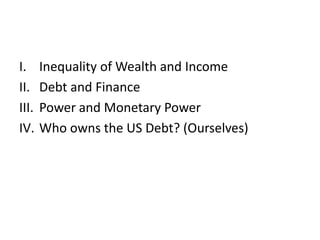
Inequality of Wealth and IncomeDebt and FinancePower and Monetary PowerWho owns the US Debt? (Ourselves)
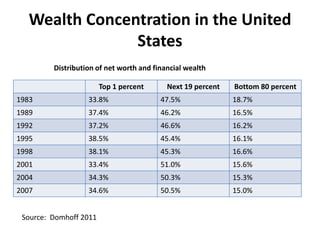
Wealth Concentration in the United StatesDistribution of net worth and financial wealthSource:  Domhoff 2011
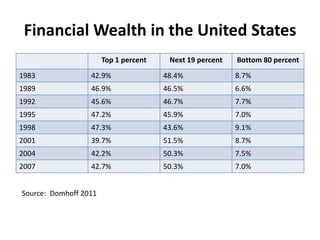
Financial Wealth in the United StatesSource:  Domhoff 2011
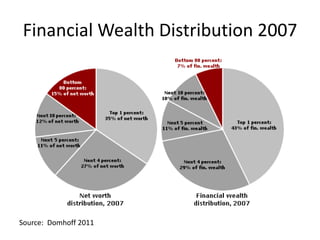
Financial Wealth Distribution 2007Source:  Domhoff 2011
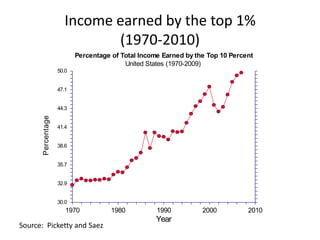
Income earned by the top 1% (1970-2010)Source:  Picketty and Saez
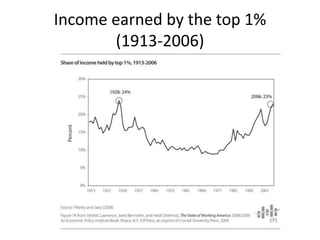
Income earned by the top 1% (1913-2006)
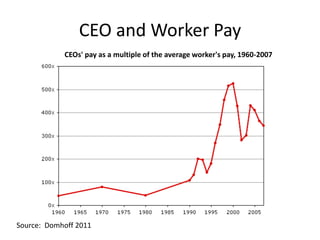
CEO and Worker PayCEOs' pay as a multiple of the average worker's pay, 1960-2007Source:  Domhoff 2011
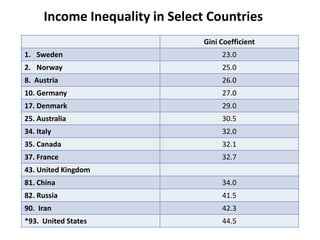
Income Inequality in Select Countries
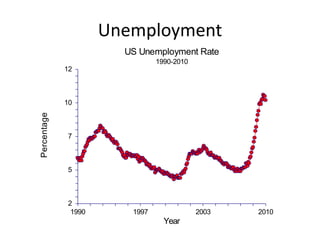
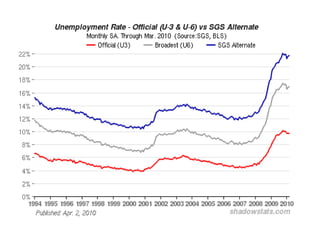
Unemployment
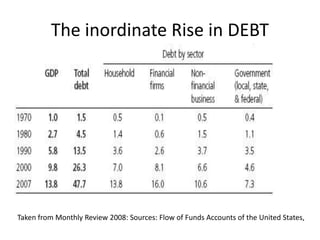
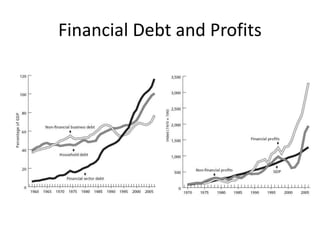
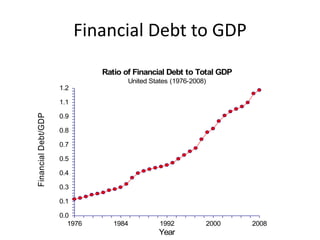
The inordinate Rise in DEBTTaken from Monthly Review 2008: Sources: Flow of Funds Accounts of the United States,
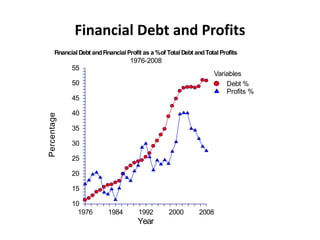
Financial Debt and Profits
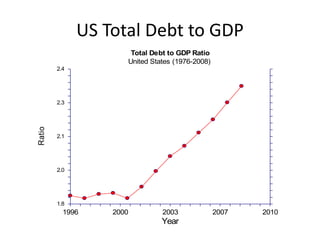
US Total Debt to GDP
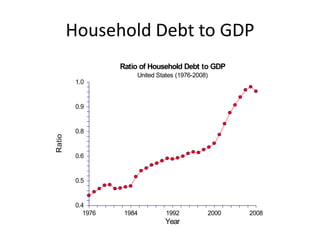
Household Debt to GDP
Financial Debt to GDP
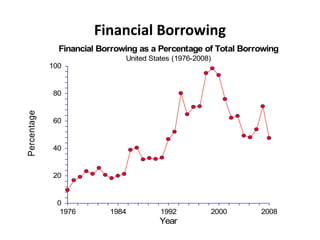
Financial Borrowing
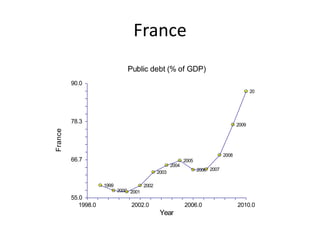
France
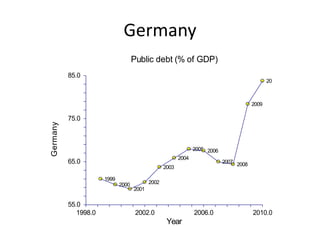
Germany
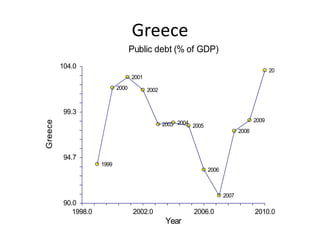
Greece
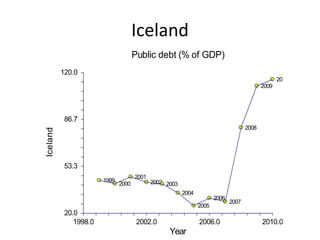
Iceland
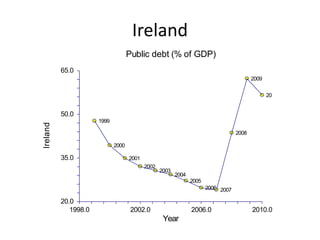
Ireland
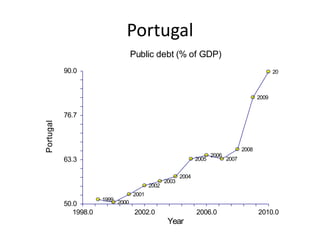
Portugal
Explaining DebtRemember:  borrowing implies a lender.   Financial profits rose faster than average, as did financial debts.Principle: To grow, banks must make more loans. Banks lend more money in order to make more money.  To make more money, they ended up borrowing more money to lend, or lending borrowed money.  LEVERAGE = DEBT:  Leverage measures the degree to which assets are funded by borrowed money. 
Leverage and Bank GrowthBanks can make more money in three ways:Borrow at  lower interest rates;Charge higher interest rates;Banks have little control over the first two.  Competition between banks for funding enforces some uniformity of interest rates.3.  Make more Loans! (aka increase its “Leverage”)
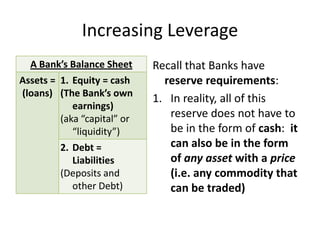
Increasing LeverageRecall that Banks have reserve requirements:  In reality, all of this reserve does not have to be in the form of cash:  it can also be in the form of any asset with a price (i.e. any commodity that can be traded)
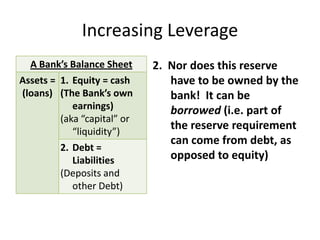
Increasing Leverage2.  Nor does this reserve have to be owned by the bank!  It can be borrowed (i.e. part of the reserve requirement can come from debt, as opposed to equity)
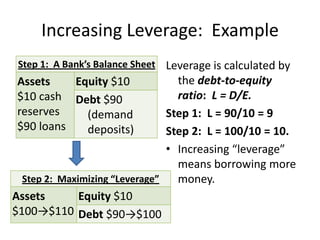
Increasing Leverage:  ExampleLeverage is calculated by the debt-to-equity ratio:  L = D/E.Step 1:  L = 90/10 = 9Step 2:  L = 100/10 = 10.Increasing “leverage” means borrowing more money.
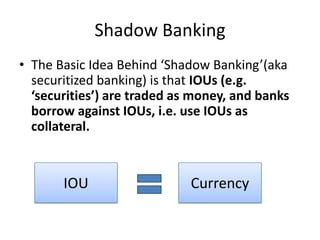
Shadow BankingThe Basic Idea Behind ‘Shadow Banking’(aka securitized banking) is that IOUs (e.g. ‘securities’) are traded as money, and banks borrow against IOUs, i.e. use IOUs as collateral.IOUCurrency
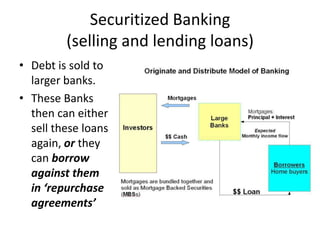
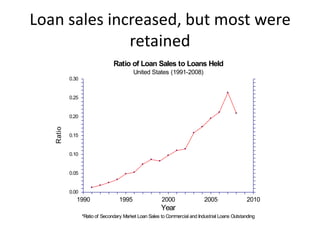
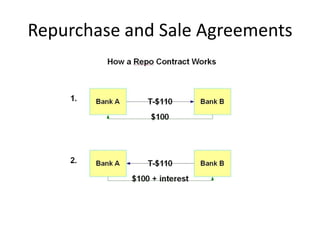
Securitized Banking (selling and lending loans)Debt is sold to larger banks.These Banks then can either sell these loans again, or they can borrow against them in ‘repurchase agreements’
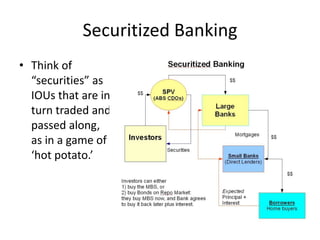
Securitized BankingThink of “securities” as IOUs that are in turn traded and passed along, as in a game of ‘hot potato.’
Loan sales increased, but most were retained
Repurchase and Sale Agreements
Bank Runs RevisitedIOUs circulated around as money.  Banks that purchased these IOUs (e.g. MBSs) borrowed against them in short-term contracts, using them as collateral to borrow cash.Like a mortgage, this is ‘securitized’ lending, because putting up collateral makes it less risky or more secure (contra the ‘Commercial Paper’ market).
Bank Runs RevisitedWhen the value of these securities dropped, because people stopped making their mortgage payments, this (loan to value ratio) was not met.  Lenders demanded that they be paid back, or else be given more collateral, i.e. more securities.This is basically a mass withdrawal on the debtors who had to find more securities or sell them to raise more money.  The sale in turn caused the prices of these securities to decline even further!  The financial panic of 2007-8 was essentially a ‘bank run’ in this secondary ‘repo markets’
Inequality and Debt:  a Link?All money (i.e. Federal Reserve notes) is loaned into existence.Monetary expansion correlates with rising Debt.Because the power to create money is concentrated in a few institutions, inequality will rise if the aggregate interest is not re-circulated in such a way that it can be earned by workers in the form of wages.
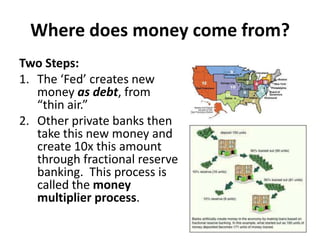
Where does money come from?Two Steps:The ‘Fed’ creates new money as debt, from “thin air.”Other private banks then take this new money and create 10x this amount through fractional reserve banking.  This process is called the money multiplier process.
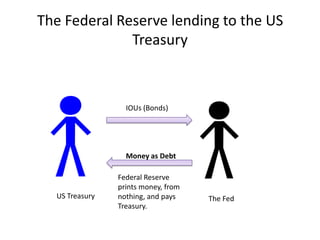
The Federal Reserve lending to the US TreasuryIOUs (Bonds)Money as DebtFederal Reserve  prints money, from nothing, and pays Treasury.US TreasuryThe Fed
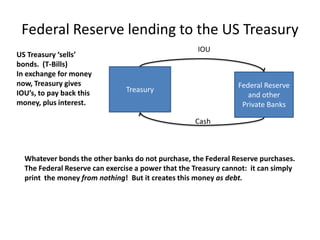
Federal Reserve lending to the US TreasuryIOU US Treasury ‘sells’ bonds.  (T-Bills)In exchange for money now, Treasury gives IOU’s, to pay back this money, plus interest.TreasuryFederal Reserve and other Private BanksCashWhatever bonds the other banks do not purchase, the Federal Reserve purchases.The Federal Reserve can exercise a power that the Treasury cannot:  it can simply print  the money from nothing!  But it creates this money as debt.
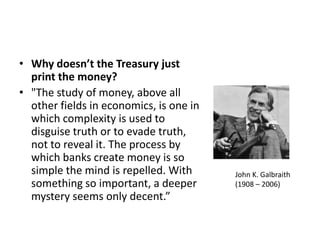
Why doesn’t the Treasury just print the money?"The study of money, above all other fields in economics, is one in which complexity is used to disguise truth or to evade truth, not to reveal it. The process by which banks create money is so simple the mind is repelled. With something so important, a deeper mystery seems only decent.”John K. Galbraith(1908 – 2006)
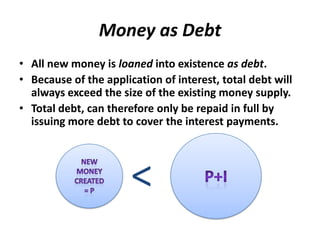
Money as DebtAll new money is loaned into existence as debt.  Because of the application of interest, total debt will always exceed the size of the existing money supply.    Total debt, can therefore only be repaid in full by issuing more debt to cover the interest payments.  P+INew money created= P<
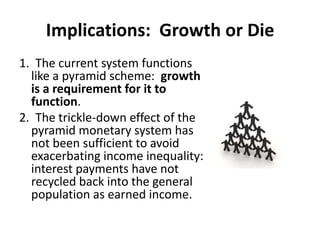
Implications:  Growth or Die1.  The current system functions like a pyramid scheme:  growth is a requirement for it to function.2.  The trickle-down effect of the pyramid monetary system has not been sufficient to avoid exacerbating income inequality:   interest payments have not recycled back into the general population as earned income.
Power and CapitalismCapitalism = stratified society in which accumulation of wealth fulfills 2 functions (Heilbroner): Realization of prestige (unconscious sexual and emotional needs;  Veblen)Expression of power (e.g. what Marx means by ‘self-expanding value’; Nitzan and Bichler ‘Capital as Power’)
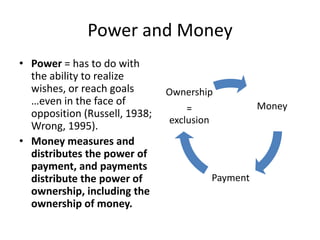
Power and MoneyPower = has to do with the ability to realize wishes, or reach goals …even in the face of opposition (Russell, 1938; Wrong, 1995).  Money measures and distributes the power of payment, and payments distribute the power of ownership, including the ownership of money.
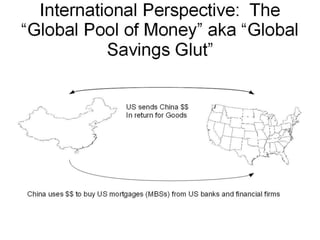
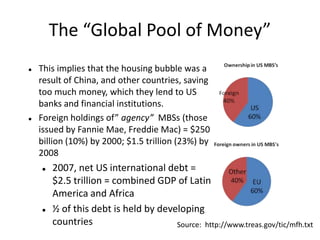
The “Global Pool of Money”This implies that the housing bubble was a result of China, and other countries, saving too much money, which they lend to US banks and financial institutions.
Foreign holdings of” agency”  MBSs (those issued by Fannie Mae, Freddie Mac) = $250 billion (10%) by 2000; $1.5 trillion (23%) by 2008
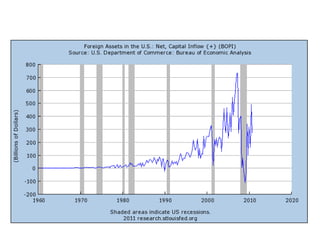
2007, net US international debt = $2.5 trillion = combined GDP of Latin America and Africa
½ of this debt is held by developing countriesSource:  http://www.treas.gov/tic/mfh.txt
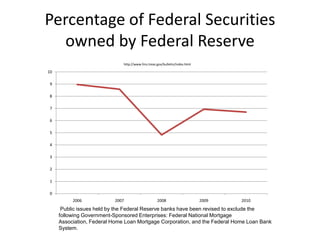
Percentage of Federal Securities owned by Federal Reserve
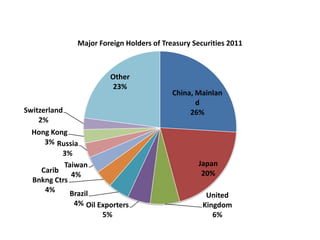
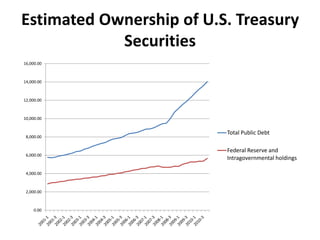
Estimated Ownership of U.S. Treasury Securities
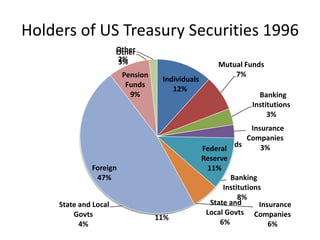
Holders of US Treasury Securities 1996
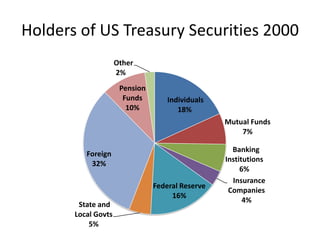
Holders of US Treasury Securities 2000
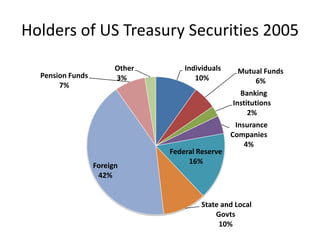
Holders of US Treasury Securities 2005
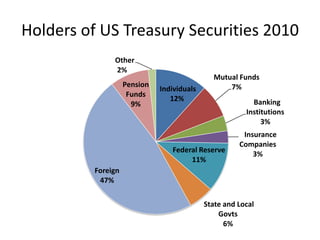
Holders of US Treasury Securities 2010
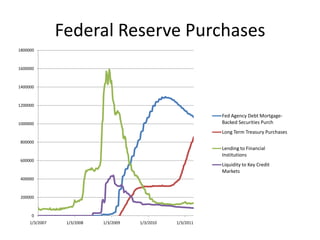
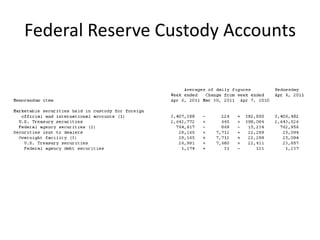
Federal Reserve Purchases

Sss 2011 conference

  • 1.
    The Debt Crisisand Rising InequalityJohn Bradford
  • 2.
    Inequality of Wealthand IncomeDebt and FinancePower and Monetary PowerWho owns the US Debt? (Ourselves)
  • 3.
    Wealth Concentration inthe United StatesDistribution of net worth and financial wealthSource: Domhoff 2011
  • 4.
    Financial Wealth inthe United StatesSource: Domhoff 2011
  • 5.
    Financial Wealth Distribution2007Source: Domhoff 2011
  • 6.
    Income earned bythe top 1% (1970-2010)Source: Picketty and Saez
  • 7.
    Income earned bythe top 1% (1913-2006)
  • 8.
    CEO and WorkerPayCEOs' pay as a multiple of the average worker's pay, 1960-2007Source: Domhoff 2011
  • 9.
    Income Inequality inSelect Countries
  • 10.
  • 12.
    The inordinate Risein DEBTTaken from Monthly Review 2008: Sources: Flow of Funds Accounts of the United States,
  • 13.
  • 14.
  • 15.
  • 16.
  • 17.
  • 18.
  • 19.
  • 20.
  • 21.
  • 22.
  • 23.
  • 24.
  • 25.
    Explaining DebtRemember: borrowing implies a lender. Financial profits rose faster than average, as did financial debts.Principle: To grow, banks must make more loans. Banks lend more money in order to make more money. To make more money, they ended up borrowing more money to lend, or lending borrowed money. LEVERAGE = DEBT: Leverage measures the degree to which assets are funded by borrowed money. 
  • 26.
    Leverage and BankGrowthBanks can make more money in three ways:Borrow at  lower interest rates;Charge higher interest rates;Banks have little control over the first two. Competition between banks for funding enforces some uniformity of interest rates.3. Make more Loans! (aka increase its “Leverage”)
  • 27.
    Increasing LeverageRecall thatBanks have reserve requirements: In reality, all of this reserve does not have to be in the form of cash: it can also be in the form of any asset with a price (i.e. any commodity that can be traded)
  • 28.
    Increasing Leverage2. Nor does this reserve have to be owned by the bank! It can be borrowed (i.e. part of the reserve requirement can come from debt, as opposed to equity)
  • 29.
    Increasing Leverage: ExampleLeverage is calculated by the debt-to-equity ratio: L = D/E.Step 1: L = 90/10 = 9Step 2: L = 100/10 = 10.Increasing “leverage” means borrowing more money.
  • 30.
    Shadow BankingThe BasicIdea Behind ‘Shadow Banking’(aka securitized banking) is that IOUs (e.g. ‘securities’) are traded as money, and banks borrow against IOUs, i.e. use IOUs as collateral.IOUCurrency
  • 31.
    Securitized Banking (sellingand lending loans)Debt is sold to larger banks.These Banks then can either sell these loans again, or they can borrow against them in ‘repurchase agreements’
  • 32.
    Securitized BankingThink of“securities” as IOUs that are in turn traded and passed along, as in a game of ‘hot potato.’
  • 33.
    Loan sales increased,but most were retained
  • 34.
  • 35.
    Bank Runs RevisitedIOUscirculated around as money. Banks that purchased these IOUs (e.g. MBSs) borrowed against them in short-term contracts, using them as collateral to borrow cash.Like a mortgage, this is ‘securitized’ lending, because putting up collateral makes it less risky or more secure (contra the ‘Commercial Paper’ market).
  • 36.
    Bank Runs RevisitedWhenthe value of these securities dropped, because people stopped making their mortgage payments, this (loan to value ratio) was not met. Lenders demanded that they be paid back, or else be given more collateral, i.e. more securities.This is basically a mass withdrawal on the debtors who had to find more securities or sell them to raise more money. The sale in turn caused the prices of these securities to decline even further! The financial panic of 2007-8 was essentially a ‘bank run’ in this secondary ‘repo markets’
  • 37.
    Inequality and Debt: a Link?All money (i.e. Federal Reserve notes) is loaned into existence.Monetary expansion correlates with rising Debt.Because the power to create money is concentrated in a few institutions, inequality will rise if the aggregate interest is not re-circulated in such a way that it can be earned by workers in the form of wages.
  • 38.
    Where does moneycome from?Two Steps:The ‘Fed’ creates new money as debt, from “thin air.”Other private banks then take this new money and create 10x this amount through fractional reserve banking. This process is called the money multiplier process.
  • 39.
    The Federal Reservelending to the US TreasuryIOUs (Bonds)Money as DebtFederal Reserve prints money, from nothing, and pays Treasury.US TreasuryThe Fed
  • 40.
    Federal Reserve lendingto the US TreasuryIOU US Treasury ‘sells’ bonds. (T-Bills)In exchange for money now, Treasury gives IOU’s, to pay back this money, plus interest.TreasuryFederal Reserve and other Private BanksCashWhatever bonds the other banks do not purchase, the Federal Reserve purchases.The Federal Reserve can exercise a power that the Treasury cannot: it can simply print the money from nothing! But it creates this money as debt.
  • 41.
    Why doesn’t theTreasury just print the money?"The study of money, above all other fields in economics, is one in which complexity is used to disguise truth or to evade truth, not to reveal it. The process by which banks create money is so simple the mind is repelled. With something so important, a deeper mystery seems only decent.”John K. Galbraith(1908 – 2006)
  • 42.
    Money as DebtAllnew money is loaned into existence as debt. Because of the application of interest, total debt will always exceed the size of the existing money supply. Total debt, can therefore only be repaid in full by issuing more debt to cover the interest payments. P+INew money created= P<
  • 43.
    Implications: Growthor Die1. The current system functions like a pyramid scheme: growth is a requirement for it to function.2. The trickle-down effect of the pyramid monetary system has not been sufficient to avoid exacerbating income inequality: interest payments have not recycled back into the general population as earned income.
  • 44.
    Power and CapitalismCapitalism= stratified society in which accumulation of wealth fulfills 2 functions (Heilbroner): Realization of prestige (unconscious sexual and emotional needs; Veblen)Expression of power (e.g. what Marx means by ‘self-expanding value’; Nitzan and Bichler ‘Capital as Power’)
  • 45.
    Power and MoneyPower= has to do with the ability to realize wishes, or reach goals …even in the face of opposition (Russell, 1938; Wrong, 1995). Money measures and distributes the power of payment, and payments distribute the power of ownership, including the ownership of money.
  • 47.
    The “Global Poolof Money”This implies that the housing bubble was a result of China, and other countries, saving too much money, which they lend to US banks and financial institutions.
  • 48.
    Foreign holdings of”agency” MBSs (those issued by Fannie Mae, Freddie Mac) = $250 billion (10%) by 2000; $1.5 trillion (23%) by 2008
  • 49.
    2007, net USinternational debt = $2.5 trillion = combined GDP of Latin America and Africa
  • 50.
    ½ of thisdebt is held by developing countriesSource: http://www.treas.gov/tic/mfh.txt
  • 52.
    Percentage of FederalSecurities owned by Federal Reserve
  • 53.
    Estimated Ownership ofU.S. Treasury Securities
  • 54.
    Holders of USTreasury Securities 1996
  • 55.
    Holders of USTreasury Securities 2000
  • 56.
    Holders of USTreasury Securities 2005
  • 57.
    Holders of USTreasury Securities 2010
  • 58.

Editor's Notes

  • #19 In 1998 the total amount of financial borrowing exceeds the total possible.   This is because in that year, the Flow of Funds accounts records that the Federal Government had a surplus of $52.6 Billion.  This number is then deducted from the total, which equals $1005.5 Billion, compared to $1026.8 Billion in financial sector borrowing. 
  • #43 In all major economies, the vast majority of money is created by private banks as debt through the fractional reserve system. In the US, all new money is created by private banks, as debt.
  • #45 More specifically, money via payment confers the power of ownership, which is primarily a social relationship granting an owner the power to exclude everyone else from use of that which is owned. This power depends, in the last instance, on the acceptance or acquiescence of those excluded.
  • #46 More specifically, money via payment confers the power of ownership, which is primarily a social relationship granting an owner the power to exclude everyone else from use of that which is owned. This power depends, in the last instance, on the acceptance or acquiescence of those excluded.
  • #50 Note. – Public issues held by the Federal Reserve banks have been revised to exclude the following Government-Sponsored Enterprises: Federal National Mortgage Association, Federal Home Loan Mortgage Corporation, and the Federal Home Loan Bank System.
  • #52 For the Federal Reserve (aka Monetary Authority) holdings, go to: http://www.federalreserve.gov/releases/z1/current/accessible/l108.htm
  • #53 For the Federal Reserve (aka Monetary Authority) holdings, go to: http://www.federalreserve.gov/releases/z1/current/accessible/l108.htm
  • #54 For the Federal Reserve (aka Monetary Authority) holdings, go to: http://www.federalreserve.gov/releases/z1/current/accessible/l108.htm
  • #55 For the Federal Reserve (aka Monetary Authority) holdings, go to: http://www.federalreserve.gov/releases/z1/current/accessible/l108.htm
  • #56 http://www.clevelandfed.org/research/data/credit_easing/index.cfm