FINANCIAL CONCEPTS
By Linda Langevoort
Macroeconomics Class
Week 3 August 24, 2014
Contents
Financial Markets & Institutions
Financial Intermediaries
Stocks
Bonds
The Deficit
Value of Money Concepts
Dealing with Risks
Standard Deviation Graph
The Dollar and Our Economy
Present Value and Future Value
Compound Interest Formula
References
Financial Markets
& Institutions
Financial markets help to loan money to those who want to
borrow.
Financial institutions are: banks, credit unions and credit
agencies.
Financial institutions are broken down into the stock market
and the bond market.
Financial Intermediaries
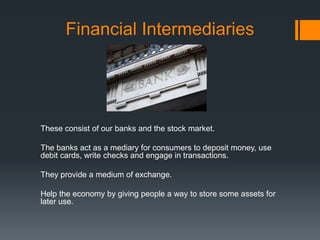
These consist of our banks and the stock market.
The banks act as a mediary for consumers to deposit money, use
debit cards, write checks and engage in transactions.
They provide a medium of exchange.
Help the economy by giving people a way to store some assets for
later use.
Stocks – Pros and Cons
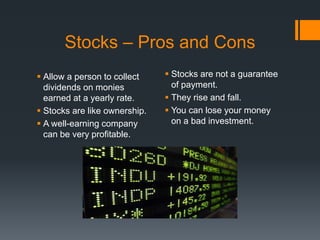
 Allow a person to collect
dividends on monies
earned at a yearly rate.
 Stocks are like ownership.
 A well-earning company
can be very profitable.
 Stocks are not a guarantee
of payment.
 They rise and fall.
 You can lose your money
on a bad investment.
Bonds – Pros and Cons
 Bonds are money invested
 Government bonds prove to
have lower interest rates
and waived tax payments.
 Upon maturity you can cash
them in.
 They are a safe investment.
 Bonds take time to mature
and are not fast cash.
 Stay away from junk bonds
due to high interest rates.
 If you borrow with a bond
and don’t pay it back you
will be in a default situation
and penalties are high
interest rates.
Federal
Government Deficit
• What is it?
• The government
overspends in
relation to tax
revenue, resulting in
a deficit.
• The national debt is
16.7 trillion dollars.
• We are so close to
the ceiling of monies
allowed, that it is time
to pay it back.
• Foreign ownership of
U.S. debt is
benefiting other
countries’
economies.
• More debt, leads to
higher interest rates.
Value of Money
Concepts
Rule #1 – Never lose
money
Rule#2 – Never forget
rule#1.
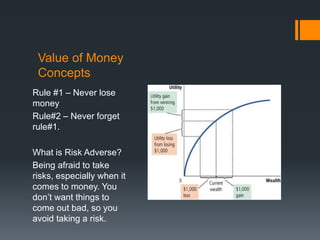
What is Risk Adverse?
Being afraid to take
risks, especially when it
comes to money. You
don’t want things to
come out bad, so you
avoid taking a risk.
Dealing With Risks
The utility function measurement can help a person to
strategize the best use of their money.
Buy some insurance. It will ease your mind from the what ifs in
life.
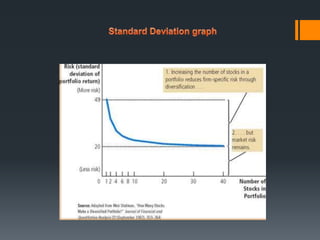
Diversification, called market risk, means we cannot be
absolutely certain of the economy.
Firm specific risk is when you spread out your investments,
so you don’t lose everything to one company if things go
awry.
Standard deviation measurements let one know if there
will be changes in things and how risky it is.
The Dollar & Our Economy
Definition “depreciation”- when a dollar received today is worth
more than a dollar received tomorrow.
Between 2002 and 2004 the dollar depreciated 19.1% against
a bunch of currencies.
Only a part of the dollar’s decline passed through to import
prices.
The U.S. has a lower pass-through rate than most
industrialized countries, because foreign exporters are more
wiling to keep prices to the U.S. consumers constant in order to
maintain market share.
The overall price level is moderate even with this depreciation.
Present Value – how
much money is needed
with normal interest
rates to get a certain
future amount of money.
Future Value – the
amount of money gotten
in the future with the
existing normal interest
rates.
 These values help to
measure the time
value of money and
find out what yields
the best figure for
your dollar.
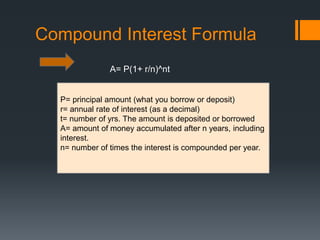
Compound Interest Formula
A= P(1+ r/n)^nt
P= principal amount (what you borrow or deposit)
r= annual rate of interest (as a decimal)
t= number of yrs. The amount is deposited or borrowed
A= amount of money accumulated after n years, including
interest.
n= number of times the interest is compounded per year.
References
Amadeo, K. (2013, September 5). The u.s. debt and how it got so big. Retrieved
from http://useconomy.about.com/od/fiscalpolicy/p/US_Debt.htm
Brainyquote.com. (2001-2014). Warren buffett. Retrieved from
http://www.brainyquote.com/quotes/quotes/w/warrenbuff149683.html
DePaul University. (2009). Compound interest formula. Retrieved from
https://qrc.depaul.edu/StudyGuide2009/Notes/Savings Accounts/Compound
Interest.htm
Investopedia. (2014). Bond. Retrieved from
http://www.investopedia.com/terms/b/bond.asp
Investopedia. (2014). What are the advantages and disadvantages of buying
stocks instead of bonds? Retrieved from
http://www.investopedia.com/ask/answers/124.asp
Mankiw, N. (2014), Principles of economics. 7th Edition. Cengage Learning,
Retrieved from: https://digitalbookshelf.southuniversity.edu
References
Mankiw, N. (Producer). (2014). FIGURE 2 Diversification Reduces
Risk [Print Graphic]. Retrieved from
http://digitalbookshelf.southuniversity.edu/
Mankiw,N. (Producer). (2014). Figure 1- The Utility Function [Web
Graphic]. Retrieved from http://digitalbookshelf.southuniversity.edu/
Norstad, J. (1999). An introduction to utility theory., Retrieved from:
http://www.norstad.org/finance/util.pdf
The Huffington Post. (Producer). (2013, October 14). Confused
About The Deficit? This 2-Minute Video Can Help [Web Video].
Retrieved from Confused About The Deficit? This 2-Minute Video
Can Help
Valderramo, D. (2004, August 13). Does a fall in the dollar mean
higher u.s. consumer prices? Retrieved from
http://www.frbsf.org/economic-research/publications/economic-
letter/2004/august/does-a-fall-in-the-dollar-mean-higher-us-
consumer-prices/
Financial concepts

Financial concepts

  • 1.
    FINANCIAL CONCEPTS By LindaLangevoort Macroeconomics Class Week 3 August 24, 2014
  • 2.
    Contents Financial Markets &Institutions Financial Intermediaries Stocks Bonds The Deficit Value of Money Concepts Dealing with Risks Standard Deviation Graph The Dollar and Our Economy Present Value and Future Value Compound Interest Formula References
  • 3.
    Financial Markets & Institutions Financialmarkets help to loan money to those who want to borrow. Financial institutions are: banks, credit unions and credit agencies. Financial institutions are broken down into the stock market and the bond market.
  • 4.
    Financial Intermediaries These consistof our banks and the stock market. The banks act as a mediary for consumers to deposit money, use debit cards, write checks and engage in transactions. They provide a medium of exchange. Help the economy by giving people a way to store some assets for later use.
  • 5.
    Stocks – Prosand Cons  Allow a person to collect dividends on monies earned at a yearly rate.  Stocks are like ownership.  A well-earning company can be very profitable.  Stocks are not a guarantee of payment.  They rise and fall.  You can lose your money on a bad investment.
  • 6.
    Bonds – Prosand Cons  Bonds are money invested  Government bonds prove to have lower interest rates and waived tax payments.  Upon maturity you can cash them in.  They are a safe investment.  Bonds take time to mature and are not fast cash.  Stay away from junk bonds due to high interest rates.  If you borrow with a bond and don’t pay it back you will be in a default situation and penalties are high interest rates.
  • 7.
    Federal Government Deficit • Whatis it? • The government overspends in relation to tax revenue, resulting in a deficit. • The national debt is 16.7 trillion dollars. • We are so close to the ceiling of monies allowed, that it is time to pay it back. • Foreign ownership of U.S. debt is benefiting other countries’ economies. • More debt, leads to higher interest rates.
  • 8.
    Value of Money Concepts Rule#1 – Never lose money Rule#2 – Never forget rule#1. What is Risk Adverse? Being afraid to take risks, especially when it comes to money. You don’t want things to come out bad, so you avoid taking a risk.
  • 9.
    Dealing With Risks Theutility function measurement can help a person to strategize the best use of their money. Buy some insurance. It will ease your mind from the what ifs in life. Diversification, called market risk, means we cannot be absolutely certain of the economy. Firm specific risk is when you spread out your investments, so you don’t lose everything to one company if things go awry. Standard deviation measurements let one know if there will be changes in things and how risky it is.
  • 11.
    The Dollar &Our Economy Definition “depreciation”- when a dollar received today is worth more than a dollar received tomorrow. Between 2002 and 2004 the dollar depreciated 19.1% against a bunch of currencies. Only a part of the dollar’s decline passed through to import prices. The U.S. has a lower pass-through rate than most industrialized countries, because foreign exporters are more wiling to keep prices to the U.S. consumers constant in order to maintain market share. The overall price level is moderate even with this depreciation.
  • 12.
    Present Value –how much money is needed with normal interest rates to get a certain future amount of money. Future Value – the amount of money gotten in the future with the existing normal interest rates.  These values help to measure the time value of money and find out what yields the best figure for your dollar.
  • 13.
    Compound Interest Formula A=P(1+ r/n)^nt P= principal amount (what you borrow or deposit) r= annual rate of interest (as a decimal) t= number of yrs. The amount is deposited or borrowed A= amount of money accumulated after n years, including interest. n= number of times the interest is compounded per year.
  • 14.
    References Amadeo, K. (2013,September 5). The u.s. debt and how it got so big. Retrieved from http://useconomy.about.com/od/fiscalpolicy/p/US_Debt.htm Brainyquote.com. (2001-2014). Warren buffett. Retrieved from http://www.brainyquote.com/quotes/quotes/w/warrenbuff149683.html DePaul University. (2009). Compound interest formula. Retrieved from https://qrc.depaul.edu/StudyGuide2009/Notes/Savings Accounts/Compound Interest.htm Investopedia. (2014). Bond. Retrieved from http://www.investopedia.com/terms/b/bond.asp Investopedia. (2014). What are the advantages and disadvantages of buying stocks instead of bonds? Retrieved from http://www.investopedia.com/ask/answers/124.asp Mankiw, N. (2014), Principles of economics. 7th Edition. Cengage Learning, Retrieved from: https://digitalbookshelf.southuniversity.edu
  • 15.
    References Mankiw, N. (Producer).(2014). FIGURE 2 Diversification Reduces Risk [Print Graphic]. Retrieved from http://digitalbookshelf.southuniversity.edu/ Mankiw,N. (Producer). (2014). Figure 1- The Utility Function [Web Graphic]. Retrieved from http://digitalbookshelf.southuniversity.edu/ Norstad, J. (1999). An introduction to utility theory., Retrieved from: http://www.norstad.org/finance/util.pdf The Huffington Post. (Producer). (2013, October 14). Confused About The Deficit? This 2-Minute Video Can Help [Web Video]. Retrieved from Confused About The Deficit? This 2-Minute Video Can Help Valderramo, D. (2004, August 13). Does a fall in the dollar mean higher u.s. consumer prices? Retrieved from http://www.frbsf.org/economic-research/publications/economic- letter/2004/august/does-a-fall-in-the-dollar-mean-higher-us- consumer-prices/