The Money Market Graph and the 3 Policy Tools that Change the Money Supply Monetary Policy
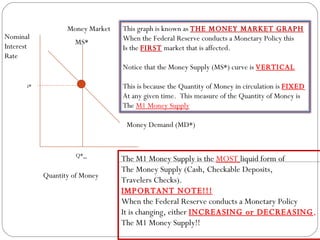
Money Market MS* i* Money Demand (MD*) Q* ms Nominal Interest Rate Quantity of Money The M1 Money Supply is the  MOST  liquid form of  The Money Supply (Cash, Checkable Deposits,  Travelers Checks).  IMPORTANT NOTE!!! When the Federal Reserve conducts a Monetary Policy It is changing, either  INCREASING or DECREASING ,  The M1 Money Supply!! This graph is known as  THE MONEY MARKET GRAPH When the Federal Reserve conducts a Monetary Policy this  Is the  FIRST  market that is affected. Notice that the Money Supply (MS*) curve is  VERTICAL This is because the Quantity of Money in circulation is  FIXED   At any given time.  This measure of the Quantity of Money is  The  M1 Money Supply
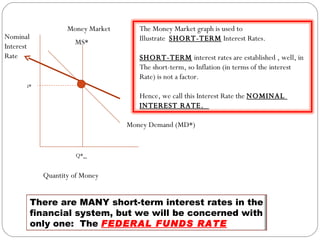
Money Market MS* i* Money Demand (MD*) Q* ms Nominal Interest Rate Quantity of Money The Money Market graph is used to  Illustrate  SHORT-TERM  Interest Rates. SHORT-TERM  interest rates are established , well, in  The short-term, so Inflation (in terms of the interest  Rate) is not a factor. Hence, we call this Interest Rate the  NOMINAL  INTEREST RATE.  There are MANY short-term interest rates in the financial system, but we will be concerned with only one:  The  FEDERAL FUNDS RATE
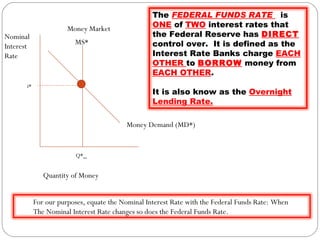
Money Market MS* i* Money Demand (MD*) Q* ms Nominal Interest Rate Quantity of Money The  FEDERAL FUNDS RATE  is  ONE  of  TWO  interest rates that the Federal Reserve has  DIRECT  control over.  It is defined as the Interest Rate Banks charge  EACH OTHER  to  BORROW  money from  EACH OTHER .  It is also know as the  Overnight Lending Rate. For our purposes, equate the Nominal Interest Rate with the Federal Funds Rate: When  The Nominal Interest Rate changes so does the Federal Funds Rate.
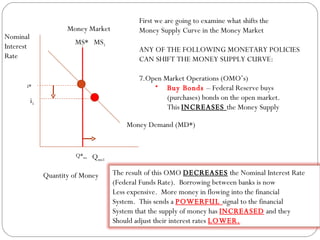
Money Market MS* i* Money Demand (MD*) Q* ms Nominal Interest Rate Quantity of Money First we are going to examine what shifts the  Money Supply Curve in the Money Market ANY OF THE FOLLOWING MONETARY POLICIES  CAN SHIFT THE MONEY SUPPLY CURVE: Open Market Operations (OMO’s) Buy Bonds  – Federal Reserve buys  (purchases) bonds on the open market.  This  INCREASES  the Money Supply i 1 Q ms1 MS 1 The result of this OMO  DECREASES  the Nominal Interest Rate (Federal Funds Rate).  Borrowing between banks is now  Less expensive.  More money in flowing into the financial System.  This sends a  POWERFUL  signal to the financial  System that the supply of money has  INCREASED  and they  Should adjust their interest rates  LOWER.
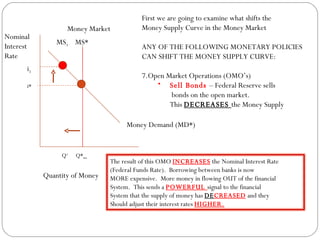
Money Market MS* i* Money Demand (MD*) Q* ms Nominal Interest Rate Quantity of Money First we are going to examine what shifts the  Money Supply Curve in the Money Market ANY OF THE FOLLOWING MONETARY POLICIES  CAN SHIFT THE MONEY SUPPLY CURVE: Open Market Operations (OMO’s) Sell Bonds  – Federal Reserve sells    bonds on the open market.  This  DECREASES  the Money Supply i 1 Q 1 MS 1 The result of this OMO  INCREASES  the Nominal Interest Rate (Federal Funds Rate).  Borrowing between banks is now  MORE expensive.  More money in flowing OUT of the financial System.  This sends a  POWERFUL  signal to the financial  System that the supply of money has  DE CREASED  and they  Should adjust their interest rates  HIGHER.
Money Market MS* i* Money Demand (MD*) Q* ms Nominal Interest Rate Quantity of Money First we are going to examine what shifts the  Money Supply Curve in the Money Market ANY OF THE FOLLOWING MONETARY POLICIES  CAN SHIFT THE MONEY SUPPLY CURVE: Change the  DISCOUNT RATE The Discount Rate is the Interest Rate the Federal Reserve charges banks to  BORROW FROM  the Federal Reserve. i 1 MS 1 Q ms1 If the Federal Reserve  DECREASES  the Discount Rate then Banks will tend to  BORROW MORE  From the Federal Reserve.  This money will  Go into the banks  EXCESS RESERVES  to be loaned Out and the money supply will  INCREASE. THE NOMINAL INTEREST RATE WILL DECREASE
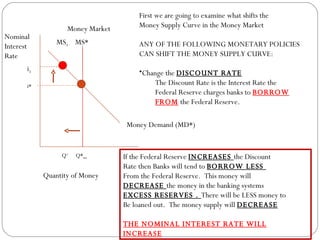
Money Market MS* i* Money Demand (MD*) Q* ms Nominal Interest Rate Quantity of Money i 1 Q 1 If the Federal Reserve  INCREASES  the Discount Rate then Banks will tend to  BORROW LESS  From the Federal Reserve.  This money will  DECREASE  the money in the banking systems  EXCESS RESERVES .  There will be LESS money to Be loaned out.  The money supply will  DECREASE THE NOMINAL INTEREST RATE WILL INCREASE First we are going to examine what shifts the  Money Supply Curve in the Money Market ANY OF THE FOLLOWING MONETARY POLICIES  CAN SHIFT THE MONEY SUPPLY CURVE: Change the  DISCOUNT RATE The Discount Rate is the Interest Rate the Federal Reserve charges banks to  BORROW FROM  the Federal Reserve. MS 1
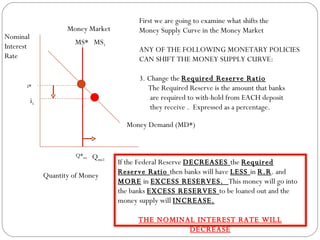
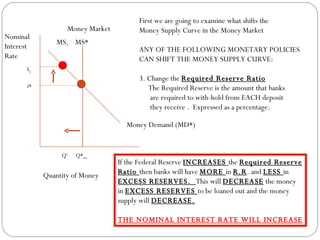
Money Market MS* i* Money Demand (MD*) Q* ms Nominal Interest Rate Quantity of Money First we are going to examine what shifts the  Money Supply Curve in the Money Market ANY OF THE FOLLOWING MONETARY POLICIES  CAN SHIFT THE MONEY SUPPLY CURVE: 3. Change the  Required Reserve Ratio The Required Reserve is the amount that banks are required to with-hold from EACH deposit  they receive .  Expressed as a percentage. i 1 Q ms1 MS 1 If the Federal Reserve  DECREASES  the  Required Reserve Ratio  then banks will have  LESS  in  R.R . and  MORE  in  EXCESS RESERVES.  This money will go into the banks  EXCESS RESERVES  to be loaned out and the money supply will  INCREASE. THE NOMINAL INTEREST RATE WILL DECREASE
Money Market MS* i* Money Demand (MD*) Q* ms Nominal Interest Rate Quantity of Money i 1 Q 1 First we are going to examine what shifts the  Money Supply Curve in the Money Market ANY OF THE FOLLOWING MONETARY POLICIES  CAN SHIFT THE MONEY SUPPLY CURVE: 3. Change the  Required Reserve Ratio The Required Reserve is the amount that banks are required to with-hold from EACH deposit  they receive .  Expressed as a percentage. MS 1 If the Federal Reserve  INCREASES  the  Required Reserve Ratio  then banks will have  MORE  in  R.R . and  LESS  in  EXCESS RESERVES.  This will  DECREASE  the money in  EXCESS RESERVES  to be loaned out and the money supply will  DECREASE. THE NOMINAL INTEREST RATE WILL INCREASE
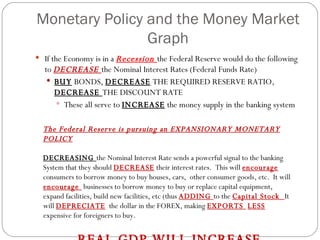
Monetary Policy and the Money Market Graph If the Economy is in a  Recession  the Federal Reserve would do the following to  DECREASE  the Nominal Interest Rates (Federal Funds Rate) BUY  BONDS,  DECREASE  THE REQUIRED RESERVE RATIO,  DECREASE  THE DISCOUNT RATE These all serve to  INCREASE  the money supply in the banking system The Federal Reserve is pursuing an EXPANSIONARY MONETARY POLICY DECREASING  the Nominal Interest Rate sends a powerful signal to the banking System that they should  DECREASE  their interest rates.  This will  encourage  consumers to borrow money to buy houses, cars,  other consumer goods, etc.  It will  encourage  businesses to borrow money to buy or replace capital equipment, expand facilities, build new facilities, etc (thus  ADDING  to the  Capital Stock  It will  DEPRECIATE   the dollar in the FOREX, making  EXPORTS  LESS  expensive for foreigners to buy. REAL GDP WILL INCREASE
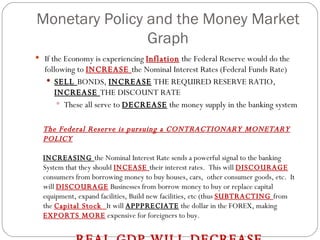
Monetary Policy and the Money Market Graph If the Economy is experiencing  Inflation  the Federal Reserve would do the following to  INCREASE  the Nominal Interest Rates (Federal Funds Rate) SELL  BONDS,  INCREASE  THE REQUIRED RESERVE RATIO,  INCREASE  THE DISCOUNT RATE These all serve to  DECREASE  the money supply in the banking system The Federal Reserve is pursuing a CONTRACTIONARY MONETARY POLICY INCREASING  the Nominal Interest Rate sends a powerful signal to the banking System that they should  INCEASE  their interest rates.  This will  DISCOURAGE  consumers from borrowing money to buy houses, cars,  other consumer goods, etc.  It will  DISCOURAGE  Businesses from borrow money to buy or replace capital equipment, expand facilities, Build new facilities, etc (thus  SUBTRACTING  from the  Capital Stock  It will  APPPRECIATE  the dollar in the FOREX, making  EXPORTS MORE   expensive for foreigners to buy. REAL GDP WILL DECREASE
Money Market MS* i* Money Demand (MD*) Q* ms Nominal Interest Rate Quantity of Money

Money Market Graph 2003

  • 1.
    The Money MarketGraph and the 3 Policy Tools that Change the Money Supply Monetary Policy
  • 2.
    Money Market MS*i* Money Demand (MD*) Q* ms Nominal Interest Rate Quantity of Money The M1 Money Supply is the MOST liquid form of The Money Supply (Cash, Checkable Deposits, Travelers Checks). IMPORTANT NOTE!!! When the Federal Reserve conducts a Monetary Policy It is changing, either INCREASING or DECREASING , The M1 Money Supply!! This graph is known as THE MONEY MARKET GRAPH When the Federal Reserve conducts a Monetary Policy this Is the FIRST market that is affected. Notice that the Money Supply (MS*) curve is VERTICAL This is because the Quantity of Money in circulation is FIXED At any given time. This measure of the Quantity of Money is The M1 Money Supply
  • 3.
    Money Market MS*i* Money Demand (MD*) Q* ms Nominal Interest Rate Quantity of Money The Money Market graph is used to Illustrate SHORT-TERM Interest Rates. SHORT-TERM interest rates are established , well, in The short-term, so Inflation (in terms of the interest Rate) is not a factor. Hence, we call this Interest Rate the NOMINAL INTEREST RATE. There are MANY short-term interest rates in the financial system, but we will be concerned with only one: The FEDERAL FUNDS RATE
  • 4.
    Money Market MS*i* Money Demand (MD*) Q* ms Nominal Interest Rate Quantity of Money The FEDERAL FUNDS RATE is ONE of TWO interest rates that the Federal Reserve has DIRECT control over. It is defined as the Interest Rate Banks charge EACH OTHER to BORROW money from EACH OTHER . It is also know as the Overnight Lending Rate. For our purposes, equate the Nominal Interest Rate with the Federal Funds Rate: When The Nominal Interest Rate changes so does the Federal Funds Rate.
  • 5.
    Money Market MS*i* Money Demand (MD*) Q* ms Nominal Interest Rate Quantity of Money First we are going to examine what shifts the Money Supply Curve in the Money Market ANY OF THE FOLLOWING MONETARY POLICIES CAN SHIFT THE MONEY SUPPLY CURVE: Open Market Operations (OMO’s) Buy Bonds – Federal Reserve buys (purchases) bonds on the open market. This INCREASES the Money Supply i 1 Q ms1 MS 1 The result of this OMO DECREASES the Nominal Interest Rate (Federal Funds Rate). Borrowing between banks is now Less expensive. More money in flowing into the financial System. This sends a POWERFUL signal to the financial System that the supply of money has INCREASED and they Should adjust their interest rates LOWER.
  • 6.
    Money Market MS*i* Money Demand (MD*) Q* ms Nominal Interest Rate Quantity of Money First we are going to examine what shifts the Money Supply Curve in the Money Market ANY OF THE FOLLOWING MONETARY POLICIES CAN SHIFT THE MONEY SUPPLY CURVE: Open Market Operations (OMO’s) Sell Bonds – Federal Reserve sells bonds on the open market. This DECREASES the Money Supply i 1 Q 1 MS 1 The result of this OMO INCREASES the Nominal Interest Rate (Federal Funds Rate). Borrowing between banks is now MORE expensive. More money in flowing OUT of the financial System. This sends a POWERFUL signal to the financial System that the supply of money has DE CREASED and they Should adjust their interest rates HIGHER.
  • 7.
    Money Market MS*i* Money Demand (MD*) Q* ms Nominal Interest Rate Quantity of Money First we are going to examine what shifts the Money Supply Curve in the Money Market ANY OF THE FOLLOWING MONETARY POLICIES CAN SHIFT THE MONEY SUPPLY CURVE: Change the DISCOUNT RATE The Discount Rate is the Interest Rate the Federal Reserve charges banks to BORROW FROM the Federal Reserve. i 1 MS 1 Q ms1 If the Federal Reserve DECREASES the Discount Rate then Banks will tend to BORROW MORE From the Federal Reserve. This money will Go into the banks EXCESS RESERVES to be loaned Out and the money supply will INCREASE. THE NOMINAL INTEREST RATE WILL DECREASE
  • 8.
    Money Market MS*i* Money Demand (MD*) Q* ms Nominal Interest Rate Quantity of Money i 1 Q 1 If the Federal Reserve INCREASES the Discount Rate then Banks will tend to BORROW LESS From the Federal Reserve. This money will DECREASE the money in the banking systems EXCESS RESERVES . There will be LESS money to Be loaned out. The money supply will DECREASE THE NOMINAL INTEREST RATE WILL INCREASE First we are going to examine what shifts the Money Supply Curve in the Money Market ANY OF THE FOLLOWING MONETARY POLICIES CAN SHIFT THE MONEY SUPPLY CURVE: Change the DISCOUNT RATE The Discount Rate is the Interest Rate the Federal Reserve charges banks to BORROW FROM the Federal Reserve. MS 1
  • 9.
    Money Market MS*i* Money Demand (MD*) Q* ms Nominal Interest Rate Quantity of Money First we are going to examine what shifts the Money Supply Curve in the Money Market ANY OF THE FOLLOWING MONETARY POLICIES CAN SHIFT THE MONEY SUPPLY CURVE: 3. Change the Required Reserve Ratio The Required Reserve is the amount that banks are required to with-hold from EACH deposit they receive . Expressed as a percentage. i 1 Q ms1 MS 1 If the Federal Reserve DECREASES the Required Reserve Ratio then banks will have LESS in R.R . and MORE in EXCESS RESERVES. This money will go into the banks EXCESS RESERVES to be loaned out and the money supply will INCREASE. THE NOMINAL INTEREST RATE WILL DECREASE
  • 10.
    Money Market MS*i* Money Demand (MD*) Q* ms Nominal Interest Rate Quantity of Money i 1 Q 1 First we are going to examine what shifts the Money Supply Curve in the Money Market ANY OF THE FOLLOWING MONETARY POLICIES CAN SHIFT THE MONEY SUPPLY CURVE: 3. Change the Required Reserve Ratio The Required Reserve is the amount that banks are required to with-hold from EACH deposit they receive . Expressed as a percentage. MS 1 If the Federal Reserve INCREASES the Required Reserve Ratio then banks will have MORE in R.R . and LESS in EXCESS RESERVES. This will DECREASE the money in EXCESS RESERVES to be loaned out and the money supply will DECREASE. THE NOMINAL INTEREST RATE WILL INCREASE
  • 11.
    Monetary Policy andthe Money Market Graph If the Economy is in a Recession the Federal Reserve would do the following to DECREASE the Nominal Interest Rates (Federal Funds Rate) BUY BONDS, DECREASE THE REQUIRED RESERVE RATIO, DECREASE THE DISCOUNT RATE These all serve to INCREASE the money supply in the banking system The Federal Reserve is pursuing an EXPANSIONARY MONETARY POLICY DECREASING the Nominal Interest Rate sends a powerful signal to the banking System that they should DECREASE their interest rates. This will encourage consumers to borrow money to buy houses, cars, other consumer goods, etc. It will encourage businesses to borrow money to buy or replace capital equipment, expand facilities, build new facilities, etc (thus ADDING to the Capital Stock It will DEPRECIATE the dollar in the FOREX, making EXPORTS LESS expensive for foreigners to buy. REAL GDP WILL INCREASE
  • 12.
    Monetary Policy andthe Money Market Graph If the Economy is experiencing Inflation the Federal Reserve would do the following to INCREASE the Nominal Interest Rates (Federal Funds Rate) SELL BONDS, INCREASE THE REQUIRED RESERVE RATIO, INCREASE THE DISCOUNT RATE These all serve to DECREASE the money supply in the banking system The Federal Reserve is pursuing a CONTRACTIONARY MONETARY POLICY INCREASING the Nominal Interest Rate sends a powerful signal to the banking System that they should INCEASE their interest rates. This will DISCOURAGE consumers from borrowing money to buy houses, cars, other consumer goods, etc. It will DISCOURAGE Businesses from borrow money to buy or replace capital equipment, expand facilities, Build new facilities, etc (thus SUBTRACTING from the Capital Stock It will APPPRECIATE the dollar in the FOREX, making EXPORTS MORE expensive for foreigners to buy. REAL GDP WILL DECREASE
  • 13.
    Money Market MS*i* Money Demand (MD*) Q* ms Nominal Interest Rate Quantity of Money