MONETARY POLICYS IN INDIA
BY,
MATHEW .V . JOSEPH
MBA
MARIAN COLLEGE,KUTTIKANAM,
KERALA
Monetary policy of India
Monetary policy is the process by which monetary authority
of a country , generally central bank controls the supply of
money in the economy by its control over interest rates in
order to maintain price stability and achieve high economic
growth. In India, the central monetary authority is
the Reserve Bank of India (RBI). It is so designed as to
maintain the price stability in the economy.
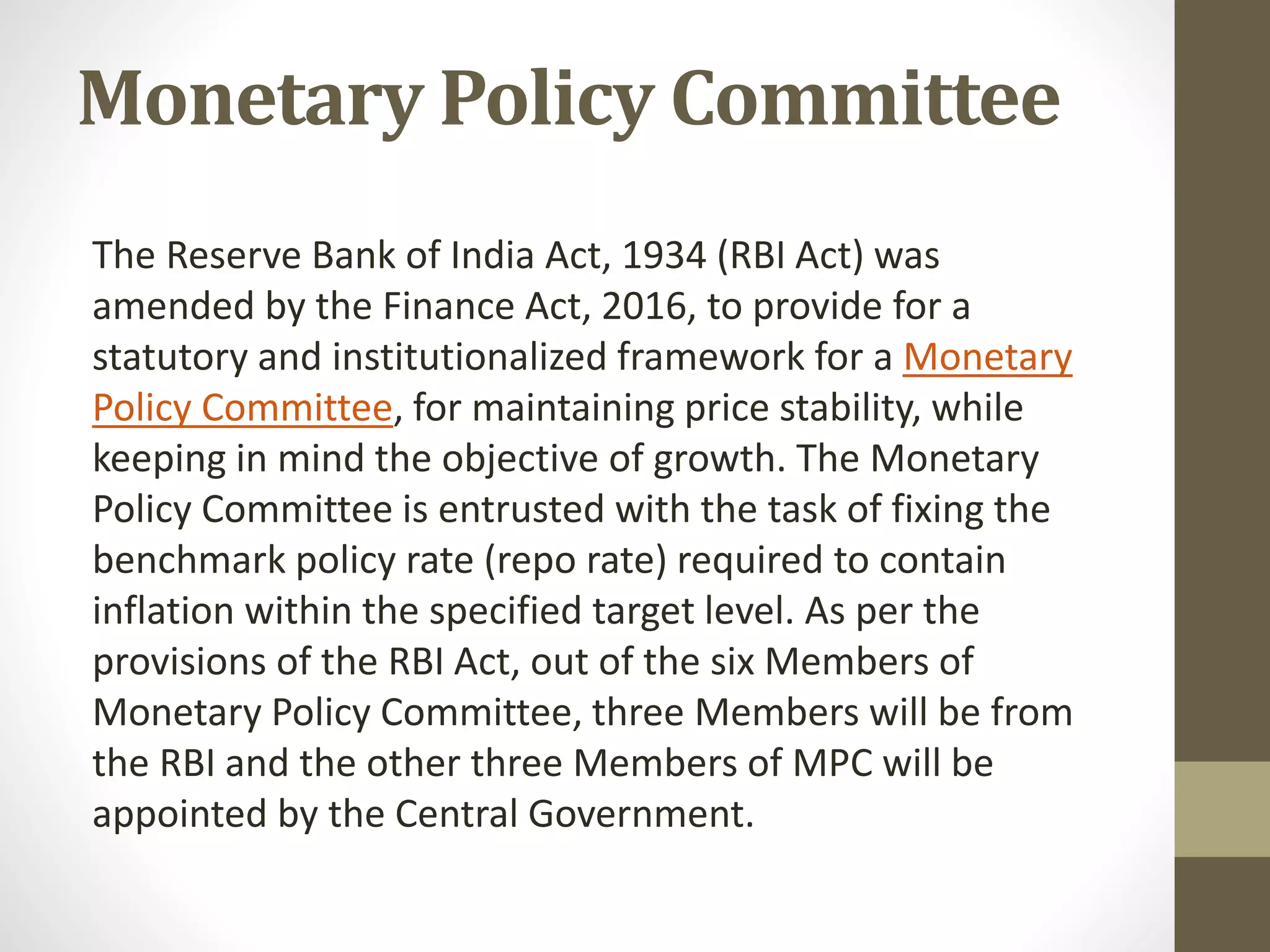
Monetary Policy Committee
The Reserve Bank of India Act, 1934 (RBI Act) was
amended by the Finance Act, 2016, to provide for a
statutory and institutionalized framework for a Monetary
Policy Committee, for maintaining price stability, while
keeping in mind the objective of growth. The Monetary
Policy Committee is entrusted with the task of fixing the
benchmark policy rate (repo rate) required to contain
inflation within the specified target level. As per the
provisions of the RBI Act, out of the six Members of
Monetary Policy Committee, three Members will be from
the RBI and the other three Members of MPC will be
appointed by the Central Government.
Objectives of the monetary policy
of India, as stated by RBI
• Price Stability
Price Stability implies promoting economic development with
considerable emphasis on price stability. The centre of focus is
to facilitate the environment which is favourable to the
architecture that enables the developmental projects to run
swiftly while also maintaining reasonable price stability.
• Controlled Expansion Of Bank Credit
One of the important functions of RBI is the controlled
expansion of bank credit and money supply with special
attention to seasonal requirement for credit without affecting
the output.
• .
• Restriction of Inventories and stocks
Overfilling of stocks and products becoming outdated due to
excess of stock often results in sickness of the unit. To avoid this
problem the central monetary authority carries out this
essential function of restricting the inventories. The main
objective of this policy is to avoid over-stocking and idle money
in the organization.
• To Promote Efficiency
It is another essential aspect where the central banks pay a lot
of attention. It tries to increase the efficiency in the financial
system and tries to incorporate structural changes such as
deregulating interest rates, ease operational constraints in the
credit delivery system, to introduce new money market
instruments etc.
• Reducing the Rigidity
• RBI tries to bring about the flexibilities in the operations which
provide a considerable autonomy. It encourages more
competitive environment and diversification. It maintains its
control over financial system whenever and wherever
necessary to maintain the discipline and prudence in
operations of the financial system.
• Promotion of Fixed Investment
The aim here is to increase the productivity of investment by
restraining non essential fixed investment
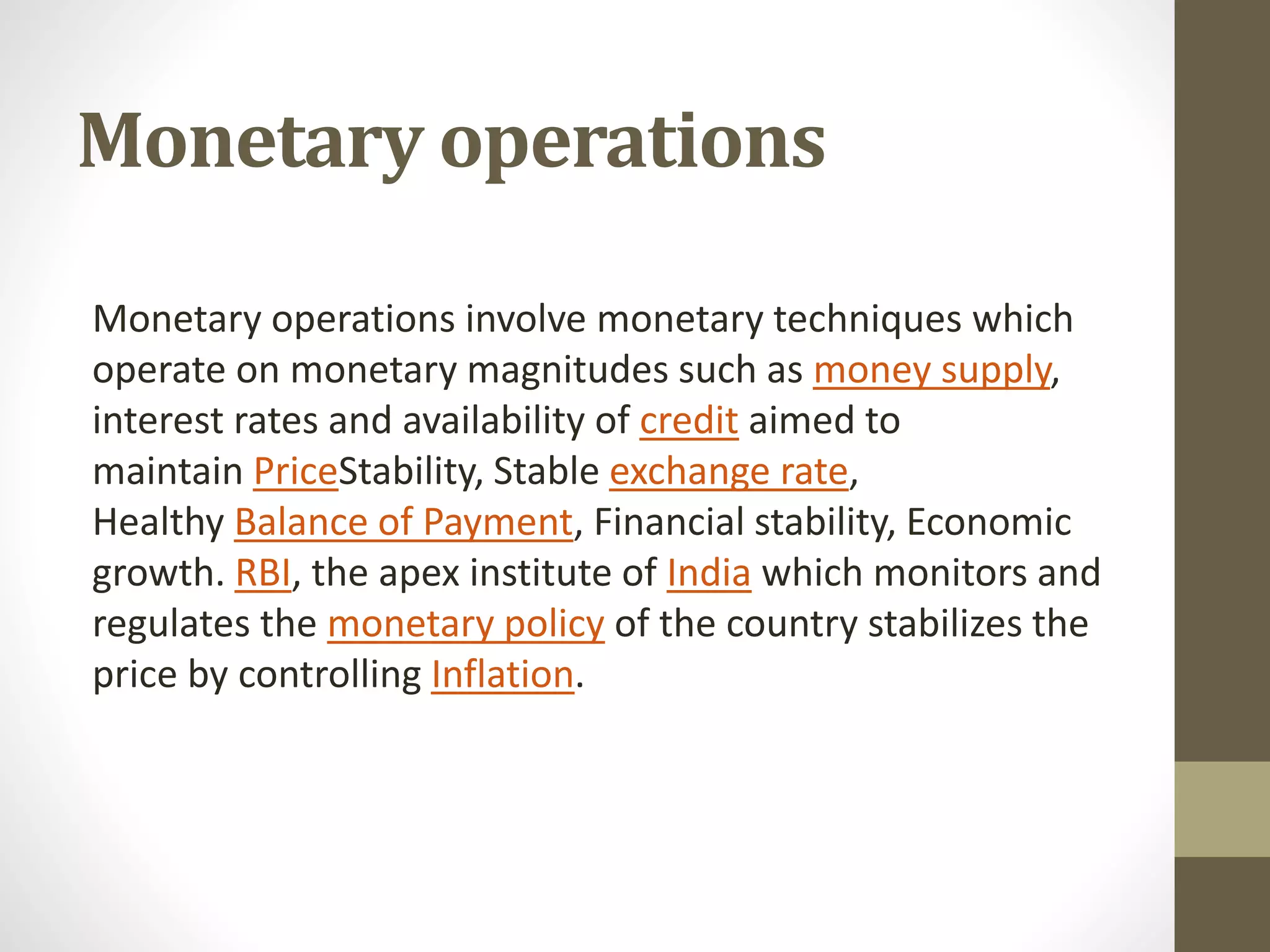
Monetary operations
Monetary operations involve monetary techniques which
operate on monetary magnitudes such as money supply,
interest rates and availability of credit aimed to
maintain PriceStability, Stable exchange rate,
Healthy Balance of Payment, Financial stability, Economic
growth. RBI, the apex institute of India which monitors and
regulates the monetary policy of the country stabilizes the
price by controlling Inflation.
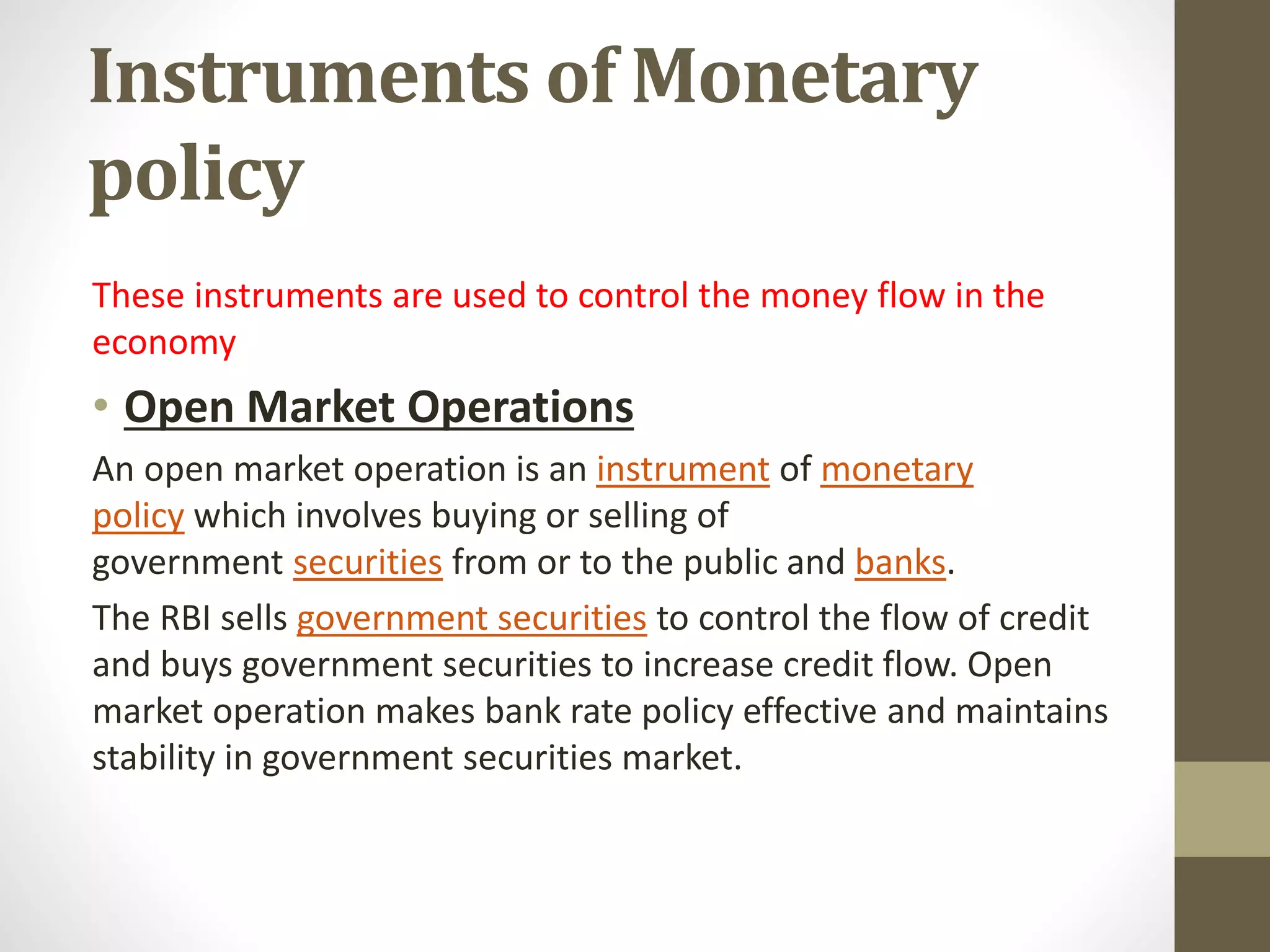
Instruments of Monetary
policy
These instruments are used to control the money flow in the
economy
• Open Market Operations
An open market operation is an instrument of monetary
policy which involves buying or selling of
government securities from or to the public and banks.
The RBI sells government securities to control the flow of credit
and buys government securities to increase credit flow. Open
market operation makes bank rate policy effective and maintains
stability in government securities market.
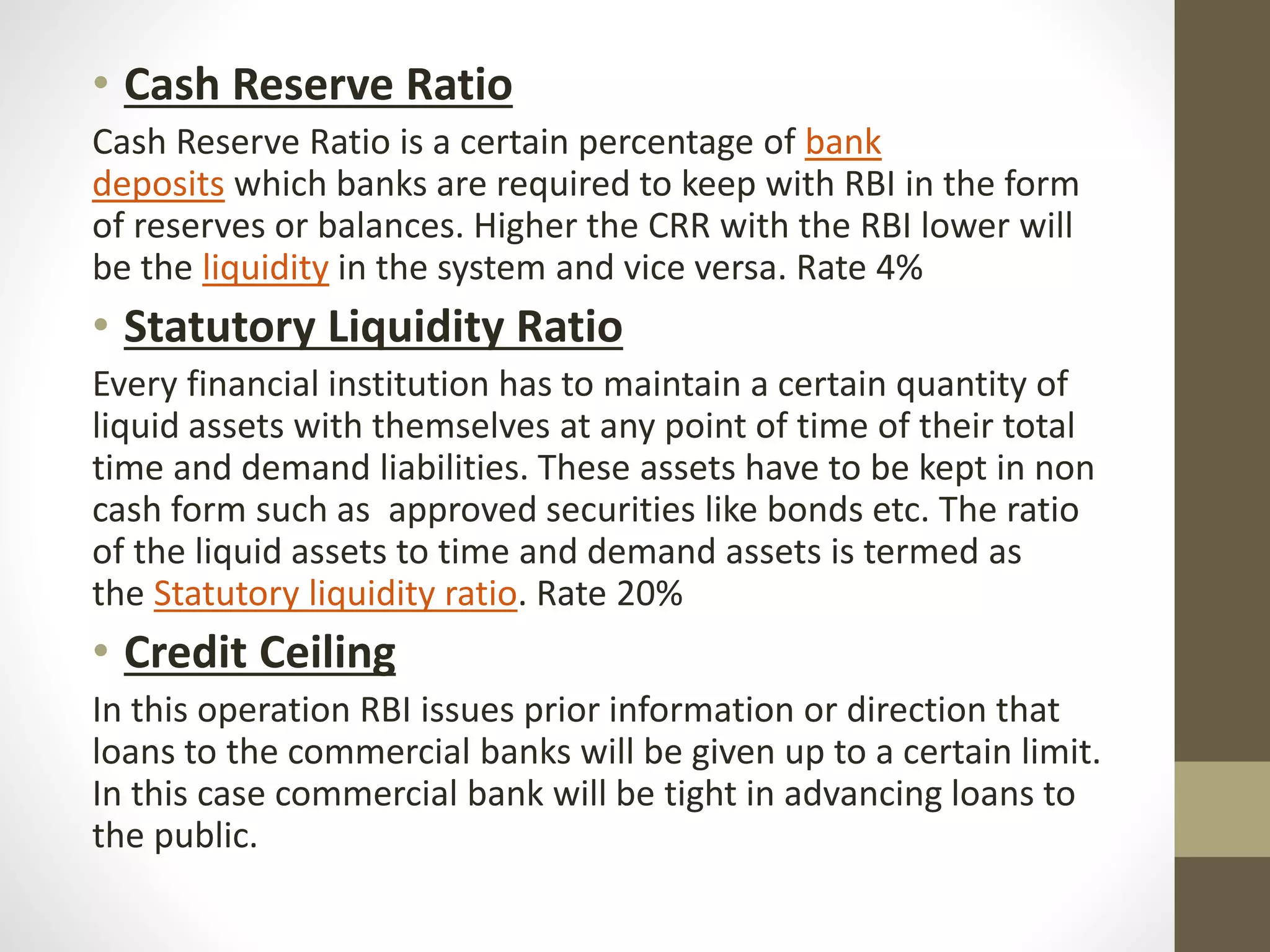
• Cash Reserve Ratio
Cash Reserve Ratio is a certain percentage of bank
deposits which banks are required to keep with RBI in the form
of reserves or balances. Higher the CRR with the RBI lower will
be the liquidity in the system and vice versa. Rate 4%
• Statutory Liquidity Ratio
Every financial institution has to maintain a certain quantity of
liquid assets with themselves at any point of time of their total
time and demand liabilities. These assets have to be kept in non
cash form such as approved securities like bonds etc. The ratio
of the liquid assets to time and demand assets is termed as
the Statutory liquidity ratio. Rate 20%
• Credit Ceiling
In this operation RBI issues prior information or direction that
loans to the commercial banks will be given up to a certain limit.
In this case commercial bank will be tight in advancing loans to
the public.
• Bank Rate Policy
The bank rate, also known as the discount rate, is the rate of
interest charged by the RBI for providing funds or loans to the
banking system. This banking system involves commercial and
co-operative banks, Industrial Development Bank of
India, IFC, EXIM Bank, and other approved financial institutes.
• Credit Authorization Scheme
Credit Authorization Scheme was introduced in November, 1965
when P C Bhattacharya was the chairman of RBI. Under this
instrument of credit regulation RBI as per the guideline
authorizes the banks to advance loans to desired sectors.
• Moral Suasion
Moral Suasion is just as a request by the RBI to the commercial
banks to take so and so action and measures in so and so trend
of the economy. RBI may request commercial banks not to give
loans for unproductive purpose which does not add to economic
growth but increases inflation.
• Repo Rate and Reverse Repo Rate
Repo rate is the rate at which RBI lends to its clients generally
against government securities. Reduction in Repo rate helps the
commercial banks to get money at a cheaper rate and increase
in Repo rate discourages the commercial banks to get money as
the rate increases and becomes expensive. Reverse Repo rate is
the rate at which RBI borrows money from the commercial
banks.
Repo rate- 6.0%
Reverse Repo rate- 5.75%

Monetary policy in india

  • 1.
    MONETARY POLICYS ININDIA BY, MATHEW .V . JOSEPH MBA MARIAN COLLEGE,KUTTIKANAM, KERALA
  • 2.
    Monetary policy ofIndia Monetary policy is the process by which monetary authority of a country , generally central bank controls the supply of money in the economy by its control over interest rates in order to maintain price stability and achieve high economic growth. In India, the central monetary authority is the Reserve Bank of India (RBI). It is so designed as to maintain the price stability in the economy.
  • 3.
    Monetary Policy Committee TheReserve Bank of India Act, 1934 (RBI Act) was amended by the Finance Act, 2016, to provide for a statutory and institutionalized framework for a Monetary Policy Committee, for maintaining price stability, while keeping in mind the objective of growth. The Monetary Policy Committee is entrusted with the task of fixing the benchmark policy rate (repo rate) required to contain inflation within the specified target level. As per the provisions of the RBI Act, out of the six Members of Monetary Policy Committee, three Members will be from the RBI and the other three Members of MPC will be appointed by the Central Government.
  • 4.
    Objectives of themonetary policy of India, as stated by RBI • Price Stability Price Stability implies promoting economic development with considerable emphasis on price stability. The centre of focus is to facilitate the environment which is favourable to the architecture that enables the developmental projects to run swiftly while also maintaining reasonable price stability. • Controlled Expansion Of Bank Credit One of the important functions of RBI is the controlled expansion of bank credit and money supply with special attention to seasonal requirement for credit without affecting the output.
  • 5.
    • . • Restrictionof Inventories and stocks Overfilling of stocks and products becoming outdated due to excess of stock often results in sickness of the unit. To avoid this problem the central monetary authority carries out this essential function of restricting the inventories. The main objective of this policy is to avoid over-stocking and idle money in the organization. • To Promote Efficiency It is another essential aspect where the central banks pay a lot of attention. It tries to increase the efficiency in the financial system and tries to incorporate structural changes such as deregulating interest rates, ease operational constraints in the credit delivery system, to introduce new money market instruments etc.
  • 6.
    • Reducing theRigidity • RBI tries to bring about the flexibilities in the operations which provide a considerable autonomy. It encourages more competitive environment and diversification. It maintains its control over financial system whenever and wherever necessary to maintain the discipline and prudence in operations of the financial system. • Promotion of Fixed Investment The aim here is to increase the productivity of investment by restraining non essential fixed investment
  • 7.
    Monetary operations Monetary operationsinvolve monetary techniques which operate on monetary magnitudes such as money supply, interest rates and availability of credit aimed to maintain PriceStability, Stable exchange rate, Healthy Balance of Payment, Financial stability, Economic growth. RBI, the apex institute of India which monitors and regulates the monetary policy of the country stabilizes the price by controlling Inflation.
  • 8.
    Instruments of Monetary policy Theseinstruments are used to control the money flow in the economy • Open Market Operations An open market operation is an instrument of monetary policy which involves buying or selling of government securities from or to the public and banks. The RBI sells government securities to control the flow of credit and buys government securities to increase credit flow. Open market operation makes bank rate policy effective and maintains stability in government securities market.
  • 9.
    • Cash ReserveRatio Cash Reserve Ratio is a certain percentage of bank deposits which banks are required to keep with RBI in the form of reserves or balances. Higher the CRR with the RBI lower will be the liquidity in the system and vice versa. Rate 4% • Statutory Liquidity Ratio Every financial institution has to maintain a certain quantity of liquid assets with themselves at any point of time of their total time and demand liabilities. These assets have to be kept in non cash form such as approved securities like bonds etc. The ratio of the liquid assets to time and demand assets is termed as the Statutory liquidity ratio. Rate 20% • Credit Ceiling In this operation RBI issues prior information or direction that loans to the commercial banks will be given up to a certain limit. In this case commercial bank will be tight in advancing loans to the public.
  • 10.
    • Bank RatePolicy The bank rate, also known as the discount rate, is the rate of interest charged by the RBI for providing funds or loans to the banking system. This banking system involves commercial and co-operative banks, Industrial Development Bank of India, IFC, EXIM Bank, and other approved financial institutes. • Credit Authorization Scheme Credit Authorization Scheme was introduced in November, 1965 when P C Bhattacharya was the chairman of RBI. Under this instrument of credit regulation RBI as per the guideline authorizes the banks to advance loans to desired sectors. • Moral Suasion Moral Suasion is just as a request by the RBI to the commercial banks to take so and so action and measures in so and so trend of the economy. RBI may request commercial banks not to give loans for unproductive purpose which does not add to economic growth but increases inflation.
  • 11.
    • Repo Rateand Reverse Repo Rate Repo rate is the rate at which RBI lends to its clients generally against government securities. Reduction in Repo rate helps the commercial banks to get money at a cheaper rate and increase in Repo rate discourages the commercial banks to get money as the rate increases and becomes expensive. Reverse Repo rate is the rate at which RBI borrows money from the commercial banks. Repo rate- 6.0% Reverse Repo rate- 5.75%