USE CASE
Mondragon University
Felix Larrinaga
flarrinaga@mondragon.edu
Mondragon University
Spanish Partner
• University Part of Mondragon Corporation (www.mcc.es) 85.000 workers (85%
members) Sectors: Finance, industry, distribution, engineering & services and
education
• University organizes with different agents from the Corporation contexts that
involve private and public collaboration.
• 3 topics- 3 contests/waves per year.
• Objectives: 1. Promote entrepreneurship among students by collecting ideas
on the creation of new enterprises or business models. (Spin-Offs)
2.Accelerate knowledge transfer from university to business.
• Methodology: Each year improvements are introduced to impact on different
aspects (participation, co-creation, marketing, …). Outcome is measured by
means of KPIs.
• Launched in 2010. Idea Management System (IMS) (Innowave) used since 2011.
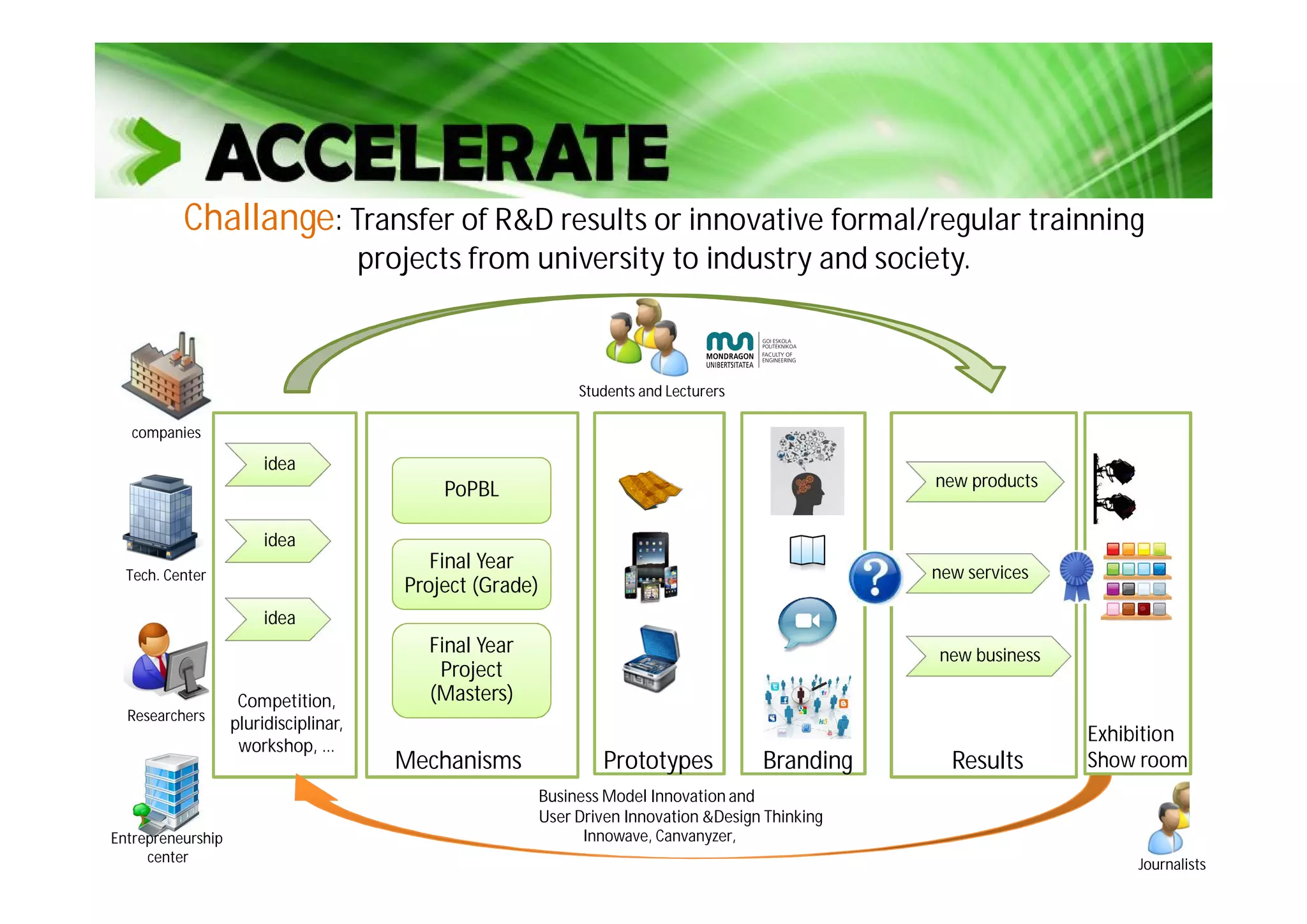
Challange: Transfer of R&D results or innovative formal/regular trainning
projects from university to industry and society.
companies
Tech. Center
Students and Lecturers
Researchers
PoPBL
Final Year
Project (Grade)
Final Year
Project
(Masters)
Mechanisms Prototypes
idea
idea
idea
Competition,
pluridisciplinar,
workshop, …
new products
new services
new business
ResultsBranding
Entrepreneurship
center Journalists
Exhibition
Show room
Innowave, Canvanyzer,
Business Model Innovation and
User Driven Innovation &Design Thinking
Challenges: Transform those prototypes into products or new businesses
• Create spin-offs: Students are by themselves. They need support to create
their company.
• No business model identified: The company does not envisage or foresee new
business models. Not encouraged to continue with the project. Development in stand by.
• No company: There is no company behind an idea.
• Transference is not an easy task: Research groups do not have the competence/time
to do this.
• Change of requirements: Companies are interested but keep on adding new
requirements (lack of maturity, different situations ...). Time development expands. Team must
be reconstructed. New people (students) must acquire new training skills.
Mechanisms Prototypes
Competition,
pluridisciplinar,
workshop, … ResultsBranding
Exhibition
Show room
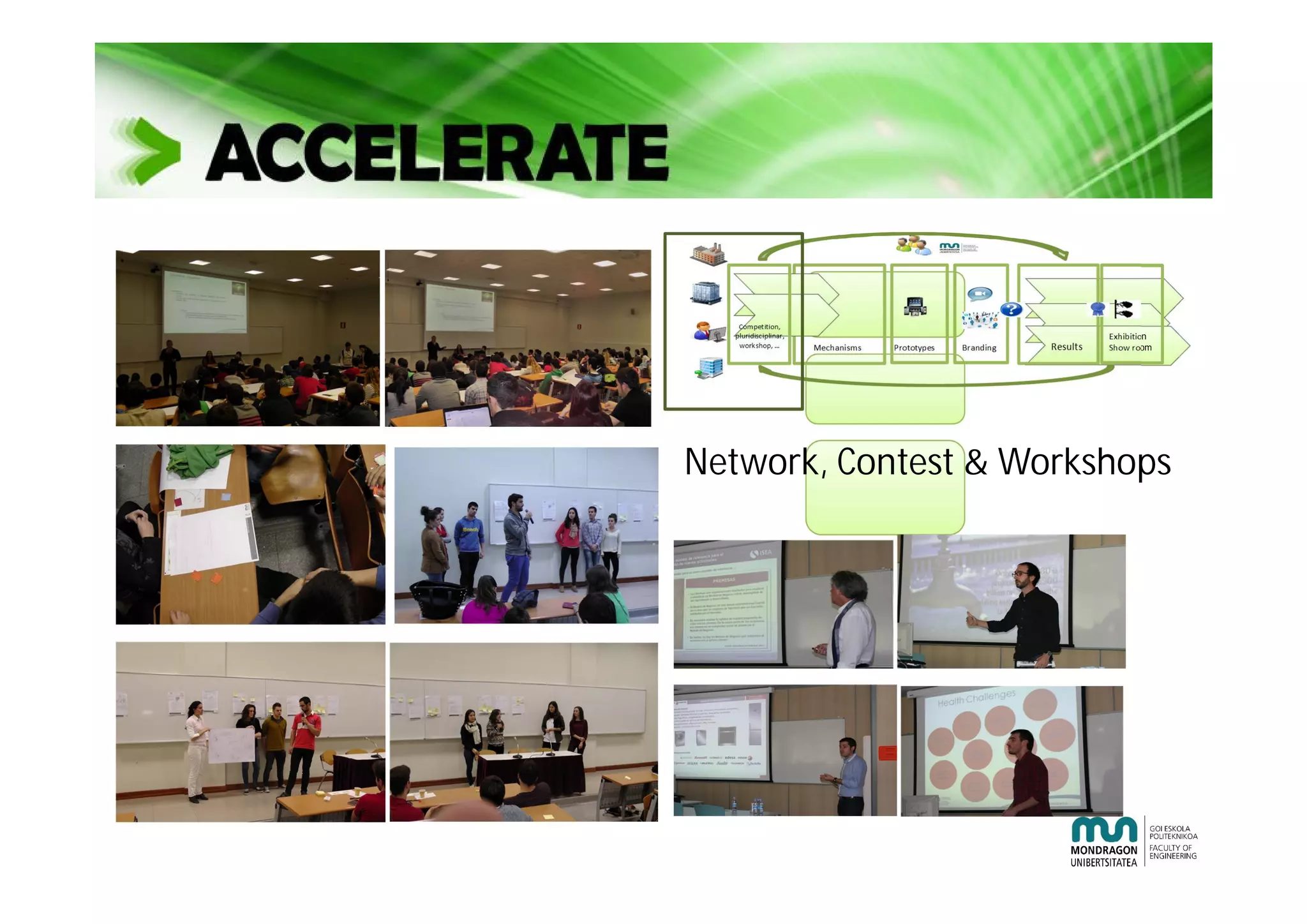
Network, Contest & Workshops
Mechanisms Prototypes
Competition,
pluridisciplinar,
workshop, … ResultsBranding
Exhibition
Show room
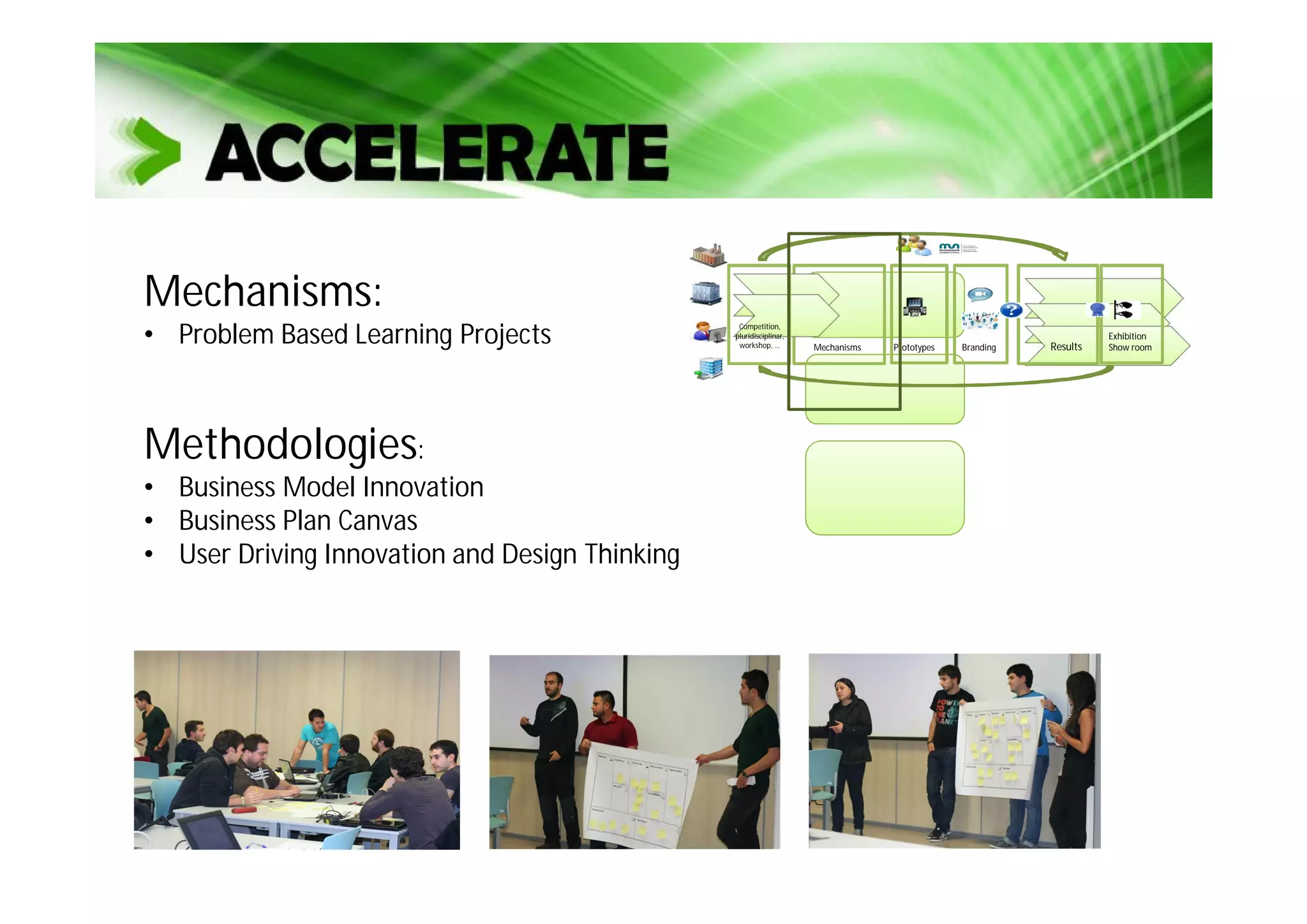
Mechanisms:
• Problem Based Learning Projects
Methodologies:
• Business Model Innovation
• Business Plan Canvas
• User Driving Innovation and Design Thinking
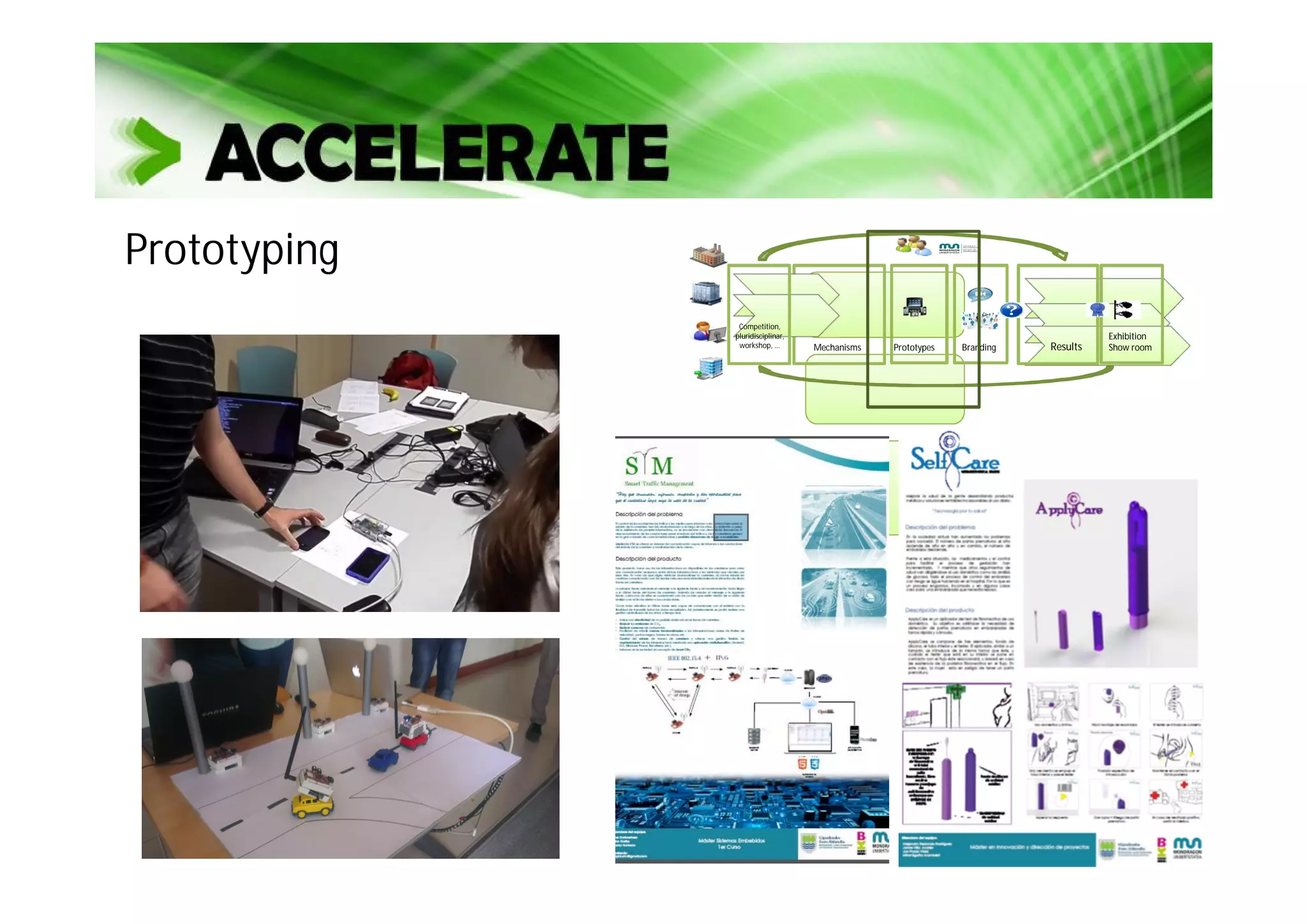
Prototyping
Mechanisms Prototypes
Competition,
pluridisciplinar,
workshop, … ResultsBranding
Exhibition
Show room
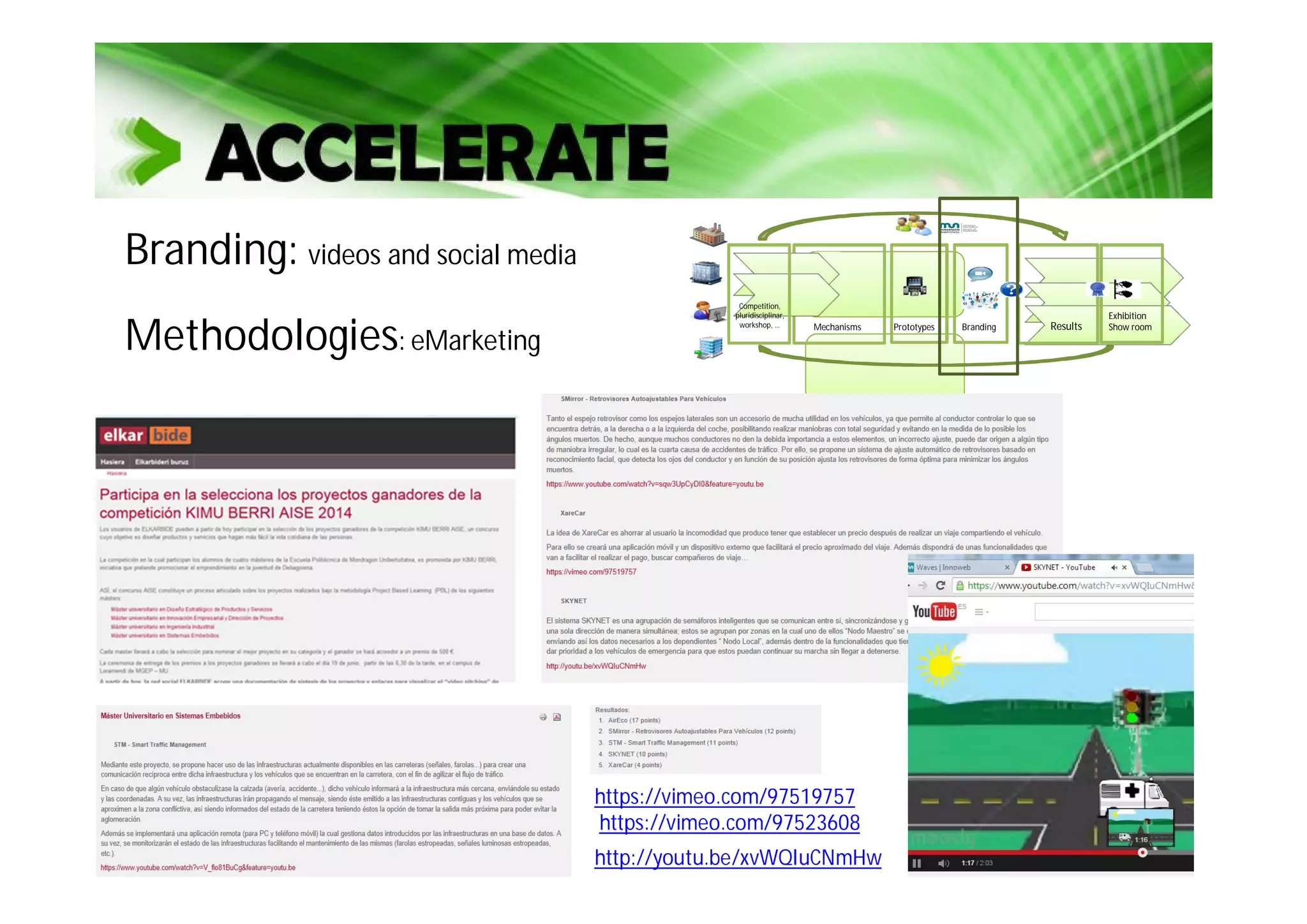
Branding: videos and social media
Methodologies: eMarketing
Mechanisms Prototypes
Competition,
pluridisciplinar,
workshop, … ResultsBranding
Exhibition
Show room
https://vimeo.com/97519757
https://vimeo.com/97523608
http://youtu.be/xvWQIuCNmHw
…..
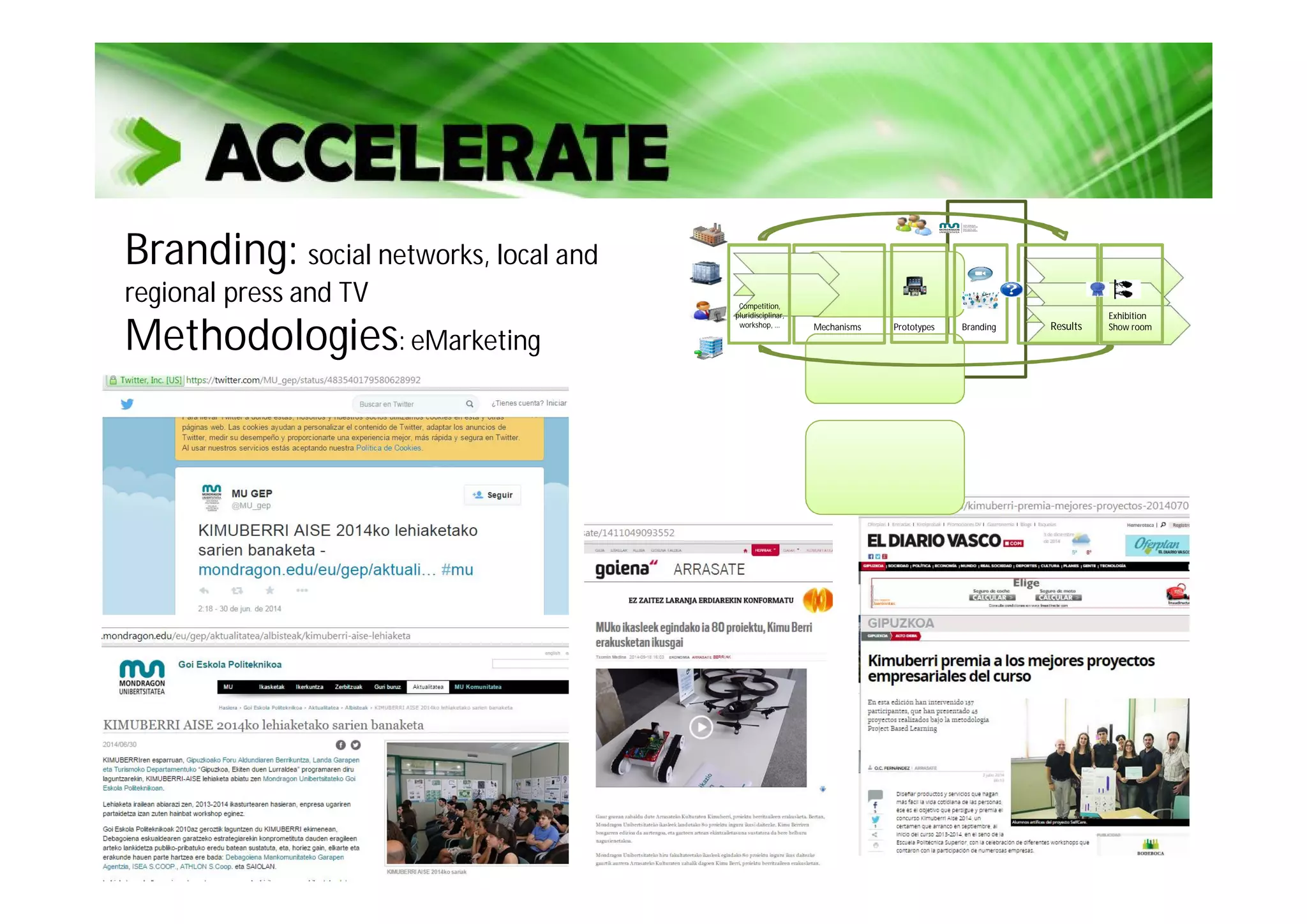
Branding: social networks, local and
regional press and TV
Methodologies: eMarketing
Mechanisms Prototypes
Competition,
pluridisciplinar,
workshop, … ResultsBranding
Exhibition
Show room
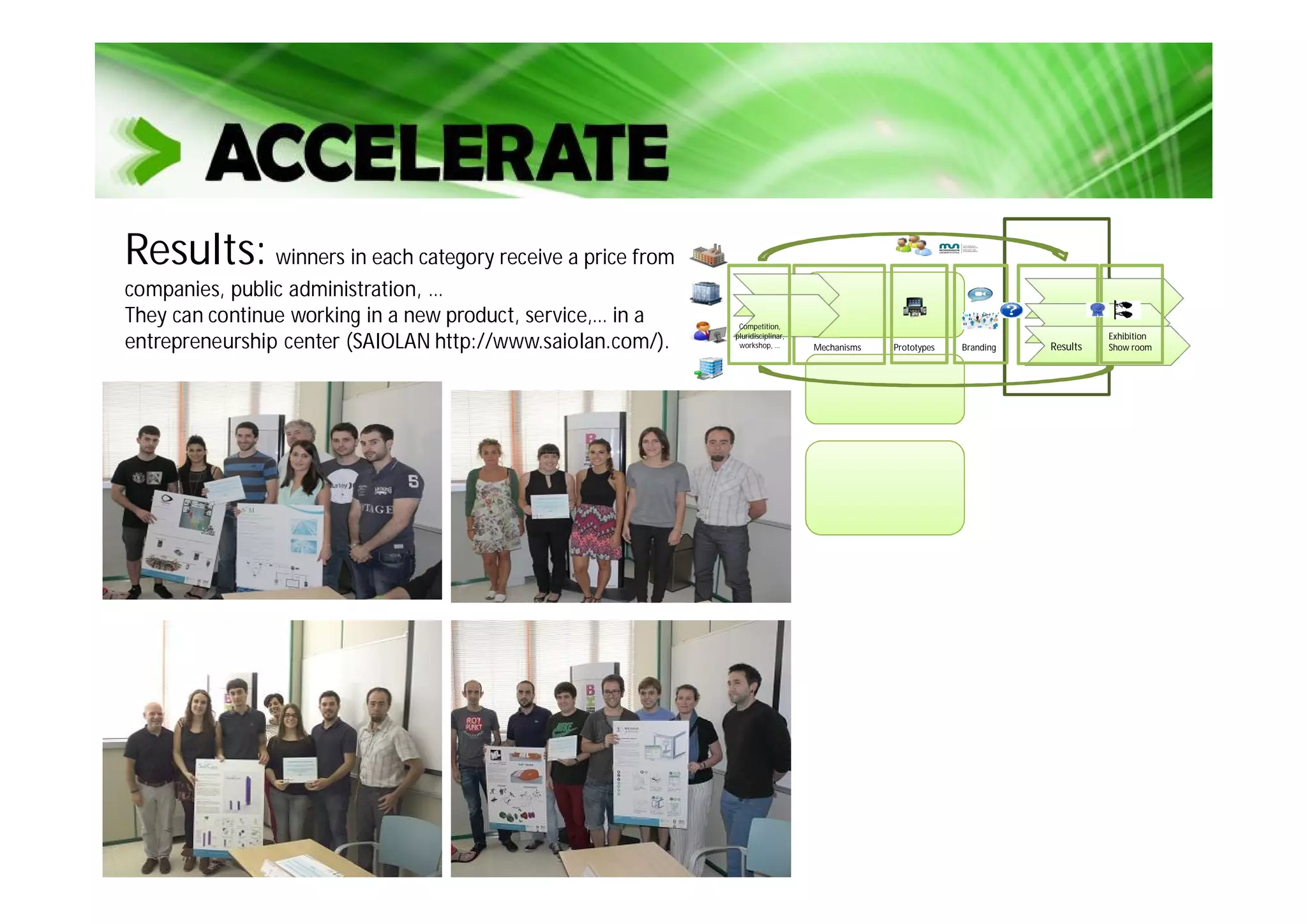
Results: winners in each category receive a price from
companies, public administration, …
They can continue working in a new product, service,… in a
entrepreneurship center (SAIOLAN http://www.saiolan.com/). Mechanisms Prototypes
Competition,
pluridisciplinar,
workshop, … ResultsBranding
Exhibition
Show room
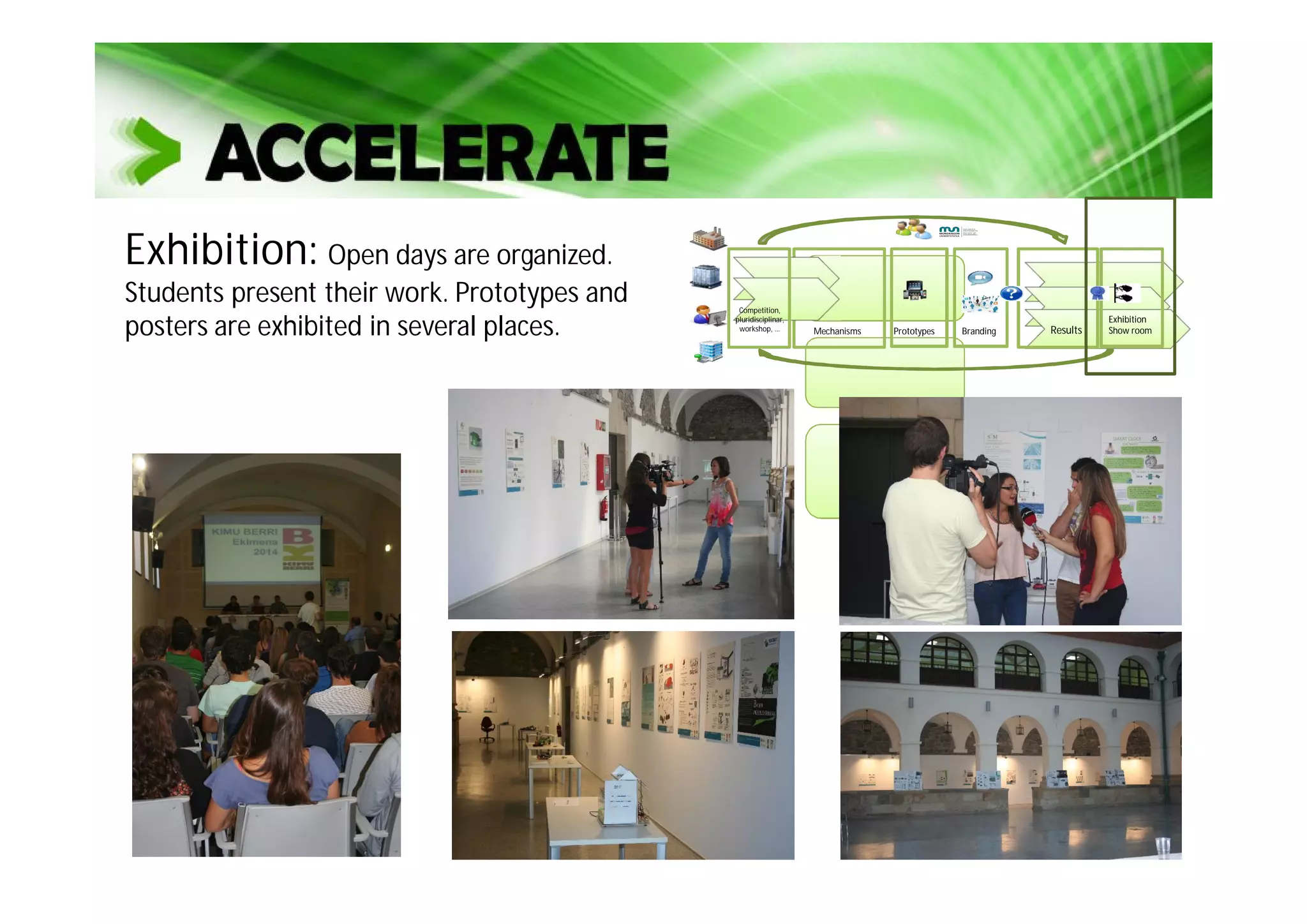
Exhibition: Open days are organized.
Students present their work. Prototypes and
posters are exhibited in several places. Mechanisms Prototypes
Competition,
pluridisciplinar,
workshop, … ResultsBranding
Exhibition
Show room
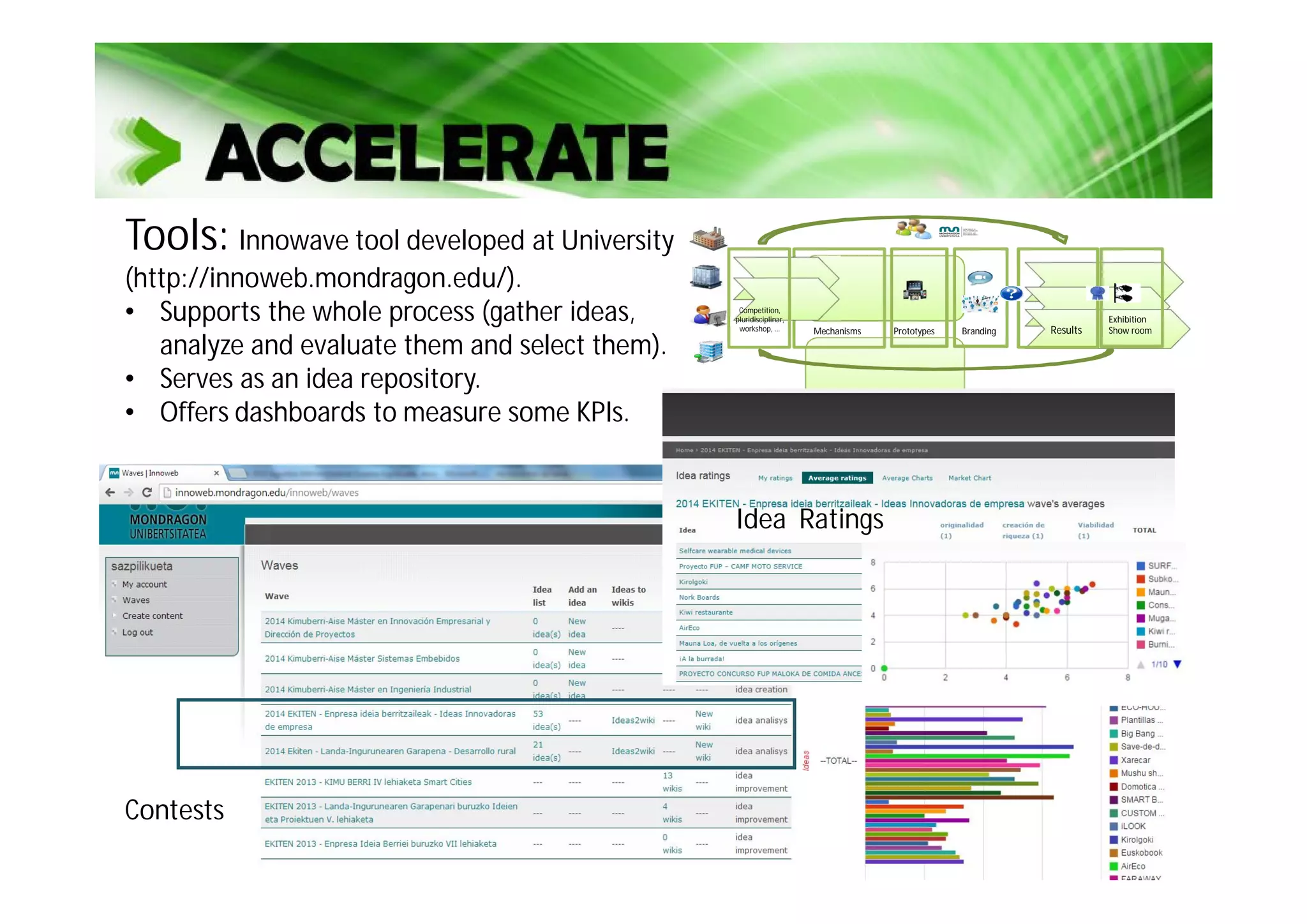
Tools: Innowave tool developed at University
(http://innoweb.mondragon.edu/).
• Supports the whole process (gather ideas,
analyze and evaluate them and select them).
• Serves as an idea repository.
• Offers dashboards to measure some KPIs.
Mechanisms Prototypes
Competition,
pluridisciplinar,
workshop, … ResultsBranding
Exhibition
Show room
Contests
Idea Ratings
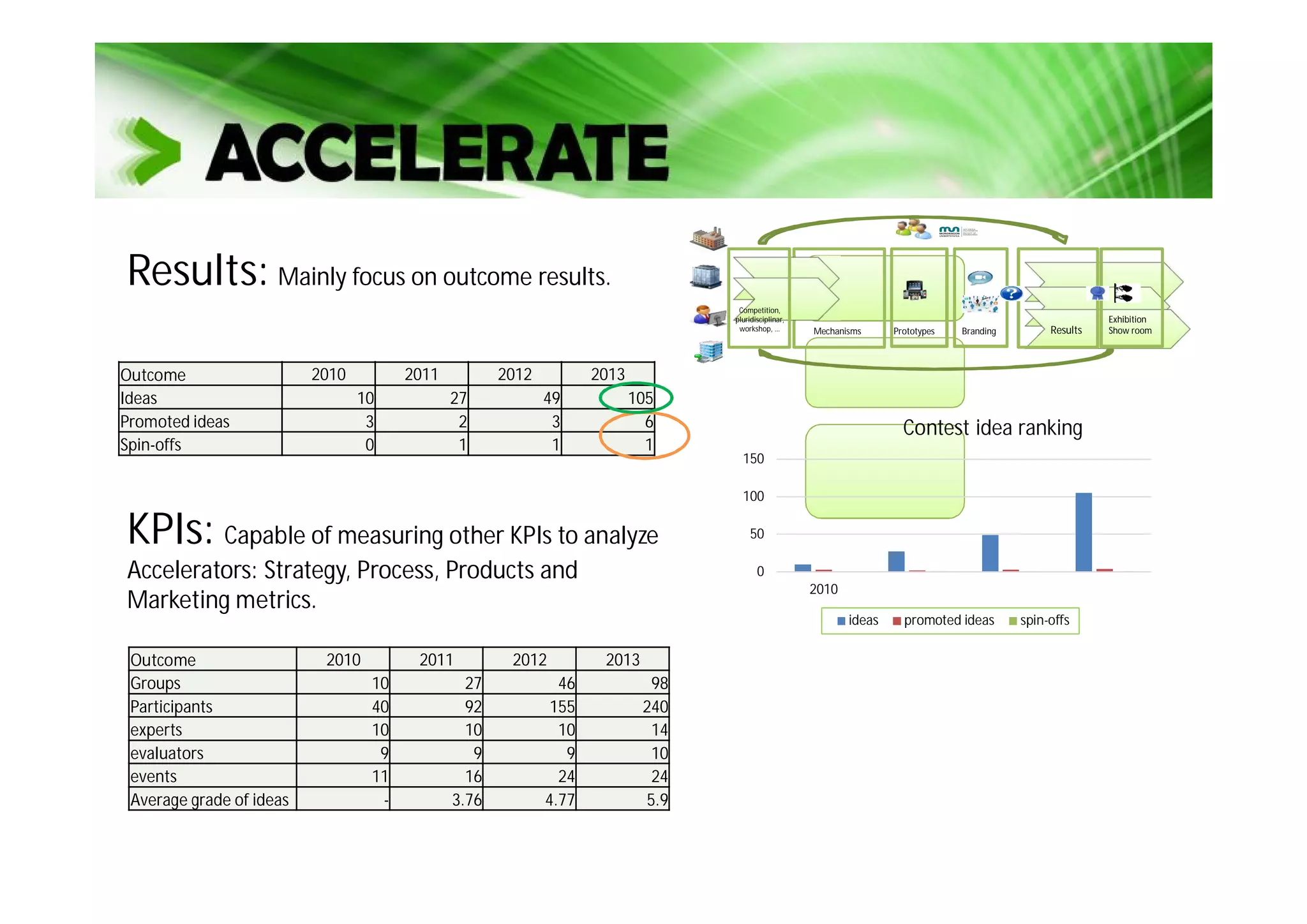
Results: Mainly focus on outcome results.
Mechanisms Prototypes
Competition,
pluridisciplinar,
workshop, … ResultsBranding
Exhibition
Show room
Outcome 2010 2011 2012 2013
Ideas 10 27 49 105
Promoted ideas 3 2 3 6
Spin-offs 0 1 1 1
0
50
100
150
2010
Contest idea ranking
ideas promoted ideas spin-offs
Outcome 2010 2011 2012 2013
Groups 10 27 46 98
Participants 40 92 155 240
experts 10 10 10 14
evaluators 9 9 9 10
events 11 16 24 24
Average grade of ideas - 3.76 4.77 5.9
KPIs: Capable of measuring other KPIs to analyze
Accelerators: Strategy, Process, Products and
Marketing metrics.
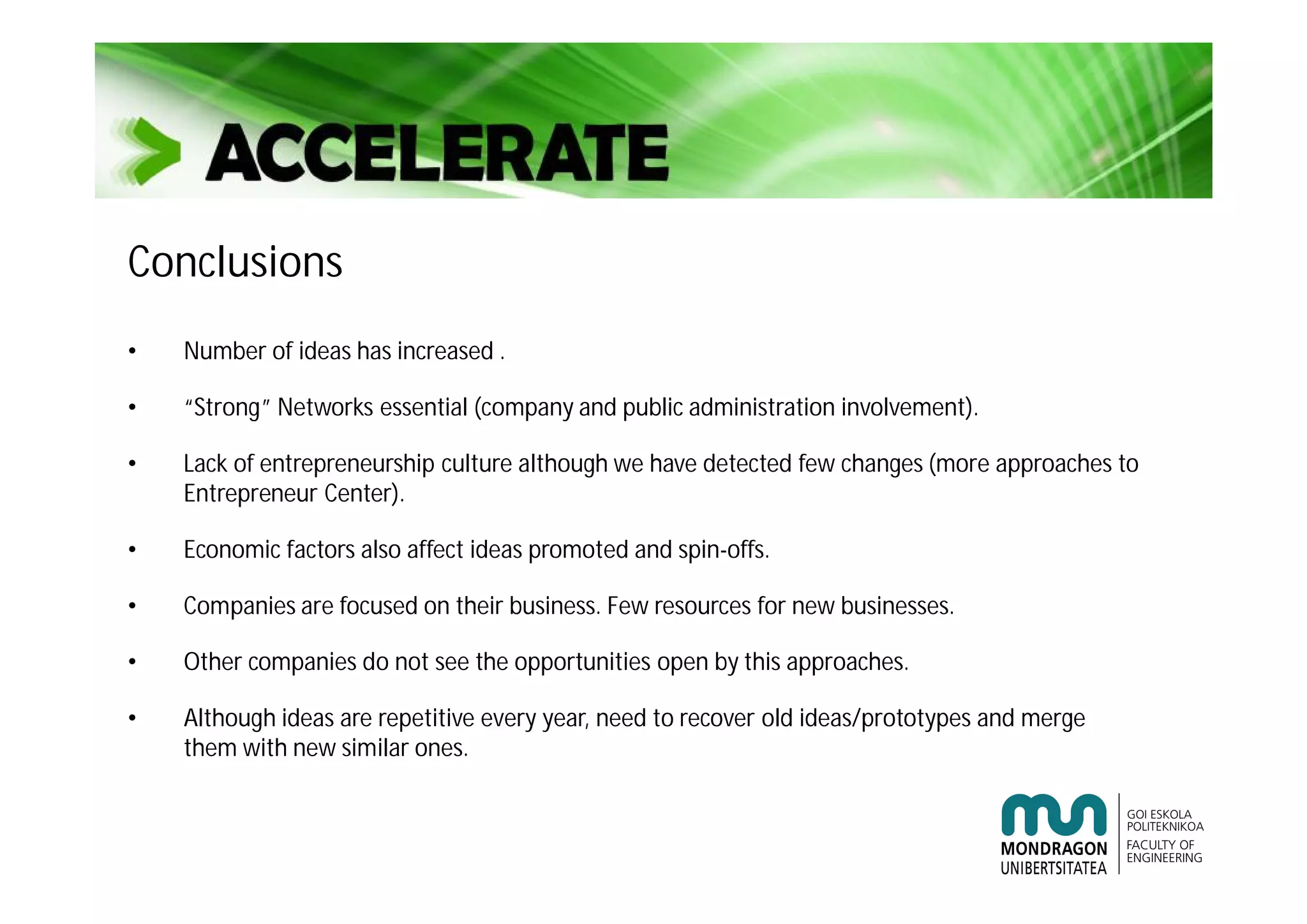
Conclusions
• Number of ideas has increased .
• “Strong” Networks essential (company and public administration involvement).
• Lack of entrepreneurship culture although we have detected few changes (more approaches to
Entrepreneur Center).
• Economic factors also affect ideas promoted and spin-offs.
• Companies are focused on their business. Few resources for new businesses.
• Other companies do not see the opportunities open by this approaches.
• Although ideas are repetitive every year, need to recover old ideas/prototypes and merge
them with new similar ones.
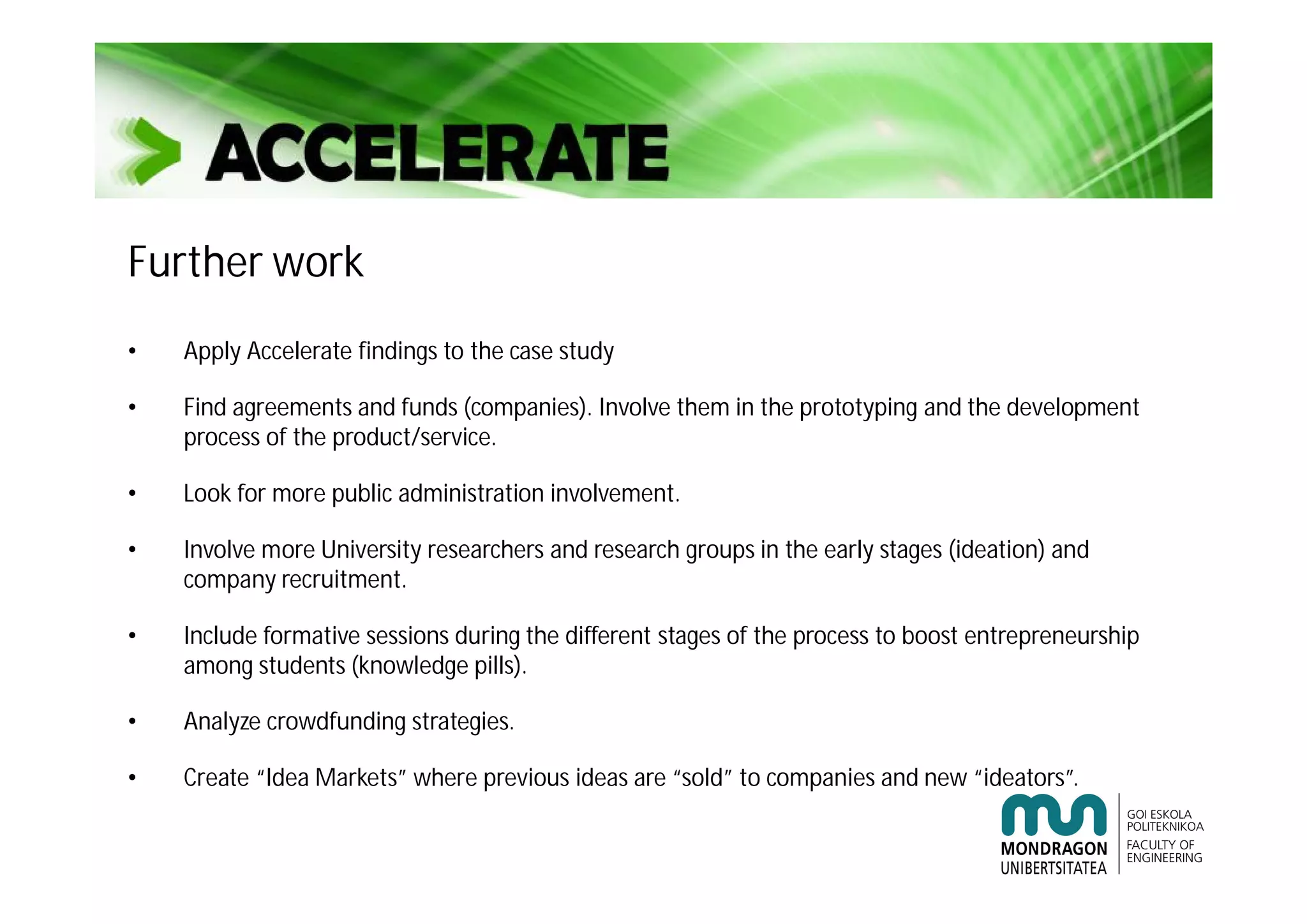
Further work
• Apply Accelerate findings to the case study
• Find agreements and funds (companies). Involve them in the prototyping and the development
process of the product/service.
• Look for more public administration involvement.
• Involve more University researchers and research groups in the early stages (ideation) and
company recruitment.
• Include formative sessions during the different stages of the process to boost entrepreneurship
among students (knowledge pills).
• Analyze crowdfunding strategies.
• Create “Idea Markets” where previous ideas are “sold” to companies and new “ideators”.

Mondragon University case

  • 1.
    USE CASE Mondragon University FelixLarrinaga flarrinaga@mondragon.edu Mondragon University Spanish Partner
  • 2.
    • University Partof Mondragon Corporation (www.mcc.es) 85.000 workers (85% members) Sectors: Finance, industry, distribution, engineering & services and education • University organizes with different agents from the Corporation contexts that involve private and public collaboration. • 3 topics- 3 contests/waves per year. • Objectives: 1. Promote entrepreneurship among students by collecting ideas on the creation of new enterprises or business models. (Spin-Offs) 2.Accelerate knowledge transfer from university to business. • Methodology: Each year improvements are introduced to impact on different aspects (participation, co-creation, marketing, …). Outcome is measured by means of KPIs. • Launched in 2010. Idea Management System (IMS) (Innowave) used since 2011.
  • 3.
    Challange: Transfer ofR&D results or innovative formal/regular trainning projects from university to industry and society. companies Tech. Center Students and Lecturers Researchers PoPBL Final Year Project (Grade) Final Year Project (Masters) Mechanisms Prototypes idea idea idea Competition, pluridisciplinar, workshop, … new products new services new business ResultsBranding Entrepreneurship center Journalists Exhibition Show room Innowave, Canvanyzer, Business Model Innovation and User Driven Innovation &Design Thinking
  • 4.
    Challenges: Transform thoseprototypes into products or new businesses • Create spin-offs: Students are by themselves. They need support to create their company. • No business model identified: The company does not envisage or foresee new business models. Not encouraged to continue with the project. Development in stand by. • No company: There is no company behind an idea. • Transference is not an easy task: Research groups do not have the competence/time to do this. • Change of requirements: Companies are interested but keep on adding new requirements (lack of maturity, different situations ...). Time development expands. Team must be reconstructed. New people (students) must acquire new training skills.
  • 5.
    Mechanisms Prototypes Competition, pluridisciplinar, workshop, …ResultsBranding Exhibition Show room Network, Contest & Workshops
  • 6.
    Mechanisms Prototypes Competition, pluridisciplinar, workshop, …ResultsBranding Exhibition Show room Mechanisms: • Problem Based Learning Projects Methodologies: • Business Model Innovation • Business Plan Canvas • User Driving Innovation and Design Thinking
  • 7.
  • 8.
    Branding: videos andsocial media Methodologies: eMarketing Mechanisms Prototypes Competition, pluridisciplinar, workshop, … ResultsBranding Exhibition Show room https://vimeo.com/97519757 https://vimeo.com/97523608 http://youtu.be/xvWQIuCNmHw …..
  • 9.
    Branding: social networks,local and regional press and TV Methodologies: eMarketing Mechanisms Prototypes Competition, pluridisciplinar, workshop, … ResultsBranding Exhibition Show room
  • 10.
    Results: winners ineach category receive a price from companies, public administration, … They can continue working in a new product, service,… in a entrepreneurship center (SAIOLAN http://www.saiolan.com/). Mechanisms Prototypes Competition, pluridisciplinar, workshop, … ResultsBranding Exhibition Show room
  • 11.
    Exhibition: Open daysare organized. Students present their work. Prototypes and posters are exhibited in several places. Mechanisms Prototypes Competition, pluridisciplinar, workshop, … ResultsBranding Exhibition Show room
  • 12.
    Tools: Innowave tooldeveloped at University (http://innoweb.mondragon.edu/). • Supports the whole process (gather ideas, analyze and evaluate them and select them). • Serves as an idea repository. • Offers dashboards to measure some KPIs. Mechanisms Prototypes Competition, pluridisciplinar, workshop, … ResultsBranding Exhibition Show room Contests Idea Ratings
  • 13.
    Results: Mainly focuson outcome results. Mechanisms Prototypes Competition, pluridisciplinar, workshop, … ResultsBranding Exhibition Show room Outcome 2010 2011 2012 2013 Ideas 10 27 49 105 Promoted ideas 3 2 3 6 Spin-offs 0 1 1 1 0 50 100 150 2010 Contest idea ranking ideas promoted ideas spin-offs Outcome 2010 2011 2012 2013 Groups 10 27 46 98 Participants 40 92 155 240 experts 10 10 10 14 evaluators 9 9 9 10 events 11 16 24 24 Average grade of ideas - 3.76 4.77 5.9 KPIs: Capable of measuring other KPIs to analyze Accelerators: Strategy, Process, Products and Marketing metrics.
  • 14.
    Conclusions • Number ofideas has increased . • “Strong” Networks essential (company and public administration involvement). • Lack of entrepreneurship culture although we have detected few changes (more approaches to Entrepreneur Center). • Economic factors also affect ideas promoted and spin-offs. • Companies are focused on their business. Few resources for new businesses. • Other companies do not see the opportunities open by this approaches. • Although ideas are repetitive every year, need to recover old ideas/prototypes and merge them with new similar ones.
  • 15.
    Further work • ApplyAccelerate findings to the case study • Find agreements and funds (companies). Involve them in the prototyping and the development process of the product/service. • Look for more public administration involvement. • Involve more University researchers and research groups in the early stages (ideation) and company recruitment. • Include formative sessions during the different stages of the process to boost entrepreneurship among students (knowledge pills). • Analyze crowdfunding strategies. • Create “Idea Markets” where previous ideas are “sold” to companies and new “ideators”.