VTT TECHNICAL RESEARCH CENTRE OF FINLAND LTD
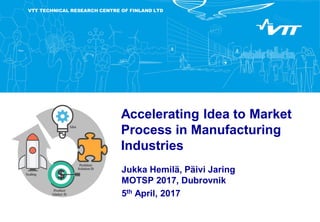
Accelerating Idea to Market
Process in Manufacturing
Industries
Jukka Hemilä, Päivi Jaring
MOTSP 2017, Dubrovnik
5th April, 2017
218/04/2017 2
INTRODUCTION
The product design and engineering in manufacturing industries has
been the way to competitive edge
Earlier, in the 70s-80s the manufacturing industries focus was on the
streamlining and speeding up the production
Toyota's focus on quality, eliminating waste, and continuous
improvement through Kanban, made the Toyota Production System
benchmark for lean production globally
Lean principles (Womack and Jones, 1996)
Principle Description
Value Specify the value desired by the customer
Value Stream Identify the value stream for each product providing that value and challenge all of
the wasted steps currently necessary to provide it
Flow Make the product flow continuously through the remaining, value-creating steps
Pull Introduce pull between all steps where continuous flow is impossible
Perfection Manage towards perfection so that the number of steps and the amount of time and
information needed to serve the customer continually falls
318/04/2017 3
INTRODUCTION
Not only the lean thinking but also agile project management methods
has been widely taken in use to large-scale and distributed projects.
Agile project management focused on four core values: customer
collaboration, iterative development, self-organizing teams, and
adaptability to change
Together lean thinking and agile methods have been successfully
applied to product development at startup companies, which is called
the lean startup methodology
However, many lean startup principles may also be of benefit to
established firms.
418/04/2017 4
RESEARCH DESIGN
European companies are over designing and engineering products
before commercialization.
The research question: how to improve mature companies’ product
innovation lifecycle in traditional product-based businesses?
The study is based on the state-of-the-art of innovation processes in
startups from the literature review and on the empirical case data
evidence from the multiple case studies.
The qualitative case study: to gain both theoretical and empirical
insight into the mature companies’ innovation culture, especially in
product innovations
The outcome is a four-stage innovation lifecycle model for mature
companies improving their product innovation speed and strategic
development as well the daily operations by utilizing lessons learned
from startups.
518/04/2017 5
INNOVATIONS AND TIME TO MARKET IN
STARTUPS
Innovation is the core for the startup: should provide something new for
the market, or otherwise their existence is questioned
Time to market innovation process is really fast, or otherwise the entire
business opportunity might be lost.
In product development, the Minimum Viable Product (MVP) is a
product with just enough features to gather validated learning about the
product and its continued development.
The concept of MVP is hardly heard by mature companies’ employees.
Startups are focusing to solve some customer problems and create
business model to solve that customer problem.
Only then startups are developing real product, and firstly MVP.
Mature companies have a business plan how to operate, and product
innovations are done in linear or step-by-step methods.
618/04/2017 6
NEW METHOD FOR ACCELERATION IDEA TO
MARKET IN MANUFACTURING INDUSTRIES
Acceleration or acceleration of innovation: the study understands
acceleration as accelerating innovation go-to-market and
commercialization.
Acceleration is a combination of means: processes, tools and methods,
which help companies go faster to the right markets
It is time for mature companies to change their innovation culture
towards their origins, the way successful startups are innovating.
Companies should focus on searching for a product-market fit and a
sustainable, scalable, profitable business model
Mature companies, the business model is not typically changed.
focus on the development of new product, which does not actually bring
competitive advantage today.
Product innovation should be continuous and lean process: Idea stage,
Problem/Solution Fit, Product/Market Fit, Scaling
718/04/2017 7
DIFFERENT STAGES OF ACCELERATION
818/04/2017 8
WHAT LEAN STARTUPS DO DIFFERENTLY
Strategy Business model
Hypothesis-driven
Business Plan
Implementation-driven
New-Product Process Customer development
Get out of the office and test
hypotheses
Product management
Prepare offering for market following a
linear, step-by-step plan
Engineering Agile development
Built the product iteratively and
incrementally
Agile or waterfall development
Built the product iteratively, or fully
specify the product before building it
Organization Customer and Agile development Teams
Hire for learning, nimbleness, and speed
Departments by Function
Hire for experience and ability to execute
Financial Reporting Metrics that matter
Customer acquisition cost, lifetime
customer value, churn, viralness
Accounting
Income statement, balance sheet, cash flow
statement
Failure Expected
Fix by iterating on ideas and pivoting
away from ones that don’t work
Exception
Fix by firing executives
Speed Rapid
Operates on good-enough data
Measured
Operates on complete data
Lean Traditional
Blank, S., Why lean startup changes everything, Harvard Business Review, May 2013.
918/04/2017 9
CONCLUSIONS
A lean product development helps companies to launch
products that customers actually want, and more quickly and
cheaply than traditional methods.
To ensure survival and growth, mature and even large
companies need to keep inventing new business models.
Traditional manufacturers have usually long technology
development cycles, which actually has been one of the main
reasons for startups to failure
Our model suggest improving design, engineering and product
launch time in traditional companies.
TECHNOLOGY FOR BUSINESS

Hemila_MOTSP2017

  • 1.
    VTT TECHNICAL RESEARCHCENTRE OF FINLAND LTD Accelerating Idea to Market Process in Manufacturing Industries Jukka Hemilä, Päivi Jaring MOTSP 2017, Dubrovnik 5th April, 2017
  • 2.
    218/04/2017 2 INTRODUCTION The productdesign and engineering in manufacturing industries has been the way to competitive edge Earlier, in the 70s-80s the manufacturing industries focus was on the streamlining and speeding up the production Toyota's focus on quality, eliminating waste, and continuous improvement through Kanban, made the Toyota Production System benchmark for lean production globally Lean principles (Womack and Jones, 1996) Principle Description Value Specify the value desired by the customer Value Stream Identify the value stream for each product providing that value and challenge all of the wasted steps currently necessary to provide it Flow Make the product flow continuously through the remaining, value-creating steps Pull Introduce pull between all steps where continuous flow is impossible Perfection Manage towards perfection so that the number of steps and the amount of time and information needed to serve the customer continually falls
  • 3.
    318/04/2017 3 INTRODUCTION Not onlythe lean thinking but also agile project management methods has been widely taken in use to large-scale and distributed projects. Agile project management focused on four core values: customer collaboration, iterative development, self-organizing teams, and adaptability to change Together lean thinking and agile methods have been successfully applied to product development at startup companies, which is called the lean startup methodology However, many lean startup principles may also be of benefit to established firms.
  • 4.
    418/04/2017 4 RESEARCH DESIGN Europeancompanies are over designing and engineering products before commercialization. The research question: how to improve mature companies’ product innovation lifecycle in traditional product-based businesses? The study is based on the state-of-the-art of innovation processes in startups from the literature review and on the empirical case data evidence from the multiple case studies. The qualitative case study: to gain both theoretical and empirical insight into the mature companies’ innovation culture, especially in product innovations The outcome is a four-stage innovation lifecycle model for mature companies improving their product innovation speed and strategic development as well the daily operations by utilizing lessons learned from startups.
  • 5.
    518/04/2017 5 INNOVATIONS ANDTIME TO MARKET IN STARTUPS Innovation is the core for the startup: should provide something new for the market, or otherwise their existence is questioned Time to market innovation process is really fast, or otherwise the entire business opportunity might be lost. In product development, the Minimum Viable Product (MVP) is a product with just enough features to gather validated learning about the product and its continued development. The concept of MVP is hardly heard by mature companies’ employees. Startups are focusing to solve some customer problems and create business model to solve that customer problem. Only then startups are developing real product, and firstly MVP. Mature companies have a business plan how to operate, and product innovations are done in linear or step-by-step methods.
  • 6.
    618/04/2017 6 NEW METHODFOR ACCELERATION IDEA TO MARKET IN MANUFACTURING INDUSTRIES Acceleration or acceleration of innovation: the study understands acceleration as accelerating innovation go-to-market and commercialization. Acceleration is a combination of means: processes, tools and methods, which help companies go faster to the right markets It is time for mature companies to change their innovation culture towards their origins, the way successful startups are innovating. Companies should focus on searching for a product-market fit and a sustainable, scalable, profitable business model Mature companies, the business model is not typically changed. focus on the development of new product, which does not actually bring competitive advantage today. Product innovation should be continuous and lean process: Idea stage, Problem/Solution Fit, Product/Market Fit, Scaling
  • 7.
  • 8.
    818/04/2017 8 WHAT LEANSTARTUPS DO DIFFERENTLY Strategy Business model Hypothesis-driven Business Plan Implementation-driven New-Product Process Customer development Get out of the office and test hypotheses Product management Prepare offering for market following a linear, step-by-step plan Engineering Agile development Built the product iteratively and incrementally Agile or waterfall development Built the product iteratively, or fully specify the product before building it Organization Customer and Agile development Teams Hire for learning, nimbleness, and speed Departments by Function Hire for experience and ability to execute Financial Reporting Metrics that matter Customer acquisition cost, lifetime customer value, churn, viralness Accounting Income statement, balance sheet, cash flow statement Failure Expected Fix by iterating on ideas and pivoting away from ones that don’t work Exception Fix by firing executives Speed Rapid Operates on good-enough data Measured Operates on complete data Lean Traditional Blank, S., Why lean startup changes everything, Harvard Business Review, May 2013.
  • 9.
    918/04/2017 9 CONCLUSIONS A leanproduct development helps companies to launch products that customers actually want, and more quickly and cheaply than traditional methods. To ensure survival and growth, mature and even large companies need to keep inventing new business models. Traditional manufacturers have usually long technology development cycles, which actually has been one of the main reasons for startups to failure Our model suggest improving design, engineering and product launch time in traditional companies.
  • 10.