MARS ORBITER MISSION 
PREPARED BY 
BAHNISIKHA GHOSH 
CENTER FOR JOURNALISM AND MASS COMMUNICATION 
VISVA BHARATI
WHAT IS MARS ORBITER MISSION (MOM) ? 
• Mars Orbiter Mission is ISRO's First Interplanetary Mission with an Orbiter 
craft. 
• The Orbiter craft is designed to orbit Mars in an elliptical orbit of 366 km x 
80000 km. 
• The Mission is to design and realize a spacecraft with a capability to perform 
• Earth Bound Manoeuvre 
• Martian Transfer Trajectory (MTT) 
• Mars Orbit Insertion (MOI), phases.
TECHNOLOGICAL OBJECTIVES OF MOM 
• To develop the technologies required For design, planning, management, deep 
space communication and operations of an Interplanetary Mission. 
• To design and realize Mars Orbiter with a capability to survive and perform Earth 
bound Manoeuvres, cruise phase of 300 days, Mars orbit insertion & capture, and 
on-orbit phase around Mars. 
• Incorporate autonomous Features to handle contingency situations.
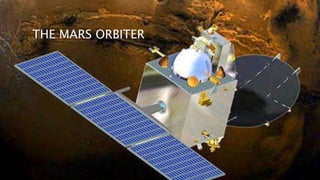
THE MARS ORBITER
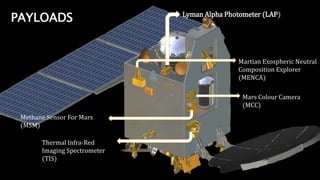
PAYLOADS Lyman Alpha Photometer (LAP) 
Martian Exospheric Neutral 
Composition Explorer 
(MENCA) 
Mars Colour Camera 
(MCC) 
Methane Sensor For Mars 
(MSM) 
Thermal Infra-Red 
Imaging Spectrometer 
(TIS)
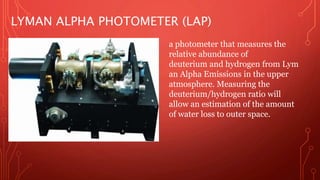
LYMAN ALPHA PHOTOMETER (LAP) 
a photometer that measures the 
relative abundance of 
deuterium and hydrogen from Lym 
an Alpha Emissions in the upper 
atmosphere. Measuring the 
deuterium/hydrogen ratio will 
allow an estimation of the amount 
of water loss to outer space.
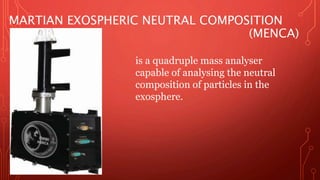
MARTIAN EXOSPHERIC NEUTRAL COMPOSITION 
EXPLORER (MENCA) 
is a quadruple mass analyser 
capable of analysing the neutral 
composition of particles in the 
exosphere.
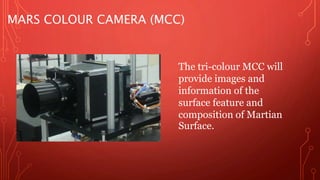
MARS COLOUR CAMERA (MCC) 
The tri-colour MCC will 
provide images and 
information of the 
surface feature and 
composition of Martian 
Surface.
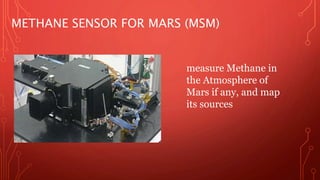
METHANE SENSOR FOR MARS (MSM) 
measure Methane in 
the Atmosphere of 
Mars if any, and map 
its sources
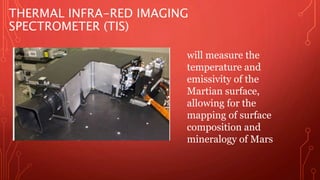
THERMAL INFRA-RED IMAGING 
SPECTROMETER (TIS) 
will measure the 
temperature and 
emissivity of the 
Martian surface, 
allowing for the 
mapping of surface 
composition and 
mineralogy of Mars
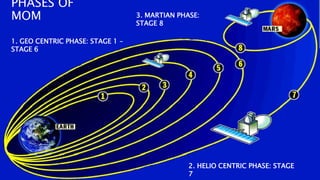
PHASES OF 
MOM 
1. GEO CENTRIC PHASE: STAGE 1 – 
STAGE 6 
3. MARTIAN PHASE: 
STAGE 8 
2. HELIO CENTRIC PHASE: STAGE 
7
PHASES 
• PHASE 1: GEO CENTRIC PHASE 
• STAGE 1: Following its launch on 5th Nov 2013 the Mars Orbiter Craft settled into a 
“Parking orbit” around the Earth with a Perigee of 248 Km and an Apogee of 23500 Km. 
• STAGE 2 : raising the apogee to 28825 Km. 
• Stage 3: raising apogee to 40000 Km 
• Stage 4 : by 9th Nov 2013 apogee raised by 71500 Km. 
• Stage 5 : on 11th Nov Apogee raised to 100000 Km. 
• Stage 6 : on 16th Nov Apogee raised to 192000 Km. 
• PHASE 2: HALIO CENTRIC PHASE 
After the crucial Trans Mars Injection on 1st Dec 2013 at 12: 42 AM 
prolonged firing of the 440 Newton Engine catapult the orbiter from the 
earth-centric orbit to Sun-centric Orbit. 
• PHASE 3: MARTIAN PHASE 
The orbiter finally captured into the Martian orbit on 24th Sep 2014 after a 
long 9 months coast around the Sun.
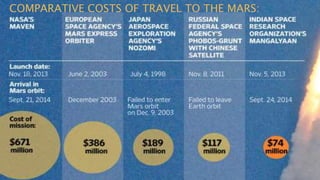
COMPARATIVE COSTS OF TRAVEL TO THE MARS:
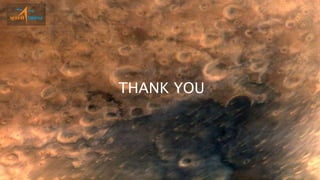
THANK YOU

Mars orbiter mission

  • 1.
    MARS ORBITER MISSION PREPARED BY BAHNISIKHA GHOSH CENTER FOR JOURNALISM AND MASS COMMUNICATION VISVA BHARATI
  • 2.
    WHAT IS MARSORBITER MISSION (MOM) ? • Mars Orbiter Mission is ISRO's First Interplanetary Mission with an Orbiter craft. • The Orbiter craft is designed to orbit Mars in an elliptical orbit of 366 km x 80000 km. • The Mission is to design and realize a spacecraft with a capability to perform • Earth Bound Manoeuvre • Martian Transfer Trajectory (MTT) • Mars Orbit Insertion (MOI), phases.
  • 3.
    TECHNOLOGICAL OBJECTIVES OFMOM • To develop the technologies required For design, planning, management, deep space communication and operations of an Interplanetary Mission. • To design and realize Mars Orbiter with a capability to survive and perform Earth bound Manoeuvres, cruise phase of 300 days, Mars orbit insertion & capture, and on-orbit phase around Mars. • Incorporate autonomous Features to handle contingency situations.
  • 4.
  • 5.
    PAYLOADS Lyman AlphaPhotometer (LAP) Martian Exospheric Neutral Composition Explorer (MENCA) Mars Colour Camera (MCC) Methane Sensor For Mars (MSM) Thermal Infra-Red Imaging Spectrometer (TIS)
  • 6.
    LYMAN ALPHA PHOTOMETER(LAP) a photometer that measures the relative abundance of deuterium and hydrogen from Lym an Alpha Emissions in the upper atmosphere. Measuring the deuterium/hydrogen ratio will allow an estimation of the amount of water loss to outer space.
  • 7.
    MARTIAN EXOSPHERIC NEUTRALCOMPOSITION EXPLORER (MENCA) is a quadruple mass analyser capable of analysing the neutral composition of particles in the exosphere.
  • 8.
    MARS COLOUR CAMERA(MCC) The tri-colour MCC will provide images and information of the surface feature and composition of Martian Surface.
  • 9.
    METHANE SENSOR FORMARS (MSM) measure Methane in the Atmosphere of Mars if any, and map its sources
  • 10.
    THERMAL INFRA-RED IMAGING SPECTROMETER (TIS) will measure the temperature and emissivity of the Martian surface, allowing for the mapping of surface composition and mineralogy of Mars
  • 11.
    PHASES OF MOM 1. GEO CENTRIC PHASE: STAGE 1 – STAGE 6 3. MARTIAN PHASE: STAGE 8 2. HELIO CENTRIC PHASE: STAGE 7
  • 12.
    PHASES • PHASE1: GEO CENTRIC PHASE • STAGE 1: Following its launch on 5th Nov 2013 the Mars Orbiter Craft settled into a “Parking orbit” around the Earth with a Perigee of 248 Km and an Apogee of 23500 Km. • STAGE 2 : raising the apogee to 28825 Km. • Stage 3: raising apogee to 40000 Km • Stage 4 : by 9th Nov 2013 apogee raised by 71500 Km. • Stage 5 : on 11th Nov Apogee raised to 100000 Km. • Stage 6 : on 16th Nov Apogee raised to 192000 Km. • PHASE 2: HALIO CENTRIC PHASE After the crucial Trans Mars Injection on 1st Dec 2013 at 12: 42 AM prolonged firing of the 440 Newton Engine catapult the orbiter from the earth-centric orbit to Sun-centric Orbit. • PHASE 3: MARTIAN PHASE The orbiter finally captured into the Martian orbit on 24th Sep 2014 after a long 9 months coast around the Sun.
  • 13.
    COMPARATIVE COSTS OFTRAVEL TO THE MARS:
  • 14.