Molecular
Orbital Theory
Limitations Of Crystal Field Theory
 The crystal field theory is highly useful and more
significant as compared to the valence bond theory. Even
after such useful properties, it has many limitations. The
following points will clearly state the limitations of
crystal field theory:
 The assumption that the interaction between metal-
ligand is purely electrostatic cannot be said to be very
realistic.
Crystal Field theory takes only d-orbitals of a central atom
into account. The s and p orbits are not considered for the
study.
The theory fails to explain the behaviour of certain metals
which cause large splitting while others show small splitting.
For example, the theory has no explanation as to why H2O is a
stronger ligand as compared to OH–.
The theory rules out the possibility of having p bonding. This
is a serious drawback because is found in many complexes.
Draw Backs of CFT
Draw Backs of CFT
 The theory gives no significance to the orbits of the
ligands. Therefore, it cannot explain any properties
related to ligand orbitals and their interaction with
metal orbitals.
 The CFT is also fail to explain the nature of CO
 Why it is strongest one.
 Bond order between C and O.
 Why C is donor atom in presence of Oxygen.
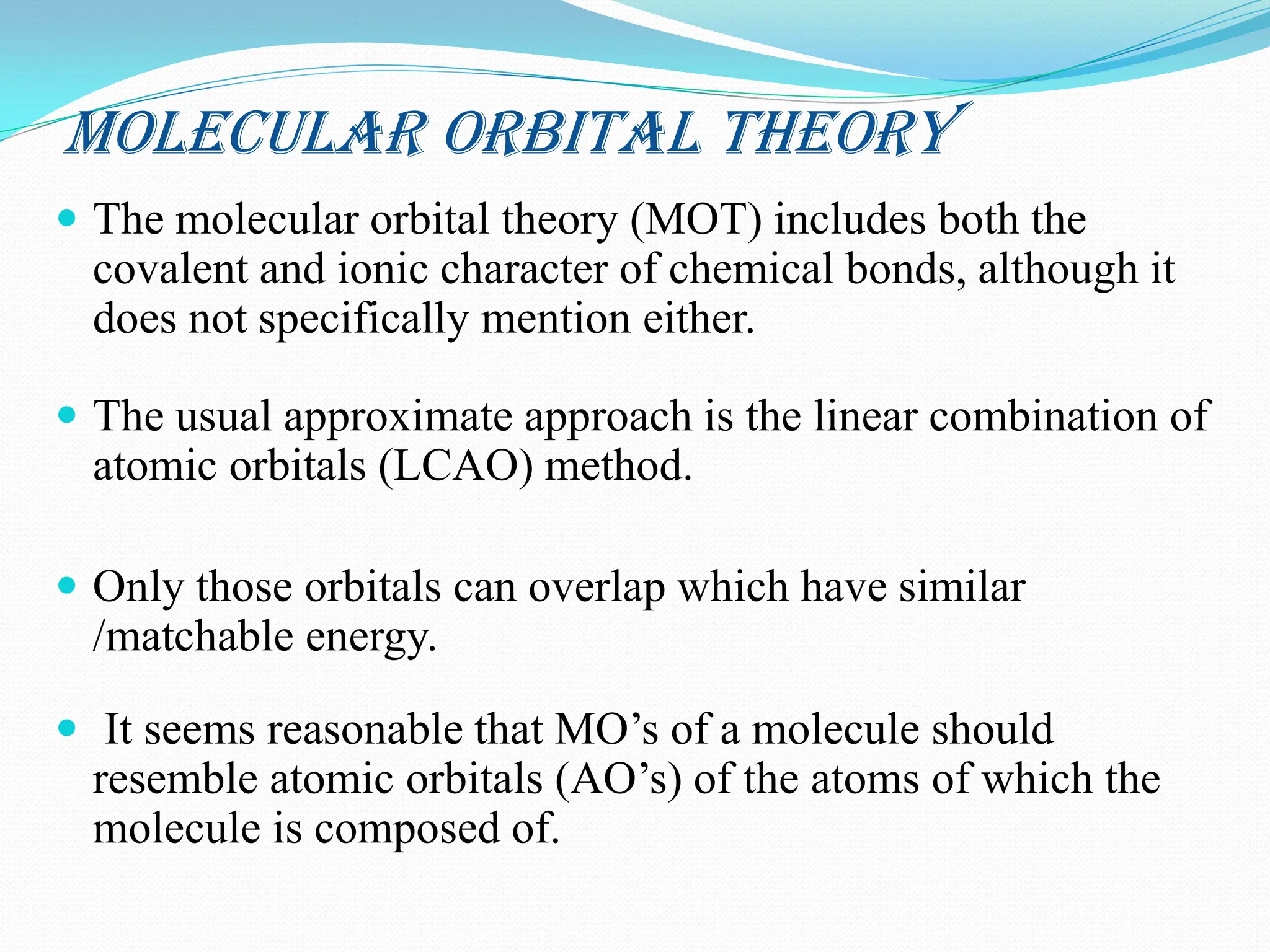
MOLECULAR ORBITAL THEORY
 The molecular orbital theory (MOT) includes both the
covalent and ionic character of chemical bonds, although it
does not specifically mention either.
 The usual approximate approach is the linear combination of
atomic orbitals (LCAO) method.
 Only those orbitals can overlap which have similar
/matchable energy.
 It seems reasonable that MO’s of a molecule should
resemble atomic orbitals (AO’s) of the atoms of which the
molecule is composed of.
MOLECULAR
ORBITALS
Combinations of s atomic
orbitals give s (sigma) MO’s.
A combination of p AO’s, as
shown in Figure 2.16, may give
either s or p (pi) MO’s
No. Of MO’s produced is equal
to the AO’s combined.
One at lower energy(stable)
called bonding MO’s and
Another at high
energy(unstable) called
antibonding MO’s
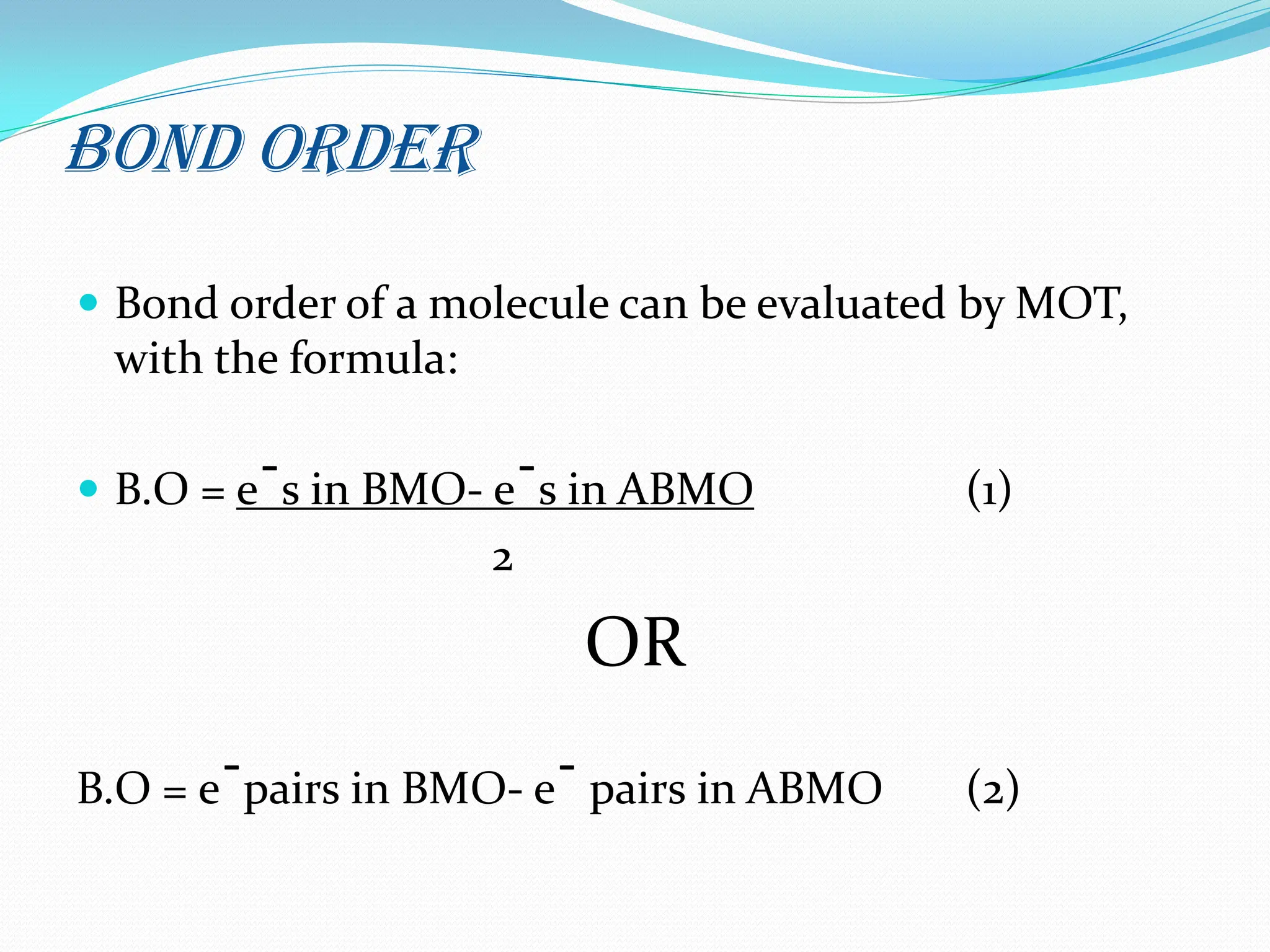
Bond Order
 Bond order of a molecule can be evaluated by MOT,
with the formula:
 B.O = eˉs in BMO- eˉs in ABMO (1)
2
OR
B.O = eˉpairs in BMO- eˉ pairs in ABMO (2)
MOLECULAR ORBITAL THEORY
 The most simple
 Homogenous molecule H2
 B.O = 2-0 = 1 Or 1-0 = 1
2
MOLECULAR ORBITAL THEORY
 Another Homogenous Molecular ion
 He-He
+
 He is 1s2 and He
+
is 1s1
 B.O = 2-1 = 1 Or 1-0.5 = 0.5
2 2
MO Diagram of a Heterogeneous Molecule
The difference of Energy (d)
between the atomic orbitals
of two atoms is indication of
ionic character of
the molecule
MO Diagrams
MO Diagram
MO Diagram of Carbon Monooxide or Carbonyl
(CO) Molecule
Here Carbon’s AO’s has higher
energy than Oxygen AO’s
HOMO
LUMO
σ bond from the ligand to the metal
atom (15) and a π bond from the
metal atom to the ligand (16).
C
O
15
16
Nature of CO
 B.O = 8-2 = 6 = 3 Or B.O = 4-1 = 3
2 2
e-s in HOMO is most loosely bonded so donation always take place from
here.
 In CO, C is donor because the highest energy orbital’s e pair is near to C
instead of O.
 LUMO of CO is similar in energy of filled AO’s of Metal, so metal can
share its e pair with CO, this is called p back donation which strengthen
the CO-M bond
Assignment:
 Draw MO diagram for CN
-
 Evaluate its BO
MO Diagram of
high spin [cof6]3-
and
low spin [Co(nh3)6]3+
Molecules
[cof6]3-
Complex
high spin
d6 system
parmagnetic Co(III)
[CoF6]
3-
6F
-
[Co(nh3)6]3+
Complex
d6 system
low spin
dimagnetic
Co(III)
[Co(NH3)6]
3+
6NH3
MO Diagram of high spin [cof6]3-
and low spin [Co(nh3)6]3+
Molecules
Assignment
1. Define Molecular Orbital Theory?
2. Who mainly developed Molecular orbital theory?
3. How many molecular orbitals are formed when two atomic
orbitals combine?
4. What are homonuclear and heteronuclear diatomic
molecules?
5. How bonding and antibonding molecular orbitals are
produced?
6. Why are bonding molecular orbitals lower in energy than
the parent atomic orbitals?
7. Helium (He) and Neon (Ne) are always monoatomic; why?
explain on the basis of Molecular Orbital Theory.
Assignment
1. Explain the molecular orbital structure, bond order,
stability and magnetic behavior of Hydrogen molecule
.
2. Draw the molecular orbital diagram of dioxygen (O2)
and calculate bond order.
3. Give reason why Oxygen molecule is paramagnetic?
4. What is the bond order in O2
+?
5. Carbon monoxide (CO) has ten bonding electrons and
four antibonding electrons. What is the bond order of
CO?
6. Calculate the bond order of NO molecule?
7. Can a molecule with an odd number of electrons ever
be diamagnetic? Explain why or why not.

molecular orbital thoery and MOT diagrams explain in detail.

  • 1.
  • 2.
    Limitations Of CrystalField Theory  The crystal field theory is highly useful and more significant as compared to the valence bond theory. Even after such useful properties, it has many limitations. The following points will clearly state the limitations of crystal field theory:  The assumption that the interaction between metal- ligand is purely electrostatic cannot be said to be very realistic.
  • 3.
    Crystal Field theorytakes only d-orbitals of a central atom into account. The s and p orbits are not considered for the study. The theory fails to explain the behaviour of certain metals which cause large splitting while others show small splitting. For example, the theory has no explanation as to why H2O is a stronger ligand as compared to OH–. The theory rules out the possibility of having p bonding. This is a serious drawback because is found in many complexes. Draw Backs of CFT
  • 4.
    Draw Backs ofCFT  The theory gives no significance to the orbits of the ligands. Therefore, it cannot explain any properties related to ligand orbitals and their interaction with metal orbitals.  The CFT is also fail to explain the nature of CO  Why it is strongest one.  Bond order between C and O.  Why C is donor atom in presence of Oxygen.
  • 5.
    MOLECULAR ORBITAL THEORY The molecular orbital theory (MOT) includes both the covalent and ionic character of chemical bonds, although it does not specifically mention either.  The usual approximate approach is the linear combination of atomic orbitals (LCAO) method.  Only those orbitals can overlap which have similar /matchable energy.  It seems reasonable that MO’s of a molecule should resemble atomic orbitals (AO’s) of the atoms of which the molecule is composed of.
  • 6.
    MOLECULAR ORBITALS Combinations of satomic orbitals give s (sigma) MO’s. A combination of p AO’s, as shown in Figure 2.16, may give either s or p (pi) MO’s No. Of MO’s produced is equal to the AO’s combined. One at lower energy(stable) called bonding MO’s and Another at high energy(unstable) called antibonding MO’s
  • 7.
    Bond Order  Bondorder of a molecule can be evaluated by MOT, with the formula:  B.O = eˉs in BMO- eˉs in ABMO (1) 2 OR B.O = eˉpairs in BMO- eˉ pairs in ABMO (2)
  • 8.
    MOLECULAR ORBITAL THEORY The most simple  Homogenous molecule H2  B.O = 2-0 = 1 Or 1-0 = 1 2
  • 9.
    MOLECULAR ORBITAL THEORY Another Homogenous Molecular ion  He-He +  He is 1s2 and He + is 1s1  B.O = 2-1 = 1 Or 1-0.5 = 0.5 2 2
  • 10.
    MO Diagram ofa Heterogeneous Molecule The difference of Energy (d) between the atomic orbitals of two atoms is indication of ionic character of the molecule
  • 11.
  • 12.
  • 13.
    MO Diagram ofCarbon Monooxide or Carbonyl (CO) Molecule Here Carbon’s AO’s has higher energy than Oxygen AO’s HOMO LUMO σ bond from the ligand to the metal atom (15) and a π bond from the metal atom to the ligand (16). C O 15 16
  • 14.
    Nature of CO B.O = 8-2 = 6 = 3 Or B.O = 4-1 = 3 2 2 e-s in HOMO is most loosely bonded so donation always take place from here.  In CO, C is donor because the highest energy orbital’s e pair is near to C instead of O.  LUMO of CO is similar in energy of filled AO’s of Metal, so metal can share its e pair with CO, this is called p back donation which strengthen the CO-M bond Assignment:  Draw MO diagram for CN -  Evaluate its BO
  • 15.
    MO Diagram of highspin [cof6]3- and low spin [Co(nh3)6]3+ Molecules
  • 16.
  • 17.
  • 18.
    MO Diagram ofhigh spin [cof6]3- and low spin [Co(nh3)6]3+ Molecules
  • 19.
    Assignment 1. Define MolecularOrbital Theory? 2. Who mainly developed Molecular orbital theory? 3. How many molecular orbitals are formed when two atomic orbitals combine? 4. What are homonuclear and heteronuclear diatomic molecules? 5. How bonding and antibonding molecular orbitals are produced? 6. Why are bonding molecular orbitals lower in energy than the parent atomic orbitals? 7. Helium (He) and Neon (Ne) are always monoatomic; why? explain on the basis of Molecular Orbital Theory.
  • 20.
    Assignment 1. Explain themolecular orbital structure, bond order, stability and magnetic behavior of Hydrogen molecule . 2. Draw the molecular orbital diagram of dioxygen (O2) and calculate bond order. 3. Give reason why Oxygen molecule is paramagnetic? 4. What is the bond order in O2 +? 5. Carbon monoxide (CO) has ten bonding electrons and four antibonding electrons. What is the bond order of CO? 6. Calculate the bond order of NO molecule? 7. Can a molecule with an odd number of electrons ever be diamagnetic? Explain why or why not.