Molecular Orbital Theory and Bond Order
Learning Outcomes
 Become comfortable with atomic orbitals, remembering shape and phase
 Visualise how s and p orbitals combine
 Use this knowledge to create MO diagrams for homo-diatomics
 Use MO diagrams to calculate bond order
Many first years find difficulty in getting their head around Molecular Orbital Theory
(MO Theory). As with most things in chemistry, it can seem daunting at first, but with
practice it becomes second nature. It may help you to try to visualise what is going
on when atomic orbitals (AOs) combine to make molecular orbitals (MOs).
The two important things here are shape and the phase of the
AO.
Exercise
For now we are going to focus on s and p orbitals. Use the space below to draw an s
and a p orbital (remember the phase).
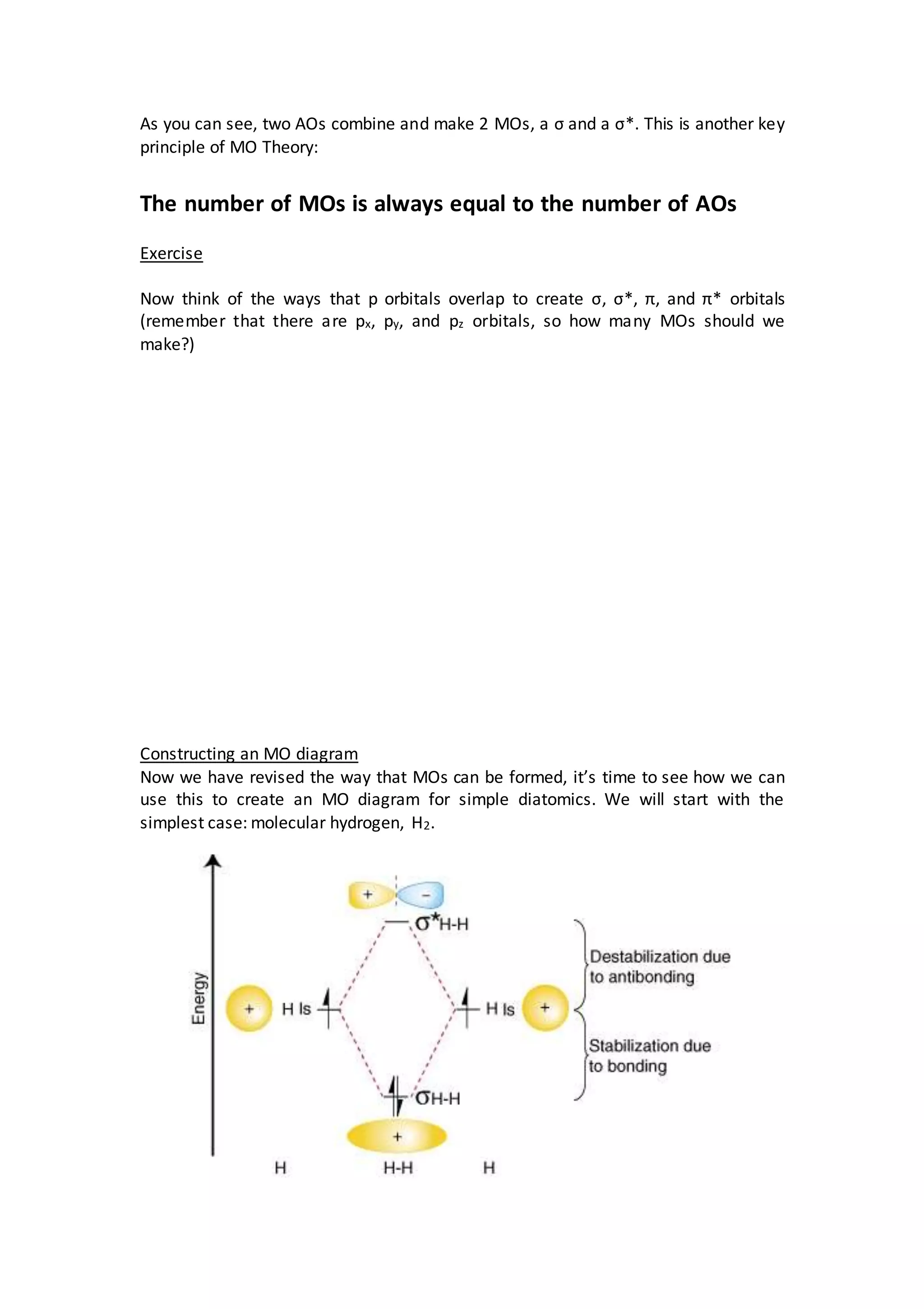
Good. Now the key is to think about how these can combine with each other. Here
you have to think about the overlap of these orbitals
As you can see, two AOs combine and make 2 MOs, a σ and a σ*. This is another key
principle of MO Theory:
The number of MOs is always equal to the number of AOs
Exercise
Now think of the ways that p orbitals overlap to create σ, σ*, π, and π* orbitals
(remember that there are px, py, and pz orbitals, so how many MOs should we
make?)
Constructing an MO diagram
Now we have revised the way that MOs can be formed, it’s time to see how we can
use this to create an MO diagram for simple diatomics. We will start with the
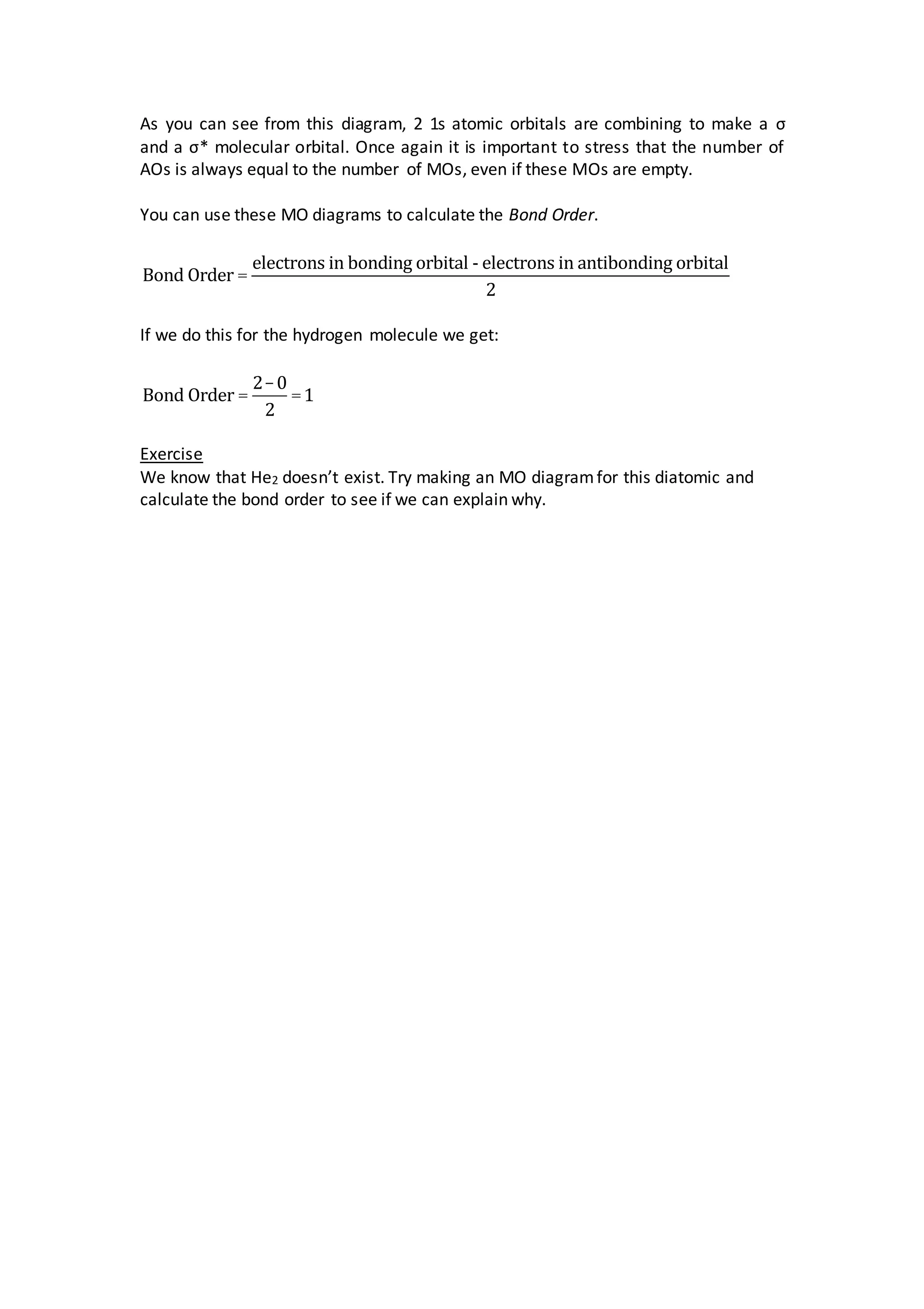
simplest case: molecular hydrogen, H2.
As you can see from this diagram, 2 1s atomic orbitals are combining to make a σ
and a σ* molecular orbital. Once again it is important to stress that the number of
AOs is always equal to the number of MOs, even if these MOs are empty.
You can use these MO diagrams to calculate the Bond Order.
Bond Order =
electrons in bonding orbital - electrons in antibonding orbital
2
If we do this for the hydrogen molecule we get:
Bond Order =
2-0
2
=1
Exercise
We know that He2 doesn’t exist. Try making an MO diagramfor this diatomic and
calculate the bond order to see if we can explain why.
Next Time:
 MO diagrams with π orbitals
 Hetero-diatomic MO diagrams
 Magnetism from MO diagrams
 Term symbols
Supplementary Exercise:
If you want to try something a little more complicated, draw the MO diagram for N2
and comment on the bonding. We will go through this in full next time.
Hints:
The electronic structure of nitrogen is 1s2, 2s2, 2p3
σ orbitals are lower in energy than π orbitals
σ* orbitals are higher in energy than π* orbitals
Orbitals of degenerate energy are drawn side by side

MO Theory Tutorial

  • 1.
    Molecular Orbital Theoryand Bond Order Learning Outcomes  Become comfortable with atomic orbitals, remembering shape and phase  Visualise how s and p orbitals combine  Use this knowledge to create MO diagrams for homo-diatomics  Use MO diagrams to calculate bond order Many first years find difficulty in getting their head around Molecular Orbital Theory (MO Theory). As with most things in chemistry, it can seem daunting at first, but with practice it becomes second nature. It may help you to try to visualise what is going on when atomic orbitals (AOs) combine to make molecular orbitals (MOs). The two important things here are shape and the phase of the AO. Exercise For now we are going to focus on s and p orbitals. Use the space below to draw an s and a p orbital (remember the phase). Good. Now the key is to think about how these can combine with each other. Here you have to think about the overlap of these orbitals
  • 2.
    As you cansee, two AOs combine and make 2 MOs, a σ and a σ*. This is another key principle of MO Theory: The number of MOs is always equal to the number of AOs Exercise Now think of the ways that p orbitals overlap to create σ, σ*, π, and π* orbitals (remember that there are px, py, and pz orbitals, so how many MOs should we make?) Constructing an MO diagram Now we have revised the way that MOs can be formed, it’s time to see how we can use this to create an MO diagram for simple diatomics. We will start with the simplest case: molecular hydrogen, H2.
  • 3.
    As you cansee from this diagram, 2 1s atomic orbitals are combining to make a σ and a σ* molecular orbital. Once again it is important to stress that the number of AOs is always equal to the number of MOs, even if these MOs are empty. You can use these MO diagrams to calculate the Bond Order. Bond Order = electrons in bonding orbital - electrons in antibonding orbital 2 If we do this for the hydrogen molecule we get: Bond Order = 2-0 2 =1 Exercise We know that He2 doesn’t exist. Try making an MO diagramfor this diatomic and calculate the bond order to see if we can explain why.
  • 4.
    Next Time:  MOdiagrams with π orbitals  Hetero-diatomic MO diagrams  Magnetism from MO diagrams  Term symbols Supplementary Exercise: If you want to try something a little more complicated, draw the MO diagram for N2 and comment on the bonding. We will go through this in full next time. Hints: The electronic structure of nitrogen is 1s2, 2s2, 2p3 σ orbitals are lower in energy than π orbitals σ* orbitals are higher in energy than π* orbitals Orbitals of degenerate energy are drawn side by side