College of Education Bridge Program

“Supporting the needs of teachers as they

transition from pre to in-service educators   ”


Western Oregon University, Oregon
Drs. Alicia Wenzel, Cindy Ryan, Carmen Cecada
Rationale for Bridge Program
• Teacher attrition has grown by 50 percent over the
  past fifteen years.

   – 46% of all new teachers in the US leave the
     profession within five years.

   – The national teacher turnover rate has risen to 16.8
     percent.

   – In urban schools it is over 20 percent.


                                      (Kain, 2011; NCES, 2010; NCTAF, 2007, 2010)
• “…inexperienced teachers often
  facing assignments in the most challenging
schools because that is where the openings are
 – but with little support, they burn out in a few
    years, feeding the churn of attrition and
 teacher turnover in these schools.” (NCTAF, 2007).
Strategies & Approaches

• What strategies & approaches are
  you using to support your new
  teachers as they transition from pre-
  to-inservice?
Recommendations

• Provide:
  – Mentoring (Kent et al, 2012; Moir et al, 2009)
  – Reflection, community, action, feedback (Hoban &
      Hastings, 1997)
  – Guided facilitative interaction (Shinoharam & Daehler, 2008)
  – Collaborative learning (Stoll et al, 2006)
  – Professional development (Fulton et al, 2010)
  – Opportunity for teachers to discuss… with others in
    trusted environments (Shinoharam & Daehler, 2008)
  – “Overlapping communities” (Artz & Curcio, 2008)
Framework:
Community of Practice
It is an aggregate of people who come together around a
mutual engagement. Ways of doing things, ways of
talking, beliefs – in short, practices –[that] emerge in the
course of this mutual endeavor.
     - (Eckert & McConnell-Ginet, 1999, p. 464, emphasis added)


Features needed to be considered a CofP.
a) mutual engagement
b) a jointly negotiated enterprise
c) a shared repertoire
 - (Wenger, 1998, pp. 76-78).
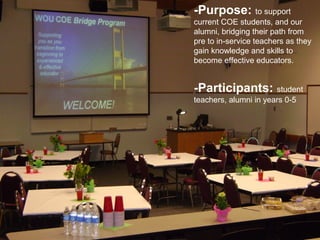
-Purpose: to support
current COE students, and our
alumni, bridging their path from
pre to in-service teachers as they
gain knowledge and skills to
become effective educators.


-Participants: student
teachers, alumni in years 0-5
Research Qs
• What challenges do novice teachers face as they
  transition from pre to in-service teachers?

• How can a Community of Practice help reduce negative
  feelings (ie: stress, frustration, anxiety) related to this
  transition and their new professional responsibilities, and
  help promote a collaborative network of professionals?

• What tools, strategies, knowledge, and skills can be
  incorporated in this Program that may help beginning
  teachers positively impact student success and increase
  teacher retention rates?
Methodology:
• Mixed methods approach blending exploratory and
  explanatory designs (Creswell, Plano Clark, Gutmann, &
  Hanson, 2003) with qualitative inquiry
   – Likert-scale & open-ended questions on surveys
      • Surveymonkey
   – Constant-comparison method (Strauss & Corbin, 1990)
   – Observational data, interviews, focus groups
Findings

• Preliminary evidence from the Program’s first meeting
  and survey responses indicate that participants find the
  following to be most beneficial:


        a) a non-evaluative CofP

        b) additional professional development

        c) “overlapping communities”

        d) time to reflect and opportunities to take action
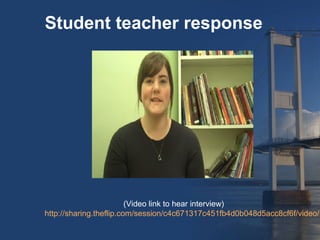
Student teacher response


                         (Video link to hear interview)
http://sharing.theflip.com/session/c4c671317c451fb4d0b048d5acc8cf6f/video/1
Alumni Response
•   “My name is Sarah. I graduated June 2012 . I have attended the BP as a
    student teacher last year and now as a graduate and licensed teacher…”


•   Favorite part –”talking with others in the education field…Teaching is an
    incredibly complex profession so it is reassuring to know others are
    experiencing the same challenges and yet still finding ways to successfully
    reach students…It was interesting (and helpful) to hear about the different paths
    people were on as teachers.”


•   Concerns:
    •   Addressing the individual needs of my students (C&I).
    •   Assessing to determine students' strengths and weaknesses, especially in
        reading
    •   Classroom Management


•   Believes the BP can: offer continuing education, links to teaching resources,
    support, and ideas from others in the field.
Challenges

•   Contact with alumni
•   Getting participants
•   Funding
•   PD needs
Implications

• Theoretical
   – New teachers will be better prepared & more effective
   – New teachers will remain in the profession
   – Students of new teachers will be more successful


• Research
   – Gain valuable information from the BP participants;
     leads to more areas to explore


• Practice
   – Strengthen TE Preparation Program areas
   – Deliver a just, inclusive, well-rounded program
Where next?

• Plan & host Winter meeting
• New grant for upcoming year –hopefully!
• Collect additional data
  – More interviews/focus groups
• Expand PD options during meetings
• Eventually, survey school district
  administrators
• Seek additional $$$
Resources:
•   National Center for Education Statistics. (2010). Teacher Attrition and Mobility , Results from 2008-
    2009 Teacher Follow Up Study. Retrieved November 20, 2012 from
    http://nces.ed.gov/pubs2010/2010353.pdf.
•   Kain, E. (2011). High Teacher Turnover Rates are a Big Problem for America’s Public Schools.
    Forbes . Retrieved December 1, 2012 from http://www.forbes.com/sites/erikkain/2011/03/08/high-
    teacher-turnover-rates-are-a-big-problem-for-americas-public-schools/.
•   Fulton, K.; Doeer, H.; & Britton, T. (2010). STEM Teachers in Professional Learning Communities:
    A Knowledge Synthesis. National Commission on Teaching and America’s Future and WestEd
    (NCTAF). Retrieved December 1, 2012 from http://nctaf.org/wp-
    content/uploads/STEMTeachersinProfessionalLearningCommunities.AKnowledgeSynthesis.pdf.
•   Barnes, G.; Crowe, E.; & Schaefer, B. (2007). The Cost of Teacher Turnover in Five School
    Districts: A Pilot Study. National Commission on Teaching and America’s Future and WestEd
    (NCTAF). Retrieved December 3, 2012 from http://nctaf.org/wp-content/uploads/2012/01/NCTAF-
    Cost-of-Teacher-Turnover-2007-full-report.pdf.
•   Moir, E.; Barlin, D.; Gless, J.; & Miles, J. (2009). New Teacher Mentoring: Hopes and Promise for
    Improving Teacher Effectiveness. Cambridge, MA :Harvard Education Press
•   Kent, A..; Green, A.; & Feldman, P. (2012). Fostering the Success of New Teachers: Developing
    Lead Teachers in a Statewide Teacher Mentoring Program. Current Issues in Education, Vol 15(3).
    Retrieved December 10, 2012 from
    http://cie.asu.edu/ojs/index.php/cieatasu/article/viewFile/988/373.
•   Western OR University, COE Bridge Program web page: http://coebridgeprogram.yolasite.com/

Bridge Program presentation for HICE

  • 1.
    College of EducationBridge Program “Supporting the needs of teachers as they transition from pre to in-service educators ” Western Oregon University, Oregon Drs. Alicia Wenzel, Cindy Ryan, Carmen Cecada
  • 2.
    Rationale for BridgeProgram • Teacher attrition has grown by 50 percent over the past fifteen years. – 46% of all new teachers in the US leave the profession within five years. – The national teacher turnover rate has risen to 16.8 percent. – In urban schools it is over 20 percent. (Kain, 2011; NCES, 2010; NCTAF, 2007, 2010)
  • 3.
    • “…inexperienced teachersoften facing assignments in the most challenging schools because that is where the openings are – but with little support, they burn out in a few years, feeding the churn of attrition and teacher turnover in these schools.” (NCTAF, 2007).
  • 4.
    Strategies & Approaches •What strategies & approaches are you using to support your new teachers as they transition from pre- to-inservice?
  • 5.
    Recommendations • Provide: – Mentoring (Kent et al, 2012; Moir et al, 2009) – Reflection, community, action, feedback (Hoban & Hastings, 1997) – Guided facilitative interaction (Shinoharam & Daehler, 2008) – Collaborative learning (Stoll et al, 2006) – Professional development (Fulton et al, 2010) – Opportunity for teachers to discuss… with others in trusted environments (Shinoharam & Daehler, 2008) – “Overlapping communities” (Artz & Curcio, 2008)
  • 6.
    Framework: Community of Practice Itis an aggregate of people who come together around a mutual engagement. Ways of doing things, ways of talking, beliefs – in short, practices –[that] emerge in the course of this mutual endeavor. - (Eckert & McConnell-Ginet, 1999, p. 464, emphasis added) Features needed to be considered a CofP. a) mutual engagement b) a jointly negotiated enterprise c) a shared repertoire - (Wenger, 1998, pp. 76-78).
  • 7.
    -Purpose: to support currentCOE students, and our alumni, bridging their path from pre to in-service teachers as they gain knowledge and skills to become effective educators. -Participants: student teachers, alumni in years 0-5
  • 9.
    Research Qs • Whatchallenges do novice teachers face as they transition from pre to in-service teachers? • How can a Community of Practice help reduce negative feelings (ie: stress, frustration, anxiety) related to this transition and their new professional responsibilities, and help promote a collaborative network of professionals? • What tools, strategies, knowledge, and skills can be incorporated in this Program that may help beginning teachers positively impact student success and increase teacher retention rates?
  • 10.
    Methodology: • Mixed methodsapproach blending exploratory and explanatory designs (Creswell, Plano Clark, Gutmann, & Hanson, 2003) with qualitative inquiry – Likert-scale & open-ended questions on surveys • Surveymonkey – Constant-comparison method (Strauss & Corbin, 1990) – Observational data, interviews, focus groups
  • 11.
    Findings • Preliminary evidencefrom the Program’s first meeting and survey responses indicate that participants find the following to be most beneficial: a) a non-evaluative CofP b) additional professional development c) “overlapping communities” d) time to reflect and opportunities to take action
  • 12.
    Student teacher response (Video link to hear interview) http://sharing.theflip.com/session/c4c671317c451fb4d0b048d5acc8cf6f/video/1
  • 13.
    Alumni Response • “My name is Sarah. I graduated June 2012 . I have attended the BP as a student teacher last year and now as a graduate and licensed teacher…” • Favorite part –”talking with others in the education field…Teaching is an incredibly complex profession so it is reassuring to know others are experiencing the same challenges and yet still finding ways to successfully reach students…It was interesting (and helpful) to hear about the different paths people were on as teachers.” • Concerns: • Addressing the individual needs of my students (C&I). • Assessing to determine students' strengths and weaknesses, especially in reading • Classroom Management • Believes the BP can: offer continuing education, links to teaching resources, support, and ideas from others in the field.
  • 14.
    Challenges • Contact with alumni • Getting participants • Funding • PD needs
  • 15.
    Implications • Theoretical – New teachers will be better prepared & more effective – New teachers will remain in the profession – Students of new teachers will be more successful • Research – Gain valuable information from the BP participants; leads to more areas to explore • Practice – Strengthen TE Preparation Program areas – Deliver a just, inclusive, well-rounded program
  • 16.
    Where next? • Plan& host Winter meeting • New grant for upcoming year –hopefully! • Collect additional data – More interviews/focus groups • Expand PD options during meetings • Eventually, survey school district administrators • Seek additional $$$
  • 17.
    Resources: • National Center for Education Statistics. (2010). Teacher Attrition and Mobility , Results from 2008- 2009 Teacher Follow Up Study. Retrieved November 20, 2012 from http://nces.ed.gov/pubs2010/2010353.pdf. • Kain, E. (2011). High Teacher Turnover Rates are a Big Problem for America’s Public Schools. Forbes . Retrieved December 1, 2012 from http://www.forbes.com/sites/erikkain/2011/03/08/high- teacher-turnover-rates-are-a-big-problem-for-americas-public-schools/. • Fulton, K.; Doeer, H.; & Britton, T. (2010). STEM Teachers in Professional Learning Communities: A Knowledge Synthesis. National Commission on Teaching and America’s Future and WestEd (NCTAF). Retrieved December 1, 2012 from http://nctaf.org/wp- content/uploads/STEMTeachersinProfessionalLearningCommunities.AKnowledgeSynthesis.pdf. • Barnes, G.; Crowe, E.; & Schaefer, B. (2007). The Cost of Teacher Turnover in Five School Districts: A Pilot Study. National Commission on Teaching and America’s Future and WestEd (NCTAF). Retrieved December 3, 2012 from http://nctaf.org/wp-content/uploads/2012/01/NCTAF- Cost-of-Teacher-Turnover-2007-full-report.pdf. • Moir, E.; Barlin, D.; Gless, J.; & Miles, J. (2009). New Teacher Mentoring: Hopes and Promise for Improving Teacher Effectiveness. Cambridge, MA :Harvard Education Press • Kent, A..; Green, A.; & Feldman, P. (2012). Fostering the Success of New Teachers: Developing Lead Teachers in a Statewide Teacher Mentoring Program. Current Issues in Education, Vol 15(3). Retrieved December 10, 2012 from http://cie.asu.edu/ojs/index.php/cieatasu/article/viewFile/988/373. • Western OR University, COE Bridge Program web page: http://coebridgeprogram.yolasite.com/

Editor's Notes

  • #7 Wenger states that “communities of practice are formed by people who engage in a process of collective learning in a shared domain of human endeavor…In a nutshell: Communities of practice are groups of people who share a concern or a passion for something they do and learn how to do it better as they interact regularly.” Smith (2009) discussing Wenger’s ideas explain that the idea of a CofP is that formal or informal groups of people are brought together because of shared interest and learning working towards a common educational goal. All groups are not considered CofP as a CofP goes beyond co-existence to co-participation. This type of participation requires a degree of commitment between the participants which creates customs unique to them and their situation. “The interaction involved, and the ability to undertake larger or more complex activities and projects through cooperation, bind people together and help facilitate relationship and trust” (Smith, 2009). These negotiated, co-participatory practices are what build CofP. And, this is what the Program aspires to create and nurture for its participants.
  • #8 Purpose and participants: We seek to address the mounting attrition issue of novice teachers by creating a supportive community of practice (Wenger, 1998) for pre- and in-service teachers as they transition from teacher candidates to expert teachers. Thus, a program has been created called the “Bridge Program” which meets once each term, on campus, for students in their last term of the teacher education program and novice teachers in their first five years of service. It is our goal to help novice teachers and teachers-to-be gain additional knowledge and skills to effectively tackle their new (and future) roles and responsibilities in an atmosphere free of evaluation and where they can gain a sense of community by sharing of resources and collaborative problem-solving. The purpose of this study is to explore challenges novice teachers experience and to identify what support can be offered at colleges of education in an attempt to bridge the gap between pre-service and in-service by addressing the needs of teachers during their first five years of service. Our objective is to find additional ways to reduce the exodus of competent and confident beginning educators, such as through collaborative learning, mentorship, and professional development, and in turn, increase achievement for all students and increase achievement for all students.
  • #12 a) find a non-evaluative CofP to be a necessary support mechanism to help them navigate successfully though their responsibilities and challenges, b) want to have additional professional development in the areas of classroom management, assessment, technology integration, and meeting the needs of diverse learners particularly students receiving special education services and English Language Learners, c) find the “overlapping communities” of varying experiences and grade/content levels strengthen their knowledge and skills d) see that time to reflect and feel they are doing something (aka: take action) to help them improve are key to student and teacher success
  • #13 In short, this student teacher found collaboration with others at the BP, who were further along in their careers and who were in other grade levels, to be extremely useful. She discovered that the meetings were
  • #14 Sarah is “I am currently a substitute teacher and I will again be full-time subbing from spring break until the end of the year” Sarah shared that she feels she may not be adequately prepared to create differentiated instruction and assessment for students Also, she stated that she has concerns about how to deal with extreme behaviors in my classroom that require constant attention and distract the rest of the class from learning? On a side note, she shared that she was suddenly inspired to start taking graduate classes...beginning next term...so I will be going to WOU next week to figure out enrollment and financial aid.  I am hoping to enroll in your ED611 class online:)   So, when I realized I had the next 3 months with less commitment I decided it would be crazy not to get started.  Yay!  I love being in school!
  • #16 Theory extends our knowledge on what we know about how to support new teachers and those about to enter the profession Research Helps up gain valuable information from the BP participants about what they perceive is needed as they transition from student teacher to teacher of students Practice Use knowledge gained in our TE Program as we work with teacher candidates seeking to strengthen areas such as differentiated C&I, assessment, classroom management, technology integration, ELL/SpEd effectively fulfilling professional responsibilities, etc.