



Ajmal Faizy
Institute of Management in Kerala
University campus, Kariavattom, TVM
 One of the most controversial outcome of UR
is the agreement Related Aspects of
Intellectual Property Rights including
Counterfeit Goods.
 TRIPS along with TRIMS and services were
called the “new issues” negotiated in
Uruguay Round.
 IPRs may be defined as “information with a
commercial value”.
 IPRs may be legally protected by patents
copyrights, industrial designs, geographical
indications, and trade marks.
 Special forms of protection have also
emerged to address specific needs of
knowledge producers as in the case of plant
breeder’s rights and the protection of layout
designs of integrated circuits.
 Some countries have laws to protect
information that gives a competitive
advantage.
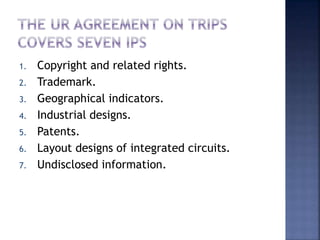
1. Copyright and related rights.
2. Trademark.
3. Geographical indicators.
4. Industrial designs.
5. Patents.
6. Layout designs of integrated circuits.
7. Undisclosed information.
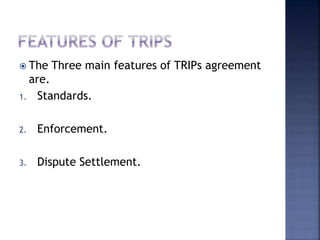
 The Three main features of TRIPs agreement
are.
1. Standards.
2. Enforcement.
3. Dispute Settlement.
 The Agreement sets out the minimum
standards of protection to be provided by
each Member.
 Each of the main elements of protection is
defined, namely the subject-matter to be
protected, the rights to be conferred and
permissible exceptions to those rights, and
the minimum duration of protection
 The Agreement sets these standards by requiring, first,
that the substantive obligations of the main conventions
of the WIPO, the Paris Convention for the Protection of
Industrial Property (Paris Convention) and the Berne
Convention for the Protection of Literary and Artistic
Works (Berne Convention) in their most recent versions,
must be complied with.
 The TRIPS Agreement is thus sometimes referred to as a
Berne and Paris-plus agreement.
 The Agreement lays down certain general
principles applicable to all IPR enforcement
procedures.
 In addition, it contains provisions on civil and
administrative procedures and remedies,
provisional measures, special requirements
related to border measures and criminal
procedures’
 The procedures and remedies that must be
available so that right holders can effectively
enforce their rights.
 The Agreement provides for certain basic principles, such
as national and most-favoured-nation treatment, and some
general rules to ensure that procedural difficulties in
acquiring or maintaining IPRs do not nullify the substantive
benefits that should flow from the Agreement.
 The obligations under the Agreement will apply equally to
all Member countries, but developing countries will have a
longer period to phase them.
 Special transition arrangements operate in the situation
where a developing country does not presently provide
product patent protection in the area of pharmaceuticals.
 Article 1- 8 contains the general principles.
 Article 9-13 deals with copyrights.
 Article 14-14.6 deals with related rights.
 Article 15-20 deals with trade marks.
 Article 22-24 deals with geographical
indications.
 Articles 25-26.4 deals with industrial
designs.
 Article 27-34 deals with patents.
 Article 35-37.2 deals with Layout designs of
integrated circuits.
 Article 39 deals with protection of un
disclosed information.
 Article 40 deals with Control of anti-
competitive practices in contractual
licenses.
 Business Environment and policy- FRANCIS
CHERUNILAM.
 www.wto.org.in
THANKYOU

Trips

  • 1.
    Ajmal Faizy Institute ofManagement in Kerala University campus, Kariavattom, TVM
  • 2.
     One ofthe most controversial outcome of UR is the agreement Related Aspects of Intellectual Property Rights including Counterfeit Goods.  TRIPS along with TRIMS and services were called the “new issues” negotiated in Uruguay Round.  IPRs may be defined as “information with a commercial value”.
  • 3.
     IPRs maybe legally protected by patents copyrights, industrial designs, geographical indications, and trade marks.  Special forms of protection have also emerged to address specific needs of knowledge producers as in the case of plant breeder’s rights and the protection of layout designs of integrated circuits.  Some countries have laws to protect information that gives a competitive advantage.
  • 4.
    1. Copyright andrelated rights. 2. Trademark. 3. Geographical indicators. 4. Industrial designs. 5. Patents. 6. Layout designs of integrated circuits. 7. Undisclosed information.
  • 5.
     The Threemain features of TRIPs agreement are. 1. Standards. 2. Enforcement. 3. Dispute Settlement.
  • 6.
     The Agreementsets out the minimum standards of protection to be provided by each Member.  Each of the main elements of protection is defined, namely the subject-matter to be protected, the rights to be conferred and permissible exceptions to those rights, and the minimum duration of protection
  • 7.
     The Agreementsets these standards by requiring, first, that the substantive obligations of the main conventions of the WIPO, the Paris Convention for the Protection of Industrial Property (Paris Convention) and the Berne Convention for the Protection of Literary and Artistic Works (Berne Convention) in their most recent versions, must be complied with.  The TRIPS Agreement is thus sometimes referred to as a Berne and Paris-plus agreement.
  • 8.
     The Agreementlays down certain general principles applicable to all IPR enforcement procedures.  In addition, it contains provisions on civil and administrative procedures and remedies, provisional measures, special requirements related to border measures and criminal procedures’  The procedures and remedies that must be available so that right holders can effectively enforce their rights.
  • 9.
     The Agreementprovides for certain basic principles, such as national and most-favoured-nation treatment, and some general rules to ensure that procedural difficulties in acquiring or maintaining IPRs do not nullify the substantive benefits that should flow from the Agreement.  The obligations under the Agreement will apply equally to all Member countries, but developing countries will have a longer period to phase them.  Special transition arrangements operate in the situation where a developing country does not presently provide product patent protection in the area of pharmaceuticals.
  • 10.
     Article 1-8 contains the general principles.  Article 9-13 deals with copyrights.  Article 14-14.6 deals with related rights.  Article 15-20 deals with trade marks.  Article 22-24 deals with geographical indications.  Articles 25-26.4 deals with industrial designs.  Article 27-34 deals with patents.
  • 11.
     Article 35-37.2deals with Layout designs of integrated circuits.  Article 39 deals with protection of un disclosed information.  Article 40 deals with Control of anti- competitive practices in contractual licenses.
  • 12.
     Business Environmentand policy- FRANCIS CHERUNILAM.  www.wto.org.in
  • 13.