CONTENTS
 What is Compulsory Licensing of Patent
in India
 Objectives of Compulsory Licensing
 Section 84 of Indian Patent Act pertains to
the grant of Compulsory Licenses
 India’s First Compulsory License of
Patents
What is Compulsory Licensing of Patent in
India:
 Patents in India are granted to encourage inventions
and to secure that it is worked on a commercial
scale. The India Patent Act ensures that a Patentee
should not be able to enjoy a Monopoly for the
importation of the patented article.
 The Patent Act provides measures by way of
Compulsory Licensing (CL) to ensure that the
patents do not impede/prevent the protection health
and the Patent Rights are not abused by the
Patentee.
Objectives of Compulsory Licensing
 To rewarding Patentees for their invention
 Making the patented products, particularly
pharmaceutical products, available to large
population in developing and under developed
countries at a cheaper and reasonable price.
Section 84 of Indian Patent Act pertains to
the grant of Compulsory Licenses
Grant of Compulsory License due to “Non-
working/Unaffordable Prices of Patented Article”
(Section 84):
 Section 84 of India Patent Act pertains to the grant
of Compulsory Licenses.
Compulsory Licenses are grated in order to:
 To prevent the abuse of patent as a Monopoly
 Make a way for commercial exploitation of the patented
invention by an interested person; and
Address the public health concern/worry in India.
 Any person interested or already the holder of the
licence under the patent can make request to the
controller for grant of Compulsory Licence on patent
after three years form the “date of grant” of that
patent, on the following ground:
 Reasonable requirements of public have not been
satisfied; or
Patented invention is not available to the public at
affordable price; or
Patented invention is not worked in the
territory/region of India
 The controller takes following aspects into
consideration while granting Compulsory
Licence:
a) Nature of the invention, i.e. complexity of the
technology;
b) Time which has elapsed since the grant of the
patent i.e. despite of the best efforts by the
patentee or licensee since the grant of patent, it
was difficult to work out the invention at
commercial scale to its fullest before the
application of the compulsory licence was filed
to the Patent Office;
c) The measures already taken by the patentee or
any licensee to make full use of the invention;
d) Ability of the applicant to work the invention to the
public advantage;
e) Capacity of the applicant to undertake the risk in
providing capital and working the invention, if
application were granted;
f) Applicant has made full efforts to obtain a licence
from the patentee on reasonable terms and
conditions and such efforts have not been successful
within a reasonable period construed as a period not
ordinarily exceeding a period of 6 months.
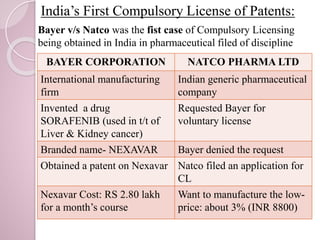
India’s First Compulsory License of Patents:
Bayer v/s Natco was the fist case of Compulsory Licensing
being obtained in India in pharmaceutical filed of discipline
BAYER CORPORATION NATCO PHARMA LTD
International manufacturing
firm
Indian generic pharmaceutical
company
Invented a drug
SORAFENIB (used in t/t of
Liver & Kidney cancer)
Requested Bayer for
voluntary license
Branded name- NEXAVAR Bayer denied the request
Obtained a patent on Nexavar Natco filed an application for
CL
Nexavar Cost: RS 2.80 lakh
for a month’s course
Want to manufacture the low-
price: about 3% (INR 8800)
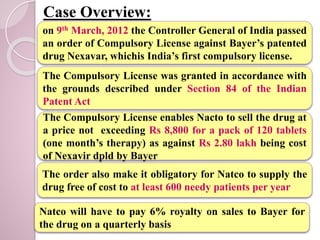
Case Overview:
on 9th March, 2012 the Controller General of India passed
an order of Compulsory License against Bayer’s patented
drug Nexavar, whichis India’s first compulsory license.
The Compulsory License was granted in accordance with
the grounds described under Section 84 of the Indian
Patent Act
The Compulsory License enables Nacto to sell the drug at
a price not exceeding Rs 8,800 for a pack of 120 tablets
(one month’s therapy) as against Rs 2.80 lakh being cost
of Nexavir dpld by Bayer
The order also make it obligatory for Natco to supply the
drug free of cost to at least 600 needy patients per year
Natco will have to pay 6% royalty on sales to Bayer for
the drug on a quarterly basis
CONCLUSION
So, it can be concluded that Compulsory
licensing now became the new hope the
financially challenged patients while
challenge for the innovators and at last we
can say that it turns into the most
concerned Intellectual Property matter
around the globe at this present scenario.
Compulsory licensing by surendra

Compulsory licensing by surendra

  • 2.
    CONTENTS  What isCompulsory Licensing of Patent in India  Objectives of Compulsory Licensing  Section 84 of Indian Patent Act pertains to the grant of Compulsory Licenses  India’s First Compulsory License of Patents
  • 3.
    What is CompulsoryLicensing of Patent in India:  Patents in India are granted to encourage inventions and to secure that it is worked on a commercial scale. The India Patent Act ensures that a Patentee should not be able to enjoy a Monopoly for the importation of the patented article.  The Patent Act provides measures by way of Compulsory Licensing (CL) to ensure that the patents do not impede/prevent the protection health and the Patent Rights are not abused by the Patentee.
  • 4.
    Objectives of CompulsoryLicensing  To rewarding Patentees for their invention  Making the patented products, particularly pharmaceutical products, available to large population in developing and under developed countries at a cheaper and reasonable price.
  • 5.
    Section 84 ofIndian Patent Act pertains to the grant of Compulsory Licenses Grant of Compulsory License due to “Non- working/Unaffordable Prices of Patented Article” (Section 84):  Section 84 of India Patent Act pertains to the grant of Compulsory Licenses. Compulsory Licenses are grated in order to:  To prevent the abuse of patent as a Monopoly  Make a way for commercial exploitation of the patented invention by an interested person; and Address the public health concern/worry in India.
  • 6.
     Any personinterested or already the holder of the licence under the patent can make request to the controller for grant of Compulsory Licence on patent after three years form the “date of grant” of that patent, on the following ground:  Reasonable requirements of public have not been satisfied; or Patented invention is not available to the public at affordable price; or Patented invention is not worked in the territory/region of India
  • 7.
     The controllertakes following aspects into consideration while granting Compulsory Licence: a) Nature of the invention, i.e. complexity of the technology; b) Time which has elapsed since the grant of the patent i.e. despite of the best efforts by the patentee or licensee since the grant of patent, it was difficult to work out the invention at commercial scale to its fullest before the application of the compulsory licence was filed to the Patent Office; c) The measures already taken by the patentee or any licensee to make full use of the invention;
  • 8.
    d) Ability ofthe applicant to work the invention to the public advantage; e) Capacity of the applicant to undertake the risk in providing capital and working the invention, if application were granted; f) Applicant has made full efforts to obtain a licence from the patentee on reasonable terms and conditions and such efforts have not been successful within a reasonable period construed as a period not ordinarily exceeding a period of 6 months.
  • 9.
    India’s First CompulsoryLicense of Patents: Bayer v/s Natco was the fist case of Compulsory Licensing being obtained in India in pharmaceutical filed of discipline BAYER CORPORATION NATCO PHARMA LTD International manufacturing firm Indian generic pharmaceutical company Invented a drug SORAFENIB (used in t/t of Liver & Kidney cancer) Requested Bayer for voluntary license Branded name- NEXAVAR Bayer denied the request Obtained a patent on Nexavar Natco filed an application for CL Nexavar Cost: RS 2.80 lakh for a month’s course Want to manufacture the low- price: about 3% (INR 8800)
  • 10.
    Case Overview: on 9thMarch, 2012 the Controller General of India passed an order of Compulsory License against Bayer’s patented drug Nexavar, whichis India’s first compulsory license. The Compulsory License was granted in accordance with the grounds described under Section 84 of the Indian Patent Act The Compulsory License enables Nacto to sell the drug at a price not exceeding Rs 8,800 for a pack of 120 tablets (one month’s therapy) as against Rs 2.80 lakh being cost of Nexavir dpld by Bayer The order also make it obligatory for Natco to supply the drug free of cost to at least 600 needy patients per year Natco will have to pay 6% royalty on sales to Bayer for the drug on a quarterly basis
  • 11.
    CONCLUSION So, it canbe concluded that Compulsory licensing now became the new hope the financially challenged patients while challenge for the innovators and at last we can say that it turns into the most concerned Intellectual Property matter around the globe at this present scenario.