
PATENT
PREPARED BY:
Mr. Prem Patil.
(M.Pharm+MBA)
GUIDED BY:
Mrs.Swati Gupta
(Pharmaceutics)
 APEEJAY STYA UNIVERSITY,
SOHNA,

 CONTENTS
 Introduction
 Intellactual property
 IPR Offices in India
 What is an Invention
 What is patent
 History of patent
 Types of patents
 What can be patented?
 What can not be patented?
 Stages to obtain a patent.
 Benificiaries of patent grant.
I. patentee
II. sociaty
 What rights do patent bring?
 Patent information.
 Importance of patent information.
 Contents of patent doccument.
 Limitations of patent.
 Conclusion.
 References.
PATENT

PATENTS
DESIGNS
TRADEMARK
COPYRIGHT
GEOGRAPHICAL INDICATORS
INTELLACTUAL
PROPERTY RIGHTS

 WHAT IS AN INVENTION
• Any new or useful
• Process or method
• Machine or apparatus
• Article of manufacture
• Improvements of any of the above
INVENTION

 The word patent originates from the Latin patere, which means "to
lay open" (i.e., to make available for public inspection). which was
a royal decree granting exclusive rights to a person, predating the
modern patent system. Similar grants included land patents, which
were land grants by early state governments in the USA,
and printing patents, a precursor of modern copyright.
 In modern usage, the term patent usually refers to the right granted
to anyone who invents any new, useful, and non-obvious process,
machine, article of manufacture, or composition of matter.
 Some other types of intellectual property rights are also
called patents in some jurisdictions: industrial design rights are
called design patents in the US, plant breeders' rights are sometimes
called plant patents.
 A patent is an exclusive monopoly grant by the govt. of an inventor over
his invention for limited period of time
PATENT

year role
1856 The act of 1856 on protection of
invention
1911 Indian patents and design act
1970 Patents act
-only process patents[14 years, 7
years (food,/drug)]
1999 India sign TRIPS
-process and product patents in all
fields
1999,2002,2004 Amendment's for the efficacy of the
act
2005 Indian patents act, 2005
-process and product patents [20
PATENT

 There are three types of patents:
 1) Utility patents may be granted to anyone who invents
or discovers any new and useful process, machine,
article of manufacture, or composition of matter, or any
new and useful improvement thereof;
 2) Design patents may be granted to anyone who invents
a new, original, and ornamental design for an article of
manufacture; and
 3) Plant patents may be granted to anyone who invents
or discovers and asexually reproduces any distinct and
new variety of plant.
 4) Reissue patents
TYPES OF PATENTS

 Any invention which must be
 Novel
 Non-obvious
 Capable of industrial application
 Must not be declared as non-patentable under the patent
act.
WHAT CAN BE
PATENTED?

 Any artistic creation
 Mathematical methods
 Buisness schemes.
 Anything against universal law.
WHAT CAN NOT BE
PATENTED?

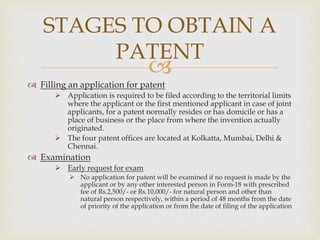
 Filling an application for patent
 Application is required to be filed according to the territorial limits
where the applicant or the first mentioned applicant in case of joint
applicants, for a patent normally resides or has domicile or has a
place of business or the place from where the invention actually
originated.
 The four patent offices are located at Kolkatta, Mumbai, Delhi &
Chennai.
 Examination
 Early request for exam
 No application for patent will be examined if no request is made by the
applicant or by any other interested person in Form-18 with prescribed
fee of Rs.2,500/- or Rs.10,000/- for natural person and other than
natural person respectively, within a period of 48 months from the date
of priority of the application or from the date of filing of the application
STAGES TO OBTAIN A
PATENT

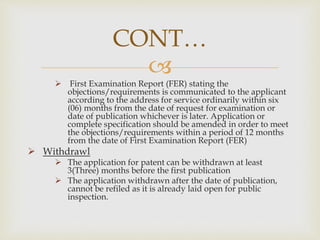
 First Examination Report (FER) stating the
objections/requirements is communicated to the applicant
according to the address for service ordinarily within six
(06) months from the date of request for examination or
date of publication whichever is later. Application or
complete specification should be amended in order to meet
the objections/requirements within a period of 12 months
from the date of First Examination Report (FER)
 Withdrawl
 The application for patent can be withdrawn at least
3(Three) months before the first publication
 The application withdrawn after the date of publication,
cannot be refiled as it is already laid open for public
inspection.
CONT…

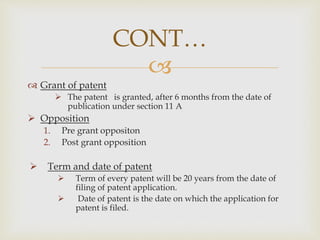
 Grant of patent
 The patent is granted, after 6 months from the date of
publication under section 11 A
 Opposition
1. Pre grant oppositon
2. Post grant opposition
 Term and date of patent
 Term of every patent will be 20 years from the date of
filing of patent application.
 Date of patent is the date on which the application for
patent is filed.
CONT…

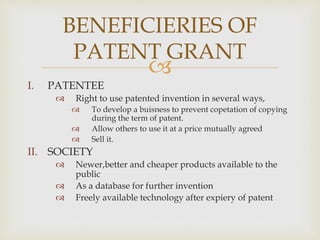
I. PATENTEE
 Right to use patented invention in several ways,
 To develop a buisness to prevent copetation of copying
during the term of patent.
 Allow others to use it at a price mutually agreed
 Sell it.
II. SOCIETY
 Newer,better and cheaper products available to the
public
 As a database for further invention
 Freely available technology after expiery of patent
BENEFICIERIES OF
PATENT GRANT

 A bargain between patentee and government
 Patentee gets exclusive rights to his invention
 Government gets rights to publish the full invention
 A negative right
 Patentee may exploit the invention
 Patentee gets rights to take legal action against the
infrigerers.
WHAT RIGHTS DO
PATENT BRING?

 Information related to inventions disclosed in a
patent document
 Which information does a patent document provide?
 What is the technology field of the invention?
 Which technical problem is solveed and how?
 What is the prior art?
 Who is the inventor?
 When and where the application for patent was filled?
 Name and the address of the inventor..
PATENT
INFORMATION

I. To researcher/inventor in industry/ R & D
organization/university:
 To avoid duplication of research.
 To find ready solutions to technical problems in ongoing
research.
 To keep up to date with developments in technology
field.
II. To industry:
 To improve existing technology.
 To increase production.
 To identify sutaible technologies for adaptation.
IMPORTANCE OF
PATENT INFORMATION

III. To buisness enterprises:
 To identify new products for marketing.
 To find out patent owners.
IV. Consultants and planners:
 To advice industry / R&D / financial institutions on
issues related to technology.
 To find out a new technology for buisness.
CONT…

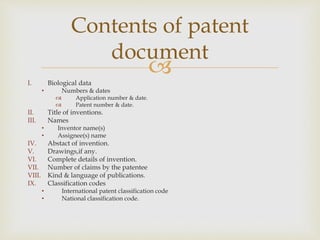
I. Biological data
• Numbers & dates
 Application number & date.
 Patent number & date.
II. Title of inventions.
III. Names
• Inventor name(s)
• Assignee(s) name
IV. Abstact of invention.
V. Drawings,if any.
VI. Complete details of invention.
VII. Number of claims by the patentee
VIII. Kind & language of publications.
IX. Classification codes
• International patent classification code
• National classification code.
Contents of patent
document

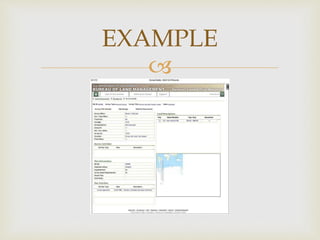
EXAMPLE

 Cost
 Time
 Loss of information
 Infrigerers
 Exploitation of invention by inventor.
LIMITATIONS OF
PATENT

 N. R. Subbaram, what everyone should know about patents, 2nd
edition, pharma book syndicate, 17:104 (2005)
 Guide to patent information for users in India, patent
information system, nagpur, 7:27
 T.T.Lang, intellactual property: patent procedure and
requirments of patentability, Parlee McLaws LLP baristores
soliscitors.
 Mark J. Nulle, Are you protected? Some basics of patent, Birch,
Stewart, Kolasch and Birch LLP sept 2003
 Legisalative framework of IP Administration, D.P.S. Parmar,
Deputy controller of patents and design.
 S. Chandrashekharan, Overview of IPR Patent System and
Practice.
REFERENCES

THANKING YOU…

Copying

  • 1.
     PATENT PREPARED BY: Mr. PremPatil. (M.Pharm+MBA) GUIDED BY: Mrs.Swati Gupta (Pharmaceutics)  APEEJAY STYA UNIVERSITY, SOHNA,
  • 2.
      CONTENTS  Introduction Intellactual property  IPR Offices in India  What is an Invention  What is patent  History of patent  Types of patents  What can be patented?  What can not be patented?  Stages to obtain a patent.  Benificiaries of patent grant. I. patentee II. sociaty  What rights do patent bring?  Patent information.  Importance of patent information.  Contents of patent doccument.  Limitations of patent.  Conclusion.  References. PATENT
  • 3.
  • 4.
      WHAT ISAN INVENTION • Any new or useful • Process or method • Machine or apparatus • Article of manufacture • Improvements of any of the above INVENTION
  • 5.
      The wordpatent originates from the Latin patere, which means "to lay open" (i.e., to make available for public inspection). which was a royal decree granting exclusive rights to a person, predating the modern patent system. Similar grants included land patents, which were land grants by early state governments in the USA, and printing patents, a precursor of modern copyright.  In modern usage, the term patent usually refers to the right granted to anyone who invents any new, useful, and non-obvious process, machine, article of manufacture, or composition of matter.  Some other types of intellectual property rights are also called patents in some jurisdictions: industrial design rights are called design patents in the US, plant breeders' rights are sometimes called plant patents.  A patent is an exclusive monopoly grant by the govt. of an inventor over his invention for limited period of time PATENT
  • 6.
     year role 1856 Theact of 1856 on protection of invention 1911 Indian patents and design act 1970 Patents act -only process patents[14 years, 7 years (food,/drug)] 1999 India sign TRIPS -process and product patents in all fields 1999,2002,2004 Amendment's for the efficacy of the act 2005 Indian patents act, 2005 -process and product patents [20 PATENT
  • 7.
      There arethree types of patents:  1) Utility patents may be granted to anyone who invents or discovers any new and useful process, machine, article of manufacture, or composition of matter, or any new and useful improvement thereof;  2) Design patents may be granted to anyone who invents a new, original, and ornamental design for an article of manufacture; and  3) Plant patents may be granted to anyone who invents or discovers and asexually reproduces any distinct and new variety of plant.  4) Reissue patents TYPES OF PATENTS
  • 8.
      Any inventionwhich must be  Novel  Non-obvious  Capable of industrial application  Must not be declared as non-patentable under the patent act. WHAT CAN BE PATENTED?
  • 9.
      Any artisticcreation  Mathematical methods  Buisness schemes.  Anything against universal law. WHAT CAN NOT BE PATENTED?
  • 10.
      Filling anapplication for patent  Application is required to be filed according to the territorial limits where the applicant or the first mentioned applicant in case of joint applicants, for a patent normally resides or has domicile or has a place of business or the place from where the invention actually originated.  The four patent offices are located at Kolkatta, Mumbai, Delhi & Chennai.  Examination  Early request for exam  No application for patent will be examined if no request is made by the applicant or by any other interested person in Form-18 with prescribed fee of Rs.2,500/- or Rs.10,000/- for natural person and other than natural person respectively, within a period of 48 months from the date of priority of the application or from the date of filing of the application STAGES TO OBTAIN A PATENT
  • 11.
      First ExaminationReport (FER) stating the objections/requirements is communicated to the applicant according to the address for service ordinarily within six (06) months from the date of request for examination or date of publication whichever is later. Application or complete specification should be amended in order to meet the objections/requirements within a period of 12 months from the date of First Examination Report (FER)  Withdrawl  The application for patent can be withdrawn at least 3(Three) months before the first publication  The application withdrawn after the date of publication, cannot be refiled as it is already laid open for public inspection. CONT…
  • 12.
      Grant ofpatent  The patent is granted, after 6 months from the date of publication under section 11 A  Opposition 1. Pre grant oppositon 2. Post grant opposition  Term and date of patent  Term of every patent will be 20 years from the date of filing of patent application.  Date of patent is the date on which the application for patent is filed. CONT…
  • 13.
     I. PATENTEE  Rightto use patented invention in several ways,  To develop a buisness to prevent copetation of copying during the term of patent.  Allow others to use it at a price mutually agreed  Sell it. II. SOCIETY  Newer,better and cheaper products available to the public  As a database for further invention  Freely available technology after expiery of patent BENEFICIERIES OF PATENT GRANT
  • 14.
      A bargainbetween patentee and government  Patentee gets exclusive rights to his invention  Government gets rights to publish the full invention  A negative right  Patentee may exploit the invention  Patentee gets rights to take legal action against the infrigerers. WHAT RIGHTS DO PATENT BRING?
  • 15.
      Information relatedto inventions disclosed in a patent document  Which information does a patent document provide?  What is the technology field of the invention?  Which technical problem is solveed and how?  What is the prior art?  Who is the inventor?  When and where the application for patent was filled?  Name and the address of the inventor.. PATENT INFORMATION
  • 16.
     I. To researcher/inventorin industry/ R & D organization/university:  To avoid duplication of research.  To find ready solutions to technical problems in ongoing research.  To keep up to date with developments in technology field. II. To industry:  To improve existing technology.  To increase production.  To identify sutaible technologies for adaptation. IMPORTANCE OF PATENT INFORMATION
  • 17.
     III. To buisnessenterprises:  To identify new products for marketing.  To find out patent owners. IV. Consultants and planners:  To advice industry / R&D / financial institutions on issues related to technology.  To find out a new technology for buisness. CONT…
  • 18.
     I. Biological data •Numbers & dates  Application number & date.  Patent number & date. II. Title of inventions. III. Names • Inventor name(s) • Assignee(s) name IV. Abstact of invention. V. Drawings,if any. VI. Complete details of invention. VII. Number of claims by the patentee VIII. Kind & language of publications. IX. Classification codes • International patent classification code • National classification code. Contents of patent document
  • 19.
  • 20.
      Cost  Time Loss of information  Infrigerers  Exploitation of invention by inventor. LIMITATIONS OF PATENT
  • 21.
      N. R.Subbaram, what everyone should know about patents, 2nd edition, pharma book syndicate, 17:104 (2005)  Guide to patent information for users in India, patent information system, nagpur, 7:27  T.T.Lang, intellactual property: patent procedure and requirments of patentability, Parlee McLaws LLP baristores soliscitors.  Mark J. Nulle, Are you protected? Some basics of patent, Birch, Stewart, Kolasch and Birch LLP sept 2003  Legisalative framework of IP Administration, D.P.S. Parmar, Deputy controller of patents and design.  S. Chandrashekharan, Overview of IPR Patent System and Practice. REFERENCES
  • 22.