THE INDIAN PATENT ACT -
1970
Professor & Lawyer
PUTTU GURU PRASAD
M.Com, M.B.A, L.L.B, M.Phil, PGDFTM, APSET,ICFAITMF, (PhD)
JNTUK
Various types of IPRs-P
Various types of IPRs-C
Various types of IPRs- TMs
Trade dress
Various types of IPRs- GI
Various types of IPRs- TS
Various types of IPRs- I Ds
Various types of IPRs- ICs
Various types of IPRs-NPVs
INTELLECTUAL PROPERTY
• Intellectual property istheproduct or creation of themind. It isdifferent
from other propertiesin term that it is“intangible”. Henceit needssome
different way for itsprotection.
INTELLECTUAL PROPERTY RIGHTS
• IPR isthebody of law developed to protect thecreativepeoplewho have
disclosed their invention for thebenefit of mankind. Thisprotectstheir
invention from being copied or imitated without their consent.
THE INDIAN PATENT ACT
• In Indiathegrant of patentsisgoverned by the
patent Act 1970 and Rules1972.
• Thepatentsgranted under theact areoperativein
thewholeof India.
HISTORY
 ThePatent Law of 1856
 ThePatent and DesignsAct, 1911.
 ThePatentsAct, 1970 and Rules1972
 ThePatent amendment act 2005
What isapatent ?
• A patent isagrant from thegovernment which
conferson theguaranteefor alimited period of time
theexclusiveprivilegeof making, selling and using
theinvention for which apatent hasbeen granted
Purposeof getting apatent……
• To enjoy theexclusiverightsover theinvention.
• Thepatent isto ensurecommercial returnsto the
inventor for thetimeand money spend in generating
anew product.
What can bepatented?
• In order to bepatentable, an invention must passfour
tests;
1. Theinvention must fall into oneof thefive“statutory
classes’: Processes, Machines, Manufactures
Compositionsof matter, and New usesof any of the
above
2. Theinvention must be“useful”
3. Theinvention must be“novel”
4. Theinvention must be“nonobvious’
Patent Law - Salient Features
• Both product and processpatent provided
• Term of patent – 20 years
• Examination on request
• Both pre-grant and post-grant opposition
• Fast track mechanism for disposal of appeals
• Provision for protection of bio-diversity and
traditional knowledge
• Publication of applicationsafter 18 monthswith
facility for early publication
• Substantially reduced time-lines
Safeguards in the Patent Law
• Compulsory licenseto ensureavailability of drugs
at reasonableprices
• Provision to deal with public health emergency
• Revocation of patent in public interest and also on
security considerations
TypesOf Patents
• Threetypesof patent aregranted under the
provisionsof theact, namely:
1. An Ordinary Patent
2. A Patent Of Addition
3. A Patent Of Convention
• A second typeof classification of patent is:
1. Product Patent
2. ProcessPatent
PatentableInventions
Invention mustInvention must
Relates to a processprocess or productproduct orboth
Be new (novel)
Involves an inventive stepinventive step
Be capable of industrial applicationindustrial application
Not fall under section 3 and 4section 3 and 4
“NEW” MEANS……….
Invention must not beInvention must not be
Published in India orelsewhere
In priorpublic knowledge orpriorpublic use
with in India
Claimed before in any specification in India
Inventive step means…
A feature of an inventionfeature of an invention that
Involves technical advance as
compared to the existing knowledge..
Industrial application means…
Invention is capable of being made orused
in any kind of industry.
Section 3 exclusions
Section 3(a)Section 3(a)
• Inventions contrary to well established
natural laws
ExamplesExamples
 Machinethat givesmorethan 100% performance
 Perpetual machine
Section 3(b)Section 3(b)
Commercial exploitation orprimary use ofCommercial exploitation orprimary use of
inventions, which isinventions, which is
Contrary to
public order or
Morality
ExamplesExamples
– Gambling machine,
– Devicefor house-breaking ,
Section 3(b)Section 3(b)
Commercial exploitation orprimary use ofCommercial exploitation orprimary use of
inventions , whichinventions , which
Causes serious Prejudice to
 health or
 human, animal, plant lifeor
 to theenvironment
ExamplesExamples
 Biological warfarematerial or device,
weaponsof massdestruction
 Terminator genetechnology,
 Embryonic stem cell
Non PatentableInventionsNon PatentableInventions
• Inventions falling within Section 20(1) of the
Atomic Energy Act, 1962 are not patentable
Eg: Inventions relating to compounds of
Uranium, Beryllium, Thorium, Plutonium,
Radium, Graphite, Lithium and more as notified
by Central Govt. from time to time.
The Term Of Patent : 
 In respect of ainvention claming processof
manufactureof asubstanceintended to beused asfood
or medicine---- 5 yrsfrom thedateof sealing or 7 yrs
from thedateof patent whichever isshorter.
 In caseof any other invention ---- 14 yrsfrom thedate
of patent.
Expiry Of A Patent
• A patent can expirein thefollowing ways:
1. Thepatent haslived itsfull term.
2. Thepatenteehasfailed to pay therenewal fee.
3. Thevalidity of thepatent hasbeen successfully
challenged by an opponent by filing an opposition
either with thepatent officeor with thecourts.
4. Assoon asthepatent expires, it passto thegeneral
public domain and now anybody can useit without
thepermission of theoriginal inventor
STAGES FROMFILING TOSTAGES FROMFILING TO
GRANTOFA PATENTGRANTOFA PATENT
Obtaining A Patent
• Filean application for patent
– With one of the patent offices based on
territorial jurisdiction of the place of office or
residenceof theapplicant /agent
– Pay therequired fee
• Information concerning application form and details
of feeavailableat www.ipindia.nic.in
• Guidelines for applicants also available on this
website
Formality Check
• An Examiner checkstheformal requirementsbefore
accepting theapplication and thefee– thisisdone
immediately
• Issueof application number and thecash receipt –
thisisdonethesameday
• In caseof receipt of application by post, cash
receipt, application number issent by post within 2-
3 days
Publication
• Application iskept secret for aperiod of 18 months
from thedateof filing
• In 19th
month, theapplication ispublished in the
official journal – thisjournal ismadeavailableon
thewebsiteweekly
• Applicant hasan option to get hisapplication
published before18 monthsalso
• In that case, application ispublished within one
month of therequest
Request forExamination
• Application isexamined on request
• Request for examination can bemadeeither by the
applicant or by athird party
• A period of 48 months, from thedateof filing, is
availablefor making request for examination
Examination
• Application issent to an Examiner within 1 month
from thedateof request for examination
• Examiner undertakesexamination w.r.t.
– whether theclaimed invention isnot prohibited
for grant of patent
– whether theinvention meetsthecriteriaof
patentability
Issue of FER
• A period of 1 to 3 monthsisavailableto Examiner
to submit thereport to theController
• 1 month’stimeavailableto Controller to vet the
Examiner’sreport
• First Examination Report (FER) containing list of
theobjectionsisissued within 6 monthsfrom the
dateof filing of request
Response from the Applicant
• 12 months’ time, from thedateof issueof FER, is
availableto theapplicant to meet theobjections
• If objectionsaremet, grant of patent isapproved by
theController – within aperiod of 1 month
Pre-grant Opposition
• After publication, an opposition can befiled within
aperiod of 6 months
• Opportunity of hearing theopponent isalso
available
Examination of Pre-grant Opposition
• Opposition (documents) issent to theapplicant
• A period of 3 monthsisallowed for receipt of
response
Consideration of
Pre-grant Opposition
• After examining theopposition and thesubmissions
madeduring thehearing, Controller may
– Either reject theopposition and grant thepatent
– Or accept theopposition and modify/reject the
patent application
• Thisisto bedonewithin aperiod of 1 month from
thedateof completion of opposition proceedings
Grant of a Patent
• A certificateof patent isissued within 7 days
• Grant of patent ispublished in theofficial journal
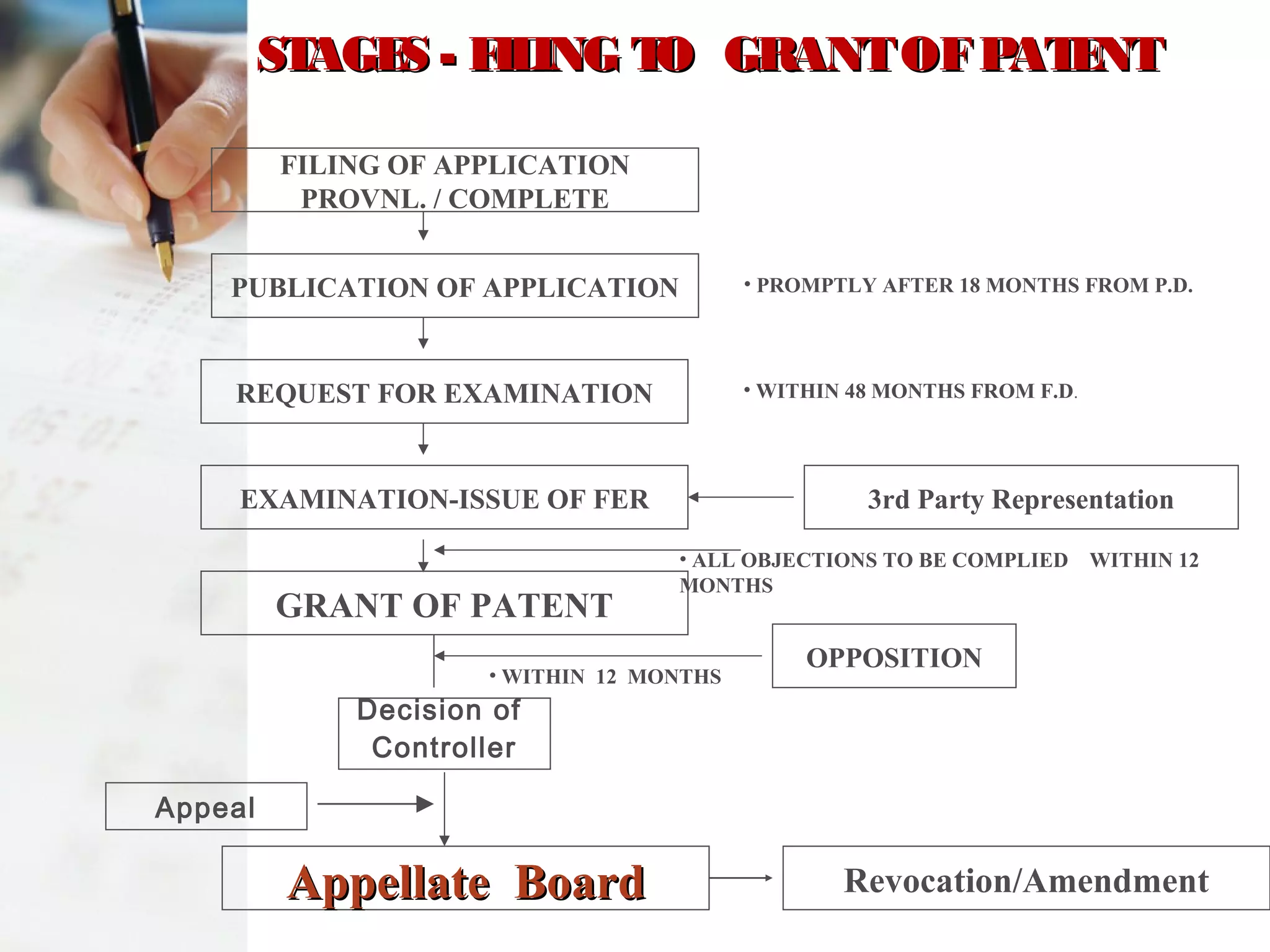
STAGES - FILING TO GRANTOFPATENTSTAGES - FILING TO GRANTOFPATENT
PUBLICATION OF APPLICATION
REQUEST FOR EXAMINATION
GRANT OF PATENT
3rd Party Representation
Revocation/Amendment
OPPOSITION
• PROMPTLY AFTER 18 MONTHS FROM P.D.
• WITHIN 48 MONTHS FROM F.D.
• ALL OBJECTIONS TO BE COMPLIED WITHIN 12
MONTHS
• WITHIN 12 MONTHS
FILING OF APPLICATION
PROVNL. / COMPLETE
Decision of
Controller
EXAMINATION-ISSUE OF FER
AppellateAppellate BoardBoard
Appeal
Renewal Fee
• To bepaid within 3+6 monthsfrom dateof
recording in theregister [sec 142 (4) ]
• No feefor 1st
and 2nd
year
• Renewal fee, on yearly basis, isrequired to bepaid
for 3rd
to 20th
for keeping thepatent in force
• Delay upto six monthsfrom duedatepermissibleon
payment of feefor extension of time
• Patent lapsesif renewal feeisnot paid within the
prescribed period
Rights of a patentee
1. Right to exploit thepatent.
 Thepatenteehasaright to prevent 3rd
parties, from exploiting
thepatented invention.
2. Right to grant license.
 Thepatenteehasapower to assign rightsor grant license.
3. Right to surrender.
 Thepatenteeisgiven theright to surrender thepatent by
giving noticein prescribed manner to thecontroller.
4. Right to suefor infringement.
 A patenteeisgiven theright to instituteproceeding for
infringement of thepatent in a district court .
Indian patent act ppt

Indian patent act ppt

  • 1.
    THE INDIAN PATENTACT - 1970 Professor & Lawyer PUTTU GURU PRASAD M.Com, M.B.A, L.L.B, M.Phil, PGDFTM, APSET,ICFAITMF, (PhD) JNTUK
  • 2.
  • 3.
  • 4.
  • 5.
  • 6.
  • 7.
  • 8.
  • 9.
    Various types ofIPRs- I Ds
  • 10.
  • 11.
  • 12.
    INTELLECTUAL PROPERTY • Intellectualproperty istheproduct or creation of themind. It isdifferent from other propertiesin term that it is“intangible”. Henceit needssome different way for itsprotection. INTELLECTUAL PROPERTY RIGHTS • IPR isthebody of law developed to protect thecreativepeoplewho have disclosed their invention for thebenefit of mankind. Thisprotectstheir invention from being copied or imitated without their consent.
  • 13.
    THE INDIAN PATENTACT • In Indiathegrant of patentsisgoverned by the patent Act 1970 and Rules1972. • Thepatentsgranted under theact areoperativein thewholeof India. HISTORY  ThePatent Law of 1856  ThePatent and DesignsAct, 1911.  ThePatentsAct, 1970 and Rules1972  ThePatent amendment act 2005
  • 14.
    What isapatent ? •A patent isagrant from thegovernment which conferson theguaranteefor alimited period of time theexclusiveprivilegeof making, selling and using theinvention for which apatent hasbeen granted
  • 15.
    Purposeof getting apatent…… •To enjoy theexclusiverightsover theinvention. • Thepatent isto ensurecommercial returnsto the inventor for thetimeand money spend in generating anew product.
  • 16.
    What can bepatented? •In order to bepatentable, an invention must passfour tests; 1. Theinvention must fall into oneof thefive“statutory classes’: Processes, Machines, Manufactures Compositionsof matter, and New usesof any of the above 2. Theinvention must be“useful” 3. Theinvention must be“novel” 4. Theinvention must be“nonobvious’
  • 17.
    Patent Law -Salient Features • Both product and processpatent provided • Term of patent – 20 years • Examination on request • Both pre-grant and post-grant opposition • Fast track mechanism for disposal of appeals • Provision for protection of bio-diversity and traditional knowledge • Publication of applicationsafter 18 monthswith facility for early publication • Substantially reduced time-lines
  • 18.
    Safeguards in thePatent Law • Compulsory licenseto ensureavailability of drugs at reasonableprices • Provision to deal with public health emergency • Revocation of patent in public interest and also on security considerations
  • 19.
    TypesOf Patents • Threetypesofpatent aregranted under the provisionsof theact, namely: 1. An Ordinary Patent 2. A Patent Of Addition 3. A Patent Of Convention • A second typeof classification of patent is: 1. Product Patent 2. ProcessPatent
  • 20.
    PatentableInventions Invention mustInvention must Relatesto a processprocess or productproduct orboth Be new (novel) Involves an inventive stepinventive step Be capable of industrial applicationindustrial application Not fall under section 3 and 4section 3 and 4
  • 21.
    “NEW” MEANS………. Invention mustnot beInvention must not be Published in India orelsewhere In priorpublic knowledge orpriorpublic use with in India Claimed before in any specification in India
  • 22.
    Inventive step means… Afeature of an inventionfeature of an invention that Involves technical advance as compared to the existing knowledge.. Industrial application means… Invention is capable of being made orused in any kind of industry.
  • 23.
    Section 3 exclusions Section3(a)Section 3(a) • Inventions contrary to well established natural laws ExamplesExamples  Machinethat givesmorethan 100% performance  Perpetual machine
  • 24.
    Section 3(b)Section 3(b) Commercialexploitation orprimary use ofCommercial exploitation orprimary use of inventions, which isinventions, which is Contrary to public order or Morality ExamplesExamples – Gambling machine, – Devicefor house-breaking ,
  • 25.
    Section 3(b)Section 3(b) Commercialexploitation orprimary use ofCommercial exploitation orprimary use of inventions , whichinventions , which Causes serious Prejudice to  health or  human, animal, plant lifeor  to theenvironment ExamplesExamples  Biological warfarematerial or device, weaponsof massdestruction  Terminator genetechnology,  Embryonic stem cell
  • 26.
    Non PatentableInventionsNon PatentableInventions •Inventions falling within Section 20(1) of the Atomic Energy Act, 1962 are not patentable Eg: Inventions relating to compounds of Uranium, Beryllium, Thorium, Plutonium, Radium, Graphite, Lithium and more as notified by Central Govt. from time to time.
  • 27.
    The Term OfPatent :   In respect of ainvention claming processof manufactureof asubstanceintended to beused asfood or medicine---- 5 yrsfrom thedateof sealing or 7 yrs from thedateof patent whichever isshorter.  In caseof any other invention ---- 14 yrsfrom thedate of patent.
  • 28.
    Expiry Of APatent • A patent can expirein thefollowing ways: 1. Thepatent haslived itsfull term. 2. Thepatenteehasfailed to pay therenewal fee. 3. Thevalidity of thepatent hasbeen successfully challenged by an opponent by filing an opposition either with thepatent officeor with thecourts. 4. Assoon asthepatent expires, it passto thegeneral public domain and now anybody can useit without thepermission of theoriginal inventor
  • 29.
    STAGES FROMFILING TOSTAGESFROMFILING TO GRANTOFA PATENTGRANTOFA PATENT
  • 30.
    Obtaining A Patent •Filean application for patent – With one of the patent offices based on territorial jurisdiction of the place of office or residenceof theapplicant /agent – Pay therequired fee • Information concerning application form and details of feeavailableat www.ipindia.nic.in • Guidelines for applicants also available on this website
  • 31.
    Formality Check • AnExaminer checkstheformal requirementsbefore accepting theapplication and thefee– thisisdone immediately • Issueof application number and thecash receipt – thisisdonethesameday • In caseof receipt of application by post, cash receipt, application number issent by post within 2- 3 days
  • 32.
    Publication • Application iskeptsecret for aperiod of 18 months from thedateof filing • In 19th month, theapplication ispublished in the official journal – thisjournal ismadeavailableon thewebsiteweekly • Applicant hasan option to get hisapplication published before18 monthsalso • In that case, application ispublished within one month of therequest
  • 33.
    Request forExamination • Applicationisexamined on request • Request for examination can bemadeeither by the applicant or by athird party • A period of 48 months, from thedateof filing, is availablefor making request for examination
  • 34.
    Examination • Application issentto an Examiner within 1 month from thedateof request for examination • Examiner undertakesexamination w.r.t. – whether theclaimed invention isnot prohibited for grant of patent – whether theinvention meetsthecriteriaof patentability
  • 35.
    Issue of FER •A period of 1 to 3 monthsisavailableto Examiner to submit thereport to theController • 1 month’stimeavailableto Controller to vet the Examiner’sreport • First Examination Report (FER) containing list of theobjectionsisissued within 6 monthsfrom the dateof filing of request
  • 36.
    Response from theApplicant • 12 months’ time, from thedateof issueof FER, is availableto theapplicant to meet theobjections • If objectionsaremet, grant of patent isapproved by theController – within aperiod of 1 month
  • 37.
    Pre-grant Opposition • Afterpublication, an opposition can befiled within aperiod of 6 months • Opportunity of hearing theopponent isalso available
  • 38.
    Examination of Pre-grantOpposition • Opposition (documents) issent to theapplicant • A period of 3 monthsisallowed for receipt of response
  • 39.
    Consideration of Pre-grant Opposition •After examining theopposition and thesubmissions madeduring thehearing, Controller may – Either reject theopposition and grant thepatent – Or accept theopposition and modify/reject the patent application • Thisisto bedonewithin aperiod of 1 month from thedateof completion of opposition proceedings
  • 40.
    Grant of aPatent • A certificateof patent isissued within 7 days • Grant of patent ispublished in theofficial journal
  • 41.
    STAGES - FILINGTO GRANTOFPATENTSTAGES - FILING TO GRANTOFPATENT PUBLICATION OF APPLICATION REQUEST FOR EXAMINATION GRANT OF PATENT 3rd Party Representation Revocation/Amendment OPPOSITION • PROMPTLY AFTER 18 MONTHS FROM P.D. • WITHIN 48 MONTHS FROM F.D. • ALL OBJECTIONS TO BE COMPLIED WITHIN 12 MONTHS • WITHIN 12 MONTHS FILING OF APPLICATION PROVNL. / COMPLETE Decision of Controller EXAMINATION-ISSUE OF FER AppellateAppellate BoardBoard Appeal
  • 42.
    Renewal Fee • Tobepaid within 3+6 monthsfrom dateof recording in theregister [sec 142 (4) ] • No feefor 1st and 2nd year • Renewal fee, on yearly basis, isrequired to bepaid for 3rd to 20th for keeping thepatent in force • Delay upto six monthsfrom duedatepermissibleon payment of feefor extension of time • Patent lapsesif renewal feeisnot paid within the prescribed period
  • 43.
    Rights of apatentee 1. Right to exploit thepatent.  Thepatenteehasaright to prevent 3rd parties, from exploiting thepatented invention. 2. Right to grant license.  Thepatenteehasapower to assign rightsor grant license. 3. Right to surrender.  Thepatenteeisgiven theright to surrender thepatent by giving noticein prescribed manner to thecontroller. 4. Right to suefor infringement.  A patenteeisgiven theright to instituteproceeding for infringement of thepatent in a district court .