A Posteriori Error Bound of DG in
Time and CG in Space FE Method for
Semilinear Parabolic Problems
Mohammad Sabawi
with
A. Cangiani and E. Georgoulis
Department of Mathematics
University of Leicester
February 20, 2015
FEM Workshop February 2015 A Posteriori EB of Time-DG and Space-CG FEM for SPPs
Outline
• Introduction
• Settings and Notations
• Fully discrete Case
FEM Workshop February 2015 A Posteriori EB of Time-DG and Space-CG FEM for SPPs
Introduction
• The variational formulation of the DG
time stepping methods gives a flexibility
in changing the time-steps and orders of
approximation and this allows for other
extensions such as hp-adaptivity.
FEM Workshop February 2015 A Posteriori EB of Time-DG and Space-CG FEM for SPPs
• We derive a posteriori error bounds for semilinear
parabolic equation by using discontinuous Galerkin
method in time and continuous (conforming) finite
element in space. Our main tools in this analysis the
reconstruction in time and elliptic reconstruction in
space with Gronwall’s lemma and continuation
argument.
FEM Workshop February 2015 A Posteriori EB of Time-DG and Space-CG FEM for SPPs
Advantages
• Strong stability properties.
• Flexibility in variation the size of time
steps and local orders of approximation
leading to hp-adaptivity.
• DG time-stepping methods with
appropriate quadrature are equivalent to
Runge-Kutta-Radau methods.
FEM Workshop February 2015 A Posteriori EB of Time-DG and Space-CG FEM for SPPs
Disadvantages
• High effort in implementation for higher
orders.
• High computational cost for solving large
linear systems with block matrices.
FEM Workshop February 2015 A Posteriori EB of Time-DG and Space-CG FEM for SPPs
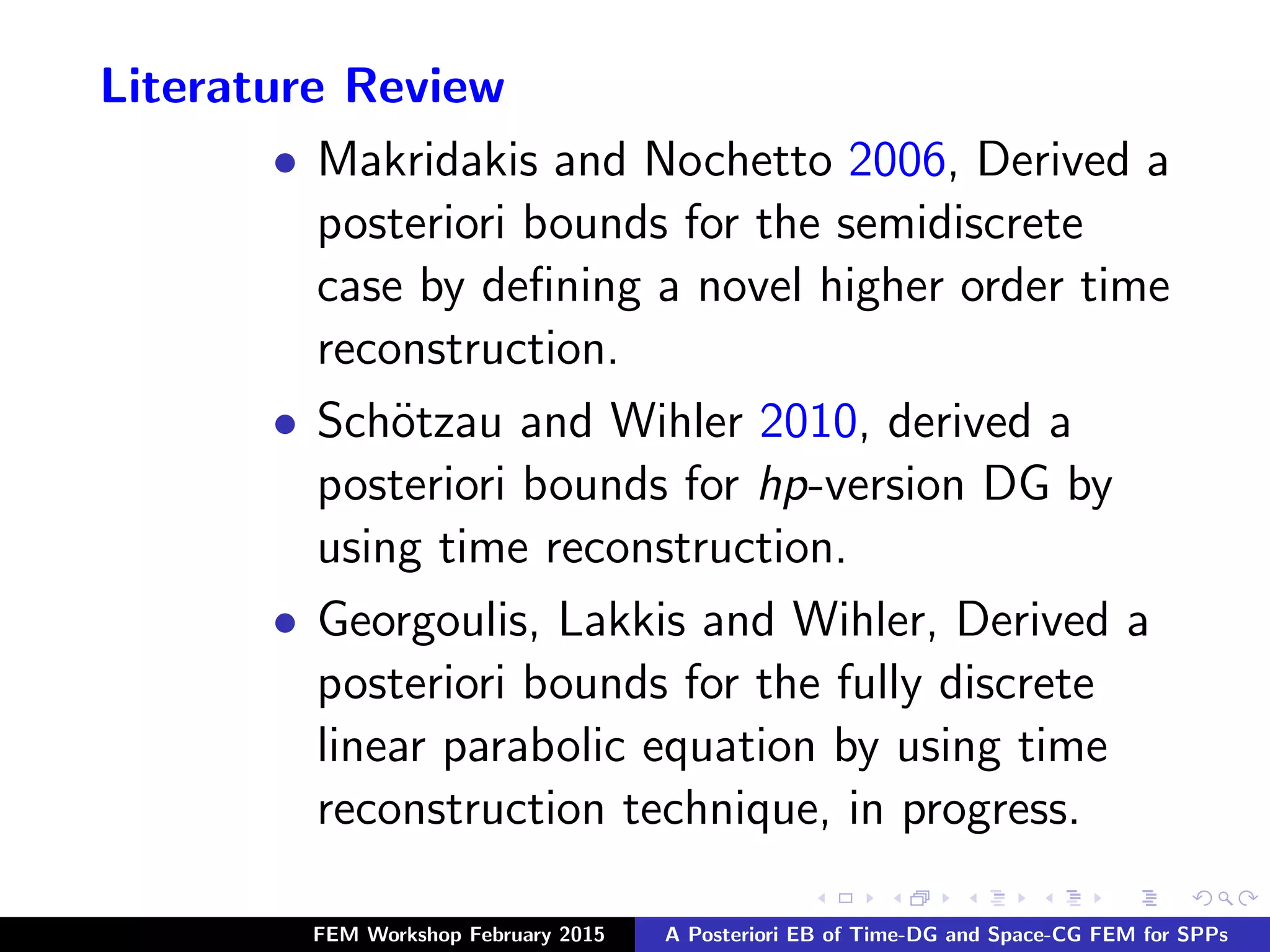
Literature Review
• Makridakis and Nochetto 2006, Derived a
posteriori bounds for the semidiscrete
case by defining a novel higher order time
reconstruction.
• Sch¨otzau and Wihler 2010, derived a
posteriori bounds for hp-version DG by
using time reconstruction.
• Georgoulis, Lakkis and Wihler, Derived a
posteriori bounds for the fully discrete
linear parabolic equation by using time
reconstruction technique, in progress.
FEM Workshop February 2015 A Posteriori EB of Time-DG and Space-CG FEM for SPPs
The Mathematical Model and Settings
We consider the following initial value semilinear
parabolic equation
u + Au = f (u), u(0) = u0 (1)
where A is the elliptic bounded self adjoint operator
A : V −→ V ∗
, where V = H1
0 and V ∗
= H−1
is the
dual space of V .
FEM Workshop February 2015 A Posteriori EB of Time-DG and Space-CG FEM for SPPs
Let I = [0, T] be the time interval and
0 = t0 < t1 < ... < tN = T
be a partition Λ of I to the time subintervals In = (tn−1, tn] with
time steps kn = tn − tn−1 and Vn ⊂ V , n = 0, ..., N be a finite
sequence of finite dimensional subspaces of V associate with time
nodes, time intervals and time steps mentioned above.
FEM Workshop February 2015 A Posteriori EB of Time-DG and Space-CG FEM for SPPs
Space-Time Galerkin Spaces
Let Pq
(D, H) denotes the space of polynomials of
degree at most q from D ⊆ Rd
into a vector space
H. Consider the space-time Galerkin subspaces of
polynomials of degree ≤ qn defined on time
subintervals In into the subspaces Vn.
Xn := Pqn
(In; Vn) (2)
Now we can define the space-time Galerkin space by
X := {v : [0, T] −→ V : v|In
∈ Xn, n = 1, ..., N}
(3)
FEM Workshop February 2015 A Posteriori EB of Time-DG and Space-CG FEM for SPPs
The time discontinuous and spatially continuous Galerkin
approximation of the exact solution u is a function U ∈ X such
that for n = 1, ..., N,
In
( U , v + a(U, v)dt + [U]n−1, v+
n−1 =
In
f (U), v dt, ∀v ∈ Xn,
U+
0 = P0u0 (4)
FEM Workshop February 2015 A Posteriori EB of Time-DG and Space-CG FEM for SPPs
where [U]n = U+
n − U−
n is the jump in time due to the
discontinuity of the approximate solution U at the time nodes,
U±
n = limδ→0 U(tn ± δ), ., . is L2 inner product, and
a(., .) is the bilinear form, where ., . is the duality pairing and Pn
is the L2 projection operator.
FEM Workshop February 2015 A Posteriori EB of Time-DG and Space-CG FEM for SPPs
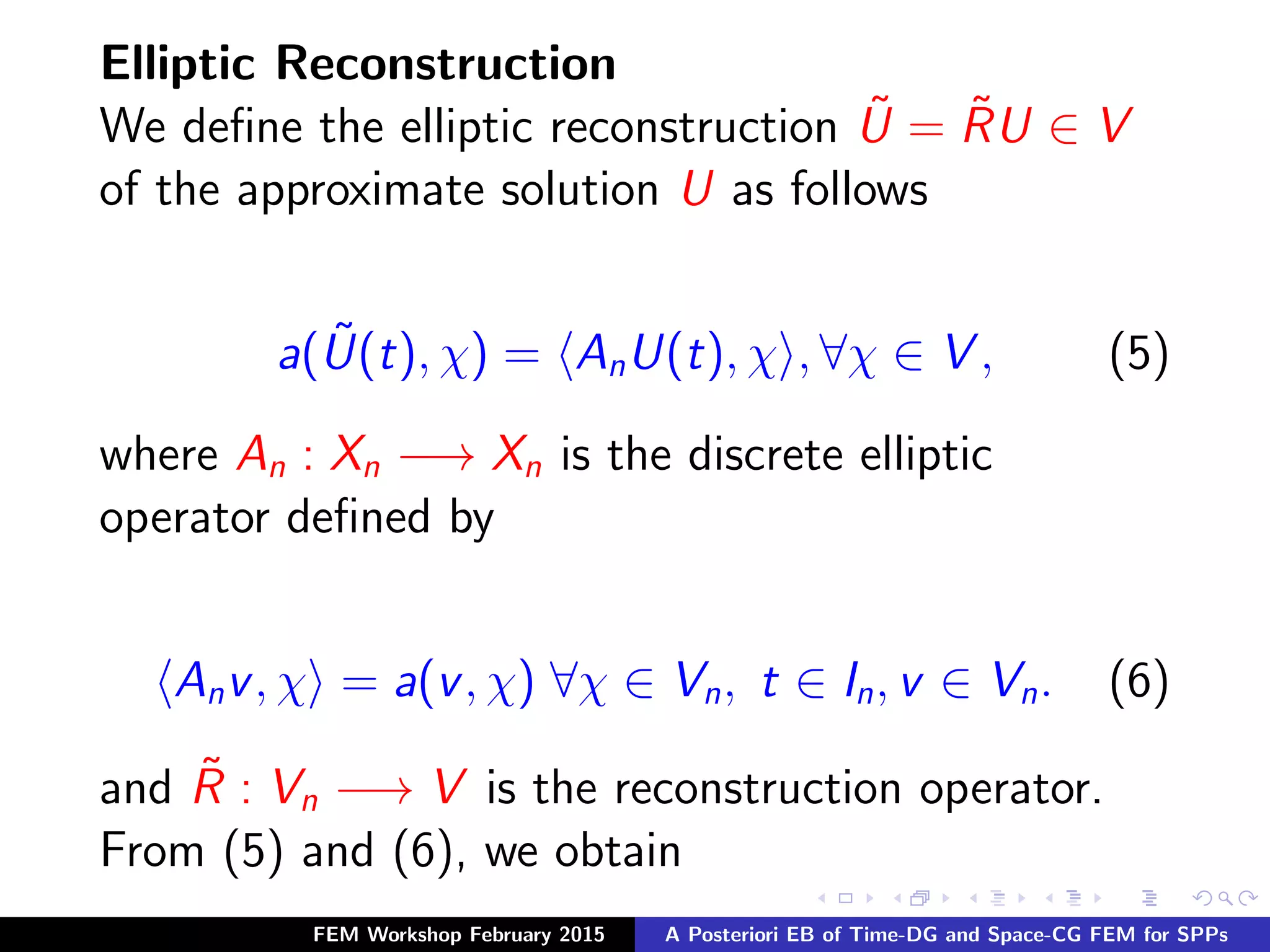
Elliptic Reconstruction
We define the elliptic reconstruction ˜U = ˜RU ∈ V
of the approximate solution U as follows
a( ˜U(t), χ) = AnU(t), χ , ∀χ ∈ V , (5)
where An : Xn −→ Xn is the discrete elliptic
operator defined by
Anv, χ = a(v, χ) ∀χ ∈ Vn, t ∈ In, v ∈ Vn. (6)
and ˜R : Vn −→ V is the reconstruction operator.
From (5) and (6), we obtain
FEM Workshop February 2015 A Posteriori EB of Time-DG and Space-CG FEM for SPPs
a( ˜U(t), χ) = AnU(t), χ = a(U(t), χ), ∀χ ∈ Vn, t ∈ In, (7)
hence
U = P ˜U, (8)
where P is the elliptic projection operator.
FEM Workshop February 2015 A Posteriori EB of Time-DG and Space-CG FEM for SPPs
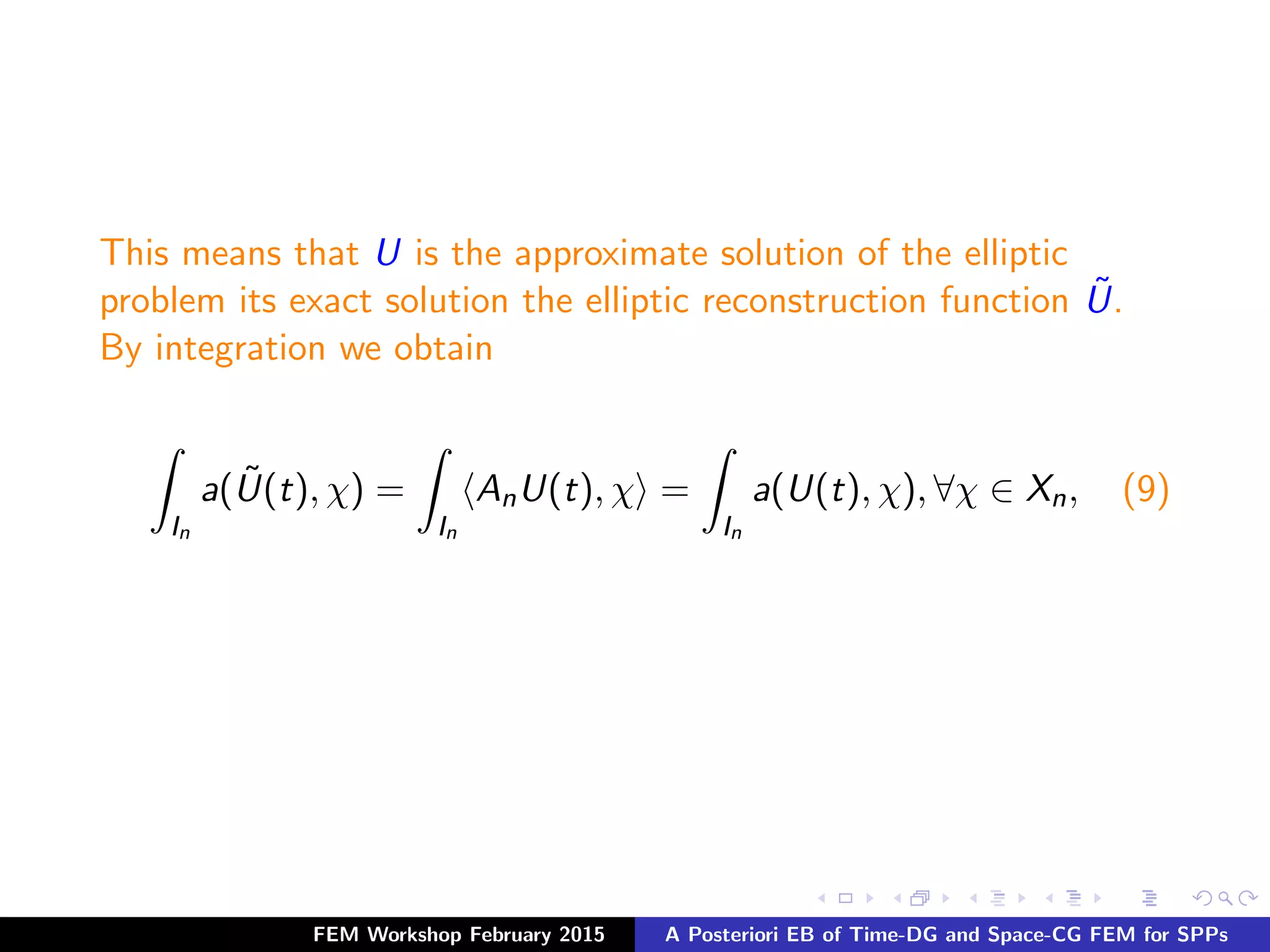
This means that U is the approximate solution of the elliptic
problem its exact solution the elliptic reconstruction function ˜U.
By integration we obtain
In
a( ˜U(t), χ) =
In
AnU(t), χ =
In
a(U(t), χ), ∀χ ∈ Xn, (9)
FEM Workshop February 2015 A Posteriori EB of Time-DG and Space-CG FEM for SPPs
Theorem 1(Elliptic A Posteriori Error Bound)
There exists a posteriori error function such that
˜U − U ≤ F(U, f (U)). (10)
FEM Workshop February 2015 A Posteriori EB of Time-DG and Space-CG FEM for SPPs
Time Reconstruction of the Elliptic Reconstruction
The time reconstruction function ˆU of the elliptic reconstruction ˜U
of the approximate solution U is defined by ˆU = ˆR ˜U where
ˆR : X(q) −→ X(q + 1) is the time reconstruction operator such
that ˆU|In ∈ Pqn+1 (In; V ) and
In
ˆU , v dt =
In
˜U , v dt + [ ˜U]n−1, v+
n−1 , ∀v ∈ X, (11)
ˆU+
0 = P1u0
ˆU+
n−1 = ˜U−
n−1, n > 0. (12)
FEM Workshop February 2015 A Posteriori EB of Time-DG and Space-CG FEM for SPPs
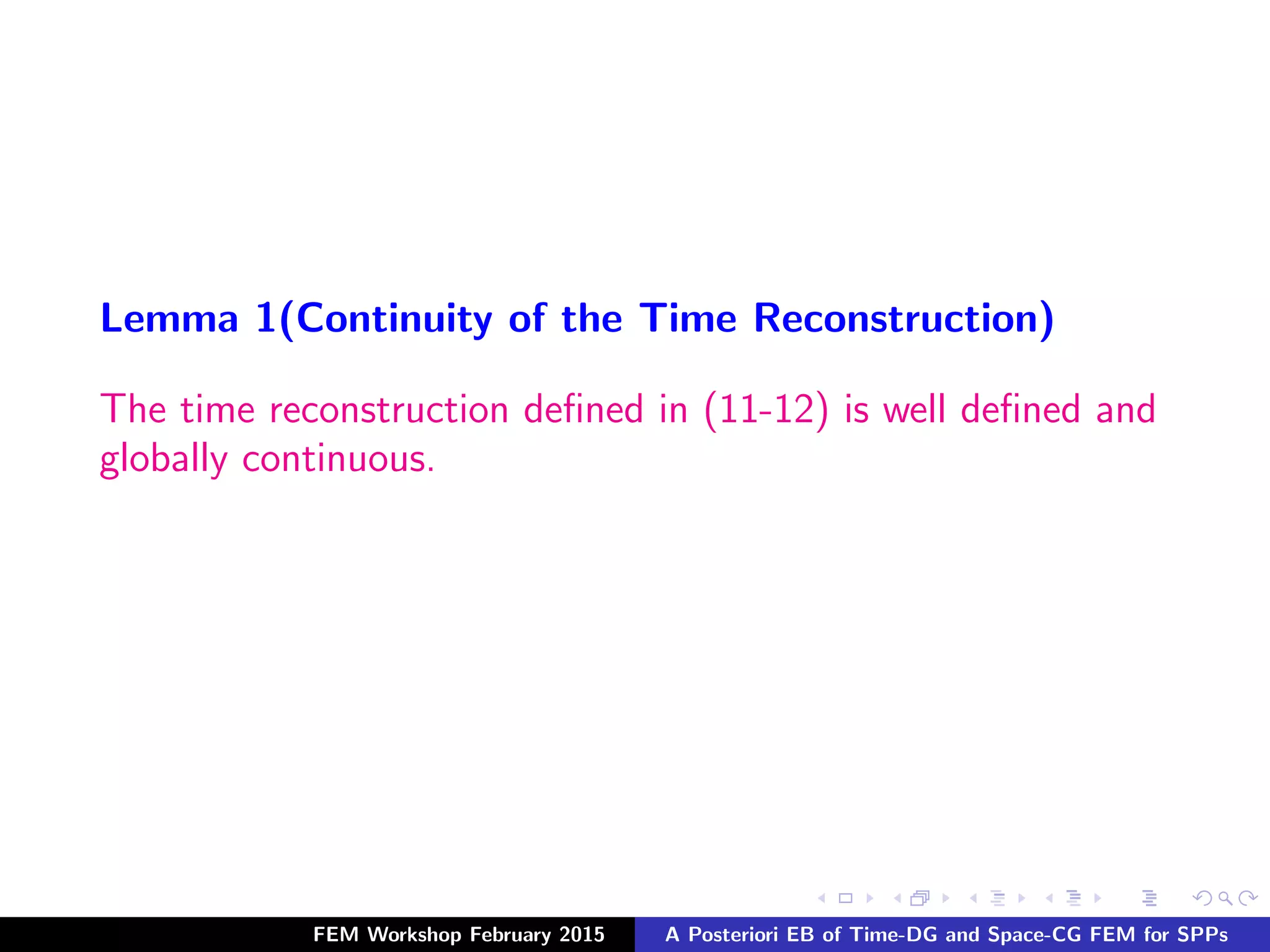
Lemma 1(Continuity of the Time Reconstruction)
The time reconstruction defined in (11-12) is well defined and
globally continuous.
FEM Workshop February 2015 A Posteriori EB of Time-DG and Space-CG FEM for SPPs
Theorem 2 (A posteriori Time Reconstruction
Error Bound)[SW10]
The following error estimate holds
ˆU − U L2(In;V ) = C2.6,kn,qn
[U]n−1 V + U−
n−1 − PnU−
n−1 V ,
(13)
where
C2.6,kn,qn
:=
k(q + 1)
(2q + 1)(2q + 3)
1/2
. (14)
FEM Workshop February 2015 A Posteriori EB of Time-DG and Space-CG FEM for SPPs
Error Analysis and the Derivation of the Error
representation Formula
We can decompose the error in the following
ways[MLW]
e = u − U = (u − ˆU) + ( ˆU − U) = ˆρ + ˆ, (15)
and
e = u − U = (u − ˜U) + ( ˜U − U) = ˜ρ + ˜, (16)
noting that
e = u − U = ˆρ + ˆ = ˜ρ + ˜. (17)
FEM Workshop February 2015 A Posteriori EB of Time-DG and Space-CG FEM for SPPs
We derive the a posteriori error bound for the error e by bounding
ˆρ and ˜ρ in terms of ˆ and ˜ which their a posteriori error bounds
are known and computable by Theorem 1 and Theorem 2.
The error representation formula for ˆρ and ˜ρ is
In
ˆρ , v + ˜ , v + a(˜ρ, v) dt − [U]n−1, v+
n−1
=
In
f (u) − Pnf (U), v dt, ∀v ∈ Xn. (18)
FEM Workshop February 2015 A Posteriori EB of Time-DG and Space-CG FEM for SPPs
Testing (18) by v = ˆρ and by using continuity of the bilinear form
we obtain
In
ˆρ , ˆρ + ˜ , ˆρ + a(˜ρ, ˆρ) dt − [U]n−1, ˆρn−1
=
In
f (u) − Pnf (U), ˆρ dt, (19)
Now, we consider to bound the nonlinear term in the right hand
side of (19) which we decompose in the following way
f (u) − Pnf (U), ˆρ = f (u) − f (U) + f (U) − Pnf (U), ˆρ
= f (u) − f (U), ˆρ + f (U) − Pnf (U), ˆρ , (20)
FEM Workshop February 2015 A Posteriori EB of Time-DG and Space-CG FEM for SPPs
The function f is locally Lipschitz continuous and satisfies the
following growth condition
|f (v) − f (w)| ≤ C|v − w|(1 + |v| + |w|)a
, 0 ≤ a < 2. (21)
where |.| is the Euclidean distance.
Now we need to bound this term by using the growth condition
(21),
Ω
|f (u) − f (U)||ˆρ| ≤ C
Ω
|u − U|(1 + |u|a
+ |U|a
)|ˆρ|. (22)
FEM Workshop February 2015 A Posteriori EB of Time-DG and Space-CG FEM for SPPs
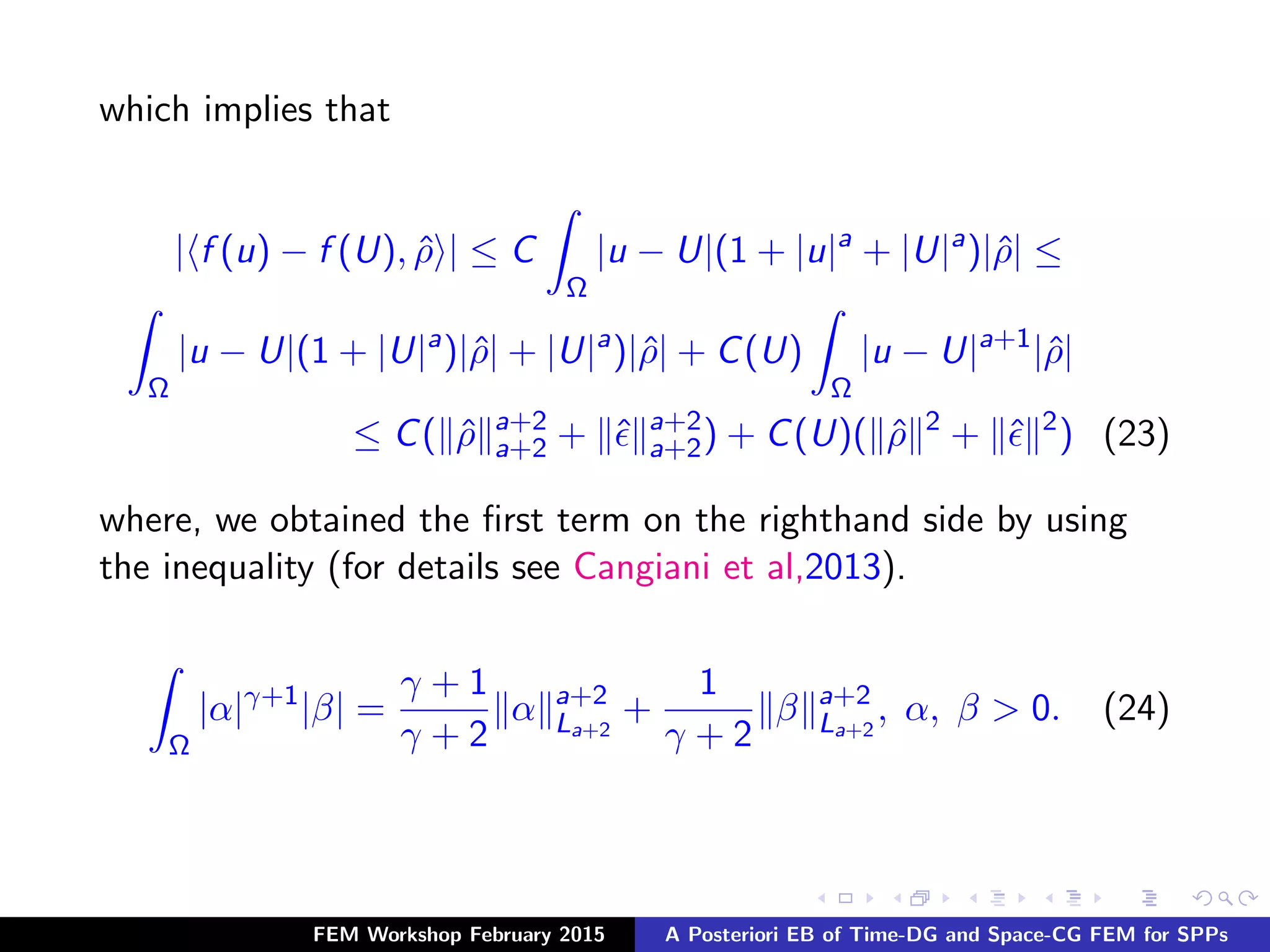
which implies that
| f (u) − f (U), ˆρ | ≤ C
Ω
|u − U|(1 + |u|a
+ |U|a
)|ˆρ| ≤
Ω
|u − U|(1 + |U|a
)|ˆρ| + |U|a
)|ˆρ| + C(U)
Ω
|u − U|a+1
|ˆρ|
≤ C( ˆρ a+2
a+2 + ˆ a+2
a+2) + C(U)( ˆρ 2
+ ˆ 2
) (23)
where, we obtained the first term on the righthand side by using
the inequality (for details see Cangiani et al,2013).
Ω
|α|γ+1
|β| =
γ + 1
γ + 2
α a+2
La+2
+
1
γ + 2
β a+2
La+2
, α, β > 0. (24)
FEM Workshop February 2015 A Posteriori EB of Time-DG and Space-CG FEM for SPPs
By using H¨older, Poincare and Sobolev inequalities inequality, we
have
ˆρ a+2
a+2 ≤ CS ˆρ a
ˆρ 2
V , (25)
and by the same way, we have
ˆ a+2
a+2 ≤ CS ˆ a
ˆ 2
V , (26)
FEM Workshop February 2015 A Posteriori EB of Time-DG and Space-CG FEM for SPPs
Finally, we have
Ω
|f (u) − f (U)||ˆρ| ≤ C( ˆ a
ˆ 2
V + ˆρ a
ˆρ 2
V ) + C(U)( ˆρ 2
+ ˆ 2
),
(27)
FEM Workshop February 2015 A Posteriori EB of Time-DG and Space-CG FEM for SPPs
After some mathematical manipulations and technicalities, we have
1
2
ˆρm
2
+
1
2
ˆρ 2
L2(Im;L2) +
C3
2
˜ρ 2
L2(Im;V ) +
1
2
ˆρ 2
L2(Im;V ) ≤
ˆρ0
2
+
1
2
m
n=1
[U]n−1
2
−
1
2
˜ 2
L2(Im;L2) +
C3
m
n=1 In
ˆ a
ˆ 2
V + C3
m
n=1 In
ˆρ a
ˆρ 2
V
+C5 ˆρ 2
L2(Im;L2) + C4 ˆ 2
L2(Im;L2) +
1
2
f (U) − Pnf (U) 2
L2(Im;L2),(28)
FEM Workshop February 2015 A Posteriori EB of Time-DG and Space-CG FEM for SPPs
Now for simplicity let
δ2
= ˆρ0
2
+
1
2
m
n=1
[U]n−1
2
−
1
2
˜ 2
L2(Im;L2) + C3
m
n=1 In
ˆ a
ˆ 2
V
+C4 ˆ 2
L2(Im;L2) +
1
2
f (U) − Pnf (U) 2
L2(Im;L2),(29)
and by substituting δ2 in (28) we get
1
2
ˆρm
2
+
1
2
ˆρ 2
L2(Im;L2) +
C3
2
˜ρ 2
L2(Im;V ) +
1
2
ˆρ 2
L2(Im;V )
≤ δ2
+ C3
m
n=1 In
ˆρ a
ˆρ 2
V + C5 ˆρ 2
L2(Im;L2), (30)
FEM Workshop February 2015 A Posteriori EB of Time-DG and Space-CG FEM for SPPs
implies that
1
2
ˆρm
2
+
1
2
ˆρ 2
L2(Im;L2) +
C3
2
˜ρ 2
L2(Im;V ) +
1
2
ˆρ 2
L2(Im;V )
≤ δ2
+ C3
m
n=1 In
sup
t∈In
ˆρ a
ˆρ 2
V + C5 ˆρ 2
L2(Im;L2) ≤
δ2
+ C3
m
n=1
sup
t∈In
ˆρ a
+
In
ˆρ 2
V
a+2
2
+ C5 ˆρ 2
L2(Im;L2), (31)
FEM Workshop February 2015 A Posteriori EB of Time-DG and Space-CG FEM for SPPs
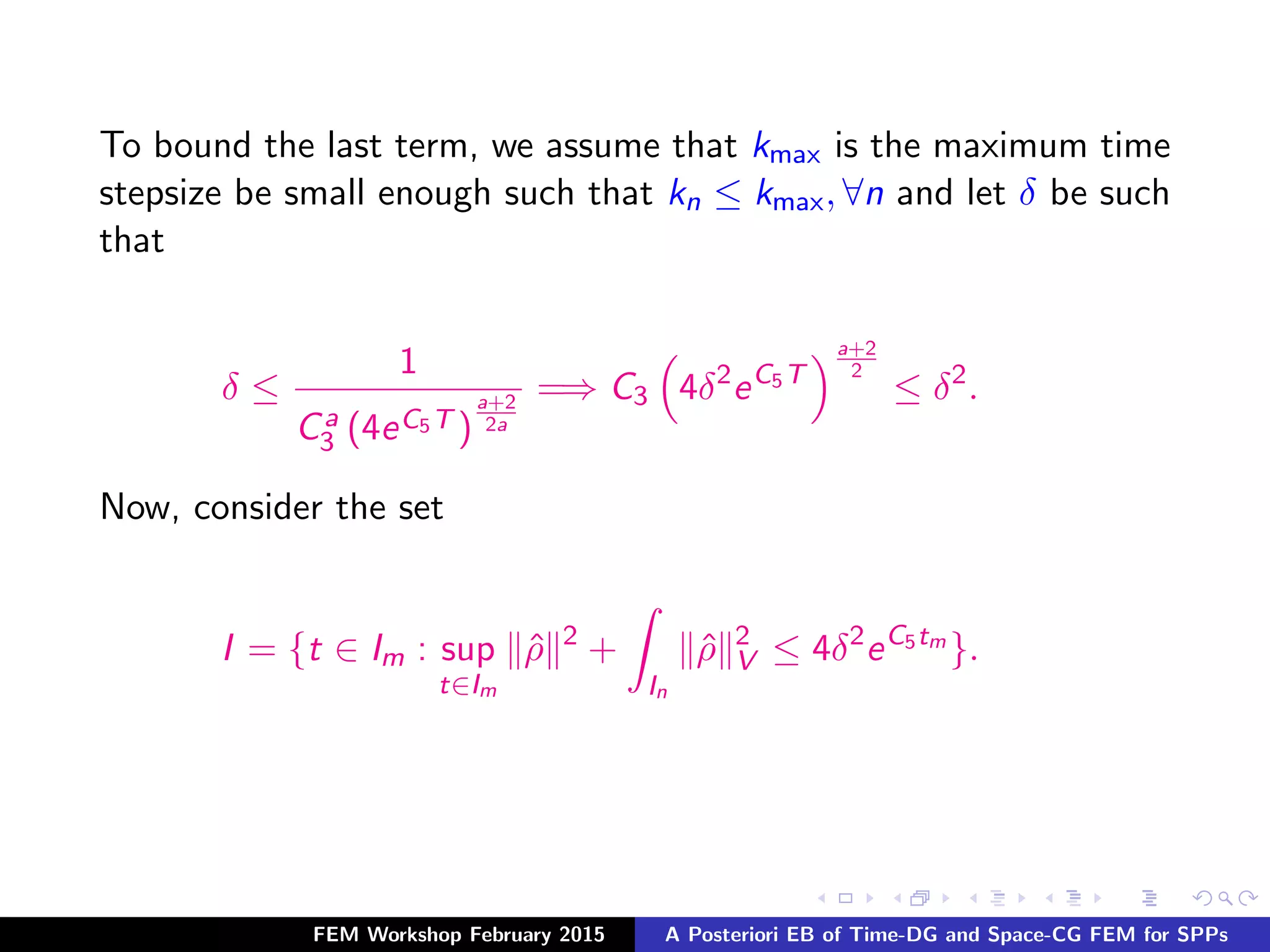
To bound the last term, we assume that kmax is the maximum time
stepsize be small enough such that kn ≤ kmax, ∀n and let δ be such
that
δ ≤
1
Ca
3 (4eC5T )
a+2
2a
=⇒ C3 4δ2
eC5T
a+2
2
≤ δ2
.
Now, consider the set
I = {t ∈ Im : sup
t∈Im
ˆρ 2
+
In
ˆρ 2
V ≤ 4δ2
eC5tm
}.
FEM Workshop February 2015 A Posteriori EB of Time-DG and Space-CG FEM for SPPs
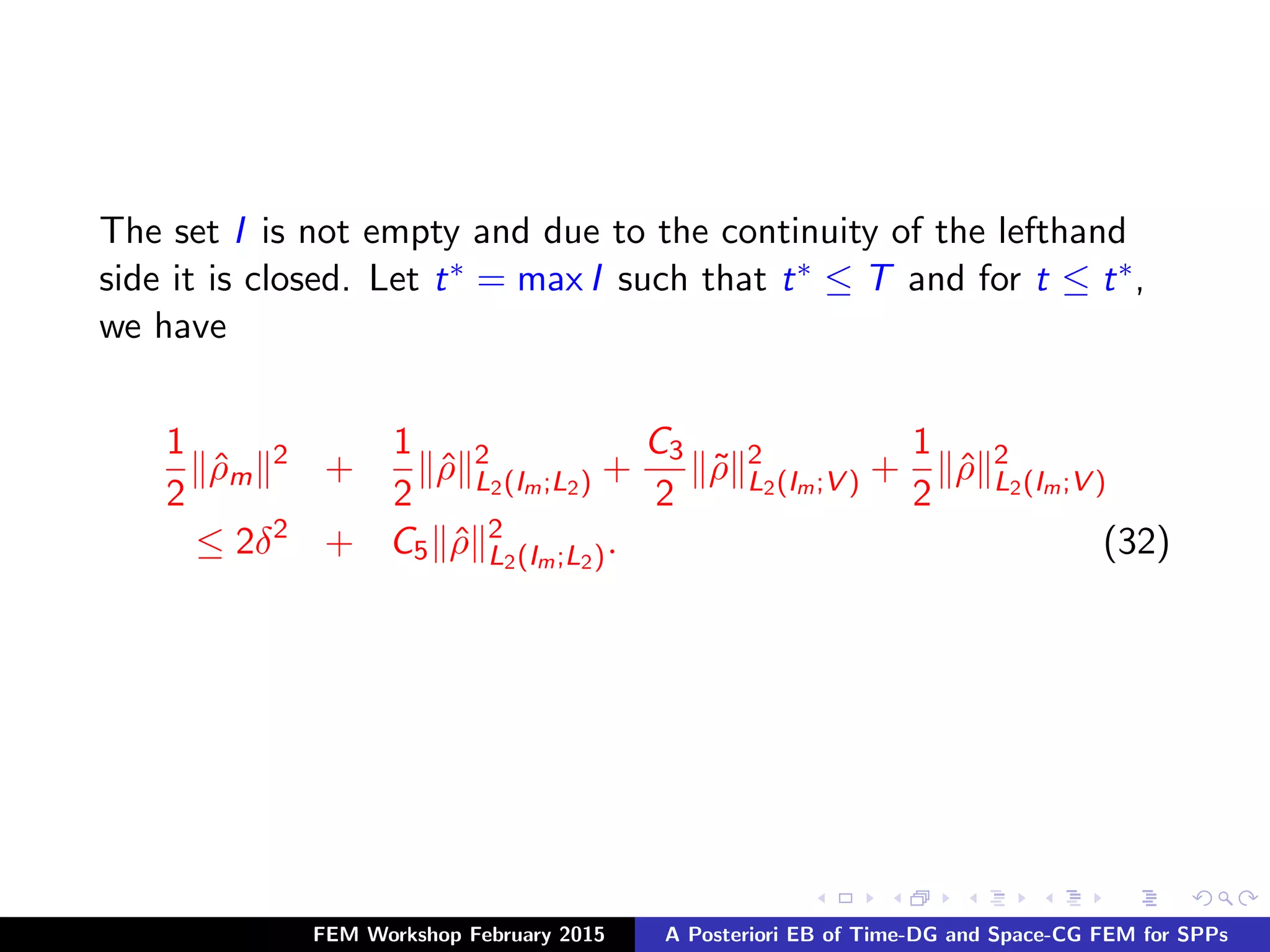
The set I is not empty and due to the continuity of the lefthand
side it is closed. Let t∗ = max I such that t∗ ≤ T and for t ≤ t∗,
we have
1
2
ˆρm
2
+
1
2
ˆρ 2
L2(Im;L2) +
C3
2
˜ρ 2
L2(Im;V ) +
1
2
ˆρ 2
L2(Im;V )
≤ 2δ2
+ C5 ˆρ 2
L2(Im;L2). (32)
FEM Workshop February 2015 A Posteriori EB of Time-DG and Space-CG FEM for SPPs
By using Gronwall’s inequality, we obtain
ˆρm
2
+ C3 ˜ρ(t∗
) 2
L2(Im;V ) + C6 ˆρ(t∗
) 2
L2(Im;V ) ≤ 4δ2
e2C7tm
. (33)
By choosing t = t∗, we have a contradiction to the assumption
that t < t∗ since the left hand side of (33) is continuous, therefore
we deduce that I = [0, tm].
Finally,
ˆρm
2
+ C3 ˜ρ 2
L2(Im;V ) + C6 ˆρ 2
L2(Im;V ) ≤ 4δ2
eC7tm
. (34)
FEM Workshop February 2015 A Posteriori EB of Time-DG and Space-CG FEM for SPPs
Thank You
for Your Attention!
FEM Workshop February 2015 A Posteriori EB of Time-DG and Space-CG FEM for SPPs

A Posteriori Error Analysis Presentation

  • 1.
    A Posteriori ErrorBound of DG in Time and CG in Space FE Method for Semilinear Parabolic Problems Mohammad Sabawi with A. Cangiani and E. Georgoulis Department of Mathematics University of Leicester February 20, 2015 FEM Workshop February 2015 A Posteriori EB of Time-DG and Space-CG FEM for SPPs
  • 2.
    Outline • Introduction • Settingsand Notations • Fully discrete Case FEM Workshop February 2015 A Posteriori EB of Time-DG and Space-CG FEM for SPPs
  • 3.
    Introduction • The variationalformulation of the DG time stepping methods gives a flexibility in changing the time-steps and orders of approximation and this allows for other extensions such as hp-adaptivity. FEM Workshop February 2015 A Posteriori EB of Time-DG and Space-CG FEM for SPPs
  • 4.
    • We derivea posteriori error bounds for semilinear parabolic equation by using discontinuous Galerkin method in time and continuous (conforming) finite element in space. Our main tools in this analysis the reconstruction in time and elliptic reconstruction in space with Gronwall’s lemma and continuation argument. FEM Workshop February 2015 A Posteriori EB of Time-DG and Space-CG FEM for SPPs
  • 5.
    Advantages • Strong stabilityproperties. • Flexibility in variation the size of time steps and local orders of approximation leading to hp-adaptivity. • DG time-stepping methods with appropriate quadrature are equivalent to Runge-Kutta-Radau methods. FEM Workshop February 2015 A Posteriori EB of Time-DG and Space-CG FEM for SPPs
  • 6.
    Disadvantages • High effortin implementation for higher orders. • High computational cost for solving large linear systems with block matrices. FEM Workshop February 2015 A Posteriori EB of Time-DG and Space-CG FEM for SPPs
  • 7.
    Literature Review • Makridakisand Nochetto 2006, Derived a posteriori bounds for the semidiscrete case by defining a novel higher order time reconstruction. • Sch¨otzau and Wihler 2010, derived a posteriori bounds for hp-version DG by using time reconstruction. • Georgoulis, Lakkis and Wihler, Derived a posteriori bounds for the fully discrete linear parabolic equation by using time reconstruction technique, in progress. FEM Workshop February 2015 A Posteriori EB of Time-DG and Space-CG FEM for SPPs
  • 8.
    The Mathematical Modeland Settings We consider the following initial value semilinear parabolic equation u + Au = f (u), u(0) = u0 (1) where A is the elliptic bounded self adjoint operator A : V −→ V ∗ , where V = H1 0 and V ∗ = H−1 is the dual space of V . FEM Workshop February 2015 A Posteriori EB of Time-DG and Space-CG FEM for SPPs
  • 9.
    Let I =[0, T] be the time interval and 0 = t0 < t1 < ... < tN = T be a partition Λ of I to the time subintervals In = (tn−1, tn] with time steps kn = tn − tn−1 and Vn ⊂ V , n = 0, ..., N be a finite sequence of finite dimensional subspaces of V associate with time nodes, time intervals and time steps mentioned above. FEM Workshop February 2015 A Posteriori EB of Time-DG and Space-CG FEM for SPPs
  • 10.
    Space-Time Galerkin Spaces LetPq (D, H) denotes the space of polynomials of degree at most q from D ⊆ Rd into a vector space H. Consider the space-time Galerkin subspaces of polynomials of degree ≤ qn defined on time subintervals In into the subspaces Vn. Xn := Pqn (In; Vn) (2) Now we can define the space-time Galerkin space by X := {v : [0, T] −→ V : v|In ∈ Xn, n = 1, ..., N} (3) FEM Workshop February 2015 A Posteriori EB of Time-DG and Space-CG FEM for SPPs
  • 11.
    The time discontinuousand spatially continuous Galerkin approximation of the exact solution u is a function U ∈ X such that for n = 1, ..., N, In ( U , v + a(U, v)dt + [U]n−1, v+ n−1 = In f (U), v dt, ∀v ∈ Xn, U+ 0 = P0u0 (4) FEM Workshop February 2015 A Posteriori EB of Time-DG and Space-CG FEM for SPPs
  • 12.
    where [U]n =U+ n − U− n is the jump in time due to the discontinuity of the approximate solution U at the time nodes, U± n = limδ→0 U(tn ± δ), ., . is L2 inner product, and a(., .) is the bilinear form, where ., . is the duality pairing and Pn is the L2 projection operator. FEM Workshop February 2015 A Posteriori EB of Time-DG and Space-CG FEM for SPPs
  • 13.
    Elliptic Reconstruction We definethe elliptic reconstruction ˜U = ˜RU ∈ V of the approximate solution U as follows a( ˜U(t), χ) = AnU(t), χ , ∀χ ∈ V , (5) where An : Xn −→ Xn is the discrete elliptic operator defined by Anv, χ = a(v, χ) ∀χ ∈ Vn, t ∈ In, v ∈ Vn. (6) and ˜R : Vn −→ V is the reconstruction operator. From (5) and (6), we obtain FEM Workshop February 2015 A Posteriori EB of Time-DG and Space-CG FEM for SPPs
  • 14.
    a( ˜U(t), χ)= AnU(t), χ = a(U(t), χ), ∀χ ∈ Vn, t ∈ In, (7) hence U = P ˜U, (8) where P is the elliptic projection operator. FEM Workshop February 2015 A Posteriori EB of Time-DG and Space-CG FEM for SPPs
  • 15.
    This means thatU is the approximate solution of the elliptic problem its exact solution the elliptic reconstruction function ˜U. By integration we obtain In a( ˜U(t), χ) = In AnU(t), χ = In a(U(t), χ), ∀χ ∈ Xn, (9) FEM Workshop February 2015 A Posteriori EB of Time-DG and Space-CG FEM for SPPs
  • 16.
    Theorem 1(Elliptic APosteriori Error Bound) There exists a posteriori error function such that ˜U − U ≤ F(U, f (U)). (10) FEM Workshop February 2015 A Posteriori EB of Time-DG and Space-CG FEM for SPPs
  • 17.
    Time Reconstruction ofthe Elliptic Reconstruction The time reconstruction function ˆU of the elliptic reconstruction ˜U of the approximate solution U is defined by ˆU = ˆR ˜U where ˆR : X(q) −→ X(q + 1) is the time reconstruction operator such that ˆU|In ∈ Pqn+1 (In; V ) and In ˆU , v dt = In ˜U , v dt + [ ˜U]n−1, v+ n−1 , ∀v ∈ X, (11) ˆU+ 0 = P1u0 ˆU+ n−1 = ˜U− n−1, n > 0. (12) FEM Workshop February 2015 A Posteriori EB of Time-DG and Space-CG FEM for SPPs
  • 18.
    Lemma 1(Continuity ofthe Time Reconstruction) The time reconstruction defined in (11-12) is well defined and globally continuous. FEM Workshop February 2015 A Posteriori EB of Time-DG and Space-CG FEM for SPPs
  • 19.
    Theorem 2 (Aposteriori Time Reconstruction Error Bound)[SW10] The following error estimate holds ˆU − U L2(In;V ) = C2.6,kn,qn [U]n−1 V + U− n−1 − PnU− n−1 V , (13) where C2.6,kn,qn := k(q + 1) (2q + 1)(2q + 3) 1/2 . (14) FEM Workshop February 2015 A Posteriori EB of Time-DG and Space-CG FEM for SPPs
  • 20.
    Error Analysis andthe Derivation of the Error representation Formula We can decompose the error in the following ways[MLW] e = u − U = (u − ˆU) + ( ˆU − U) = ˆρ + ˆ, (15) and e = u − U = (u − ˜U) + ( ˜U − U) = ˜ρ + ˜, (16) noting that e = u − U = ˆρ + ˆ = ˜ρ + ˜. (17) FEM Workshop February 2015 A Posteriori EB of Time-DG and Space-CG FEM for SPPs
  • 21.
    We derive thea posteriori error bound for the error e by bounding ˆρ and ˜ρ in terms of ˆ and ˜ which their a posteriori error bounds are known and computable by Theorem 1 and Theorem 2. The error representation formula for ˆρ and ˜ρ is In ˆρ , v + ˜ , v + a(˜ρ, v) dt − [U]n−1, v+ n−1 = In f (u) − Pnf (U), v dt, ∀v ∈ Xn. (18) FEM Workshop February 2015 A Posteriori EB of Time-DG and Space-CG FEM for SPPs
  • 22.
    Testing (18) byv = ˆρ and by using continuity of the bilinear form we obtain In ˆρ , ˆρ + ˜ , ˆρ + a(˜ρ, ˆρ) dt − [U]n−1, ˆρn−1 = In f (u) − Pnf (U), ˆρ dt, (19) Now, we consider to bound the nonlinear term in the right hand side of (19) which we decompose in the following way f (u) − Pnf (U), ˆρ = f (u) − f (U) + f (U) − Pnf (U), ˆρ = f (u) − f (U), ˆρ + f (U) − Pnf (U), ˆρ , (20) FEM Workshop February 2015 A Posteriori EB of Time-DG and Space-CG FEM for SPPs
  • 23.
    The function fis locally Lipschitz continuous and satisfies the following growth condition |f (v) − f (w)| ≤ C|v − w|(1 + |v| + |w|)a , 0 ≤ a < 2. (21) where |.| is the Euclidean distance. Now we need to bound this term by using the growth condition (21), Ω |f (u) − f (U)||ˆρ| ≤ C Ω |u − U|(1 + |u|a + |U|a )|ˆρ|. (22) FEM Workshop February 2015 A Posteriori EB of Time-DG and Space-CG FEM for SPPs
  • 24.
    which implies that |f (u) − f (U), ˆρ | ≤ C Ω |u − U|(1 + |u|a + |U|a )|ˆρ| ≤ Ω |u − U|(1 + |U|a )|ˆρ| + |U|a )|ˆρ| + C(U) Ω |u − U|a+1 |ˆρ| ≤ C( ˆρ a+2 a+2 + ˆ a+2 a+2) + C(U)( ˆρ 2 + ˆ 2 ) (23) where, we obtained the first term on the righthand side by using the inequality (for details see Cangiani et al,2013). Ω |α|γ+1 |β| = γ + 1 γ + 2 α a+2 La+2 + 1 γ + 2 β a+2 La+2 , α, β > 0. (24) FEM Workshop February 2015 A Posteriori EB of Time-DG and Space-CG FEM for SPPs
  • 25.
    By using H¨older,Poincare and Sobolev inequalities inequality, we have ˆρ a+2 a+2 ≤ CS ˆρ a ˆρ 2 V , (25) and by the same way, we have ˆ a+2 a+2 ≤ CS ˆ a ˆ 2 V , (26) FEM Workshop February 2015 A Posteriori EB of Time-DG and Space-CG FEM for SPPs
  • 26.
    Finally, we have Ω |f(u) − f (U)||ˆρ| ≤ C( ˆ a ˆ 2 V + ˆρ a ˆρ 2 V ) + C(U)( ˆρ 2 + ˆ 2 ), (27) FEM Workshop February 2015 A Posteriori EB of Time-DG and Space-CG FEM for SPPs
  • 27.
    After some mathematicalmanipulations and technicalities, we have 1 2 ˆρm 2 + 1 2 ˆρ 2 L2(Im;L2) + C3 2 ˜ρ 2 L2(Im;V ) + 1 2 ˆρ 2 L2(Im;V ) ≤ ˆρ0 2 + 1 2 m n=1 [U]n−1 2 − 1 2 ˜ 2 L2(Im;L2) + C3 m n=1 In ˆ a ˆ 2 V + C3 m n=1 In ˆρ a ˆρ 2 V +C5 ˆρ 2 L2(Im;L2) + C4 ˆ 2 L2(Im;L2) + 1 2 f (U) − Pnf (U) 2 L2(Im;L2),(28) FEM Workshop February 2015 A Posteriori EB of Time-DG and Space-CG FEM for SPPs
  • 28.
    Now for simplicitylet δ2 = ˆρ0 2 + 1 2 m n=1 [U]n−1 2 − 1 2 ˜ 2 L2(Im;L2) + C3 m n=1 In ˆ a ˆ 2 V +C4 ˆ 2 L2(Im;L2) + 1 2 f (U) − Pnf (U) 2 L2(Im;L2),(29) and by substituting δ2 in (28) we get 1 2 ˆρm 2 + 1 2 ˆρ 2 L2(Im;L2) + C3 2 ˜ρ 2 L2(Im;V ) + 1 2 ˆρ 2 L2(Im;V ) ≤ δ2 + C3 m n=1 In ˆρ a ˆρ 2 V + C5 ˆρ 2 L2(Im;L2), (30) FEM Workshop February 2015 A Posteriori EB of Time-DG and Space-CG FEM for SPPs
  • 29.
    implies that 1 2 ˆρm 2 + 1 2 ˆρ 2 L2(Im;L2)+ C3 2 ˜ρ 2 L2(Im;V ) + 1 2 ˆρ 2 L2(Im;V ) ≤ δ2 + C3 m n=1 In sup t∈In ˆρ a ˆρ 2 V + C5 ˆρ 2 L2(Im;L2) ≤ δ2 + C3 m n=1 sup t∈In ˆρ a + In ˆρ 2 V a+2 2 + C5 ˆρ 2 L2(Im;L2), (31) FEM Workshop February 2015 A Posteriori EB of Time-DG and Space-CG FEM for SPPs
  • 30.
    To bound thelast term, we assume that kmax is the maximum time stepsize be small enough such that kn ≤ kmax, ∀n and let δ be such that δ ≤ 1 Ca 3 (4eC5T ) a+2 2a =⇒ C3 4δ2 eC5T a+2 2 ≤ δ2 . Now, consider the set I = {t ∈ Im : sup t∈Im ˆρ 2 + In ˆρ 2 V ≤ 4δ2 eC5tm }. FEM Workshop February 2015 A Posteriori EB of Time-DG and Space-CG FEM for SPPs
  • 31.
    The set Iis not empty and due to the continuity of the lefthand side it is closed. Let t∗ = max I such that t∗ ≤ T and for t ≤ t∗, we have 1 2 ˆρm 2 + 1 2 ˆρ 2 L2(Im;L2) + C3 2 ˜ρ 2 L2(Im;V ) + 1 2 ˆρ 2 L2(Im;V ) ≤ 2δ2 + C5 ˆρ 2 L2(Im;L2). (32) FEM Workshop February 2015 A Posteriori EB of Time-DG and Space-CG FEM for SPPs
  • 32.
    By using Gronwall’sinequality, we obtain ˆρm 2 + C3 ˜ρ(t∗ ) 2 L2(Im;V ) + C6 ˆρ(t∗ ) 2 L2(Im;V ) ≤ 4δ2 e2C7tm . (33) By choosing t = t∗, we have a contradiction to the assumption that t < t∗ since the left hand side of (33) is continuous, therefore we deduce that I = [0, tm]. Finally, ˆρm 2 + C3 ˜ρ 2 L2(Im;V ) + C6 ˆρ 2 L2(Im;V ) ≤ 4δ2 eC7tm . (34) FEM Workshop February 2015 A Posteriori EB of Time-DG and Space-CG FEM for SPPs
  • 33.
    Thank You for YourAttention! FEM Workshop February 2015 A Posteriori EB of Time-DG and Space-CG FEM for SPPs