Supply Chain Management
by
Dr. Manjunath Patel G C
Assistant Professor,
Dept. of Mechanical Engineering,
PES Institute of Technology and Management, Shivamogga
Module 5:
Current Trends: Supply Chain Integration
Building partnership and trust in Supply chain Value of Information:
Bullwhip Effect - Effective forecasting - Coordinating the supply chain
Supply Chain restructuring
Supply Chain Mapping-Supply Chain process restructuring
Postpone the point of differentiation
IT in Supply Chain
Agile Supply Chains
Reverse Supply chain
Future of IT in supply chain
E- Business in supply chain.
Supply Chain Management
Supply Chain Integration
It has been found that there are significant wastages at all departmental and
organizational interfaces. However, better intra- and inter-firm integration of supply
chains helps reduce waste in the system and improve the overall efficiency, which results
in the downward movement of the efficiency frontier.
To make this possible, organizations will have to make corresponding changes in the
organization structure processes and performance measures.
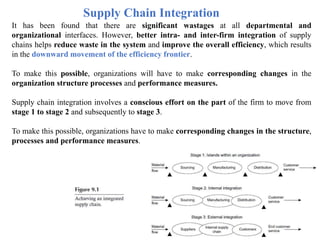
Supply chain integration involves a conscious effort on the part of the firm to move from
stage 1 to stage 2 and subsequently to stage 3.
To make this possible, organizations have to make corresponding changes in the structure,
processes and performance measures.
Supply Chain Integration
Most firms have by and large understood the need for internal integration while very few
have realized the need for external integration.
Payoffs through internal integration can be likened to the tip of an iceberg. The benefits of
external integration though not immediately visible, are immense.
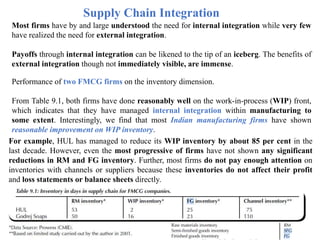
Performance of two FMCG firms on the inventory dimension.
From Table 9.1, both firms have done reasonably well on the work-in-process (WIP) front,
which indicates that they have managed internal integration within manufacturing to
some extent. Interestingly, we find that most Indian manufacturing firms have shown
reasonable improvement on WIP inventory.
For example, HUL has managed to reduce its WIP inventory by about 85 per cent in the
last decade. However, even the most progressive of firms have not shown any significant
reductions in RM and FG inventory. Further, most firms do not pay enough attention on
inventories with channels or suppliers because these inventories do not affect their profit
and loss statements or balance sheets directly.
Supply Chain Integration
Huge inventory in the channel reduces flexibility in launching any marketing initiatives
by FMCG companies.
Internal Integration
A typical firm is functionally organized, and material and information have to go
through multiple departments across the internal supply chain. As each function is
focusing on a narrowly defined local performance, there are many inefficiencies and
buffers at departmental boundaries.
An electric machinery firm, which has a manufacturing plant in Mumbai, serves the
southern market through a stock point in Chennai. The Mumbai plant ships goods to the
Chennai stock point once a month because monthly demand amounts to approximately a
full truckload.
Obviously by shipping goods using full truckloads, the plant is able to minimize
transportation costs. As it receives goods only once a month, the Chennai stock point has
to keep high safety stocks to ensure a reasonable level of service to its customers. Thus,
both the Mumbai plant and the Chennai regional stock point have made so-called locally
optimal decisions. A detailed analysis shows that it will be optimal (total transportation
and inventory cost will be lowest) for the firm to ship goods to Chennai from Mumbai
once a week. There is a trade-off between transportation and inventory costs, individual
departments chose to ignore this trade-off to make locally optimal decisions, resulting in
a substantial increase in the overall cost in the system.
Supply Chain Integration
External Integration
In a well-managed supply chain, there should be seamless flow of material/product and
information across organizational boundaries. Unfortunately, it is found that information
flow gets significantly distorted as we move along the chain and the material/product
flow is also correspondingly distorted across the chain.
As discussed earlier, in a supply chain all the entities are linked in buyer–supplier chains
and have to ultimately serve the end customer. Information is passed on from buyer to
supplier in the form of orders, that is, the demand placed by the buyer to the supplier.
For example, a garment retailer will place an order with the wholesaler, who in turn will
place the order with the garment manufacturer, who passes the order to the fabric
manufacturer and so on. It has been found that information in the form of orders gets
distorted as we move up the chain. This increased volatility results in increased costs for
all the members of the chain. The reason for this increased distortion is that each entity
within the supply chain focuses on its short-term performance measures.
This occurs because the demand volatility issues for a typical single buyer–supplier link in
the chain and subsequently look at issues related to the overall chain that consists of a
larger number of buyer–supplier links.
Supply Chain restructuring
Restructuring of supply chains helps a firm in moving the entire efficiency frontier in the
downward direction.
Supply chain restructuring involves significant changes in the supply chain structure in
terms of the way material and information flows are managed in the chain.
Some ways in which supply chains can be restructured include the following:
• Moving from the MTS (Make-to-stock) model to the (Configure-to-order) CTO model
• Reducing the number of stock points in distribution
• Differentiating fast-moving and slow-moving items in terms of material flow in chain
• Product and process redesign
By restructuring its supply chain, a company can either change the slope of the efficiency
frontier curve so as to make it flatter or shift the entire frontier downward.
In the case of functional products, the focus is on supply chain integration; in the case
of innovative products, the focus is on supply chain restructuring.
Supply Chain restructuring
For example, functional products require smooth flow of material in the system and do
not need much inventory within the chain, while innovative products require more
flexibility in the chain, which can be achieved by keeping a high inventory of material
at appropriate locations in the chain.
Supply Chain Process Restructuring
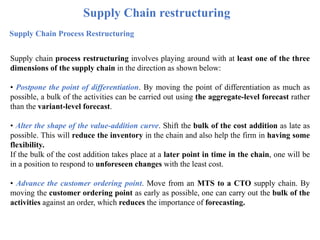
Supply chain process restructuring involves playing around with at least one of the three
dimensions of the supply chain in the direction as shown below:
• Postpone the point of differentiation. By moving the point of differentiation as much as
possible, a bulk of the activities can be carried out using the aggregate-level forecast rather
than the variant-level forecast.
• Alter the shape of the value-addition curve. Shift the bulk of the cost addition as late as
possible. This will reduce the inventory in the chain and also help the firm in having some
flexibility.
If the bulk of the cost addition takes place at a later point in time in the chain, one will be
in a position to respond to unforeseen changes with the least cost.
• Advance the customer ordering point. Move from an MTS to a CTO supply chain. By
moving the customer ordering point as early as possible, one can carry out the bulk of the
activities against an order, which reduces the importance of forecasting.
Supply Chain Mapping-Supply Chain process restructuring
Supply Chain Mapping
Before a firm sets out to restructure its supply chain, it has to find a method to
successfully capture and evaluate the existing supply chain processes.
The method used to capture current supply chain processes is termed supply chain
mapping.
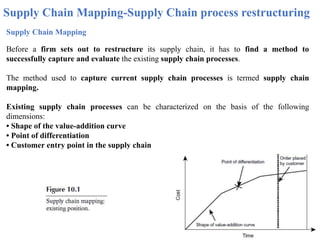
Existing supply chain processes can be characterized on the basis of the following
dimensions:
• Shape of the value-addition curve
• Point of differentiation
• Customer entry point in the supply chain
Supply Chain Mapping-Supply Chain process restructuring
Supply Chain Mapping
Restructuring of the supply chain process involves altering the supply chain on at least
one of the three dimensions.
It may also involve altering more than one dimension of the supply chain process.
We initially take one dimension at a time and later on discuss a specific innovation,
which involves altering two dimensions in the process.
Value-addition Curve
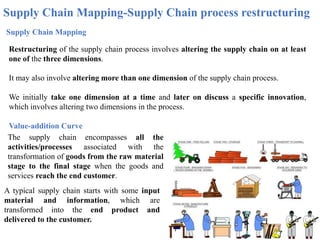
The supply chain encompasses all the
activities/processes associated with the
transformation of goods from the raw material
stage to the final stage when the goods and
services reach the end customer.
A typical supply chain starts with some input
material and information, which are
transformed into the end product and
delivered to the customer.
Supply Chain Mapping-Supply Chain process restructuring
Supply Chain Mapping: Value-addition Curve
For example, a truck manufacturer receives engine castings from a casting supplier, which
then wait till the machining operation is scheduled in the machine shop.
After that operation the machined castings go to the intermediate store and later on are
taken to the engine assembly stage. Then, the engine is mounted on a chassis in the truck
assembly line and the finished truck is dispatched to the dealer. The finished truck will be
available at dealer’s warehouse till the end customer picks it up.
This transformation involves a number of activities, with each activity taking time,
incurring cost and adding value.
One can debate on whether all activities add value or if there some activities that are non-
value-added activities.
At this stage, we assume that the firm has removed all non-value added activities from the
supply chain processes.
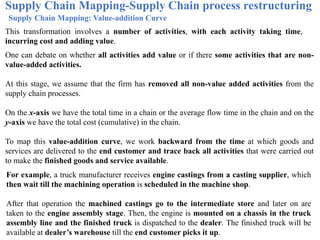
On the x-axis we have the total time in a chain or the average flow time in the chain and on the
y-axis we have the total cost (cumulative) in the chain.
To map this value-addition curve, we work backward from the time at which goods and
services are delivered to the end customer and trace back all activities that were carried out
to make the finished goods and service available.
Supply Chain Mapping-Supply Chain process restructuring
Supply Chain Mapping: Value-addition Curve
In this simplified version of the process, apart from the conversion and transportation
activities, the material in different forms waits at several stages: raw material store,
intermediate store, finished good store and dealer warehouse. If we map all the operations
(value-added and non-value-added activities)
Supply Chain Mapping-Supply Chain process restructuring
Supply Chain Mapping: Customer Entry Point in the Supply Chain
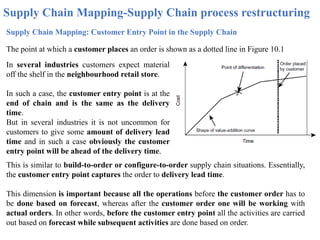
The point at which a customer places an order is shown as a dotted line in Figure 10.1
In several industries customers expect material
off the shelf in the neighbourhood retail store.
In such a case, the customer entry point is at the
end of chain and is the same as the delivery
time.
But in several industries it is not uncommon for
customers to give some amount of delivery lead
time and in such a case obviously the customer
entry point will be ahead of the delivery time.
This is similar to build-to-order or configure-to-order supply chain situations. Essentially,
the customer entry point captures the order to delivery lead time.
This dimension is important because all the operations before the customer order has to
be done based on forecast, whereas after the customer order one will be working with
actual orders. In other words, before the customer entry point all the activities are carried
out based on forecast while subsequent activities are done based on order.
Supply Chain Mapping-Supply Chain process restructuring
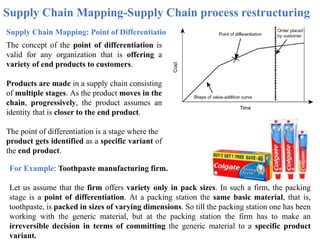
Supply Chain Mapping: Point of Differentiation
The concept of the point of differentiation is
valid for any organization that is offering a
variety of end products to customers.
Products are made in a supply chain consisting
of multiple stages. As the product moves in the
chain, progressively, the product assumes an
identity that is closer to the end product.
The point of differentiation is a stage where the
product gets identified as a specific variant of
the end product.
For Example: Toothpaste manufacturing firm.
Let us assume that the firm offers variety only in pack sizes. In such a firm, the packing
stage is a point of differentiation. At a packing station the same basic material, that is,
toothpaste, is packed in sizes of varying dimensions. So till the packing station one has been
working with the generic material, but at the packing station the firm has to make an
irreversible decision in terms of committing the generic material to a specific product
variant.
Supply Chain Mapping-Supply Chain process restructuring
Supply Chain Mapping: Point of Differentiation
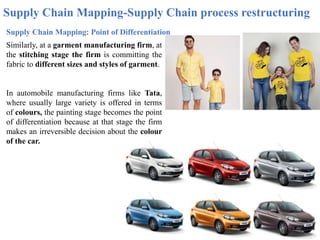
Similarly, at a garment manufacturing firm, at
the stitching stage the firm is committing the
fabric to different sizes and styles of garment.
In automobile manufacturing firms like Tata,
where usually large variety is offered in terms
of colours, the painting stage becomes the point
of differentiation because at that stage the firm
makes an irreversible decision about the colour
of the car.
Supply Chain restructuring
Supply Chain Process Restructuring
Supply chain process restructuring involves playing around with at least one of the three
dimensions of the supply chain in the direction as shown below:
• Postpone the point of differentiation. By moving the point of differentiation as much as
possible, a bulk of the activities can be carried out using the aggregate-level forecast rather
than the variant-level forecast.
• Alter the shape of the value-addition curve. Shift the bulk of the cost addition as late as
possible. This will reduce the inventory in the chain and also help the firm in having some
flexibility.
If the bulk of the cost addition takes place at a later point in time in the chain, one will be
in a position to respond to unforeseen changes with the least cost.
• Advance the customer ordering point. Move from an MTS to a CTO supply chain. By
moving the customer ordering point as early as possible, one can carry out the bulk of the
activities against an order, which reduces the importance of forecasting.
Role of IT in a Supply Chain
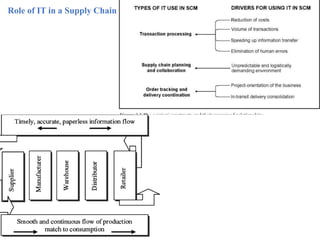
Information is crucial to the performance of a supply chain because it provides the
basis on which supply chain managers make decisions. Information provides
supply chain visibility, allowing managers to make decisions to improve the
supply chain’s performance.
Without information, a manager cannot know what customers want, how much
inventory is in stock, and when more product should be produced or shipped.
Information technology consists of the tools used to gain awareness of
information, analyze this information, and execute on it to improve the
performance of the supply chain.
IT consists of the hardware, software, and people throughout a supply chain that
gather, analyze, and execute upon information. IT serves as the eyes and ears (and
sometimes a portion of the brain) of management in a supply chain, capturing and
analyzing the information necessary to make a good decision.
For instance, an IT system at a PC manufacturer may show the finished goods
inventory at different stages of the supply chain and also provide the optimal
production plan and level of inventory based on demand and supply information.
Role of IT in a Supply Chain
Availability and analysis of information to drive decision making is a key to the
success of a supply chain.
Companies that have built their success on the availability and analysis of
information include Seven-Eleven Japan, Walmart, Amazon, UPS, and Netflix.
To support effective supply chain decisions, information must have the following
characteristics:
Information must be accurate. Without information that gives a true picture of the
state of the supply chain, it is difficult to make good decisions. That is not to say that
all information must be 100 percent correct, but rather that the data available paint a
picture that is at least directionally correct.
Information must be accessible in a timely manner. Accurate information often
exists, but by the time it is available, it is either out of date or it is not in an accessible
form. To make good decisions, a manager needs to have up-to-date information that
is easily accessible.
Information must be of the right kind. Decision makers need information that they
can use. Often companies have large amounts of data that are not helpful in making
a decision. Companies must think about what information should be recorded so
Role of IT in a Supply Chain
Information must be shared. A supply chain can be effective only if all its
stakeholders share a common view of the information that they use to make
business decisions. Different information with different stakeholders results in
misaligned action plans that hurt supply chain performance.
Information is used when making a wide variety of decisions about each supply chain
driver
Facility. Determining the location, capacity, and schedules of a facility requires
information on the trade-offs among efficiency and flexibility, demand, exchange
rates, taxes, and so on. Walmart’s suppliers use the demand information from.
Walmart’s stores to set their production schedules.
Walmart uses demand information to determine where to place its new
stores and cross-docking facilities.
Inventory. Setting optimal inventory policies requires information that includes
demand patterns, cost of carrying inventory, costs of stocking out, and costs of
ordering.
For example, Walmart collects detailed demand, cost, margin, and supplier
information to make these inventory policy decisions.
Transportation. Deciding on transportation networks, routings, modes, shipments,
and vendors requires information about costs, customer locations, and shipment
Role of IT in a Supply Chain
Sourcing. Information on product margins, prices, quality, delivery lead times,
and so on, are all important in making sourcing decisions.
Given sourcing deals with inter-enterprise transactions, a wide range of
transactional information must be recorded in order to execute operations, even
once sourcing decisions have been made.
Pricing and revenue management. To set pricing policies, one needs information on
demand, both its volume and various customer segments’ willingness to pay,
and on many supply issues, such as the product margin, lead time, and
availability.
Agile Supply Chain
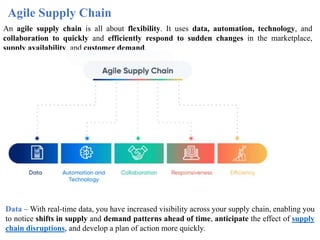
An agile supply chain is all about flexibility. It uses data, automation, technology, and
collaboration to quickly and efficiently respond to sudden changes in the marketplace,
supply availability, and customer demand.
Data – With real-time data, you have increased visibility across your supply chain, enabling you
to notice shifts in supply and demand patterns ahead of time, anticipate the effect of supply
chain disruptions, and develop a plan of action more quickly.
Agile Supply Chain
Automation and Technology – You have supply chain planning systems in place that can
process that real-time data – and automate your demand planning – while simultaneously
limiting human error and guesstimates that can wreak havoc on your bottom line.
Collaboration – Collaboration helps grease the wheels of an agile supply chain. By breaking
down organizational silos, teams can decide how best to respond to fluctuating demand by
understanding how that response will impact the company as a whole. This type of insight can
help you support the goals and balance the demands of different departments.
Responsiveness – If you have accurate data when you need it, your team can take decisive
action earlier to mitigate the negative effects, boosting your inventory optimization and
reputation among consumers to drive a competitive advantage.
Efficiency – Efficiency requires being adaptable and strategic with your available resources.
Responding quickly to real-time data won’t do you much good if you aren’t able to pivot. But
if you’re agile, you are neither underprepared nor overreacting. Instead, you’re calibrating
stock levels, service targets, and planning approaches to be prepared for shortages without
getting bogged down by obsolescence and warehousing cost
Agile Supply Chain
How to Implement an Agile Supply Chain Strategy
How do you go about implementing an agile supply chain? Here are some guidelines and tips.
1. Start at the end. Think about what you want your supply chain to look like when you’ve
implemented your new planning process.
2. Identify pain points. Gather feedback and consider your current obstacles and challenges.
Identify your blind spots, your siloes, and your inefficiencies.
3. Assemble the team. Invest in a team dedicated to improving agility and give them the
support and tools they need to explore planning options and implement best practices.
4. Invest in technology. Consider what supply chain software is best suited for your business.
For example, demand sensing software can help plan for demand and optimal inventory levels.
Incorporate your team’s input when considering how it would be used in day-to-day
operations.
5. Involve the whole ecosystem. Employees across departments are integral to this project.
Train and equip your people to succeed and regularly gather their feedback so you can adjust
and improve your workflows.
6. Communicate with your suppliers and customers. This minimizes the chances of
catching them by surprise and undermining those relationships.
Agile Supply Chain
1. Be realistic but optimistic. Understand that change isn’t easy – there will be some growing
pains, but the results are worth it. Look for opportunities to measure results and share wins,
demonstrating the benefits of the process company wide.
Agile Supply Chain
The Benefits of an Agile Supply Chain
Agility provides some obvious advantages. With increased visibility, proper planning
systems, speedier response times, improved collaboration, and efficient inventory
management, an agile supply chain can:
• Account for volatility and variable market demand
• Get your inventory management under control, minimizing the risk of obsolescence
• Reduce costs of production, warehousing, and transportation
• Produce a broad portfolio more quickly
• Break down organizational silos
• Improve supplier visibility
• Streamline clunky processes to improve planner productivity
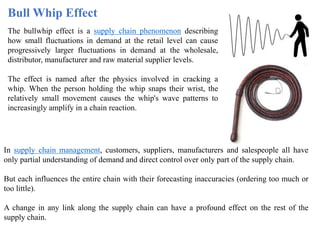
Bull Whip Effect
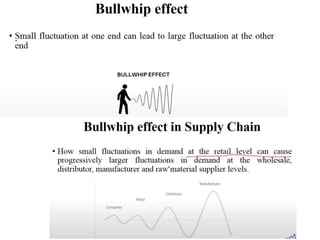
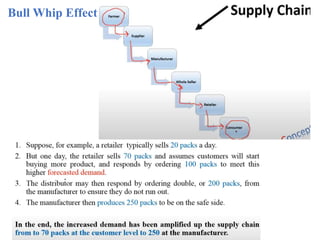
The bullwhip effect is a supply chain phenomenon describing
how small fluctuations in demand at the retail level can cause
progressively larger fluctuations in demand at the wholesale,
distributor, manufacturer and raw material supplier levels.
The effect is named after the physics involved in cracking a
whip. When the person holding the whip snaps their wrist, the
relatively small movement causes the whip's wave patterns to
increasingly amplify in a chain reaction.
In supply chain management, customers, suppliers, manufacturers and salespeople all have
only partial understanding of demand and direct control over only part of the supply chain.
But each influences the entire chain with their forecasting inaccuracies (ordering too much or
too little).
A change in any link along the supply chain can have a profound effect on the rest of the
supply chain.
Bull Whip Effect
The bullwhip effect is a supply chain phenomenon describing
how small fluctuations in demand at the retail level can cause
progressively larger fluctuations in demand at the wholesale,
distributor, manufacturer and raw material supplier levels.
The effect is named after the physics involved in cracking a
whip. When the person holding the whip snaps their wrist, the
relatively small movement causes the whip's wave patterns to
increasingly amplify in a chain reaction.
In supply chain management, customers, suppliers, manufacturers and salespeople all have
only partial understanding of demand and direct control over only part of the supply chain.
But each influences the entire chain with their forecasting inaccuracies (ordering too much or
too little).
A change in any link along the supply chain can have a profound effect on the rest of the
supply chain.
Bull Whip Effect
Bull Whip Effect
Bull Whip Effect
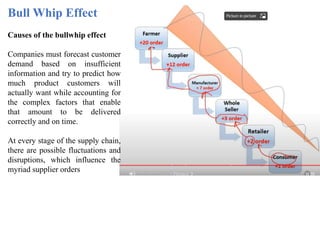
Causes of the bullwhip effect
Companies must forecast customer
demand based on insufficient
information and try to predict how
much product customers will
actually want while accounting for
the complex factors that enable
that amount to be delivered
correctly and on time.
At every stage of the supply chain,
there are possible fluctuations and
disruptions, which influence the
myriad supplier orders
Bull Whip Effect
Causes of the bullwhip effect
A few of the most common dependencies that can cause a bullwhip effect include the
following.
•lead-time issues, such as manufacturing delays;
•less-than-optimal decisions made by supply chain stakeholders at any point along the chain --
for example, customer service or shipping;
•a lack of communication and alignment between each link or stakeholder organization in
the supply chain;
•over- or under-reacting to demand expectations, such as ordering too many units or not
enough;
•customer companies -- often retailers -- waiting until orders build up before placing orders
with their suppliers, a practice called order batching;
•discounts, cost changes and other price variations that disrupt regular buying patterns; and
•inaccurate forecasts from over-reliance on historical demand to predict future demand.
Solutions to Bull Whip Effect
Solutions to the bullwhip effect
Better information is necessary to reduce the bullwhip effect. This means better
communication among supply chain partners and better forecasting methods. Some
commonly recommended actions include the following:
Foster supply chain communication and collaboration
Better alignment around supply chain issues is needed both within the company and
among customers, suppliers, distributors, manufacturing and the rest of the partners.
When suppliers understand customer needs, they can reduce excessive inventory. Supplier
and project portals, Electronic Data Interchange transactions and other capabilities of supply
chain management software can help.
Use better forecasting and visibility tools
A wide range of software enables more accurate demand forecasts and visibility into what is
happening along the supply chain. These include demand-sensing software, forecasting
software, inventory optimization software, tools that use analytics (especially predictive
analytics), artificial intelligence and Internet of Things connectivity.
Explore a demand-driven approach to supply chain management
Each company will need to decide on the right push-pull approach to its strategy, where a
push approach is used for stable products and a pull approach is used for those with more
erratic demand.

Module 5-SCM.pptx

  • 1.
    Supply Chain Management by Dr.Manjunath Patel G C Assistant Professor, Dept. of Mechanical Engineering, PES Institute of Technology and Management, Shivamogga
  • 2.
    Module 5: Current Trends:Supply Chain Integration Building partnership and trust in Supply chain Value of Information: Bullwhip Effect - Effective forecasting - Coordinating the supply chain Supply Chain restructuring Supply Chain Mapping-Supply Chain process restructuring Postpone the point of differentiation IT in Supply Chain Agile Supply Chains Reverse Supply chain Future of IT in supply chain E- Business in supply chain. Supply Chain Management
  • 3.
    Supply Chain Integration Ithas been found that there are significant wastages at all departmental and organizational interfaces. However, better intra- and inter-firm integration of supply chains helps reduce waste in the system and improve the overall efficiency, which results in the downward movement of the efficiency frontier. To make this possible, organizations will have to make corresponding changes in the organization structure processes and performance measures. Supply chain integration involves a conscious effort on the part of the firm to move from stage 1 to stage 2 and subsequently to stage 3. To make this possible, organizations have to make corresponding changes in the structure, processes and performance measures.
  • 4.
    Supply Chain Integration Mostfirms have by and large understood the need for internal integration while very few have realized the need for external integration. Payoffs through internal integration can be likened to the tip of an iceberg. The benefits of external integration though not immediately visible, are immense. Performance of two FMCG firms on the inventory dimension. From Table 9.1, both firms have done reasonably well on the work-in-process (WIP) front, which indicates that they have managed internal integration within manufacturing to some extent. Interestingly, we find that most Indian manufacturing firms have shown reasonable improvement on WIP inventory. For example, HUL has managed to reduce its WIP inventory by about 85 per cent in the last decade. However, even the most progressive of firms have not shown any significant reductions in RM and FG inventory. Further, most firms do not pay enough attention on inventories with channels or suppliers because these inventories do not affect their profit and loss statements or balance sheets directly.
  • 5.
    Supply Chain Integration Hugeinventory in the channel reduces flexibility in launching any marketing initiatives by FMCG companies. Internal Integration A typical firm is functionally organized, and material and information have to go through multiple departments across the internal supply chain. As each function is focusing on a narrowly defined local performance, there are many inefficiencies and buffers at departmental boundaries. An electric machinery firm, which has a manufacturing plant in Mumbai, serves the southern market through a stock point in Chennai. The Mumbai plant ships goods to the Chennai stock point once a month because monthly demand amounts to approximately a full truckload. Obviously by shipping goods using full truckloads, the plant is able to minimize transportation costs. As it receives goods only once a month, the Chennai stock point has to keep high safety stocks to ensure a reasonable level of service to its customers. Thus, both the Mumbai plant and the Chennai regional stock point have made so-called locally optimal decisions. A detailed analysis shows that it will be optimal (total transportation and inventory cost will be lowest) for the firm to ship goods to Chennai from Mumbai once a week. There is a trade-off between transportation and inventory costs, individual departments chose to ignore this trade-off to make locally optimal decisions, resulting in a substantial increase in the overall cost in the system.
  • 6.
    Supply Chain Integration ExternalIntegration In a well-managed supply chain, there should be seamless flow of material/product and information across organizational boundaries. Unfortunately, it is found that information flow gets significantly distorted as we move along the chain and the material/product flow is also correspondingly distorted across the chain. As discussed earlier, in a supply chain all the entities are linked in buyer–supplier chains and have to ultimately serve the end customer. Information is passed on from buyer to supplier in the form of orders, that is, the demand placed by the buyer to the supplier. For example, a garment retailer will place an order with the wholesaler, who in turn will place the order with the garment manufacturer, who passes the order to the fabric manufacturer and so on. It has been found that information in the form of orders gets distorted as we move up the chain. This increased volatility results in increased costs for all the members of the chain. The reason for this increased distortion is that each entity within the supply chain focuses on its short-term performance measures. This occurs because the demand volatility issues for a typical single buyer–supplier link in the chain and subsequently look at issues related to the overall chain that consists of a larger number of buyer–supplier links.
  • 7.
    Supply Chain restructuring Restructuringof supply chains helps a firm in moving the entire efficiency frontier in the downward direction. Supply chain restructuring involves significant changes in the supply chain structure in terms of the way material and information flows are managed in the chain. Some ways in which supply chains can be restructured include the following: • Moving from the MTS (Make-to-stock) model to the (Configure-to-order) CTO model • Reducing the number of stock points in distribution • Differentiating fast-moving and slow-moving items in terms of material flow in chain • Product and process redesign By restructuring its supply chain, a company can either change the slope of the efficiency frontier curve so as to make it flatter or shift the entire frontier downward. In the case of functional products, the focus is on supply chain integration; in the case of innovative products, the focus is on supply chain restructuring.
  • 8.
    Supply Chain restructuring Forexample, functional products require smooth flow of material in the system and do not need much inventory within the chain, while innovative products require more flexibility in the chain, which can be achieved by keeping a high inventory of material at appropriate locations in the chain. Supply Chain Process Restructuring Supply chain process restructuring involves playing around with at least one of the three dimensions of the supply chain in the direction as shown below: • Postpone the point of differentiation. By moving the point of differentiation as much as possible, a bulk of the activities can be carried out using the aggregate-level forecast rather than the variant-level forecast. • Alter the shape of the value-addition curve. Shift the bulk of the cost addition as late as possible. This will reduce the inventory in the chain and also help the firm in having some flexibility. If the bulk of the cost addition takes place at a later point in time in the chain, one will be in a position to respond to unforeseen changes with the least cost. • Advance the customer ordering point. Move from an MTS to a CTO supply chain. By moving the customer ordering point as early as possible, one can carry out the bulk of the activities against an order, which reduces the importance of forecasting.
  • 9.
    Supply Chain Mapping-SupplyChain process restructuring Supply Chain Mapping Before a firm sets out to restructure its supply chain, it has to find a method to successfully capture and evaluate the existing supply chain processes. The method used to capture current supply chain processes is termed supply chain mapping. Existing supply chain processes can be characterized on the basis of the following dimensions: • Shape of the value-addition curve • Point of differentiation • Customer entry point in the supply chain
  • 10.
    Supply Chain Mapping-SupplyChain process restructuring Supply Chain Mapping Restructuring of the supply chain process involves altering the supply chain on at least one of the three dimensions. It may also involve altering more than one dimension of the supply chain process. We initially take one dimension at a time and later on discuss a specific innovation, which involves altering two dimensions in the process. Value-addition Curve The supply chain encompasses all the activities/processes associated with the transformation of goods from the raw material stage to the final stage when the goods and services reach the end customer. A typical supply chain starts with some input material and information, which are transformed into the end product and delivered to the customer.
  • 11.
    Supply Chain Mapping-SupplyChain process restructuring Supply Chain Mapping: Value-addition Curve For example, a truck manufacturer receives engine castings from a casting supplier, which then wait till the machining operation is scheduled in the machine shop. After that operation the machined castings go to the intermediate store and later on are taken to the engine assembly stage. Then, the engine is mounted on a chassis in the truck assembly line and the finished truck is dispatched to the dealer. The finished truck will be available at dealer’s warehouse till the end customer picks it up. This transformation involves a number of activities, with each activity taking time, incurring cost and adding value. One can debate on whether all activities add value or if there some activities that are non- value-added activities. At this stage, we assume that the firm has removed all non-value added activities from the supply chain processes. On the x-axis we have the total time in a chain or the average flow time in the chain and on the y-axis we have the total cost (cumulative) in the chain. To map this value-addition curve, we work backward from the time at which goods and services are delivered to the end customer and trace back all activities that were carried out to make the finished goods and service available.
  • 12.
    Supply Chain Mapping-SupplyChain process restructuring Supply Chain Mapping: Value-addition Curve In this simplified version of the process, apart from the conversion and transportation activities, the material in different forms waits at several stages: raw material store, intermediate store, finished good store and dealer warehouse. If we map all the operations (value-added and non-value-added activities)
  • 13.
    Supply Chain Mapping-SupplyChain process restructuring Supply Chain Mapping: Customer Entry Point in the Supply Chain The point at which a customer places an order is shown as a dotted line in Figure 10.1 In several industries customers expect material off the shelf in the neighbourhood retail store. In such a case, the customer entry point is at the end of chain and is the same as the delivery time. But in several industries it is not uncommon for customers to give some amount of delivery lead time and in such a case obviously the customer entry point will be ahead of the delivery time. This is similar to build-to-order or configure-to-order supply chain situations. Essentially, the customer entry point captures the order to delivery lead time. This dimension is important because all the operations before the customer order has to be done based on forecast, whereas after the customer order one will be working with actual orders. In other words, before the customer entry point all the activities are carried out based on forecast while subsequent activities are done based on order.
  • 14.
    Supply Chain Mapping-SupplyChain process restructuring Supply Chain Mapping: Point of Differentiation The concept of the point of differentiation is valid for any organization that is offering a variety of end products to customers. Products are made in a supply chain consisting of multiple stages. As the product moves in the chain, progressively, the product assumes an identity that is closer to the end product. The point of differentiation is a stage where the product gets identified as a specific variant of the end product. For Example: Toothpaste manufacturing firm. Let us assume that the firm offers variety only in pack sizes. In such a firm, the packing stage is a point of differentiation. At a packing station the same basic material, that is, toothpaste, is packed in sizes of varying dimensions. So till the packing station one has been working with the generic material, but at the packing station the firm has to make an irreversible decision in terms of committing the generic material to a specific product variant.
  • 15.
    Supply Chain Mapping-SupplyChain process restructuring Supply Chain Mapping: Point of Differentiation Similarly, at a garment manufacturing firm, at the stitching stage the firm is committing the fabric to different sizes and styles of garment. In automobile manufacturing firms like Tata, where usually large variety is offered in terms of colours, the painting stage becomes the point of differentiation because at that stage the firm makes an irreversible decision about the colour of the car.
  • 16.
    Supply Chain restructuring SupplyChain Process Restructuring Supply chain process restructuring involves playing around with at least one of the three dimensions of the supply chain in the direction as shown below: • Postpone the point of differentiation. By moving the point of differentiation as much as possible, a bulk of the activities can be carried out using the aggregate-level forecast rather than the variant-level forecast. • Alter the shape of the value-addition curve. Shift the bulk of the cost addition as late as possible. This will reduce the inventory in the chain and also help the firm in having some flexibility. If the bulk of the cost addition takes place at a later point in time in the chain, one will be in a position to respond to unforeseen changes with the least cost. • Advance the customer ordering point. Move from an MTS to a CTO supply chain. By moving the customer ordering point as early as possible, one can carry out the bulk of the activities against an order, which reduces the importance of forecasting.
  • 17.
    Role of ITin a Supply Chain
  • 18.
    Role of ITin a Supply Chain Information is crucial to the performance of a supply chain because it provides the basis on which supply chain managers make decisions. Information provides supply chain visibility, allowing managers to make decisions to improve the supply chain’s performance. Without information, a manager cannot know what customers want, how much inventory is in stock, and when more product should be produced or shipped. Information technology consists of the tools used to gain awareness of information, analyze this information, and execute on it to improve the performance of the supply chain. IT consists of the hardware, software, and people throughout a supply chain that gather, analyze, and execute upon information. IT serves as the eyes and ears (and sometimes a portion of the brain) of management in a supply chain, capturing and analyzing the information necessary to make a good decision. For instance, an IT system at a PC manufacturer may show the finished goods inventory at different stages of the supply chain and also provide the optimal production plan and level of inventory based on demand and supply information.
  • 19.
    Role of ITin a Supply Chain Availability and analysis of information to drive decision making is a key to the success of a supply chain. Companies that have built their success on the availability and analysis of information include Seven-Eleven Japan, Walmart, Amazon, UPS, and Netflix. To support effective supply chain decisions, information must have the following characteristics: Information must be accurate. Without information that gives a true picture of the state of the supply chain, it is difficult to make good decisions. That is not to say that all information must be 100 percent correct, but rather that the data available paint a picture that is at least directionally correct. Information must be accessible in a timely manner. Accurate information often exists, but by the time it is available, it is either out of date or it is not in an accessible form. To make good decisions, a manager needs to have up-to-date information that is easily accessible. Information must be of the right kind. Decision makers need information that they can use. Often companies have large amounts of data that are not helpful in making a decision. Companies must think about what information should be recorded so
  • 20.
    Role of ITin a Supply Chain Information must be shared. A supply chain can be effective only if all its stakeholders share a common view of the information that they use to make business decisions. Different information with different stakeholders results in misaligned action plans that hurt supply chain performance. Information is used when making a wide variety of decisions about each supply chain driver Facility. Determining the location, capacity, and schedules of a facility requires information on the trade-offs among efficiency and flexibility, demand, exchange rates, taxes, and so on. Walmart’s suppliers use the demand information from. Walmart’s stores to set their production schedules. Walmart uses demand information to determine where to place its new stores and cross-docking facilities. Inventory. Setting optimal inventory policies requires information that includes demand patterns, cost of carrying inventory, costs of stocking out, and costs of ordering. For example, Walmart collects detailed demand, cost, margin, and supplier information to make these inventory policy decisions. Transportation. Deciding on transportation networks, routings, modes, shipments, and vendors requires information about costs, customer locations, and shipment
  • 21.
    Role of ITin a Supply Chain Sourcing. Information on product margins, prices, quality, delivery lead times, and so on, are all important in making sourcing decisions. Given sourcing deals with inter-enterprise transactions, a wide range of transactional information must be recorded in order to execute operations, even once sourcing decisions have been made. Pricing and revenue management. To set pricing policies, one needs information on demand, both its volume and various customer segments’ willingness to pay, and on many supply issues, such as the product margin, lead time, and availability.
  • 22.
    Agile Supply Chain Anagile supply chain is all about flexibility. It uses data, automation, technology, and collaboration to quickly and efficiently respond to sudden changes in the marketplace, supply availability, and customer demand. Data – With real-time data, you have increased visibility across your supply chain, enabling you to notice shifts in supply and demand patterns ahead of time, anticipate the effect of supply chain disruptions, and develop a plan of action more quickly.
  • 23.
    Agile Supply Chain Automationand Technology – You have supply chain planning systems in place that can process that real-time data – and automate your demand planning – while simultaneously limiting human error and guesstimates that can wreak havoc on your bottom line. Collaboration – Collaboration helps grease the wheels of an agile supply chain. By breaking down organizational silos, teams can decide how best to respond to fluctuating demand by understanding how that response will impact the company as a whole. This type of insight can help you support the goals and balance the demands of different departments. Responsiveness – If you have accurate data when you need it, your team can take decisive action earlier to mitigate the negative effects, boosting your inventory optimization and reputation among consumers to drive a competitive advantage. Efficiency – Efficiency requires being adaptable and strategic with your available resources. Responding quickly to real-time data won’t do you much good if you aren’t able to pivot. But if you’re agile, you are neither underprepared nor overreacting. Instead, you’re calibrating stock levels, service targets, and planning approaches to be prepared for shortages without getting bogged down by obsolescence and warehousing cost
  • 24.
    Agile Supply Chain Howto Implement an Agile Supply Chain Strategy How do you go about implementing an agile supply chain? Here are some guidelines and tips. 1. Start at the end. Think about what you want your supply chain to look like when you’ve implemented your new planning process. 2. Identify pain points. Gather feedback and consider your current obstacles and challenges. Identify your blind spots, your siloes, and your inefficiencies. 3. Assemble the team. Invest in a team dedicated to improving agility and give them the support and tools they need to explore planning options and implement best practices. 4. Invest in technology. Consider what supply chain software is best suited for your business. For example, demand sensing software can help plan for demand and optimal inventory levels. Incorporate your team’s input when considering how it would be used in day-to-day operations. 5. Involve the whole ecosystem. Employees across departments are integral to this project. Train and equip your people to succeed and regularly gather their feedback so you can adjust and improve your workflows. 6. Communicate with your suppliers and customers. This minimizes the chances of catching them by surprise and undermining those relationships.
  • 25.
    Agile Supply Chain 1.Be realistic but optimistic. Understand that change isn’t easy – there will be some growing pains, but the results are worth it. Look for opportunities to measure results and share wins, demonstrating the benefits of the process company wide.
  • 26.
    Agile Supply Chain TheBenefits of an Agile Supply Chain Agility provides some obvious advantages. With increased visibility, proper planning systems, speedier response times, improved collaboration, and efficient inventory management, an agile supply chain can: • Account for volatility and variable market demand • Get your inventory management under control, minimizing the risk of obsolescence • Reduce costs of production, warehousing, and transportation • Produce a broad portfolio more quickly • Break down organizational silos • Improve supplier visibility • Streamline clunky processes to improve planner productivity
  • 27.
    Bull Whip Effect Thebullwhip effect is a supply chain phenomenon describing how small fluctuations in demand at the retail level can cause progressively larger fluctuations in demand at the wholesale, distributor, manufacturer and raw material supplier levels. The effect is named after the physics involved in cracking a whip. When the person holding the whip snaps their wrist, the relatively small movement causes the whip's wave patterns to increasingly amplify in a chain reaction. In supply chain management, customers, suppliers, manufacturers and salespeople all have only partial understanding of demand and direct control over only part of the supply chain. But each influences the entire chain with their forecasting inaccuracies (ordering too much or too little). A change in any link along the supply chain can have a profound effect on the rest of the supply chain.
  • 28.
    Bull Whip Effect Thebullwhip effect is a supply chain phenomenon describing how small fluctuations in demand at the retail level can cause progressively larger fluctuations in demand at the wholesale, distributor, manufacturer and raw material supplier levels. The effect is named after the physics involved in cracking a whip. When the person holding the whip snaps their wrist, the relatively small movement causes the whip's wave patterns to increasingly amplify in a chain reaction. In supply chain management, customers, suppliers, manufacturers and salespeople all have only partial understanding of demand and direct control over only part of the supply chain. But each influences the entire chain with their forecasting inaccuracies (ordering too much or too little). A change in any link along the supply chain can have a profound effect on the rest of the supply chain.
  • 29.
  • 30.
  • 31.
    Bull Whip Effect Causesof the bullwhip effect Companies must forecast customer demand based on insufficient information and try to predict how much product customers will actually want while accounting for the complex factors that enable that amount to be delivered correctly and on time. At every stage of the supply chain, there are possible fluctuations and disruptions, which influence the myriad supplier orders
  • 32.
    Bull Whip Effect Causesof the bullwhip effect A few of the most common dependencies that can cause a bullwhip effect include the following. •lead-time issues, such as manufacturing delays; •less-than-optimal decisions made by supply chain stakeholders at any point along the chain -- for example, customer service or shipping; •a lack of communication and alignment between each link or stakeholder organization in the supply chain; •over- or under-reacting to demand expectations, such as ordering too many units or not enough; •customer companies -- often retailers -- waiting until orders build up before placing orders with their suppliers, a practice called order batching; •discounts, cost changes and other price variations that disrupt regular buying patterns; and •inaccurate forecasts from over-reliance on historical demand to predict future demand.
  • 33.
    Solutions to BullWhip Effect Solutions to the bullwhip effect Better information is necessary to reduce the bullwhip effect. This means better communication among supply chain partners and better forecasting methods. Some commonly recommended actions include the following: Foster supply chain communication and collaboration Better alignment around supply chain issues is needed both within the company and among customers, suppliers, distributors, manufacturing and the rest of the partners. When suppliers understand customer needs, they can reduce excessive inventory. Supplier and project portals, Electronic Data Interchange transactions and other capabilities of supply chain management software can help. Use better forecasting and visibility tools A wide range of software enables more accurate demand forecasts and visibility into what is happening along the supply chain. These include demand-sensing software, forecasting software, inventory optimization software, tools that use analytics (especially predictive analytics), artificial intelligence and Internet of Things connectivity. Explore a demand-driven approach to supply chain management Each company will need to decide on the right push-pull approach to its strategy, where a push approach is used for stable products and a pull approach is used for those with more erratic demand.