ELEC – Teaching
Multigrade Class
Module 5 Making a Scheme
of Work and a Unit Plan
Prepared by: Prof. Marjorie DF. San Juan
Introduction
• In module 5, you learned more about the
support necessary for successful multigrade
teaching.
• In this module, we will discuss various
aspects of planning for instruction and
outline the key steps in the planning process.
The module will focus specifically on making
a scheme of work and a unit plan.
After completing this unit, you should be
able to:
•Discuss the value of planning for
instructional purposes.
•Explain why a scheme of work is important
•Explain why a unit is needed.
•Prepare a scheme of work and a unit plan.
Objectives
Content
This module will cover the following topics:
•Planning for instruction
•Steps in the planning process
•Scheme of work and unit plan.
Planning
Before we get to the details of making a scheme of work, let us
consider why we need to plan for instruction. Planning is one of the
keys to a successful instructional program. It helps us:
• select relevant goals and objectives,
• make decisions about the content and structure of the
instructional program,
• ensure that necessary resources are acquired, and
• evaluate the effectiveness of the program.
Planning requires dedication, time, research and resources. It is
exceedingly important in multigrade situations. It takes planning to
effectively address the variety of needs in the multigrade classroom.
What is a Scheme of Work?
A scheme of work is a plan or a schedule that shows what
you will teach each week of the term during the school
year. Each teacher in a school makes a scheme of work
from a given curriculum and adjusts it each year as
needed.
Why do we make a scheme of work?
• To identify the topics that you and your learners must
cover within a given period and, most important, to avoid
gaps in students’ learning.
• To assist you in establishing realistic targets and to
assess whether you have achieved those targets.
Without a scheme of work, you might teach
only half of all the topics you need to teach
and may miss some important topics.
Schemes of work also facilitate continuity.
When a teacher leaves the system or is
absent, schemes serve as a map of the
material that the new teacher needs to
cover. A scheme of work also helps us think
about the learning sequence.
Planning a scheme of work for the
multigrade classroom helps you to ensure
that learners of different class levels are
always engaged in activities that are:
• interesting,
• meaningful,
• stimulating, and
• conducive to learning.
A scheme of work makes it easier for you to
sustain the interest of learners and ensure
that they learn. To achieve these goals, you
must understand, among other things:
• how children learn,
• the teaching methods that are effective in
multigrade situations,
• the approaches that you can use to
organize content and to group learners, and
• the steps involved in preparing a scheme
of work.
Preparing for instruction is like preparing to
build a house. We start with basic things like
the foundation, the floor and the walls. Then,
we build the roof. If we try to build the roof
before we build the walls, the building
collapses. If we try to teach learners how to
solve quadratic equations before we teach
them how to solve linear equations, the
learners will be confused. How does one
decide what to teach? You decide what to
teach by considering:
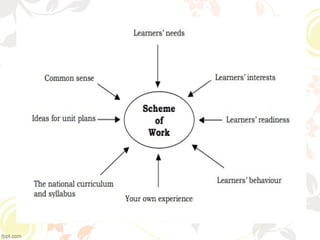
• your own experience and common sense,
• learners’ needs, interests, readiness and
behavior,
• the national curriculum and syllabus, and
• ideas for unit plans.
The following figure illustrates the link
between a scheme of work and the
concepts listed.
Your Own Experience and
Common Sense
Suppose your learners know how to add single-digit
numbers and the next topic you want to teach them is the
addition of two-digit numbers. But then you notice learners
taking stones out of a pile and counting them. What are the
learners doing? They are performing subtraction, even
though they may not know it. Because of this observation,
you decide that instead of teaching how to add two-digit
numbers, you will teach how to subtract single-digit
numbers. Common sense helps you adapt your plan and
change the sequence of what you intended to teach.
Learners
Whenever we teach something, we decide in which
direction learners should proceed next. This might be
based on the learners’ needs, interests and
readiness. A boy may bring money to school and
want to learn how to add it. The child is ready to
learn. A girl knows how to count to 20, so you
continue counting with her up to 30 or more.
Whenever possible, take advantage of situations in
which students have a need to learn or are motivated
to learn something that is relevant to their daily lives.
The National Curriculum and
Syllabi
The national curriculum is the total content to be
taught in a given subject over several years. For
example, the mathematics curriculum for basic
education describes everything to be taught in
mathematics from Grades 1 to 10. A curriculum is
divided into syllabuses. A syllabus is the total
content to be taught in a given year for one subject
at one level. For example, the mathematics Grade
1 syllabus only describes everything to be taught
in a Grade 1 mathematics class.
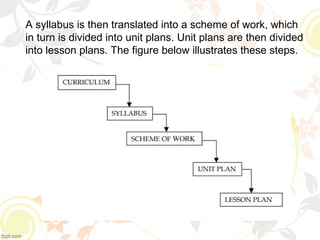
A syllabus is then translated into a scheme of work, which
in turn is divided into unit plans. Unit plans are then divided
into lesson plans. The figure below illustrates these steps.
Steps Involved in Planning a
Scheme of Work
Study the following scenario. It is about Brenda, a teacher who is
planning to teach three grades at the same time.
Making a Scheme of Work
After developing her timetable, Brenda was now ready to
plan her scheme of work for three grade levels. This seemed
a challenging task since the scheme of work had to be
different from that she had planned for her previous year’s
class, which was single-grade.
“Phew!” she thought, as she tried to decide what to do. “I
have to deal with three groups. Grade 1 is new to school life,
while Grade 2 and Grade 3 have some prior knowledge of
the curriculum content. What must I do?”
Fortunately, Brenda had received some training on
planning for multigrade classes. As she reflected on what
she had been taught and browsed through the curriculum
and syllabi, she realized that she could use three
organizational approaches.
1.Subject grouping: Brenda can let all the classes do
some of the same subject areas together. Two of the
subjects she can teach in this manner are technology and
official language.
2. Subject staggering: Brenda can let Grade 2 and 3
students do science while Grade 1 students do social
studies.
3. Common subject grouping: Brenda can let all the
classes focus on the same areas but at different levels.
After checking the timetable, she decided to develop
the following scheme of work:
• The mathematics and language arts periods would
be held in the morning and would be used for
common subject groupings.
• Social studies would be taught in the first session in
the afternoon from Monday to Thursday. She would
try subject staggering.
• Common subject groupings would be used for the
second and third periods of the afternoon.
• She would work with Grade 3 during the last period
of the day after the Grade 1 and 2 students were
dismissed at 12:30 in the afternoon
Now that Brenda had determined the grouping
strategy for various periods of the day, she
searched the curriculum for:
• common topics for three grade levels in
mathematics and language arts
• the approach to use in organizing the content
• the objectives that should be covered.
She then did some research, identified resources
for learning centers and wrote her scheme of work
in the weekly plan book that she had drawn up.
Source: Adapted from Commowealth Secretariat and Caribbean Community Secretariat and Commonwealth of
Learning. (1998: 22-24). Multigrade Teaching Programme. Module 9: Preparing the Scheme of Work and Lesson Plan.
London: Commonwealth Secretariat.
Now that you have read the scenario, pause for a moment
and think carefully about the steps that Brenda has taken
as she plans her scheme of work.
1. She decided on possible organizational approaches or
ways of grouping her learners: subject grouping, subject
staggering and common subject grouping.
2. She consulted the timetable to determine what subject
areas she would need to teach. (This is particularly
important in the multigrade situation because it is possible
to forget to cover some areas.)
3. She consulted the curriculum and syllabuses to
determine the topics she would teach, how she should
structure the content and the long- and short-term
objectives that she should cover.
4. She identified an appropriate organizational
approach for each period of the day.
5. She researched information on the topics.
6. She decided on the activities that each group of
learners would need to complete while she was
working with another group.
7. She identified resources that she needed in
order to set up learning centers in the classroom.
(Teachers need to have several useful activities so
that pupils can be occupied at all times.)
8. She wrote her scheme of work in her weekly
plan book.
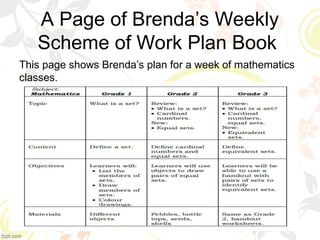
A Page of Brenda’s Weekly
Scheme of Work Plan Book
This page shows Brenda’s plan for a week of mathematics
classes.
In a scheme of work, you can show different
components of the plan:
Topic – the subject of the lesson
Content – defines the topic or outlines the
main concept.
Objectives – state what the learners must be
able to do.
Materials. – identify the necessary
resources.
Methods – describe the strategies the
teacher will use.
Independent Work – identifies the activities in which the
learners will engage while the teacher is with another class
group.
Evaluation – describes the method the teacher will use to
measure the success of the teaching-learning activity.
Brenda used only the first four components in her plan. The
approach used in this scheme of work is for common
subject groupings.
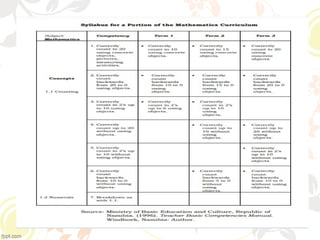
The content included in a scheme of work is based on the
syllabus for each subject. Remember that a syllabus is the
total content to be taught in a given year for one subject at
one grade level. An example of a syllabus for mathematics
is presented below.
You can use the information provided in the
syllabus to help you plan for the terms of the
school year. Note that you might need to
spread out difficult competencies over two or
three terms.
Unit Plan
After organizing the scheme of work, you
need to develop a unit plan. The unit plan
helps you to organize your teaching ideas
and activities. Let us look at the unit plan in
detail.
What Is a Unit Plan?
A unit plan:
• focuses on teaching and learning experiences
that are organized around chosen topics or
themes.
• extends for a period of four weeks or more. In
simple terms, a unit is an idea we use for
organizing instruction.
• is based on the syllabus and the scheme of work.
It contains broad goals and specific objectives that
serve as guidelines for the selection of appropriate
content and activities.
Why Do We Plan Units?
• Organizing the subject matter, teaching
methods, learning activities and materials in
a sequence helps students to learn.
• Structuring the learning experiences
around a single theme or topic over a period
of time helps students relate the ideas in
individual lessons to a broader concept.
The Components of a Unit
The components of a teaching plan generally
reflect the major components of the curriculum.
The main components of a unit are
• goals,
• concepts, skills and attitudes,
• objectives,
• activities,
• materials, and
• evaluation
A unit plan should outline the instructional
purpose, content, teaching strategies and
evaluation methods.
If it is to be an effective guide to teaching,
the unit plan should also include:
• a unit title,
• the class level(s), and
• the duration of each activity or component.
Steps to Follow in Planning a
Unit
When planning a unit, you should consult
the syllabus and decide on the topic or
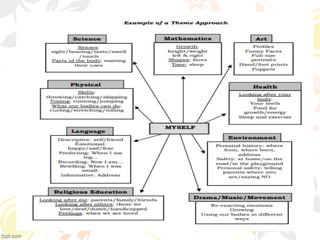
theme of the unit. For example, if the topic is
‘myself’, then ‘myself’ could be developed
into a unit for English, mathematics, health
and environmental studies, art, science,
physical education, drama/music/movement
and religious education.
As you do this, think about the lesson
activities you would like to use. What
materials could you use? What books would
be helpful? Are they available? How can you
use the materials and books in each
subject? Which outcomes will the learners
achieve? In this example about ‘myself’,
theme-based planning is used to plan the
unit.
When you finish developing some ideas for the
term or unit plans, look at your scheme of work
again. You will notice that the topics and
competencies are connected. You are teaching a
larger topic, ‘myself’, using different subjects, e.g.,
mathematics and English, to understand the topic.
This is called thematic instruction. Individual skills
are derived from a theme across the different
subjects.
In a thematic approach, you may need to
reorganize some topics or competencies in your
scheme of work. Now do the unit plans for other
terms of the year.
• Remember: You should organise your
planning around topics you are teaching,
and the learner’s needs – NOT necessarily
according to the order of competencies in
the syllabus. However, you should check
to see if you have included the most
important competencies.
When you have finished your unit plans for
all the terms, look again at the competencies
you have included. Tick them off in your
syllabus. Then, ask yourself:
• Have I missed any important
competencies?
• How can I add items I may have missed to
my unit plans?
When you have completed your unit plans,
make a lesson plan for each day. In Unit 6,
you will learn how to make lesson plans
ACTIVITY
Answer the following questions.
1.What is a scheme of work?
2. Define a unit plan.
3. Compare thematic instruction with topical
instruction.
4. What guidelines and/or resources can you
use to help you sequence objectives,
content and activities?

Module 5 - Making a Scheme of Work and a Unit Plan.ppt

  • 1.
    ELEC – Teaching MultigradeClass Module 5 Making a Scheme of Work and a Unit Plan Prepared by: Prof. Marjorie DF. San Juan
  • 2.
    Introduction • In module5, you learned more about the support necessary for successful multigrade teaching. • In this module, we will discuss various aspects of planning for instruction and outline the key steps in the planning process. The module will focus specifically on making a scheme of work and a unit plan.
  • 3.
    After completing thisunit, you should be able to: •Discuss the value of planning for instructional purposes. •Explain why a scheme of work is important •Explain why a unit is needed. •Prepare a scheme of work and a unit plan. Objectives
  • 4.
    Content This module willcover the following topics: •Planning for instruction •Steps in the planning process •Scheme of work and unit plan.
  • 5.
    Planning Before we getto the details of making a scheme of work, let us consider why we need to plan for instruction. Planning is one of the keys to a successful instructional program. It helps us: • select relevant goals and objectives, • make decisions about the content and structure of the instructional program, • ensure that necessary resources are acquired, and • evaluate the effectiveness of the program. Planning requires dedication, time, research and resources. It is exceedingly important in multigrade situations. It takes planning to effectively address the variety of needs in the multigrade classroom.
  • 6.
    What is aScheme of Work? A scheme of work is a plan or a schedule that shows what you will teach each week of the term during the school year. Each teacher in a school makes a scheme of work from a given curriculum and adjusts it each year as needed. Why do we make a scheme of work? • To identify the topics that you and your learners must cover within a given period and, most important, to avoid gaps in students’ learning. • To assist you in establishing realistic targets and to assess whether you have achieved those targets.
  • 7.
    Without a schemeof work, you might teach only half of all the topics you need to teach and may miss some important topics. Schemes of work also facilitate continuity. When a teacher leaves the system or is absent, schemes serve as a map of the material that the new teacher needs to cover. A scheme of work also helps us think about the learning sequence.
  • 8.
    Planning a schemeof work for the multigrade classroom helps you to ensure that learners of different class levels are always engaged in activities that are: • interesting, • meaningful, • stimulating, and • conducive to learning.
  • 9.
    A scheme ofwork makes it easier for you to sustain the interest of learners and ensure that they learn. To achieve these goals, you must understand, among other things: • how children learn, • the teaching methods that are effective in multigrade situations, • the approaches that you can use to organize content and to group learners, and • the steps involved in preparing a scheme of work.
  • 10.
    Preparing for instructionis like preparing to build a house. We start with basic things like the foundation, the floor and the walls. Then, we build the roof. If we try to build the roof before we build the walls, the building collapses. If we try to teach learners how to solve quadratic equations before we teach them how to solve linear equations, the learners will be confused. How does one decide what to teach? You decide what to teach by considering:
  • 11.
    • your ownexperience and common sense, • learners’ needs, interests, readiness and behavior, • the national curriculum and syllabus, and • ideas for unit plans. The following figure illustrates the link between a scheme of work and the concepts listed.
  • 13.
    Your Own Experienceand Common Sense Suppose your learners know how to add single-digit numbers and the next topic you want to teach them is the addition of two-digit numbers. But then you notice learners taking stones out of a pile and counting them. What are the learners doing? They are performing subtraction, even though they may not know it. Because of this observation, you decide that instead of teaching how to add two-digit numbers, you will teach how to subtract single-digit numbers. Common sense helps you adapt your plan and change the sequence of what you intended to teach.
  • 14.
    Learners Whenever we teachsomething, we decide in which direction learners should proceed next. This might be based on the learners’ needs, interests and readiness. A boy may bring money to school and want to learn how to add it. The child is ready to learn. A girl knows how to count to 20, so you continue counting with her up to 30 or more. Whenever possible, take advantage of situations in which students have a need to learn or are motivated to learn something that is relevant to their daily lives.
  • 15.
    The National Curriculumand Syllabi The national curriculum is the total content to be taught in a given subject over several years. For example, the mathematics curriculum for basic education describes everything to be taught in mathematics from Grades 1 to 10. A curriculum is divided into syllabuses. A syllabus is the total content to be taught in a given year for one subject at one level. For example, the mathematics Grade 1 syllabus only describes everything to be taught in a Grade 1 mathematics class.
  • 16.
    A syllabus isthen translated into a scheme of work, which in turn is divided into unit plans. Unit plans are then divided into lesson plans. The figure below illustrates these steps.
  • 17.
    Steps Involved inPlanning a Scheme of Work Study the following scenario. It is about Brenda, a teacher who is planning to teach three grades at the same time. Making a Scheme of Work After developing her timetable, Brenda was now ready to plan her scheme of work for three grade levels. This seemed a challenging task since the scheme of work had to be different from that she had planned for her previous year’s class, which was single-grade. “Phew!” she thought, as she tried to decide what to do. “I have to deal with three groups. Grade 1 is new to school life, while Grade 2 and Grade 3 have some prior knowledge of the curriculum content. What must I do?”
  • 18.
    Fortunately, Brenda hadreceived some training on planning for multigrade classes. As she reflected on what she had been taught and browsed through the curriculum and syllabi, she realized that she could use three organizational approaches. 1.Subject grouping: Brenda can let all the classes do some of the same subject areas together. Two of the subjects she can teach in this manner are technology and official language. 2. Subject staggering: Brenda can let Grade 2 and 3 students do science while Grade 1 students do social studies. 3. Common subject grouping: Brenda can let all the classes focus on the same areas but at different levels.
  • 19.
    After checking thetimetable, she decided to develop the following scheme of work: • The mathematics and language arts periods would be held in the morning and would be used for common subject groupings. • Social studies would be taught in the first session in the afternoon from Monday to Thursday. She would try subject staggering. • Common subject groupings would be used for the second and third periods of the afternoon. • She would work with Grade 3 during the last period of the day after the Grade 1 and 2 students were dismissed at 12:30 in the afternoon
  • 20.
    Now that Brendahad determined the grouping strategy for various periods of the day, she searched the curriculum for: • common topics for three grade levels in mathematics and language arts • the approach to use in organizing the content • the objectives that should be covered. She then did some research, identified resources for learning centers and wrote her scheme of work in the weekly plan book that she had drawn up. Source: Adapted from Commowealth Secretariat and Caribbean Community Secretariat and Commonwealth of Learning. (1998: 22-24). Multigrade Teaching Programme. Module 9: Preparing the Scheme of Work and Lesson Plan. London: Commonwealth Secretariat.
  • 21.
    Now that youhave read the scenario, pause for a moment and think carefully about the steps that Brenda has taken as she plans her scheme of work. 1. She decided on possible organizational approaches or ways of grouping her learners: subject grouping, subject staggering and common subject grouping. 2. She consulted the timetable to determine what subject areas she would need to teach. (This is particularly important in the multigrade situation because it is possible to forget to cover some areas.) 3. She consulted the curriculum and syllabuses to determine the topics she would teach, how she should structure the content and the long- and short-term objectives that she should cover.
  • 22.
    4. She identifiedan appropriate organizational approach for each period of the day. 5. She researched information on the topics. 6. She decided on the activities that each group of learners would need to complete while she was working with another group. 7. She identified resources that she needed in order to set up learning centers in the classroom. (Teachers need to have several useful activities so that pupils can be occupied at all times.) 8. She wrote her scheme of work in her weekly plan book.
  • 23.
    A Page ofBrenda’s Weekly Scheme of Work Plan Book This page shows Brenda’s plan for a week of mathematics classes.
  • 24.
    In a schemeof work, you can show different components of the plan: Topic – the subject of the lesson Content – defines the topic or outlines the main concept. Objectives – state what the learners must be able to do. Materials. – identify the necessary resources. Methods – describe the strategies the teacher will use.
  • 25.
    Independent Work –identifies the activities in which the learners will engage while the teacher is with another class group. Evaluation – describes the method the teacher will use to measure the success of the teaching-learning activity. Brenda used only the first four components in her plan. The approach used in this scheme of work is for common subject groupings. The content included in a scheme of work is based on the syllabus for each subject. Remember that a syllabus is the total content to be taught in a given year for one subject at one grade level. An example of a syllabus for mathematics is presented below.
  • 27.
    You can usethe information provided in the syllabus to help you plan for the terms of the school year. Note that you might need to spread out difficult competencies over two or three terms.
  • 28.
    Unit Plan After organizingthe scheme of work, you need to develop a unit plan. The unit plan helps you to organize your teaching ideas and activities. Let us look at the unit plan in detail.
  • 29.
    What Is aUnit Plan? A unit plan: • focuses on teaching and learning experiences that are organized around chosen topics or themes. • extends for a period of four weeks or more. In simple terms, a unit is an idea we use for organizing instruction. • is based on the syllabus and the scheme of work. It contains broad goals and specific objectives that serve as guidelines for the selection of appropriate content and activities.
  • 30.
    Why Do WePlan Units? • Organizing the subject matter, teaching methods, learning activities and materials in a sequence helps students to learn. • Structuring the learning experiences around a single theme or topic over a period of time helps students relate the ideas in individual lessons to a broader concept.
  • 31.
    The Components ofa Unit The components of a teaching plan generally reflect the major components of the curriculum. The main components of a unit are • goals, • concepts, skills and attitudes, • objectives, • activities, • materials, and • evaluation
  • 32.
    A unit planshould outline the instructional purpose, content, teaching strategies and evaluation methods. If it is to be an effective guide to teaching, the unit plan should also include: • a unit title, • the class level(s), and • the duration of each activity or component.
  • 33.
    Steps to Followin Planning a Unit When planning a unit, you should consult the syllabus and decide on the topic or theme of the unit. For example, if the topic is ‘myself’, then ‘myself’ could be developed into a unit for English, mathematics, health and environmental studies, art, science, physical education, drama/music/movement and religious education.
  • 34.
    As you dothis, think about the lesson activities you would like to use. What materials could you use? What books would be helpful? Are they available? How can you use the materials and books in each subject? Which outcomes will the learners achieve? In this example about ‘myself’, theme-based planning is used to plan the unit.
  • 36.
    When you finishdeveloping some ideas for the term or unit plans, look at your scheme of work again. You will notice that the topics and competencies are connected. You are teaching a larger topic, ‘myself’, using different subjects, e.g., mathematics and English, to understand the topic. This is called thematic instruction. Individual skills are derived from a theme across the different subjects. In a thematic approach, you may need to reorganize some topics or competencies in your scheme of work. Now do the unit plans for other terms of the year.
  • 37.
    • Remember: Youshould organise your planning around topics you are teaching, and the learner’s needs – NOT necessarily according to the order of competencies in the syllabus. However, you should check to see if you have included the most important competencies.
  • 38.
    When you havefinished your unit plans for all the terms, look again at the competencies you have included. Tick them off in your syllabus. Then, ask yourself: • Have I missed any important competencies? • How can I add items I may have missed to my unit plans? When you have completed your unit plans, make a lesson plan for each day. In Unit 6, you will learn how to make lesson plans
  • 39.
    ACTIVITY Answer the followingquestions. 1.What is a scheme of work? 2. Define a unit plan. 3. Compare thematic instruction with topical instruction. 4. What guidelines and/or resources can you use to help you sequence objectives, content and activities?