Introduction about IoT  
 
 
Introduction
 
The Internet of Things (IoT) is emerging as the third wave in the development of the Internet.                                 
The 1990s’ Internet wave connected 1 billion users while the 2000s’ mobile wave connected                           
another 2 billion. The IoT has the potential to connect 10X as many (28 billion) “things” to the                                   
Internet by 2020, ranging from bracelets to cars. Breakthroughs in the cost of sensors,                           
processing power and bandwidth to connect devices are enabling ubiquitous connections                     
right now. Smart products like smart watches and thermostats (Nest) are already gaining                         
traction as stated in Goldman Sachs Global Investment Research’s report. 
 
IoT Generic Definition
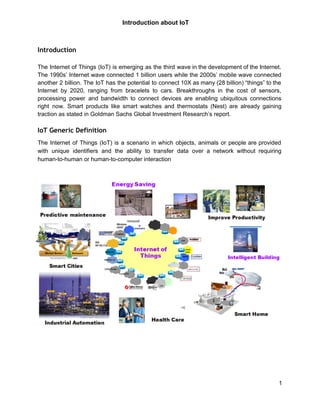
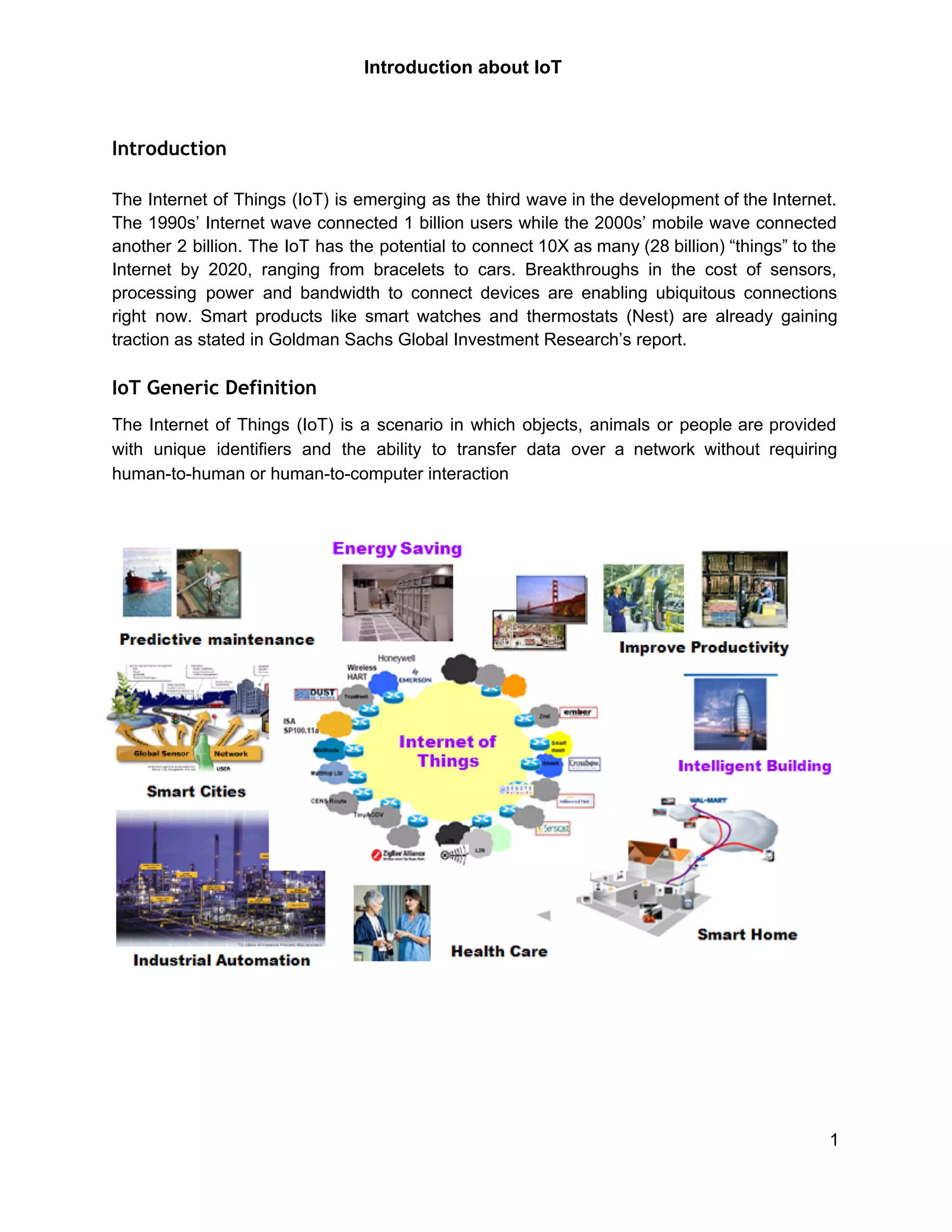
The Internet of Things (IoT) is a scenario in which objects, animals or people are provided                               
with unique identifiers and the ability to transfer data over a network without requiring                           
human­to­human or human­to­computer interaction 


1 
 
 
Introduction about IoT  
 
 
IoT Definition from IT perspective
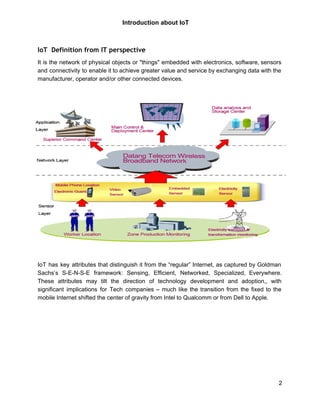
It is the network of physical objects or "things" embedded with electronics, software, sensors                           
and connectivity to enable it to achieve greater value and service by exchanging data with the                               
manufacturer, operator and/or other connected devices.
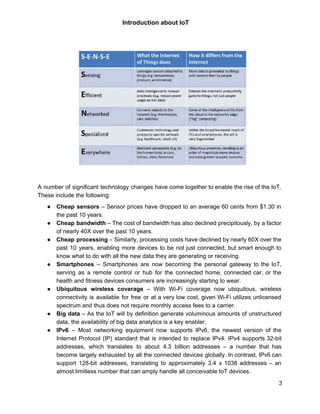
IoT has key attributes that distinguish it from the “regular” Internet, as captured by Goldman                             
Sachs’s S­E­N­S­E framework: Sensing, Efficient, Networked, Specialized, Everywhere.               
These attributes may tilt the direction of technology development and adoption,, with                       
significant implications for Tech companies – much like the transition from the fixed to the                             
mobile Internet shifted the center of gravity from Intel to Qualcomm or from Dell to Apple. 
2 
 
 
Introduction about IoT  


A number of significant technology changes have come together to enable the rise of the IoT.                               
These include the following: 
● Cheap sensors – Sensor prices have dropped to an average 60 cents from $1.30 in                             
the past 10 years. 
● Cheap bandwidth – The cost of bandwidth has also declined precipitously, by a factor                           
of nearly 40X over the past 10 years. 
● Cheap processing – Similarly, processing costs have declined by nearly 60X over the                         
past 10 years, enabling more devices to be not just connected, but smart enough to                             
know what to do with all the new data they are generating or receiving. 
● Smartphones – Smartphones are now becoming the personal gateway to the IoT,                       
serving as a remote control or hub for the connected home, connected car, or the                             
health and fitness devices consumers are increasingly starting to wear. 
● Ubiquitous wireless coverage – With Wi­Fi coverage now ubiquitous, wireless                   
connectivity is available for free or at a very low cost, given Wi­Fi utilizes unlicensed                             
spectrum and thus does not require monthly access fees to a carrier. 
● Big data ​– As the IoT will by definition generate voluminous amounts of unstructured                           
data, the availability of big data analytics is a key enabler. 
● IPv6 – Most networking equipment now supports IPv6, the newest version of the                         
Internet Protocol (IP) standard that is intended to replace IPv4. IPv4 supports 32­bit                         
addresses, which translates to about 4.3 billion addresses – a number that has                         
become largely exhausted by all the connected devices globally. In contrast, IPv6 can                         
support 128­bit addresses, translating to approximately 3.4 x 1038 addresses – an                       
almost limitless number that can amply handle all conceivable IoT devices. 
3 
 
 
Introduction about IoT  
 
 
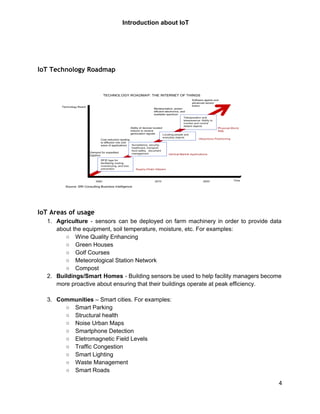
IoT Technology Roadmap
IoT Areas of usage
1. Agriculture ­ sensors can be deployed on farm machinery in order to provide data                           
about the equipment, soil temperature, moisture, etc. For examples:  
○ Wine Quality Enhancing 
○ Green Houses 
○ Golf Courses 
○ Meteorological Station Network 
○ Compost 
2. Buildings/Smart Homes ​­ Building sensors be used to help facility managers become                       
more proactive about ensuring that their buildings operate at peak efficiency. 
 
3. Communities​ – Smart cities. For examples:  
○ Smart Parking 
○ Structural health 
○ Noise Urban Maps 
○ Smartphone Detection 
○ Eletromagnetic Field Levels 
○ Traffic Congestion 
○ Smart Lighting 
○ Waste Management 
○ Smart Roads 
4 
 
 
Introduction about IoT  
 
 
4. Healthcare – Infant monitors, smart diapers, pills with ingestible sensors are just some                         
of the IOT­based devices. 
5. Manufacturing – factories with sensors can improve operations, product quality, and                     
decrease safety hazards. 
6. Smartphones ​– can control everything from door locks, thermostats, light bulbs,                     
vacuum cleaners, and more. 
7. Utilities – smart water meters can be used to reduce water leaks. Smart electric grids                             
can adjust rates depending on usage. 
8. Wearables – Smart watches, fitness trackers and health monitors may become                     
primary source for human­related data, and can also be used in sports, retail, travel                           
and manufacturing. 
Suggested Services:
1. Crowdfunding 
2. Seed­funding 
3. Co­working space 
4. Mentoring  
5. Access to Telekom assets 
6. Lab(IoT­LAB) 
7. Kickstart program 
IoT Products
Microcontrollers 
Sensors 
Wireless and RF Solutions 
 
 
Resources:
https://www.mapr.com/solutions/enterprise/internet­of­things  
http://www.libelium.com/top_50_iot_sensor_applications_ranking/  
http://iotlab.wisc.edu/ 
http://www.claropartners.com/iot­lab­barcelona­june­2014/ 
https://www.silabs.com/iot/Pages/internet­of­things.aspx 
https://uwiotlab.wordpress.com/ 
https://docs.google.com/document/d/1Jqqs9Es9pjica6bW_3YCUJ8ahTxTIF5L2sLi1A2CZuM/
edit 
http://ahmedbanafa.blogspot.com/2014/10/internet­of­things­iot­third­wave.html  
Companies List:  
http://postscapes.com/companies/ 
5 
 
 
Introduction about IoT  
 
 
http://iotchina.net/ 
http://www.cio.com/article/2602467/consumer­technology/10­hot­internet­of­things­startups.ht
ml 
http://iotinternetofthingsconference.com/companies/ 
http://www.link­labs.com/iot­agriculture/ 
http://senslab.u­strasbg.fr/blog/ 
http://www.element14.com/community/groups/internet­of­things/blog/2014/07/05/building­an­i
ot­lab 
https://www.kickstarter.com/  
https://www.iot­lab.info/what­is­iot­lab/ 
Labs Examples:
http://www.mandint.org/en/iotlab 
http://autoidlabs.org/wordpress_website/ 
https://www.hubraum.com/programs 
http://www.rackspace.co.uk/sites/default/files/whitepapers/The_Human_Cloud_­_June_2013.
pdf  
http://cordis.europa.eu/project/rcn/110587_en.html 
http://postscapes.com/internet­of­things­investment 
 
Top  IoT tools: 
http://blog.profitbricks.com/top­49­tools­internet­of­things/ 
http://iot.eclipse.org/tools.html 


6 

Introduction About IoT

  • 1.
        Introduction about IoT       Introduction   The Internetof Things (IoT) is emerging as the third wave in the development of the Internet.                                  The 1990s’ Internet wave connected 1 billion users while the 2000s’ mobile wave connected                            another 2 billion. The IoT has the potential to connect 10X as many (28 billion) “things” to the                                    Internet by 2020, ranging from bracelets to cars. Breakthroughs in the cost of sensors,                            processing power and bandwidth to connect devices are enabling ubiquitous connections                      right now. Smart products like smart watches and thermostats (Nest) are already gaining                          traction as stated in Goldman Sachs Global Investment Research’s report.    IoT Generic Definition The Internet of Things (IoT) is a scenario in which objects, animals or people are provided                                with unique identifiers and the ability to transfer data over a network without requiring                            human­to­human or human­to­computer interaction        1 
  • 2.
        Introduction about IoT       IoT Definitionfrom IT perspective It is the network of physical objects or "things" embedded with electronics, software, sensors                            and connectivity to enable it to achieve greater value and service by exchanging data with the                                manufacturer, operator and/or other connected devices. IoT has key attributes that distinguish it from the “regular” Internet, as captured by Goldman                              Sachs’s S­E­N­S­E framework: Sensing, Efficient, Networked, Specialized, Everywhere.                These attributes may tilt the direction of technology development and adoption,, with                        significant implications for Tech companies – much like the transition from the fixed to the                              mobile Internet shifted the center of gravity from Intel to Qualcomm or from Dell to Apple.  2 
  • 3.
        Introduction about IoT         A numberof significant technology changes have come together to enable the rise of the IoT.                                These include the following:  ● Cheap sensors – Sensor prices have dropped to an average 60 cents from $1.30 in                              the past 10 years.  ● Cheap bandwidth – The cost of bandwidth has also declined precipitously, by a factor                            of nearly 40X over the past 10 years.  ● Cheap processing – Similarly, processing costs have declined by nearly 60X over the                          past 10 years, enabling more devices to be not just connected, but smart enough to                              know what to do with all the new data they are generating or receiving.  ● Smartphones – Smartphones are now becoming the personal gateway to the IoT,                        serving as a remote control or hub for the connected home, connected car, or the                              health and fitness devices consumers are increasingly starting to wear.  ● Ubiquitous wireless coverage – With Wi­Fi coverage now ubiquitous, wireless                    connectivity is available for free or at a very low cost, given Wi­Fi utilizes unlicensed                              spectrum and thus does not require monthly access fees to a carrier.  ● Big data ​– As the IoT will by definition generate voluminous amounts of unstructured                            data, the availability of big data analytics is a key enabler.  ● IPv6 – Most networking equipment now supports IPv6, the newest version of the                          Internet Protocol (IP) standard that is intended to replace IPv4. IPv4 supports 32­bit                          addresses, which translates to about 4.3 billion addresses – a number that has                          become largely exhausted by all the connected devices globally. In contrast, IPv6 can                          support 128­bit addresses, translating to approximately 3.4 x 1038 addresses – an                        almost limitless number that can amply handle all conceivable IoT devices.  3 
  • 4.
        Introduction about IoT       IoT TechnologyRoadmap IoT Areas of usage 1. Agriculture ­ sensors can be deployed on farm machinery in order to provide data                            about the equipment, soil temperature, moisture, etc. For examples:   ○ Wine Quality Enhancing  ○ Green Houses  ○ Golf Courses  ○ Meteorological Station Network  ○ Compost  2. Buildings/Smart Homes ​­ Building sensors be used to help facility managers become                        more proactive about ensuring that their buildings operate at peak efficiency.    3. Communities​ – Smart cities. For examples:   ○ Smart Parking  ○ Structural health  ○ Noise Urban Maps  ○ Smartphone Detection  ○ Eletromagnetic Field Levels  ○ Traffic Congestion  ○ Smart Lighting  ○ Waste Management  ○ Smart Roads  4 
  • 5.
        Introduction about IoT       4. Healthcare– Infant monitors, smart diapers, pills with ingestible sensors are just some                          of the IOT­based devices.  5. Manufacturing – factories with sensors can improve operations, product quality, and                      decrease safety hazards.  6. Smartphones ​– can control everything from door locks, thermostats, light bulbs,                      vacuum cleaners, and more.  7. Utilities – smart water meters can be used to reduce water leaks. Smart electric grids                              can adjust rates depending on usage.  8. Wearables – Smart watches, fitness trackers and health monitors may become                      primary source for human­related data, and can also be used in sports, retail, travel                            and manufacturing.  Suggested Services: 1. Crowdfunding  2. Seed­funding  3. Co­working space  4. Mentoring   5. Access to Telekom assets  6. Lab(IoT­LAB)  7. Kickstart program  IoT Products Microcontrollers  Sensors  Wireless and RF Solutions      Resources: https://www.mapr.com/solutions/enterprise/internet­of­things   http://www.libelium.com/top_50_iot_sensor_applications_ranking/   http://iotlab.wisc.edu/  http://www.claropartners.com/iot­lab­barcelona­june­2014/  https://www.silabs.com/iot/Pages/internet­of­things.aspx  https://uwiotlab.wordpress.com/  https://docs.google.com/document/d/1Jqqs9Es9pjica6bW_3YCUJ8ahTxTIF5L2sLi1A2CZuM/ edit  http://ahmedbanafa.blogspot.com/2014/10/internet­of­things­iot­third­wave.html   Companies List:   http://postscapes.com/companies/  5 
  • 6.
        Introduction about IoT       http://iotchina.net/  http://www.cio.com/article/2602467/consumer­technology/10­hot­internet­of­things­startups.ht ml  http://iotinternetofthingsconference.com/companies/  http://www.link­labs.com/iot­agriculture/  http://senslab.u­strasbg.fr/blog/  http://www.element14.com/community/groups/internet­of­things/blog/2014/07/05/building­an­i ot­lab  https://www.kickstarter.com/   https://www.iot­lab.info/what­is­iot­lab/  Labs Examples: http://www.mandint.org/en/iotlab  http://autoidlabs.org/wordpress_website/  https://www.hubraum.com/programs  http://www.rackspace.co.uk/sites/default/files/whitepapers/The_Human_Cloud_­_June_2013. pdf   http://cordis.europa.eu/project/rcn/110587_en.html  http://postscapes.com/internet­of­things­investment    Top  IoT tools:  http://blog.profitbricks.com/top­49­tools­internet­of­things/  http://iot.eclipse.org/tools.html                6