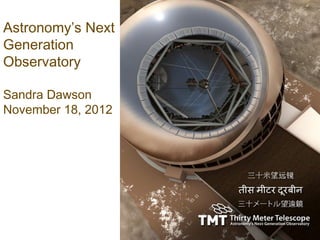
Astronomy’s Next
Generation
Observatory

Sandra Dawson
November 18, 2012
The observatories of Mauna Kea
The high, dry, stable air of Mauna Kea, and the dark skies make this
one of the best places in the world to do astronomy. Mauna Kea is also
a sacred place of legend to Hawaiians.
Exciting Astronomy from Mauna Kea
 Keck and CFHT: coldest known star: a brown dwarf with about the
   same temperature as a hot cup of coffee. That's cool enough to
   begin crossing the blurry line between small cold stars and big hot
   planets.
 Keck: the discovery of a planet that could have liquid water on its
   surface.
 Subaru - red star-forming galaxies around a galaxy cluster situated
   four billion light years away from Earth; they may demonstrate the
   dramatic evolution of galaxies in the environment surrounding the
   cluster.
 Gemini – new research revealing the history of the outer Solar
   System by measuring the mutual orbits of extremely widely
   separated binaries located beyond Neptune in the icy Kuiper Belt.
Glowing Young Planets

• This star has three orbiting planets -
  the first imaged planetary system!

• Planets are much fainter than their
  parent star, so are difficult to image

• Why are these pictures possible?

    • Advanced observing techniques         Three planets
      were used to block the star’s light   orbiting HR8799
    • Observations were repeated over       Keck Observatory infrared image of star
      years, confirming planetary           HR8799 and three orbiting planets with orbital
      motion                                directions indicated by arrows. The light from
                                            the star was subtracted, but a lot of ‘noise’
    • The planets are young and hot,        remains.
      and therefore glow more brightly
      than by reflected starlight alone
Evolution of Modern Telescopes                                THIRTY METER TELESCOPE


                                         TMT.PMO.PRE.09.018.DR           4
Project Website: www.TMT-HawaiiEIS.org
                                                 F03
Segment #1 Prototype
TMT.PMO.PRE.10.034.REL05                                                                             7
The Information Herein is Subject to the Restrictions Contained on the Cover Page of this Document
THIRTY METER TELESCOPE


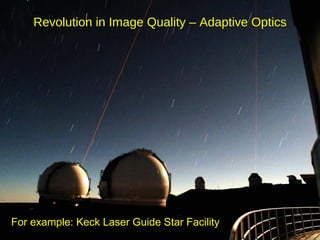
         Revolution in Image Quality – Adaptive Optics


For example: Keck Laser Guide Star Facility
 Project Website: www.TMT-HawaiiEIS.org
Adaptive Optics                                    THIRTY METER TELESCOPE


     Taking the “twinkle twinkle” out of that little star...


 Large telescope image quality is limited by the
    atmosphere
 Adaptive optics is a technique that measures the
    atmospheric changes and corrects them as they
    occur, thus eliminating them
 This must be done very rapidly ~ 500
    times/second


Project Website: www.TMT-HawaiiEIS.org
THIRTY METER TELESCOPE


   NGC 1569                               Hubble NIC2
    SSC B                                      F160W


                                           15 pc
(Field of view: 6” x 6”)
 Project Website: www.TMT-HawaiiEIS.org
THIRTY METER TELESCOPE


   NGC 1569                                   Keck AO
    SSC B                                         IHK’


                                          15 pc
(Field of view: 6” x 6”)
 Project Website: www.TMT-HawaiiEIS.org
Enables studies of “weather” on Uranus
TMT: Key Science                                THIRTY METER TELESCOPE


                                             Formation of stars and planets

                                              Nature of extra-solar planets

                                     Presence of life elsewhere in the Universe

                                         Nature and composition of the Universe

                                         Formation of the first stars and galaxies

                                           Evolution of galaxies
                            Relationship between black holes and their galaxies


                                                                                          11
Project Website: www.TMT-HawaiiEIS.org
Conceptual Design of TMT Observatory       THIRTY METER TELESCOPE


  Project Website: www.TMT-HawaiiEIS.org
THIRTY METER TELESCOPE


                                                         Mahalo!

                                          Project Website: www.TMT.org


                                         Join TMT on :


                                                     @TMTHawaii


Project Website: www.TMT-HawaiiEIS.org

Sandra Dawson - TMT Update

  • 1.
  • 2.
    The observatories ofMauna Kea The high, dry, stable air of Mauna Kea, and the dark skies make this one of the best places in the world to do astronomy. Mauna Kea is also a sacred place of legend to Hawaiians.
  • 3.
    Exciting Astronomy fromMauna Kea  Keck and CFHT: coldest known star: a brown dwarf with about the same temperature as a hot cup of coffee. That's cool enough to begin crossing the blurry line between small cold stars and big hot planets.  Keck: the discovery of a planet that could have liquid water on its surface.  Subaru - red star-forming galaxies around a galaxy cluster situated four billion light years away from Earth; they may demonstrate the dramatic evolution of galaxies in the environment surrounding the cluster.  Gemini – new research revealing the history of the outer Solar System by measuring the mutual orbits of extremely widely separated binaries located beyond Neptune in the icy Kuiper Belt.
  • 4.
    Glowing Young Planets •This star has three orbiting planets - the first imaged planetary system! • Planets are much fainter than their parent star, so are difficult to image • Why are these pictures possible? • Advanced observing techniques Three planets were used to block the star’s light orbiting HR8799 • Observations were repeated over Keck Observatory infrared image of star years, confirming planetary HR8799 and three orbiting planets with orbital motion directions indicated by arrows. The light from the star was subtracted, but a lot of ‘noise’ • The planets are young and hot, remains. and therefore glow more brightly than by reflected starlight alone
  • 5.
    Evolution of ModernTelescopes THIRTY METER TELESCOPE TMT.PMO.PRE.09.018.DR 4 Project Website: www.TMT-HawaiiEIS.org F03
  • 6.
  • 7.
    TMT.PMO.PRE.10.034.REL05 7 The Information Herein is Subject to the Restrictions Contained on the Cover Page of this Document
  • 8.
    THIRTY METER TELESCOPE Revolution in Image Quality – Adaptive Optics For example: Keck Laser Guide Star Facility Project Website: www.TMT-HawaiiEIS.org
  • 9.
    Adaptive Optics THIRTY METER TELESCOPE Taking the “twinkle twinkle” out of that little star...  Large telescope image quality is limited by the atmosphere  Adaptive optics is a technique that measures the atmospheric changes and corrects them as they occur, thus eliminating them  This must be done very rapidly ~ 500 times/second Project Website: www.TMT-HawaiiEIS.org
  • 10.
    THIRTY METER TELESCOPE NGC 1569 Hubble NIC2 SSC B F160W 15 pc (Field of view: 6” x 6”) Project Website: www.TMT-HawaiiEIS.org
  • 11.
    THIRTY METER TELESCOPE NGC 1569 Keck AO SSC B IHK’ 15 pc (Field of view: 6” x 6”) Project Website: www.TMT-HawaiiEIS.org
  • 13.
    Enables studies of“weather” on Uranus
  • 14.
    TMT: Key Science THIRTY METER TELESCOPE Formation of stars and planets Nature of extra-solar planets Presence of life elsewhere in the Universe Nature and composition of the Universe Formation of the first stars and galaxies Evolution of galaxies Relationship between black holes and their galaxies 11 Project Website: www.TMT-HawaiiEIS.org
  • 16.
    Conceptual Design ofTMT Observatory THIRTY METER TELESCOPE Project Website: www.TMT-HawaiiEIS.org
  • 17.
    THIRTY METER TELESCOPE Mahalo! Project Website: www.TMT.org Join TMT on : @TMTHawaii Project Website: www.TMT-HawaiiEIS.org