Guidelines for Integrating Gender-
based Violence Interventions in
Humanitarian Action
MODULE TWO:
Defining Gender-based Violence (GBV)
Guidelines for Integrating Gender-based Violence Interventions in Humanitarian Action
Core Concepts in understanding GBV:
• Sex and gender
• Human rights
• Power
• Violence
• Harm
• Consent
Guidelines for Integrating Gender-based Violence Interventions in Humanitarian Action
Activity: what is gender?
• Divide into two groups
• Draw or write down the personality
traits, attributes and roles that are
associated with:
• Group 1: women
• Group 2: men
Guidelines for Integrating Gender-based Violence Interventions in Humanitarian Action
Core concept 1: GENDER
• What is the difference between sex and
gender?
• Why is this important when talking about
gender-based violence?
Guidelines for Integrating Gender-based Violence Interventions in Humanitarian Action
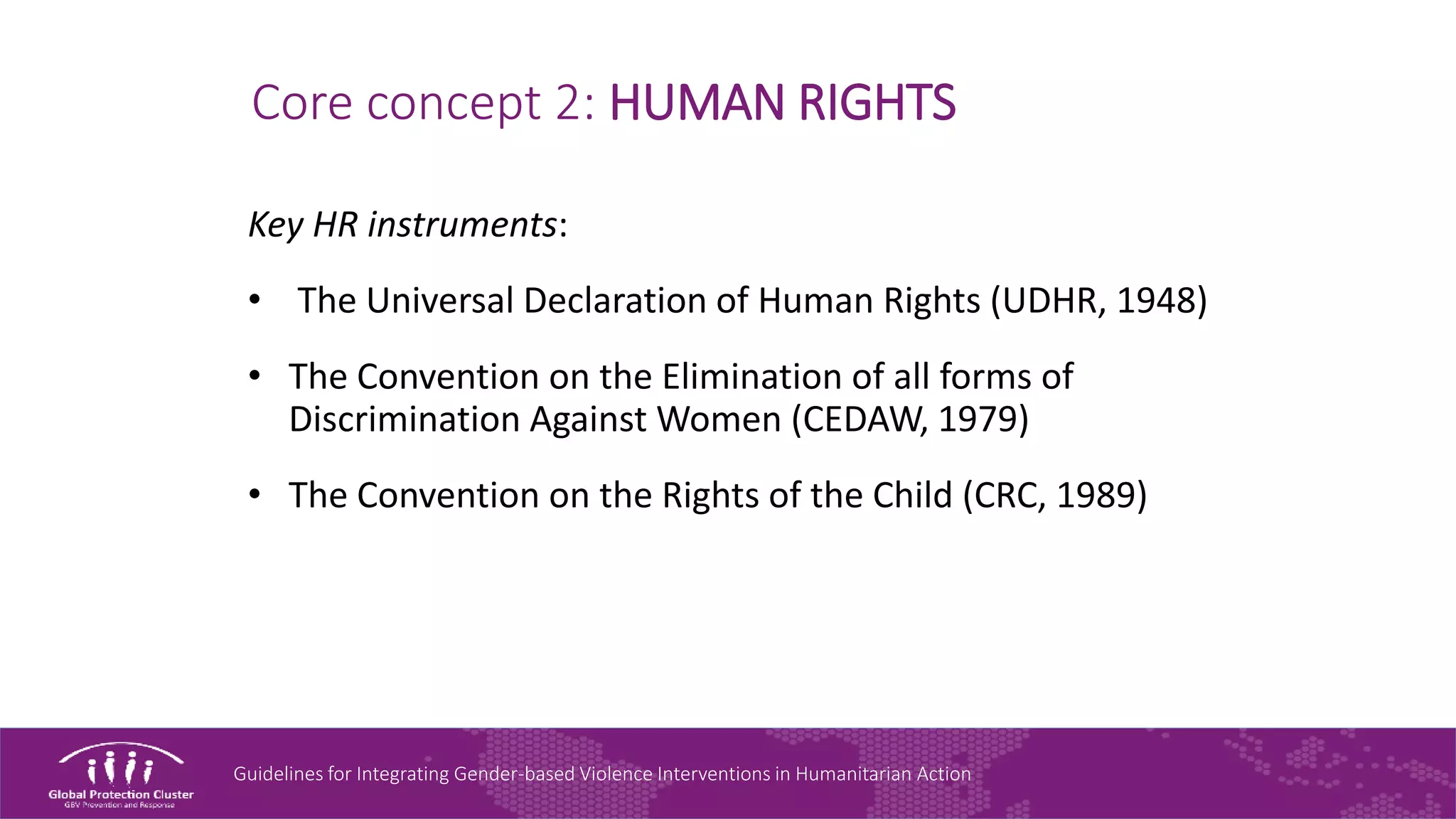
Core concept 2: HUMAN RIGHTS
Key HR instruments:
• The Universal Declaration of Human Rights (UDHR, 1948)
• The Convention on the Elimination of all forms of
Discrimination Against Women (CEDAW, 1979)
• The Convention on the Rights of the Child (CRC, 1989)
Guidelines for Integrating Gender-based Violence Interventions in Humanitarian Action
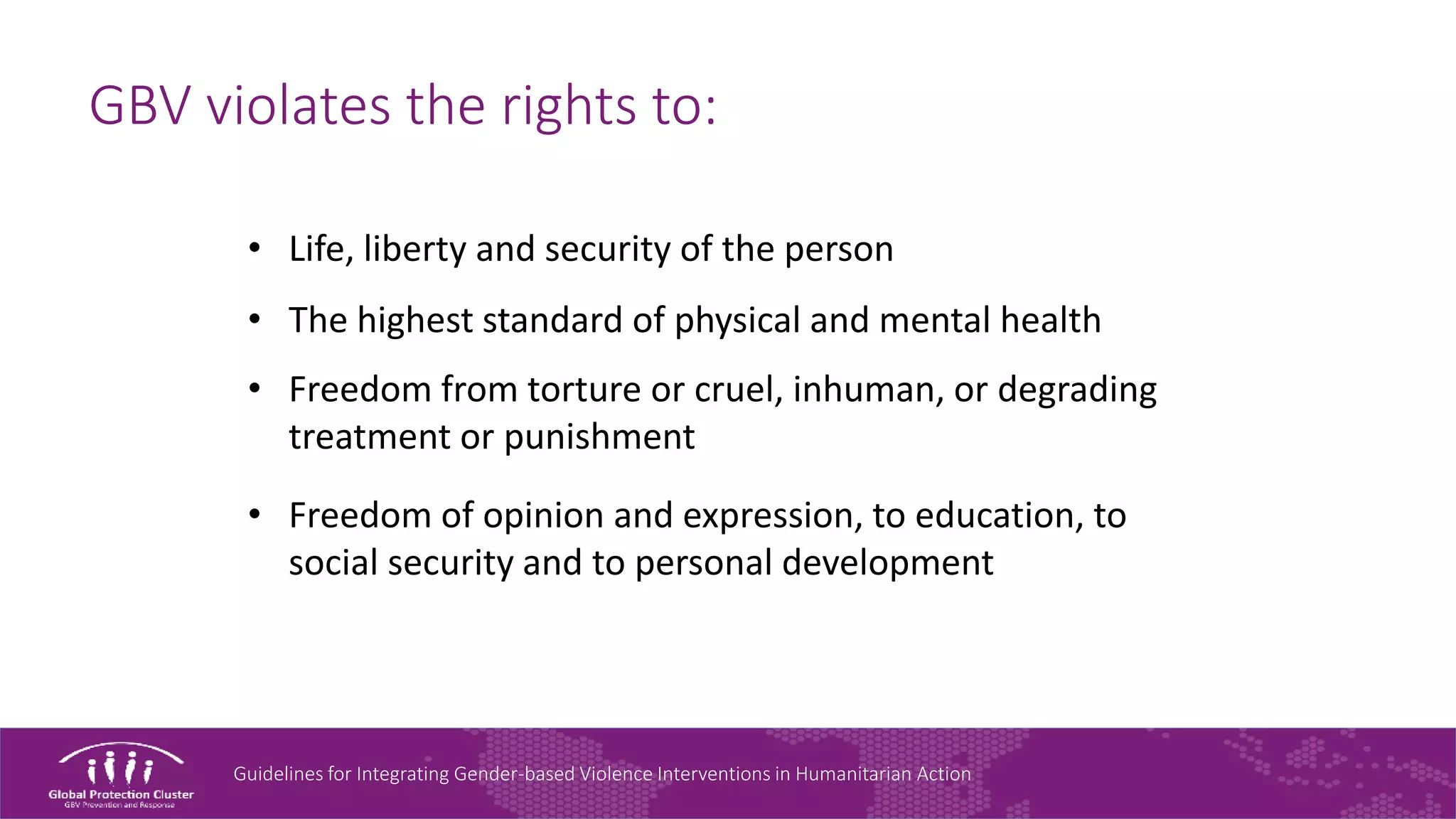
GBV violates the rights to:
• Life, liberty and security of the person
• The highest standard of physical and mental health
• Freedom from torture or cruel, inhuman, or degrading
treatment or punishment
• Freedom of opinion and expression, to education, to
social security and to personal development
Guidelines for Integrating Gender-based Violence Interventions in Humanitarian Action
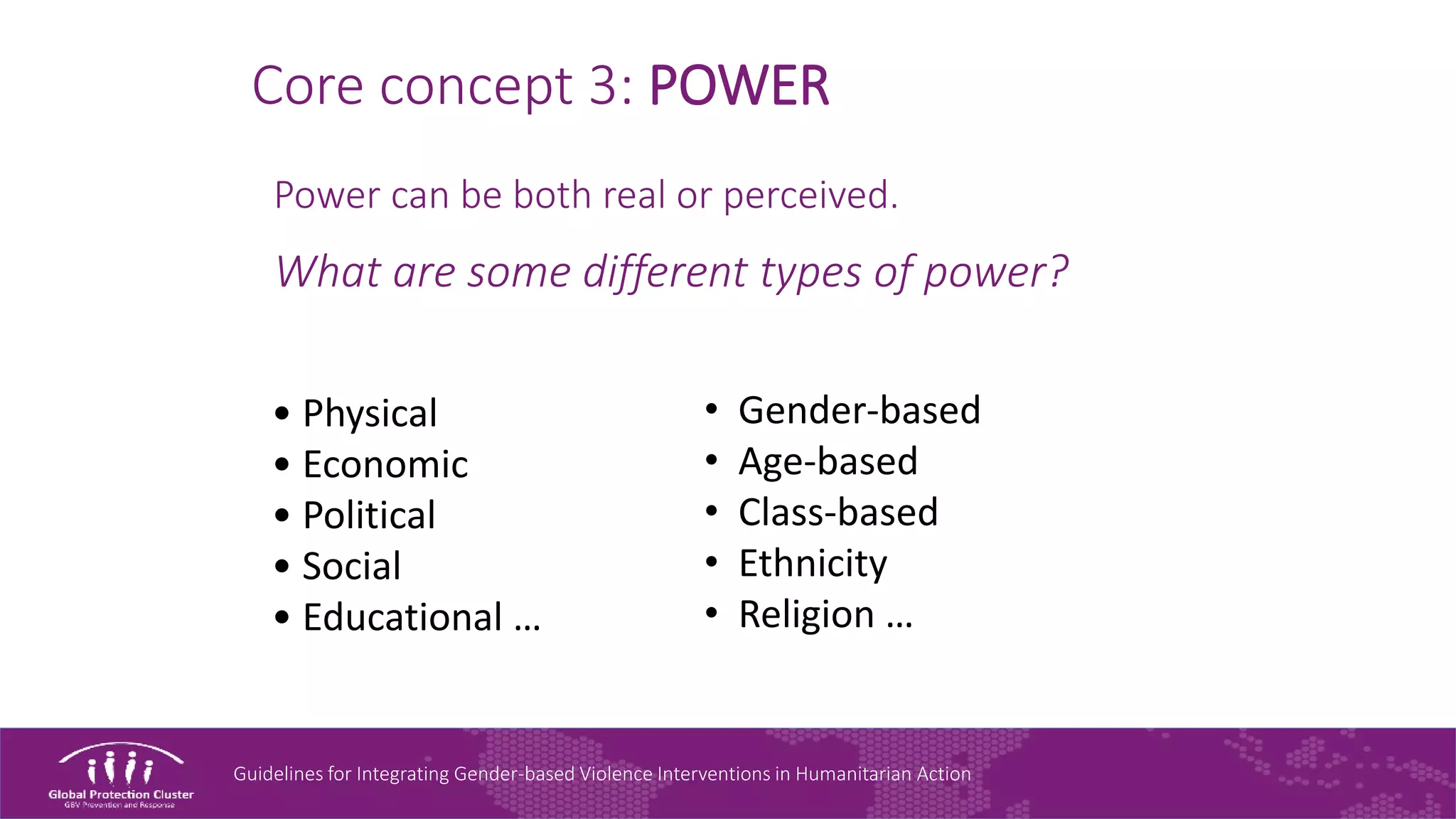
Core concept 3: POWER
Power can be both real or perceived.
What are some different types of power?
• Gender-based
• Age-based
• Class-based
• Ethnicity
• Religion …
• Physical
• Economic
• Political
• Social
• Educational …
Guidelines for Integrating Gender-based Violence Interventions in Humanitarian Action
What is power?
Power is the ability to control and access
resources, opportunities, privileges and
decision-making processes.
Guidelines for Integrating Gender-based Violence Interventions in Humanitarian Action
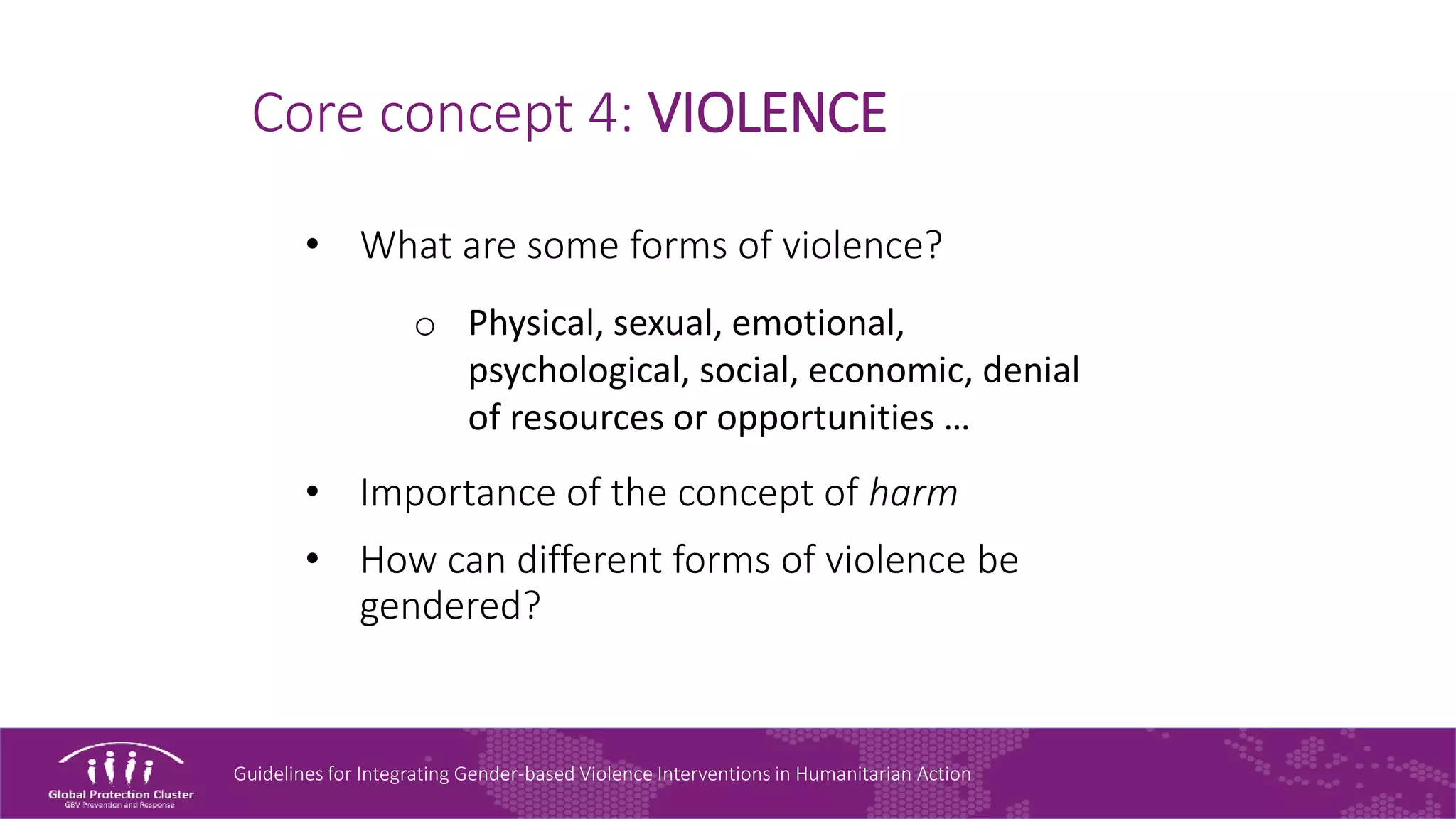
Core concept 4: VIOLENCE
• What are some forms of violence?
• Importance of the concept of harm
• How can different forms of violence be
gendered?
o Physical, sexual, emotional,
psychological, social, economic, denial
of resources or opportunities …
Guidelines for Integrating Gender-based Violence Interventions in Humanitarian Action
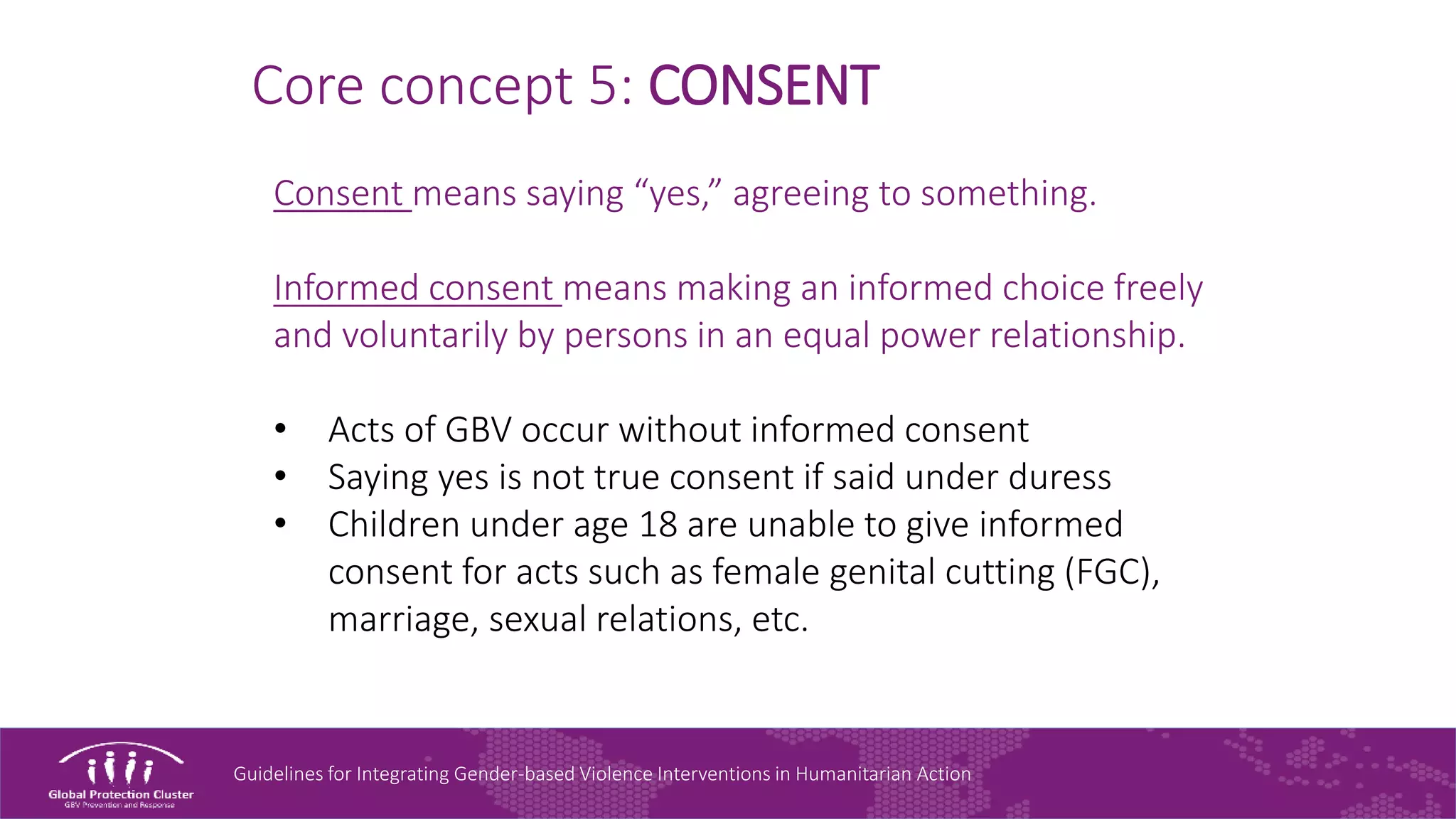
Core concept 5: CONSENT
Consent means saying “yes,” agreeing to something.
Informed consent means making an informed choice freely
and voluntarily by persons in an equal power relationship.
• Acts of GBV occur without informed consent
• Saying yes is not true consent if said under duress
• Children under age 18 are unable to give informed
consent for acts such as female genital cutting (FGC),
marriage, sexual relations, etc.
Guidelines for Integrating Gender-based Violence Interventions in Humanitarian Action
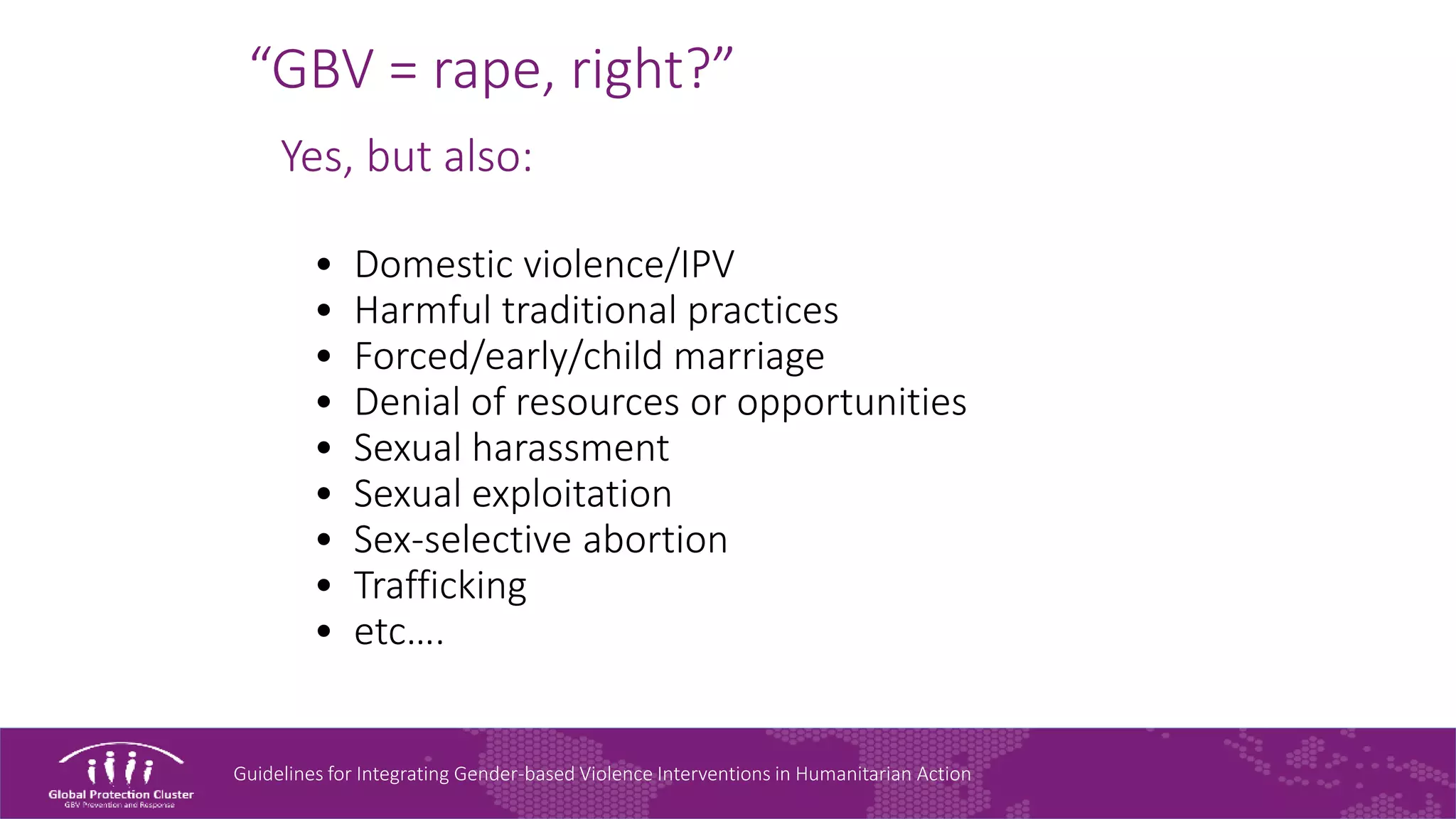
“GBV = rape, right?”
Yes, but also:
• Domestic violence/IPV
• Harmful traditional practices
• Forced/early/child marriage
• Denial of resources or opportunities
• Sexual harassment
• Sexual exploitation
• Sex-selective abortion
• Trafficking
• etc….
Guidelines for Integrating Gender-based Violence Interventions in Humanitarian Action
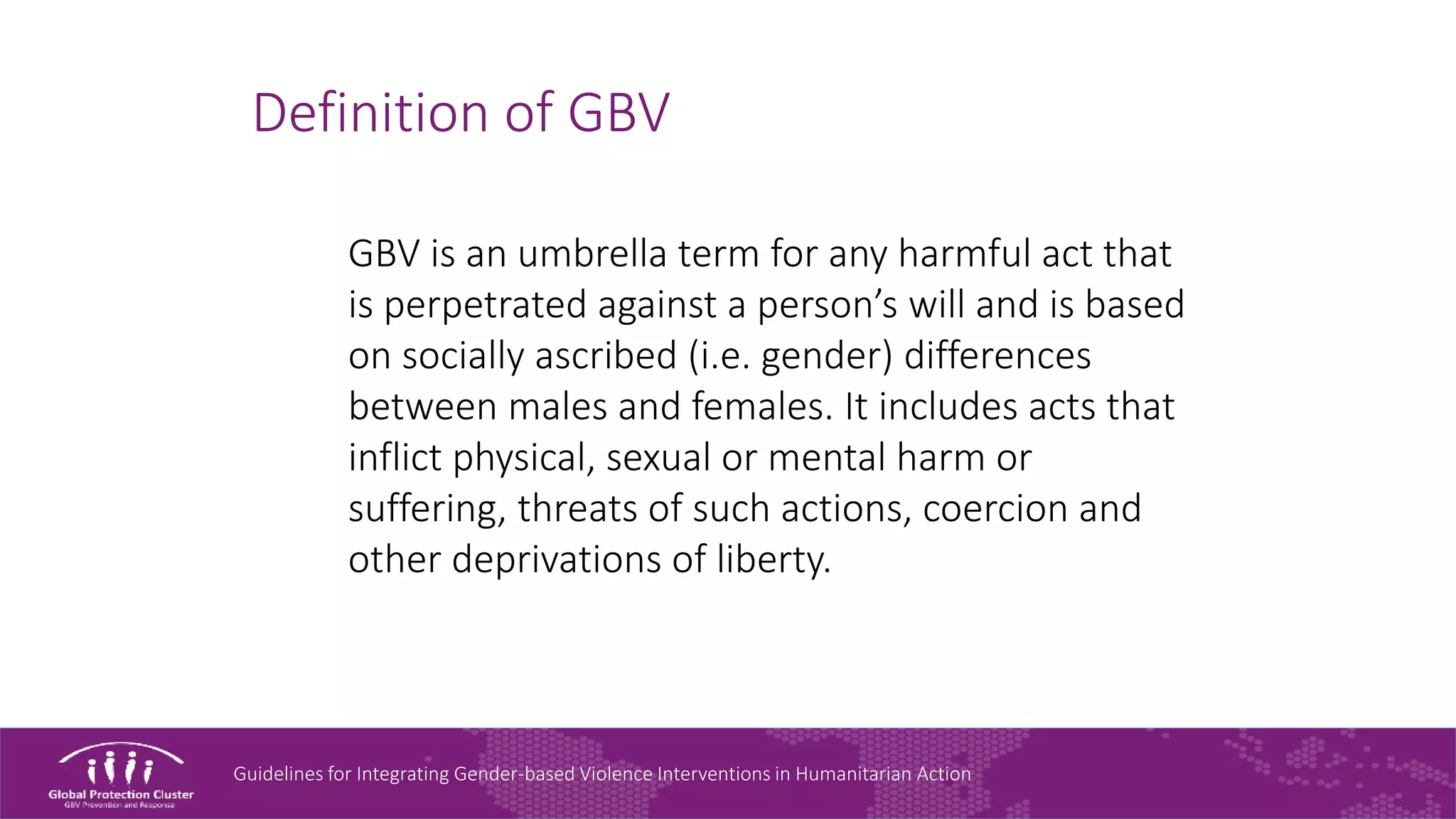
Definition of GBV
GBV is an umbrella term for any harmful act that
is perpetrated against a person’s will and is based
on socially ascribed (i.e. gender) differences
between males and females. It includes acts that
inflict physical, sexual or mental harm or
suffering, threats of such actions, coercion and
other deprivations of liberty.
Guidelines for Integrating Gender-based Violence Interventions in Humanitarian Action
Why does GBV exist?
In small groups, identify:
• Root causes for GBV
• Specific risk factors for GBV in your context?
- What increases the likelihood of GBV occurring?
• Consequences of different forms of GBV?
- Physical, social, economic, psychological?
Guidelines for Integrating Gender-based Violence Interventions in Humanitarian Action
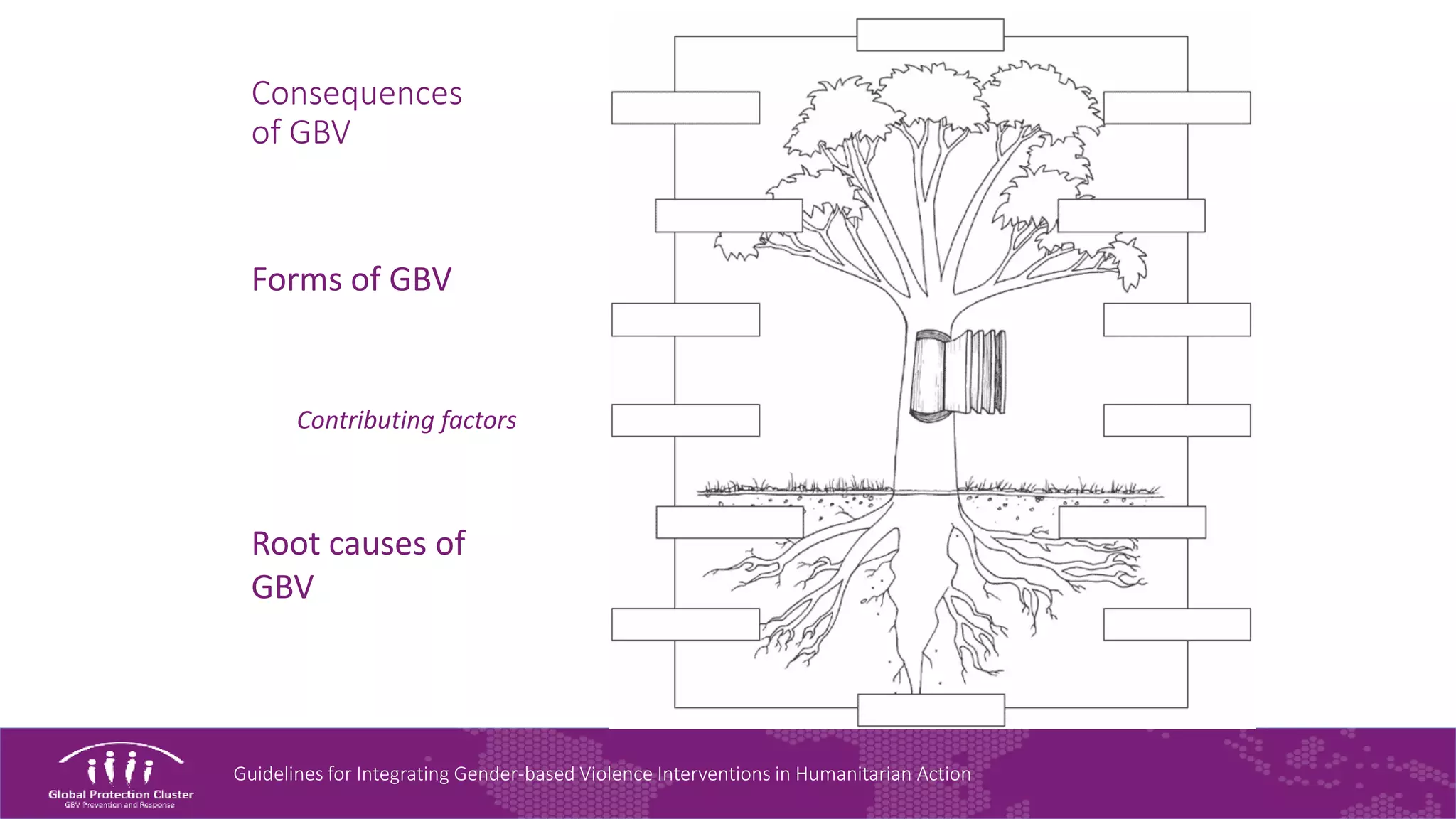
Consequences
of GBV
Root causes of
GBV
Contributing factors
Forms of GBV
Guidelines for Integrating Gender-based Violence Interventions in Humanitarian Action
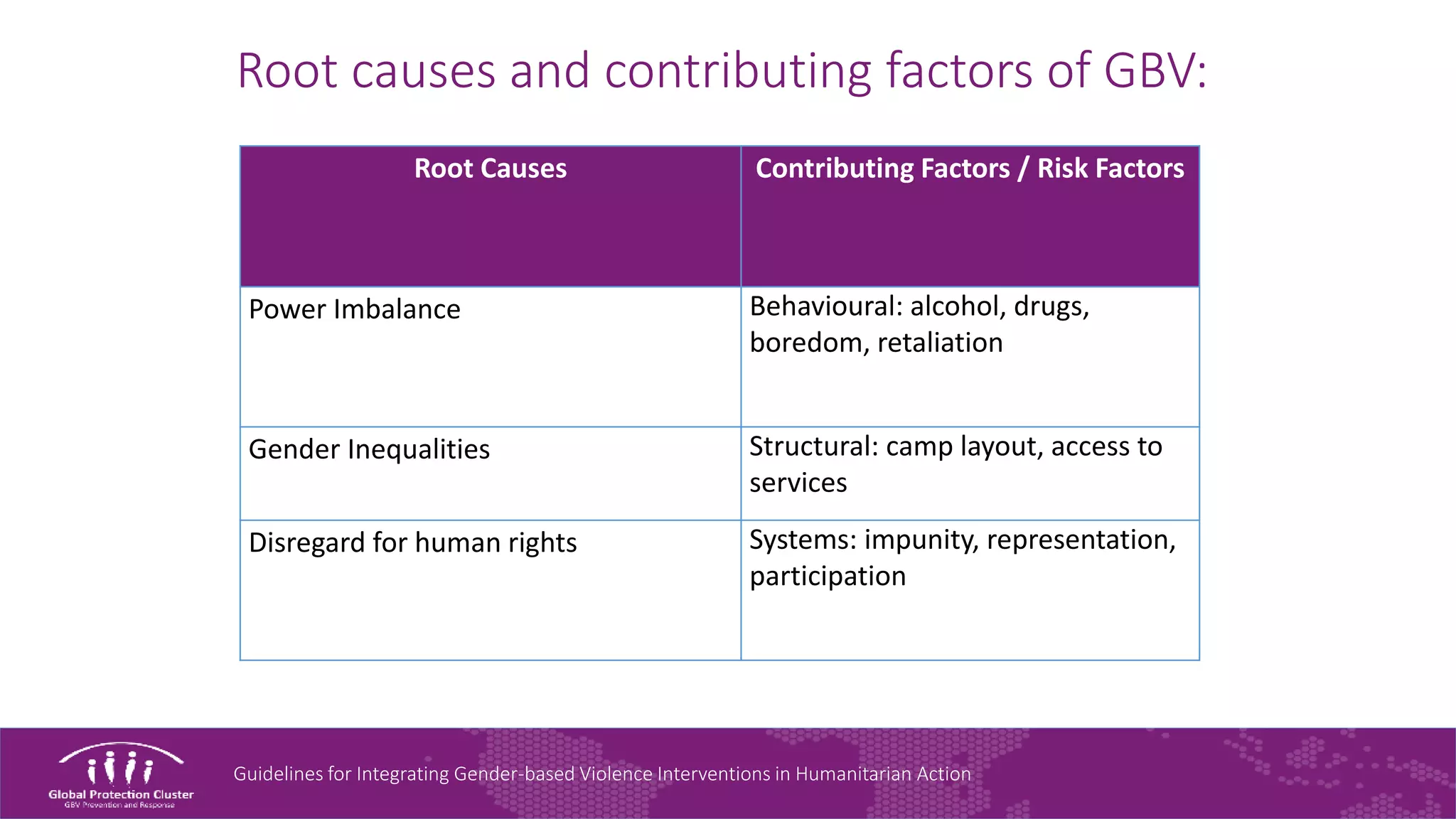
Root causes and contributing factors of GBV:
Root Causes Contributing Factors / Risk Factors
Power Imbalance Behavioural: alcohol, drugs,
boredom, retaliation
Gender Inequalities Structural: camp layout, access to
services
Disregard for human rights Systems: impunity, representation,
participation
Guidelines for Integrating Gender-based Violence Interventions in Humanitarian Action
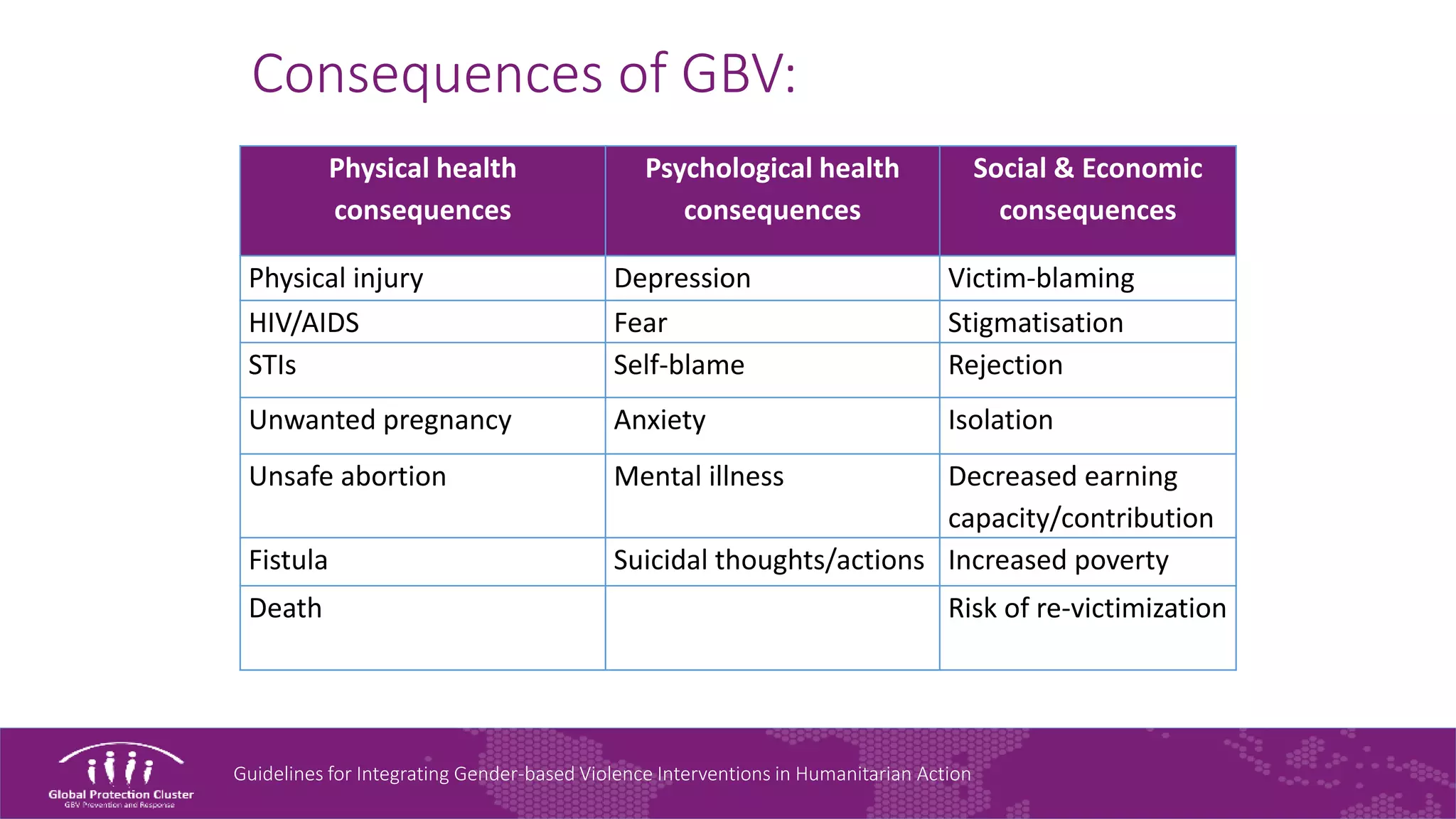
Consequences of GBV:
Physical health
consequences
Psychological health
consequences
Social & Economic
consequences
Physical injury Depression Victim-blaming
HIV/AIDS Fear Stigmatisation
STIs Self-blame Rejection
Unwanted pregnancy Anxiety Isolation
Unsafe abortion Mental illness Decreased earning
capacity/contribution
Fistula Suicidal thoughts/actions Increased poverty
Death Risk of re-victimization
Guidelines for Integrating Gender-based Violence Interventions in Humanitarian Action
Example of Democratic Republic of the Congo DRC
Survivors:
• Socio-economic problems
• Challenges in social reintegration
• Problems with attachment to or rejection of the child
• Unsafe abortion
Children of survivors:
• Delays in physical and emotional development
• Seen as “time-bomb”: children who will turn against their families
• Stigmatization, neglect/abuse or rejection
• Lack of access to food, health care or education
Guidelines for Integrating Gender-based Violence Interventions in Humanitarian Action
GBV and VAWG
UN Declaration on the Elimination of Violence Against
Women (1993):
“Violence against women is a manifestation of historically
unequal power relations between men and women,
which have led to domination over and discrimination
against women by men and to the prevention of the full
advancement of women.”
Guidelines for Integrating Gender-based Violence Interventions in Humanitarian Action
Can GBV happen to men and boys?
• Gendered vulnerabilities can put ANYONE - men, women, boys
and girls - at heightened risk for violence. Humanitarians must
ensure care and support for all survivors.
• The contexts, causes, and consequences of violence against
women and girls/men and boys are different. Risk analyses that
take gender into account are critical to inform programming.
• The Guidelines recognize the heightened vulnerability of
women and girls and other specific populations to GBV and
provide targeted guidance to address these vulnerabilities -
including through strategies that promote gender equality.
Guidelines for Integrating Gender-based Violence Interventions in Humanitarian Action
GBV, VAWG, VAMB
• What are some examples from your work of
working specifically to address GBV against
women and girls?
• What are some examples from your work of
working specifically to address GBV against
men and boys?
Guidelines for Integrating Gender-based Violence Interventions in Humanitarian Action
GBV and VAWG, cont’d
• GBV is a cause and consequence of women’s inferior political,
economic and social status
• Boys and men can be exposed to gendered violence, but
women’s inferior status virtually everywhere in the world
means that they are its primary targets.
• Men typically hold more of the power in societies worldwide:
physical, economic, legal – and:
• have more access to and control of resources
• have more opportunities
• have more economic freedom – including freedom to leave
violence
Guidelines for Integrating Gender-based Violence Interventions in Humanitarian Action
Children & GBV
• Being a boy or a girl makes a child vulnerable to
particular forms of violence
• Violence is learned through socialization into social
norms and expectations around masculinity and
femininity, sex and sexuality, male entitlement
Guidelines for Integrating Gender-based Violence Interventions in Humanitarian Action
Boys & Violence
• More likely to experience harsh physical punishment
within the family and schools; peer-based violence
perpetrated by other boys
• At greater risk of perpetrating violence than girls
Guidelines for Integrating Gender-based Violence Interventions in Humanitarian Action
Girls & Violence
• At higher risk than boys for infanticide, sexual abuse,
educational and nutritional neglect, forced
prostitution and FGM
• At risk because they have the least power, status and
control over their own bodies and over resources
within the family and community
• Relative position of powerlessness in relation to
adults, but also in relation to males, including male
children
Guidelines for Integrating Gender-based Violence Interventions in Humanitarian Action
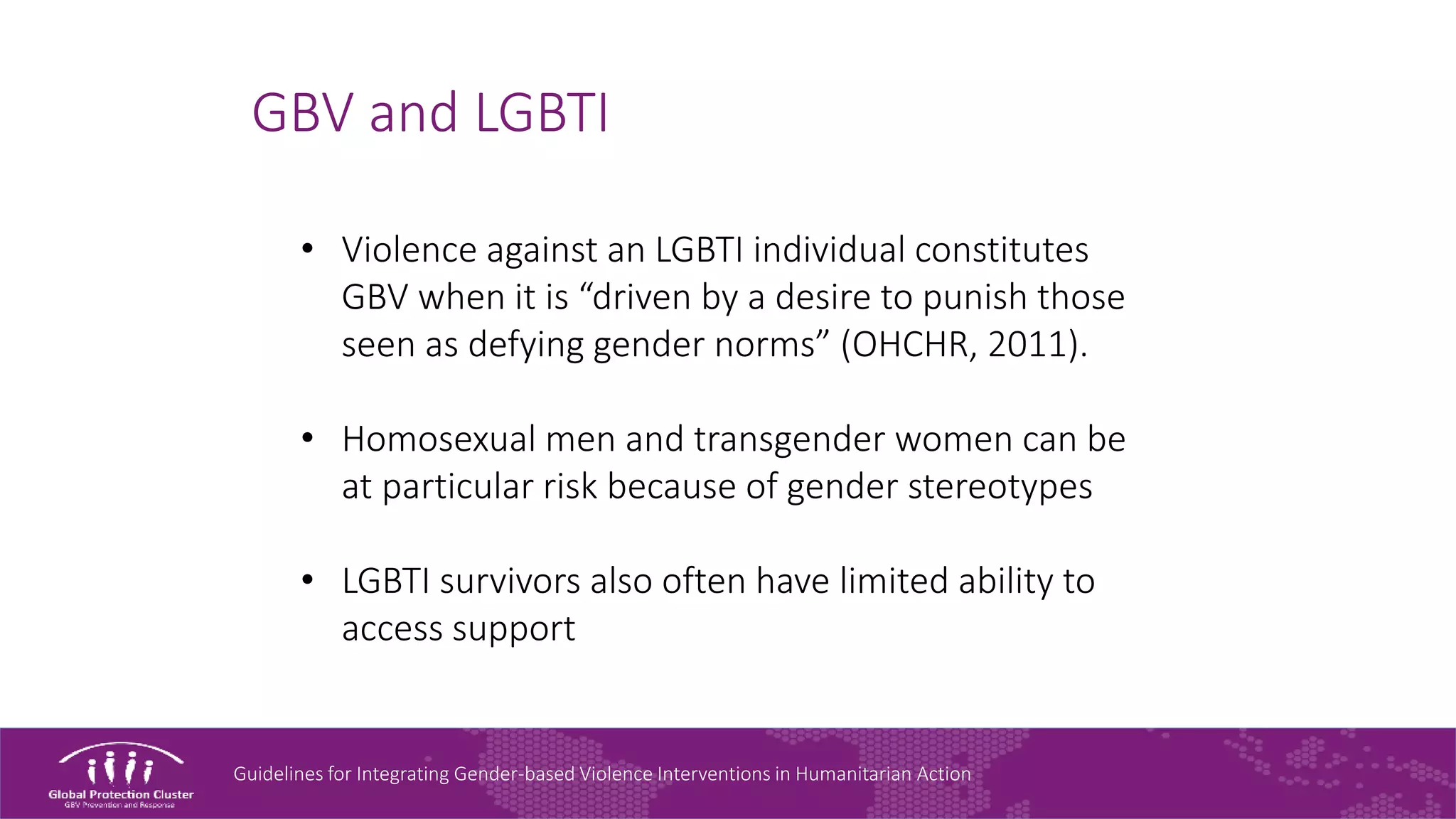
GBV and LGBTI
• Violence against an LGBTI individual constitutes
GBV when it is “driven by a desire to punish those
seen as defying gender norms” (OHCHR, 2011).
• Homosexual men and transgender women can be
at particular risk because of gender stereotypes
• LGBTI survivors also often have limited ability to
access support
Guidelines for Integrating Gender-based Violence Interventions in Humanitarian Action
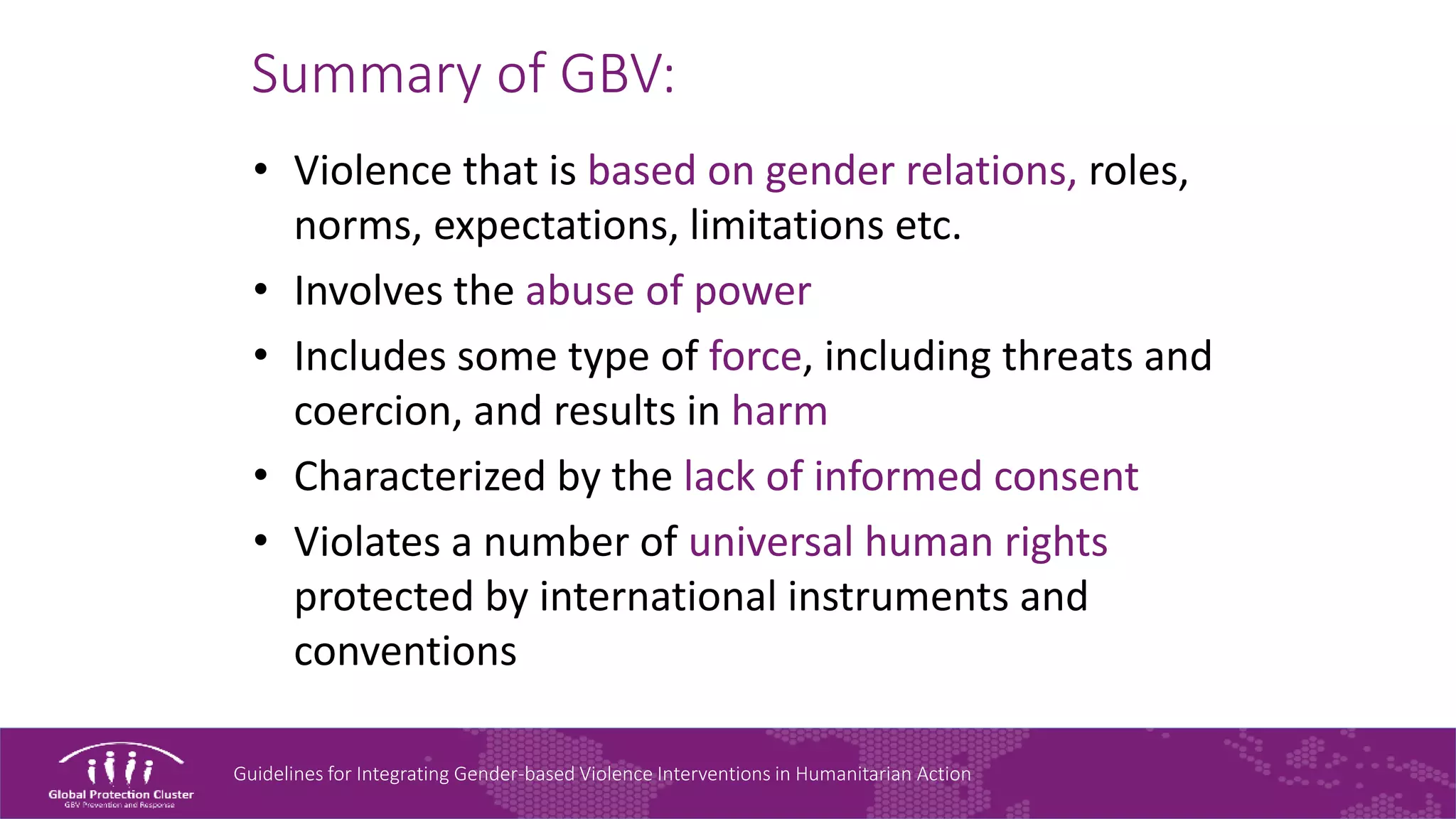
Summary of GBV:
• Violence that is based on gender relations, roles,
norms, expectations, limitations etc.
• Involves the abuse of power
• Includes some type of force, including threats and
coercion, and results in harm
• Characterized by the lack of informed consent
• Violates a number of universal human rights
protected by international instruments and
conventions
Guidelines for Integrating Gender-
based Violence Interventions in
Humanitarian Action
Questions?

Module 2: Defining Gender-based Violence (GBV)

  • 1.
    Guidelines for IntegratingGender- based Violence Interventions in Humanitarian Action MODULE TWO: Defining Gender-based Violence (GBV)
  • 2.
    Guidelines for IntegratingGender-based Violence Interventions in Humanitarian Action Core Concepts in understanding GBV: • Sex and gender • Human rights • Power • Violence • Harm • Consent
  • 3.
    Guidelines for IntegratingGender-based Violence Interventions in Humanitarian Action Activity: what is gender? • Divide into two groups • Draw or write down the personality traits, attributes and roles that are associated with: • Group 1: women • Group 2: men
  • 4.
    Guidelines for IntegratingGender-based Violence Interventions in Humanitarian Action Core concept 1: GENDER • What is the difference between sex and gender? • Why is this important when talking about gender-based violence?
  • 5.
    Guidelines for IntegratingGender-based Violence Interventions in Humanitarian Action Core concept 2: HUMAN RIGHTS Key HR instruments: • The Universal Declaration of Human Rights (UDHR, 1948) • The Convention on the Elimination of all forms of Discrimination Against Women (CEDAW, 1979) • The Convention on the Rights of the Child (CRC, 1989)
  • 6.
    Guidelines for IntegratingGender-based Violence Interventions in Humanitarian Action GBV violates the rights to: • Life, liberty and security of the person • The highest standard of physical and mental health • Freedom from torture or cruel, inhuman, or degrading treatment or punishment • Freedom of opinion and expression, to education, to social security and to personal development
  • 7.
    Guidelines for IntegratingGender-based Violence Interventions in Humanitarian Action Core concept 3: POWER Power can be both real or perceived. What are some different types of power? • Gender-based • Age-based • Class-based • Ethnicity • Religion … • Physical • Economic • Political • Social • Educational …
  • 8.
    Guidelines for IntegratingGender-based Violence Interventions in Humanitarian Action What is power? Power is the ability to control and access resources, opportunities, privileges and decision-making processes.
  • 9.
    Guidelines for IntegratingGender-based Violence Interventions in Humanitarian Action Core concept 4: VIOLENCE • What are some forms of violence? • Importance of the concept of harm • How can different forms of violence be gendered? o Physical, sexual, emotional, psychological, social, economic, denial of resources or opportunities …
  • 10.
    Guidelines for IntegratingGender-based Violence Interventions in Humanitarian Action Core concept 5: CONSENT Consent means saying “yes,” agreeing to something. Informed consent means making an informed choice freely and voluntarily by persons in an equal power relationship. • Acts of GBV occur without informed consent • Saying yes is not true consent if said under duress • Children under age 18 are unable to give informed consent for acts such as female genital cutting (FGC), marriage, sexual relations, etc.
  • 11.
    Guidelines for IntegratingGender-based Violence Interventions in Humanitarian Action “GBV = rape, right?” Yes, but also: • Domestic violence/IPV • Harmful traditional practices • Forced/early/child marriage • Denial of resources or opportunities • Sexual harassment • Sexual exploitation • Sex-selective abortion • Trafficking • etc….
  • 12.
    Guidelines for IntegratingGender-based Violence Interventions in Humanitarian Action Definition of GBV GBV is an umbrella term for any harmful act that is perpetrated against a person’s will and is based on socially ascribed (i.e. gender) differences between males and females. It includes acts that inflict physical, sexual or mental harm or suffering, threats of such actions, coercion and other deprivations of liberty.
  • 13.
    Guidelines for IntegratingGender-based Violence Interventions in Humanitarian Action Why does GBV exist? In small groups, identify: • Root causes for GBV • Specific risk factors for GBV in your context? - What increases the likelihood of GBV occurring? • Consequences of different forms of GBV? - Physical, social, economic, psychological?
  • 14.
    Guidelines for IntegratingGender-based Violence Interventions in Humanitarian Action Consequences of GBV Root causes of GBV Contributing factors Forms of GBV
  • 15.
    Guidelines for IntegratingGender-based Violence Interventions in Humanitarian Action Root causes and contributing factors of GBV: Root Causes Contributing Factors / Risk Factors Power Imbalance Behavioural: alcohol, drugs, boredom, retaliation Gender Inequalities Structural: camp layout, access to services Disregard for human rights Systems: impunity, representation, participation
  • 16.
    Guidelines for IntegratingGender-based Violence Interventions in Humanitarian Action Consequences of GBV: Physical health consequences Psychological health consequences Social & Economic consequences Physical injury Depression Victim-blaming HIV/AIDS Fear Stigmatisation STIs Self-blame Rejection Unwanted pregnancy Anxiety Isolation Unsafe abortion Mental illness Decreased earning capacity/contribution Fistula Suicidal thoughts/actions Increased poverty Death Risk of re-victimization
  • 17.
    Guidelines for IntegratingGender-based Violence Interventions in Humanitarian Action Example of Democratic Republic of the Congo DRC Survivors: • Socio-economic problems • Challenges in social reintegration • Problems with attachment to or rejection of the child • Unsafe abortion Children of survivors: • Delays in physical and emotional development • Seen as “time-bomb”: children who will turn against their families • Stigmatization, neglect/abuse or rejection • Lack of access to food, health care or education
  • 18.
    Guidelines for IntegratingGender-based Violence Interventions in Humanitarian Action GBV and VAWG UN Declaration on the Elimination of Violence Against Women (1993): “Violence against women is a manifestation of historically unequal power relations between men and women, which have led to domination over and discrimination against women by men and to the prevention of the full advancement of women.”
  • 19.
    Guidelines for IntegratingGender-based Violence Interventions in Humanitarian Action Can GBV happen to men and boys? • Gendered vulnerabilities can put ANYONE - men, women, boys and girls - at heightened risk for violence. Humanitarians must ensure care and support for all survivors. • The contexts, causes, and consequences of violence against women and girls/men and boys are different. Risk analyses that take gender into account are critical to inform programming. • The Guidelines recognize the heightened vulnerability of women and girls and other specific populations to GBV and provide targeted guidance to address these vulnerabilities - including through strategies that promote gender equality.
  • 20.
    Guidelines for IntegratingGender-based Violence Interventions in Humanitarian Action GBV, VAWG, VAMB • What are some examples from your work of working specifically to address GBV against women and girls? • What are some examples from your work of working specifically to address GBV against men and boys?
  • 21.
    Guidelines for IntegratingGender-based Violence Interventions in Humanitarian Action GBV and VAWG, cont’d • GBV is a cause and consequence of women’s inferior political, economic and social status • Boys and men can be exposed to gendered violence, but women’s inferior status virtually everywhere in the world means that they are its primary targets. • Men typically hold more of the power in societies worldwide: physical, economic, legal – and: • have more access to and control of resources • have more opportunities • have more economic freedom – including freedom to leave violence
  • 22.
    Guidelines for IntegratingGender-based Violence Interventions in Humanitarian Action Children & GBV • Being a boy or a girl makes a child vulnerable to particular forms of violence • Violence is learned through socialization into social norms and expectations around masculinity and femininity, sex and sexuality, male entitlement
  • 23.
    Guidelines for IntegratingGender-based Violence Interventions in Humanitarian Action Boys & Violence • More likely to experience harsh physical punishment within the family and schools; peer-based violence perpetrated by other boys • At greater risk of perpetrating violence than girls
  • 24.
    Guidelines for IntegratingGender-based Violence Interventions in Humanitarian Action Girls & Violence • At higher risk than boys for infanticide, sexual abuse, educational and nutritional neglect, forced prostitution and FGM • At risk because they have the least power, status and control over their own bodies and over resources within the family and community • Relative position of powerlessness in relation to adults, but also in relation to males, including male children
  • 25.
    Guidelines for IntegratingGender-based Violence Interventions in Humanitarian Action GBV and LGBTI • Violence against an LGBTI individual constitutes GBV when it is “driven by a desire to punish those seen as defying gender norms” (OHCHR, 2011). • Homosexual men and transgender women can be at particular risk because of gender stereotypes • LGBTI survivors also often have limited ability to access support
  • 26.
    Guidelines for IntegratingGender-based Violence Interventions in Humanitarian Action Summary of GBV: • Violence that is based on gender relations, roles, norms, expectations, limitations etc. • Involves the abuse of power • Includes some type of force, including threats and coercion, and results in harm • Characterized by the lack of informed consent • Violates a number of universal human rights protected by international instruments and conventions
  • 27.
    Guidelines for IntegratingGender- based Violence Interventions in Humanitarian Action Questions?